
Summary
Editor's rating
Is it worth the money? Depends what you expect from it
Design & usability: smart folding body, a few placement headaches
Portability without a battery: what that really means
Build quality, noise, and long-term use expectations
Image quality & gaming: strong in the dark, with a few catches
What this projector actually is (and what it isn’t)
Pros
- Sharp 4K image with strong colours in a dark room and real optical zoom
- Compact, foldable design with Google TV and decent built-in speakers
- Low input lag and gaming-friendly features like VRR and ALLM
Cons
- Black levels and contrast are mediocre; 20,000:1 spec is not realistic in use
- Laser speckle is noticeable on white walls and can be very distracting for some users
- Placement quirks: fixed vertical offset, tilt affected by cable weight, often forcing keystone and reducing effective resolution

Specifications
View full product page →| Brand | XGIMI |
A portable 4K laser projector that tries to do it all
I’ve been using the XGIMI Elfin Flip 4K Laser as my main screen for evenings and weekends, swapping it in for a 55" TV and an older 1080p LED projector. I didn’t get it for some fancy home cinema room, just a regular living room and the odd movie night in the bedroom and garden. So this isn’t a calibrator’s review, more like: does it actually make Netflix, games, and sports look good without driving you mad?
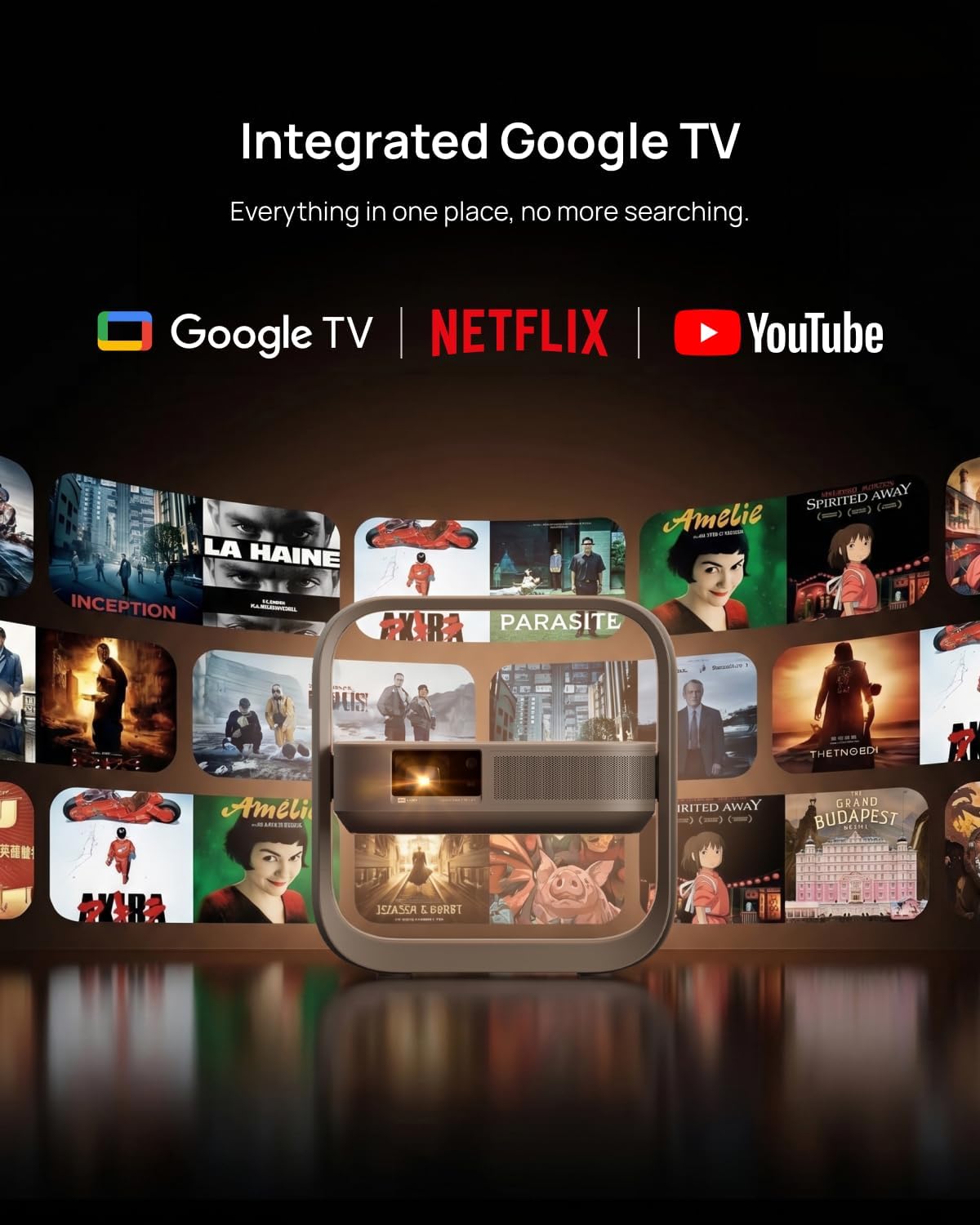
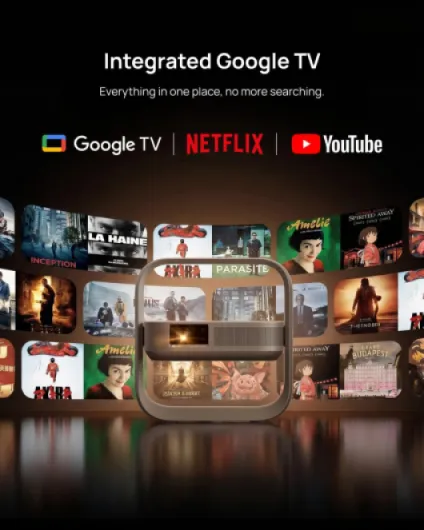
The first thing that hit me is that it’s clearly built for people who move it around a lot. It’s light, folds into itself to protect the lens, and has Google TV built in so you don’t have to mess with extra streaming sticks unless you want to. I literally plugged it in, signed into Google, and was watching YouTube in under 10 minutes. That part is very straightforward.
Where it gets more interesting is once you start pushing it: big screen sizes (100–120"), gaming on PS5, and daytime viewing. The 4K image is genuinely sharp for a portable box, and the triple-laser light source gives very punchy colours in a dark room. But it’s still a projector with 1600 lumens, not a TV, so if you expect it to replace a bright living-room TV at noon with curtains open, you’re going to be disappointed. It’s usable in a dim room, but it really comes alive at night.
Overall, my feeling after a couple of weeks is: picture quality in the dark is pretty solid for the size and price, the smart features are convenient, but you have to accept compromises. Black levels are nothing special, placement is more finicky than the marketing suggests, and the laser speckle will annoy some people, especially on plain white walls. If you go in knowing that, you’re more likely to be happy with it.
Is it worth the money? Depends what you expect from it
Price-wise, the Elfin Flip 4K often sits around the £700–£800 range, depending on promos. For that, you’re getting native 4K, triple-laser light source, optical zoom, Google TV, and a compact form factor. Compared to cheaper 1080p LED projectors, it’s obviously more expensive, but the bump in sharpness, brightness, and colour is very noticeable on big screens. One reviewer even saw 3–4× brightness versus the older 1080p Elfin, and I’d agree it’s a clear step up from budget units.
Compared to more expensive 4K projectors in the £1200+ range, you’re saving money but also accepting some compromises: mediocre black levels, limited brightness for daytime use, no lens shift, and some laser speckle. If you’re a hardcore home cinema fan with a dedicated dark room and a proper screen, you might be better off stretching the budget for something with better contrast and lens controls. But then you usually lose the compactness and built-in smart TV features.
Where I think the value makes sense is for people who want a big 4K image in a normal living room at night, don’t want to deal with an external streaming box, and like the idea of moving the projector around or taking it on trips. In that scenario, it does a lot right: plug in, auto-focus, auto keystone (with minor manual tweaks), decent speakers, and you’re watching a 100"+ image pretty quickly. The Amazon rating around 3.9/5 matches my feeling: good product, but not without flaws.
If you’re very sensitive to speckle, need strong daytime performance, or are picky about black levels, you’ll probably feel it’s overpriced and should look elsewhere. If you mainly watch at night, are okay with “dark grey blacks” and want a compact, all-in-one 4K projector, then the price is reasonable for what you get, even if it’s not a bargain.
Design & usability: smart folding body, a few placement headaches
The design is one of the strong points. The Elfin Flip 4K is roughly book-sized (about 24.5 × 7.8 × 25.4 cm) and around 1.5 kg. The main trick is the folding/gimbal-style base: you can tilt the projector up and down without needing a separate tripod or stack of books. When you fold it down, the body sort of protects the lens, which makes it feel safer to throw in a backpack or move between rooms without babying it.
Controls are minimal. You basically live on the remote, which is light, feels decent in the hand, and has some backlit keys so you’re not hunting in the dark. It runs on two AAA batteries (included). Personally, I would have preferred a USB‑C rechargeable remote, but that’s a minor gripe. The projector itself looks simple and clean in white, so it doesn’t scream “gamer toy” in the living room.
The downside of the design shows up when you start plugging in cables. You get 2 HDMI ports plus USB, and if you use both HDMI ports with chunky cables (console + eARC sound system, for example), the weight of the cables can actually pull on the back of the projector. Because the body tilts, that extra weight can slowly tilt the image up and mess with your carefully aligned screen. One user mentioned this, and I ran into the same thing: you align the picture, then a heavy HDMI cable drags it out of place. A stiffer hinge would help a lot here.
There’s also a built-in vertical offset in the optics: even when the projector is level, the image is projected higher than the lens. That’s fine if it’s on a low coffee table pointing up to a screen, but it’s less ideal if you want to mount it high behind a sofa pointing straight at the centre of the screen. You end up overshooting the screen and hitting the ceiling unless you tilt it down and use keystone, which costs you some resolution. So design-wise: compact, clever and very living-room friendly, but you need to think about cable weight and where exactly you’re going to place it.
Portability without a battery: what that really means
One thing that’s easy to miss in the marketing: this projector does not have a built-in battery. The form factor screams “travel projector” and “outdoor cinema”, but you always need a power source. For home use, that’s obviously not a big deal. For outdoor movie nights or camping, it changes the story quite a bit compared to fully battery-powered projectors like some smaller XGIMI models.
In practice, what “portable” means here is: light and compact enough to move between rooms, take to a friend’s house, or pack in a suitcase, but you’ll still need a power extension or a decent power station. I used it in the garden a couple of times with an extension cord, and it worked fine, but it’s not the grab-and-go, no-cable experience some people might imagine from the photos and size.
Power consumption is around 120 W at full brightness, which is reasonable for a 4K laser projector. On a normal wall outlet, no problem at all. On a portable power station, you just need to check that it can comfortably handle that draw for the duration of your movie or gaming session. If you were thinking of using it a lot off-grid, factor the cost of a proper power bank or generator into your budget.
So in daily life, I’d say the portability is physical, not electrical. It’s easy to pick up, tilt, and move, and the folding design makes it safe to throw in a bag. But if you’re looking for something to casually use on a campsite with no plugs around, this isn’t the right model. For home and garden use with access to mains power, it’s perfectly fine and the low weight is a real plus.
Build quality, noise, and long-term use expectations
Build quality feels solid enough for the price bracket, without feeling like a tank. The plastic shell doesn’t creak, the hinge mechanism on the base feels reasonably firm, and the lens is well protected when folded. I moved it around quite a bit between rooms and didn’t feel like I had to treat it like glass. At the same time, the earlier point stands: the tilt mechanism could be stiffer to better handle heavy HDMI cables without slowly shifting.
The triple-laser light source is rated for a very long lifespan (usually tens of thousands of hours on this kind of hardware), so I’m not worried about the lamp burning out anytime soon. There’s no bulb to replace like old-school projectors. As long as the cooling is decent and you don’t block the vents, it should last for years of regular evening use. Fan noise was a pleasant surprise: it’s very quiet in normal mode, and even sitting about half a meter away, once content is playing, I just don’t notice it. If you’re in a silent room with no audio, you hear a low hum, but nothing crazy.
The built-in Harman Kardon speakers are 7 W units. For a small projector, they’re okay: voices are clear, volume is enough for a medium room, and there’s a bit of bass but don’t expect miracles. For casual viewing it’s fine, but for movies or games I quickly switched to external speakers. The good part is that Bluetooth audio works well and there’s a setting to manually adjust audio delay; in my case, the default was already in sync.
Long-term, the main durability concern I see is more about speckle and eye comfort than hardware failure. Some people are more sensitive to the laser speckle and the slightly harsh look of certain scenes. If you’re one of those people, it may feel tiring over long sessions. But from a pure build and reliability standpoint, with a 2‑year warranty and no obvious weak points besides the somewhat loose tilt, I’d rate it as decent and in line with what you’d expect at this price.
Image quality & gaming: strong in the dark, with a few catches
In terms of image quality, this thing is pretty solid once the lights are down. The triple-laser light source and 4K DLP chip give you sharp detail and very punchy colours, especially in HDR10 content. On a 100–110" image, you can clearly see the difference versus 1080p: subtitles are crisp, fine textures in movies and games look cleaner, and the diamond-shaped pixel structure does help reduce the usual DLP “screen door” effect. One user mentioned the pixels are rotated 45°; I noticed the same and it does make the image look smoother from a normal viewing distance.
Brightness-wise, 1600 lumens is enough for dark rooms and evening use. In a fully dark room, even with a plain white wall, the image pops nicely. In a shaded room during the day, with curtains drawn, it’s watchable but not ideal. With lights fully on, the image washes out a lot, especially darker scenes. So if you’re expecting TV-like brightness at noon, this isn’t it. It’s more a “close the curtains and enjoy” kind of device.
Now the two big image drawbacks: black levels and laser speckle. Black levels are just okay. Dark scenes look more dark-grey than true black, and if you’re used to an OLED TV you’ll notice it instantly. That’s pretty normal for this class of projector, but don’t believe the huge contrast numbers in the spec sheet. Laser speckle is more annoying: on a plain white wall, some people (including one Amazon reviewer) find the grainy, shimmering effect very distracting, to the point of returning the unit. I definitely see it on some scenes, especially bright uniform areas. On a proper screen it’s reduced, but if you’re planning to just hit a white wall, be aware this might bother you.
For gaming, the advertised 1 ms latency feels optimistic on paper, but in practice input lag is low enough that I didn’t feel handicapped playing fast games. With a PS5 and Xbox, response is snappy and motion is smooth when you enable the low latency/gaming mode. VRR and ALLM support are nice to have if your console or PC supports them. Just remember you still need a dim room for the picture to look its best, so it’s not ideal for bright daytime multiplayer sessions. Overall, performance is good for movies and gaming at night, with the main caveats being greyish blacks and potential speckle annoyance.
What this projector actually is (and what it isn’t)
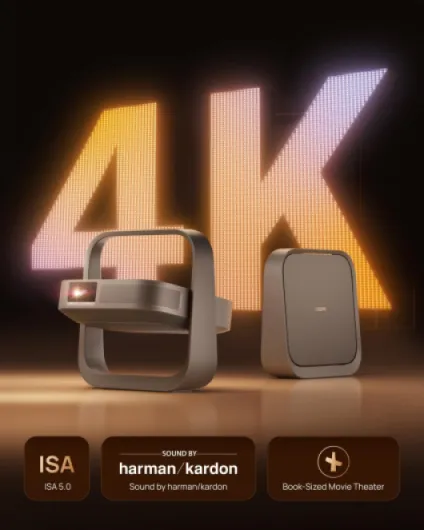
On paper, the XGIMI Elfin Flip 4K ticks a lot of boxes: native 4K (3840 × 2160), RGB triple-laser light source, 1600 ISO/ANSI lumens, Harman Kardon speakers, Google TV, HDMI/USB/Wi‑Fi, and optical zoom. It’s sold as a portable home/outdoor projector that can handle movies, gaming, and casual daytime use. The reality is a bit more down to earth, but still decent.
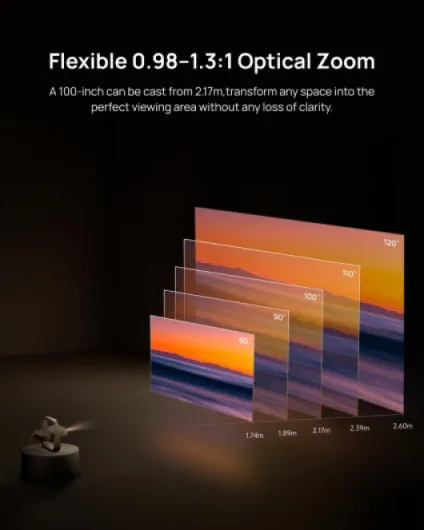
The 4K claim holds up in practice. On a 100–110" image, text from menus, subtitles, and UI elements look sharp. Compared to my old 1080p projector, the jump is obvious, especially if you sit a bit closer. The optical zoom is also a real advantage versus cheap projectors that only offer digital zoom. You can adjust image size without throwing away pixels, which matters if you’re trying to keep that 4K detail.
Where the spec sheet oversells things is brightness and contrast. Yes, 1600 lumens is decent for a portable laser unit, and in a dark room the picture has good punch. But the claimed 20,000:1 contrast ratio is marketing fluff. In real use, blacks are dark grey, and in very dark scenes you’re reminded you’re watching a projector that costs under the high-end models, not a high-end OLED TV. If you’re sensitive to that, you’ll notice it straight away.
They also push the gaming angle hard: 1 ms latency, VRR, ALLM. In practice, latency feels low enough for casual and even competitive console gaming, but you still have to factor in that it’s a projector with all the usual limitations: needs dim light, and motion handling is only as good as the source and settings. So I’d describe it as a capable all-round 4K portable projector for dark rooms and big-screen fun, not a full TV replacement or hardcore cinema machine.
Pros
- Sharp 4K image with strong colours in a dark room and real optical zoom
- Compact, foldable design with Google TV and decent built-in speakers
- Low input lag and gaming-friendly features like VRR and ALLM
Cons
- Black levels and contrast are mediocre; 20,000:1 spec is not realistic in use
- Laser speckle is noticeable on white walls and can be very distracting for some users
- Placement quirks: fixed vertical offset, tilt affected by cable weight, often forcing keystone and reducing effective resolution
Conclusion
Editor's rating
After living with the XGIMI Elfin Flip 4K for a while, my take is simple: it’s a solid portable 4K projector for night-time use, with a few quirks you really need to know about before buying. The image in a dark room is sharp and colourful, the 4K resolution actually matters at 100"+, and the optical zoom plus auto-focus make setup fairly painless. Add Google TV and decent Harman Kardon speakers, and you genuinely can just plug it in and watch without extra gadgets. For casual gaming, the low latency and VRR/ALLM support also do the job.
On the downside, you have the usual projector weaknesses: black levels are only okay, brightness is limited for daytime viewing, and the marketing contrast numbers are basically wishful thinking. The laser speckle can be a real problem if you’re projecting on a plain white wall and are sensitive to that effect. Placement is also more finicky than it should be: the built-in vertical offset and relatively loose tilt mechanism mean some setups will force you into heavy keystone correction, which eats into that nice 4K detail. And there’s no internal battery, so “portable” still means carrying a power cord.
I’d recommend this to people who mainly watch movies and series at night, want a big 4K image without setting up a huge home cinema, and like the idea of a compact, easy-to-move unit. If you’re super picky about contrast, plan to watch a lot in daylight, or know laser speckle drives you mad, I’d say skip it and look at a different type of projector or a big TV instead.