
Summary
Editor's rating
Value for money: good package if you want an all-in-one projector
Design and build: compact, practical, not fancy
Build, noise and reliability: solid enough for regular home use
Image quality and sound: good for movies and gaming, with some usual projector limits
What you actually get with the TOPTRO A2
Smart features and daily use: mostly smooth, a couple of small quirks
Pros
- Built-in VIDAA OS with Netflix, YouTube and Prime Video so no need for extra streaming sticks
- Auto focus and 6D keystone make setup fast and painless, even when you move it around
- Loud 36W speakers with Dolby Audio that are actually usable without a soundbar
Cons
- Fan noise is noticeable in quiet scenes, even if it fades during normal viewing
- Image loses punch in bright daylight like most projectors at this price
- Remote has no voice control and menus can sometimes feel a bit scattered

Specifications
View full product page →| Brand | TOPTRO |
A Netflix-ready projector that doesn’t fight you on setup
I’ve been using this TOPTRO A2 projector for a bit now, mainly in the living room and occasionally in the bedroom, and the short version is: it does the job well, especially if you just want to plug in, hit Netflix and watch something without faffing with extra boxes. I’ve had a couple of budget projectors before, and they always needed a Fire Stick or some Android TV box to get proper apps. Here, everything important is built in, which is already a big plus for lazy evenings.
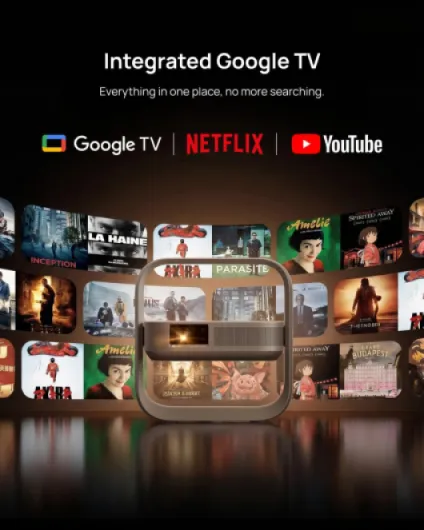
The first time I turned it on, it auto-focused and straightened the image in a few seconds. I didn’t have to dive into settings to get a clean rectangle on the wall, which is usually the annoying part with cheaper models. The VIDAA system looks a lot like a Fire Stick or smart TV interface, so if you’ve used any streaming device in the last few years, you’ll find your way around quickly. Netflix, YouTube and Prime Video were there from the start, no sideloading or weird tricks.
I mostly used it for films, series and a bit of Nintendo Switch gaming. Distance was between 2 and 3 meters, projected onto a light grey wall and sometimes a basic pull-down screen. Picture quality in the evening is honestly very decent: sharp enough to read small subtitles, colours look fine, and I never felt like I had to squint. In the daytime, you still see the image, but like any projector, it loses punch if there’s a lot of direct light. It’s not magic, but for a normal living room with curtains, it’s workable.
Overall, my first impression was that it’s a pretty solid all-in-one box: it has the apps, it has surprisingly loud speakers, and the automatic adjustments mean you don’t spend 20 minutes tweaking every time you move it. It’s not perfect and there are a few small annoyances, but for the price bracket it sits in, it feels like a good balance between convenience and image quality.
Value for money: good package if you want an all-in-one projector
In terms of value, this projector sits in that mid-range zone: not the ultra-cheap no-name stuff, but also far from the price of big brands like Epson or BenQ. For what you pay, you’re getting quite a lot: native 1080p, 1400 ANSI lumens, built-in Netflix and major apps, auto focus/keystone, a rotatable stand, Wi-Fi 6, two-way Bluetooth and a pretty beefy 36W speaker setup. If you tried to replicate all that with a basic projector plus a Fire Stick plus a Bluetooth speaker, you’d probably end up around the same price or more, with more clutter.
Where it earns its keep is the convenience factor. No need for extra boxes, no manual focus every time, no external speaker required for normal rooms. If you’re setting this up for a family room, kids’ gaming nights or bedroom Netflix sessions, it’s a very straightforward solution. You plug it in, connect Wi-Fi, log into your apps, and you’re basically done. That simplicity has value, especially for people who don’t want to mess with tech.
On the flip side, if you’re a picture quality nerd or a hardcore gamer, you might be better off with a more specialised projector or a good TV. You can find projectors in a similar price range that might have slightly better black levels or more calibration options, but they usually lack the smart OS and strong speakers, so you end up buying extras anyway. So it depends what you care about more: raw image performance or an all-in-one package.
Overall, I’d say it’s good value for money for the average user who wants a big-screen experience without turning their living room into a cable jungle. There are cheaper projectors, but they usually cut corners on brightness, sound or software. There are better projectors, but you’ll pay a lot more and likely need additional gear. This one sits in a comfortable middle ground where you get a lot of features for a still reasonable price.
Design and build: compact, practical, not fancy
Physically, the projector is on the compact side for something with this level of brightness and built-in speakers. The grey-black finish is pretty neutral, so it doesn’t scream for attention in the living room. It’s not super slim or anything, but for moving it between rooms or taking it to a friend’s place or camping, the 1.9 kg weight is manageable. I could carry it in one hand with cables in the other without feeling like I’m hauling a brick.
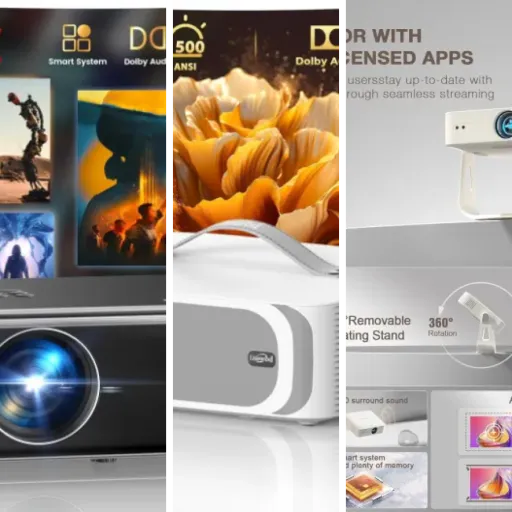
The big design feature that stands out is the rotatable stand. TOPTRO talks about 200° rotation, and in practice that means you can tilt it up to project on the ceiling, or angle it down a bit if it’s on a shelf. For bedroom use, pointing it at the ceiling for lazy movie sessions is actually quite nice. You don’t need a separate tripod or stack of books to get the right angle, which is usually how these things end up being used. There’s also a standard 1/4" screw hole if you want to mount it on a tripod or ceiling mount.
Controls are simple: remote for daily use, a few buttons on the unit for power and basic navigation if you misplace the remote. Ports are all accessible on the back/side and spaced enough that you can plug HDMI, USB and audio at the same time without fighting for room. Ventilation grills are visible but not ugly. Fan noise is noticeable in a quiet room, but once you start a film and the speakers kick in, it fades into the background. It’s there, but it didn’t bother me unless I paused on a silent menu screen.
Build quality feels decent for the price. It’s mostly plastic, but nothing feels loose or about to snap. This is not premium metal hardware, but it doesn’t feel like a toy either. If I had to nitpick, a carry handle or included bag would have been nice since it’s clearly marketed for portable use. As it is, you’ll probably end up reusing the box or buying a generic case if you plan to move it around often. Overall, the design is more about practicality than style, which fits the product’s purpose.
Build, noise and reliability: solid enough for regular home use
I haven’t owned it long enough to judge multi-year durability, but based on a few weeks of regular use, it feels solid for the price. The casing doesn’t flex when you pick it up, and the adjustable stand mechanism doesn’t feel wobbly or loose. I moved it around the house a fair bit, from living room to bedroom to a quick test in the garden, and nothing shifted or rattled. Ports still feel snug when plugging in HDMI and USB, not like they’re going to tear off the board.
Fan noise is always a concern with projectors. Here, it’s audible, but I’d call it average. In eco or normal mode, you can hear a constant whoosh if you listen for it, but as soon as a film or game starts, your brain kind of tunes it out. If you’re watching a very quiet film late at night, you’ll be aware of it, but it didn’t ruin anything for me. The upside of decent cooling is that the unit never got alarmingly hot. It gets warm, sure, but not to the point where you worry about it cooking itself on a shelf.
TOPTRO advertises a 3-year warranty plus lifetime tech support, which is reassuring on paper. There’s also mention of 1-year money-back and 3-year free replacement, which is more generous than a lot of random brands. Obviously you only know how good support is when something breaks, but at least they put contact info ([email protected]) front and centre, which is better than brands that hide behind generic Amazon messages. I didn’t have to use support, so I can’t judge response times.
If you plan to use it outdoors occasionally, I’d still be careful. It’s not weatherproof, so moisture and dust will be the main enemies. I’d recommend keeping the lens covered when not in use and maybe getting a small case if you plan to travel with it. For static home use, I don’t see any obvious weak points that would fail quickly, as long as you don’t block the vents and you treat it like actual electronics and not a football.
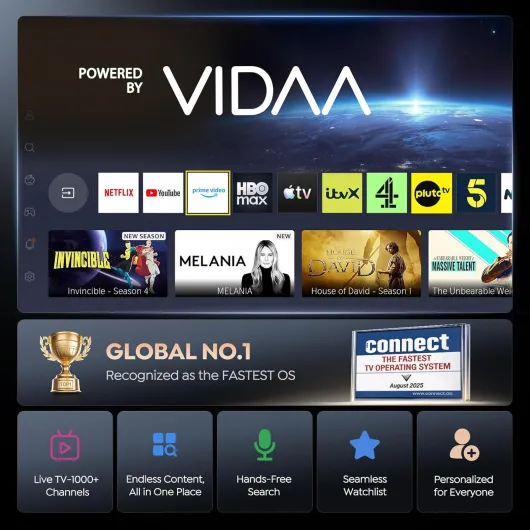
Image quality and sound: good for movies and gaming, with some usual projector limits
On the image side, the projector is native 1080p, and you can see it. Text in menus and subtitles is clean, and console UIs look sharp enough that you don’t feel like you’re looking at a blurry mess. It accepts 4K input and downscales it, which is fine for streaming platforms that output in 4K. HDR10 support is there, but don’t expect a TV-level HDR effect; it’s more about slightly better contrast and colour handling than anything dramatic. Still, for films and series in the evening, the picture is pleasant, and colours don’t look washed out once you tweak the picture mode a bit.
The 1400 ANSI lumens spec sounds big, but like always, take projector numbers with a bit of caution. In a dim or dark room, it’s bright enough for a 100-inch image without feeling dull. In moderate daylight with curtains half-closed, it’s still usable but obviously less punchy. If you try to use it in a very bright room with sunlight, it’s going to struggle, like pretty much every projector in this price range. Compared to older cheap projectors I’ve tried, this one definitely holds up better in non-perfect lighting, but it’s still not a TV replacement at noon in a sunlit room.
For gaming, input lag felt fine on a Nintendo Switch and PS5 for casual play. I didn’t measure it with tools, but I played some Mario Kart and a bit of Rocket League and didn’t feel any annoying delay. Serious competitive gamers will always do better with a monitor, but for couch gaming with friends or kids, it’s totally fine. The throw ratio (1.0:1) is handy: at about 2.2 m I got around 100 inches, which is nice for smaller rooms where you can’t push the projector too far back.
Sound is one of the better surprises. The 2×18W speakers with Dolby Audio are genuinely loud for a projector. Dialog is clear and there is some bass, not subwoofer-level, but enough so that films don’t sound thin. For a bedroom or small living room, I didn’t feel forced to plug in external speakers. You can still use the Bluetooth 5.4 to connect a soundbar or headphones if you want, and it works both ways, so you can also use the projector as a Bluetooth speaker. Personally, I just used the built-in speakers 90% of the time, which says a lot, because most projectors force you to add external audio to be bearable.
What you actually get with the TOPTRO A2
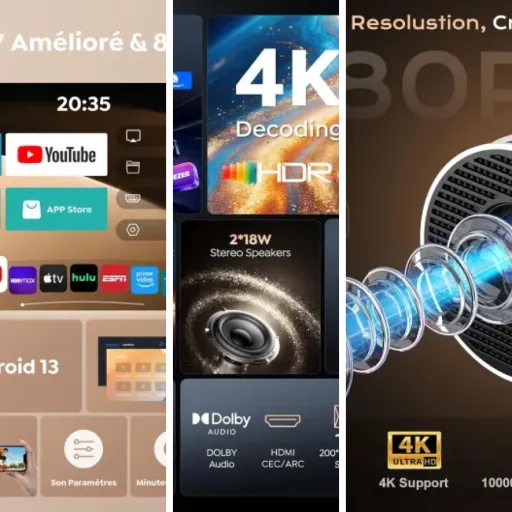
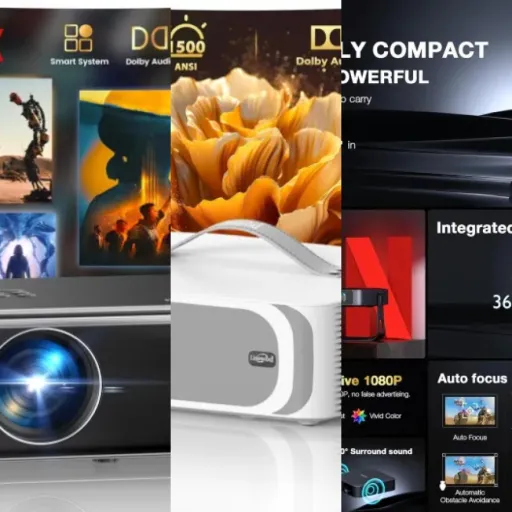
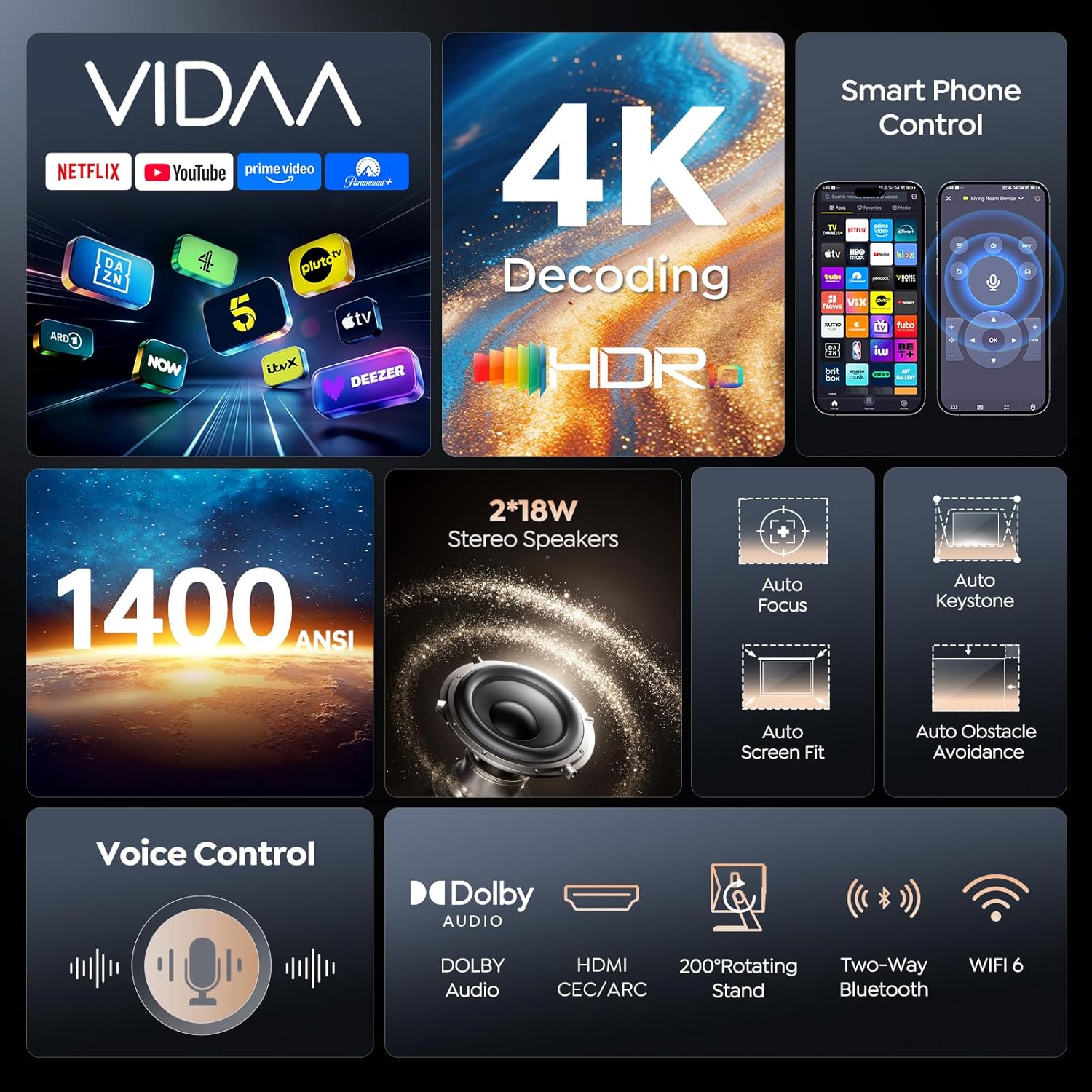
The TOPTRO A2 is sold as a 1080p native projector with 4K decoding, 1400 ANSI lumens, HDR10 support and a VIDAA smart OS that includes Netflix and over 1000 live channels. On paper, that’s a lot of claims for a compact projector that weighs about 1.9 kg and is roughly the size of a medium toaster. You get Wi-Fi 6, Bluetooth 5.4, HDMI, USB, a 3.5 mm jack, and a built-in 36W audio system (2×18W). It’s clearly meant to be a self-contained home cinema box rather than a barebones projector that needs extra gear.
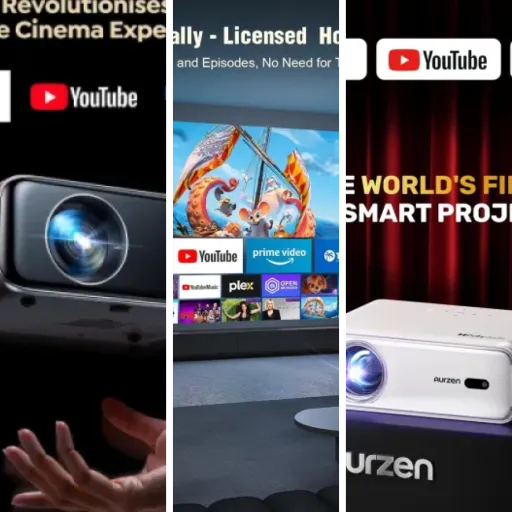
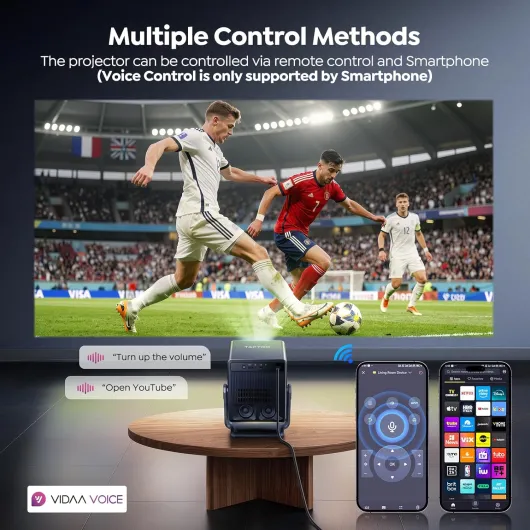
In practice, the "smart" part is what changes things compared to the usual Amazon cheap projectors. Once it’s connected to Wi-Fi, you can open Netflix, Prime Video, YouTube and a bunch of other apps directly, just like on a smart TV. I didn’t need to plug in a Fire Stick or anything, which keeps cable mess down. The VIDAA app for the phone is also handy: you can use your phone as a remote and even voice control, which is useful when the remote inevitably ends up lost in the sofa.
The auto setup features are the other big selling point. It has auto focus, 6D keystone, obstacle avoidance and automatic screen fit. That sounds like marketing jargon, but basically: put it down, point it roughly where you want, and it fixes the focus and geometry on its own. If there’s a shelf or object in the way, it tries to adjust the picture size to avoid it. It’s not flawless, but most of the time it gets the image in the right place without manual fiddling.
From a usage point of view, this is clearly aimed at people who want a quick movie setup in a bedroom, living room or for occasional outdoor nights, without needing to be techy. You can still plug in consoles, laptops or a USB stick if you want, but you don’t have to. If you’re expecting ultra-precise calibration and professional-level flexibility, it’s not that. If you just want to watch Netflix on a big wall with minimum hassle, it lines up well with that use case.
Smart features and daily use: mostly smooth, a couple of small quirks
Day to day, the VIDAA OS is what you interact with the most, and it’s actually decent. Boot time is reasonable, the main screen loads quickly, and navigating between Netflix, YouTube, Prime Video and settings is straightforward. It feels closer to a mid-range smart TV OS than the clunky Android forks you often see on cheap projectors. I didn’t have crashes or random reboots during my use, which is already better than some devices I’ve tried. Logging into apps is the usual pain (typing passwords with a remote), but once that’s done, it remembers everything.
The auto focus and 6D keystone are honestly the features that make it easy to live with. Each time you move the projector or tilt it, it quickly re-adjusts focus and corrects the shape. Most of the time, it nails it in a couple of seconds. Occasionally, it overshoots slightly, and you might want to fine-tune, but for casual use it’s fine as is. The automatic obstacle avoidance and screen fit sounds like a gimmick, but if you’re projecting near shelves or frames, it does help keep the image from overlapping weird surfaces.
Wi-Fi 6 connectivity has been solid. Streaming 1080p and 4K content from Netflix and YouTube worked without buffering on a decent home connection. Obviously, if your Wi-Fi is weak, no projector can fix that, but the wireless performance here didn’t give me trouble. Screen mirroring and AirPlay also worked, though there’s a bit of delay, which is fine for photos and videos but not ideal for fast-paced gaming from your phone. The phone app as a remote is surprisingly handy, especially the keyboard function when searching on YouTube or logging in.
There are some small annoyances. The remote doesn’t support voice control (only the phone app does), which feels like a missed opportunity. The settings menus are a bit scattered; sometimes you have to dig around to find specific picture or sound tweaks. And like many smart devices, the OS pushes some extra apps and channels you’ll probably never use. But overall, as a daily streaming and movie machine, it does what it’s supposed to do without much hassle, which is what most people care about.
Pros
- Built-in VIDAA OS with Netflix, YouTube and Prime Video so no need for extra streaming sticks
- Auto focus and 6D keystone make setup fast and painless, even when you move it around
- Loud 36W speakers with Dolby Audio that are actually usable without a soundbar
Cons
- Fan noise is noticeable in quiet scenes, even if it fades during normal viewing
- Image loses punch in bright daylight like most projectors at this price
- Remote has no voice control and menus can sometimes feel a bit scattered
Conclusion
Editor's rating
After using the TOPTRO A2 for films, series and some casual gaming, my overall feeling is pretty clear: it’s a solid all-in-one home projector that focuses on convenience and does that well. The combination of native 1080p, decent brightness, automatic focus/keystone and built-in Netflix/VIDAA OS makes everyday use simple. The sound is better than expected, to the point where external speakers are optional rather than mandatory, which is rare at this level.
It’s not trying to be a pro cinema machine. In bright daylight, it behaves like most projectors: usable but washed out. The fan is audible, and picture quality, while good, won’t beat a high-end TV in contrast or HDR. But if you mainly watch in the evening, want a big image in a bedroom or living room, and don’t want to juggle extra sticks and speakers, it hits a nice balance. The rotatable stand and quick auto setup make it easy to move around, so it also works well for camping trips or occasional outdoor movie nights.
Who is it for? People who want a straightforward, Netflix-ready projector with decent sound and minimal setup hassle. Families, renters who can’t mount a big TV, or anyone who likes the idea of a portable cinema box will probably be happy. Who should skip it? If you’re obsessed with perfect blacks, ultra-low gaming latency, or you already own a good sound system and streaming box, you might want to look at a more specialised projector from a cinema-focused brand. For most casual users though, it’s a practical, good-value choice that gets the job done without much fuss.