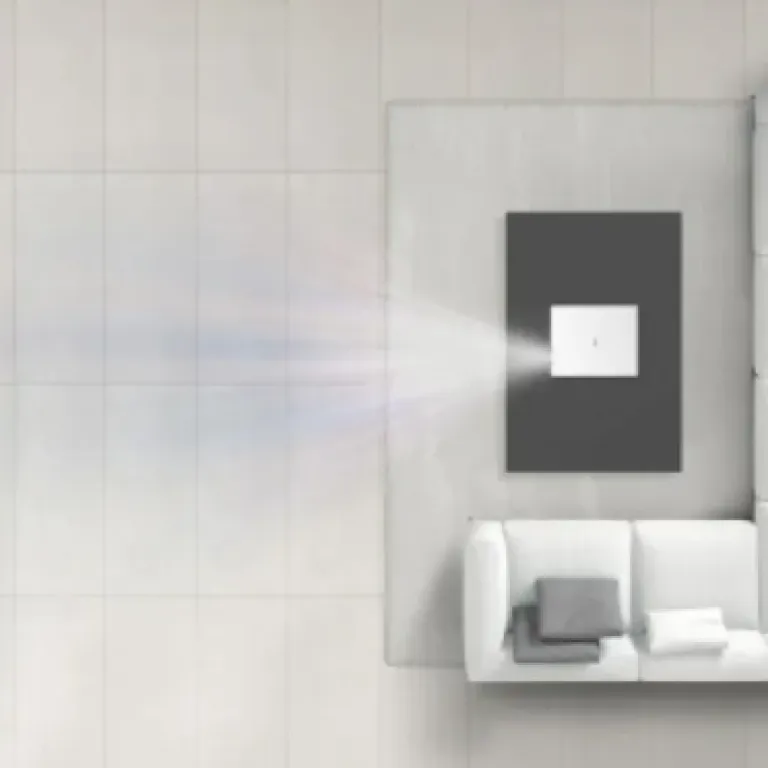

Summary
Editor's rating
Is it worth the money compared to other options?
Big, heavy, and feels like proper hardware
Noise, heat, and everyday use
Build quality and long-term worries
Image quality: sharp, bright, but blacks are only decent
What this projector actually offers on paper
Pros
- Very sharp and bright 4K image, usable even with some ambient light
- Long-life laser light source (~20,000 hours) with quick start-up
- WebOS with Magic Remote, built-in apps and decent gaming modes (1080p/1440p at 120 Hz)
Cons
- Black levels only average; dark-room performance is limited
- Visible laser sparkling on red tones for some users, especially in menus and games
- No true 4K 120 Hz despite HDMI 2.1, and built-in speaker is weak

Specifications
View full product page →| Brand | LG |
A TV replacement that almost gets there
I’ve been using the LG CineBeam Laser 4K HU810PW as my main “TV” in the living room for a while now, and I’ll be honest: this thing is pretty solid, but not perfect. If you’re dreaming of a huge 4K image without going into crazy JVC/Sony prices, it ticks a lot of boxes. But you need to know what you’re getting into, especially with black levels and some quirks linked to the laser.
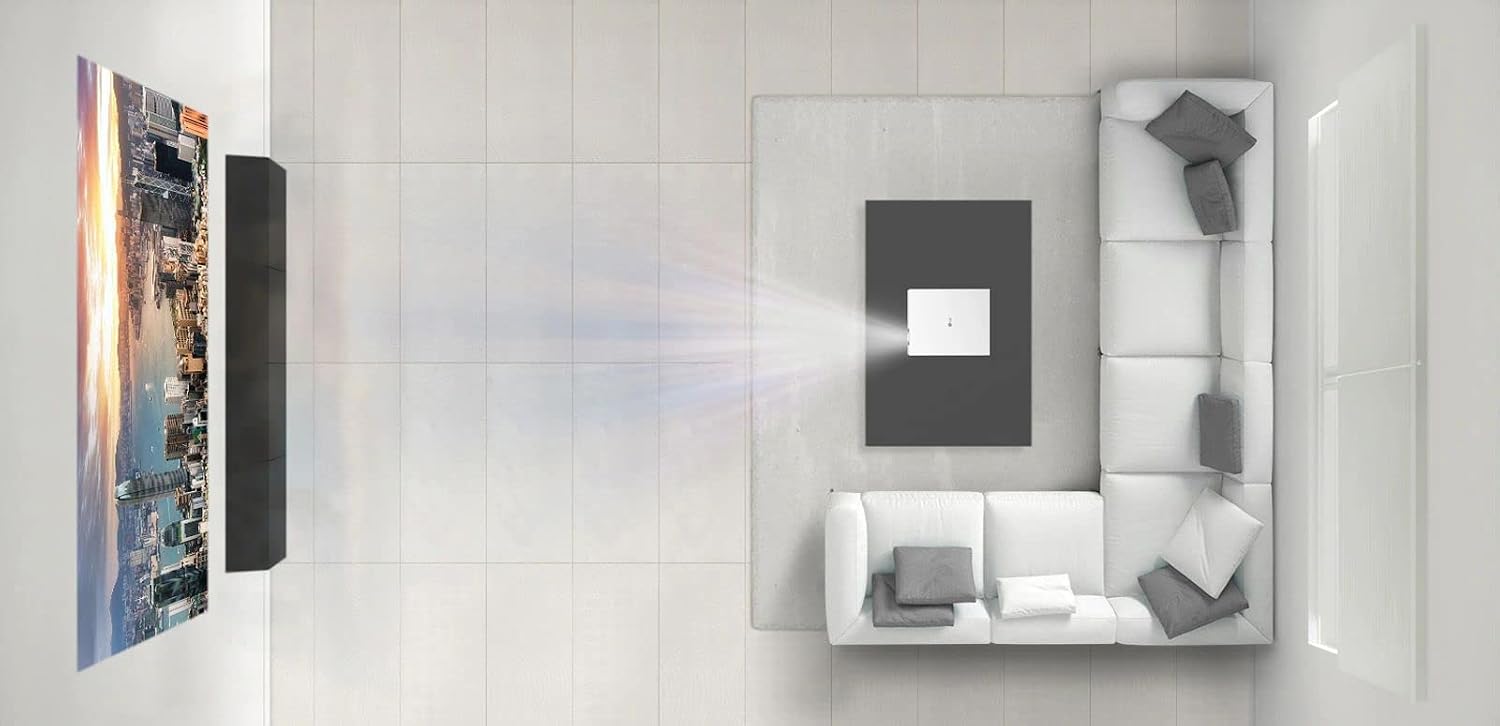
My setup: white wall screen area of about 3 meters wide, seating distance around 3.5–4 meters, room can be darkened but it’s not a dedicated bat cave with black walls. I use it for movies and series in 4K, some console gaming, and a bit of sports. Sources are a PS5, an Apple TV 4K, and occasionally streaming directly via WebOS. Sound is handled by an AV receiver; I basically ignored the built-in speaker after the first evening.
In day-to-day use, the first thing that stands out is the brightness and sharpness. Even with some ambient light, the image stays very watchable, which is not always the case with cheaper projectors. 4K content looks crisp, text is easy to read, and colors have punch without looking like a cartoon, once you dial in the settings a bit. You don’t get the deep OLED-style blacks, but for a mixed-use living room, it does the job.
If you’re coming from a budget 1080p projector, you’ll probably be happy. If you’re already picky about contrast and you’ve spent time with high-end projectors, you’ll see the limits. That’s basically the story of this device: strong all-rounder, especially now that the price has dropped, but with a few compromises you have to accept to enjoy it fully.
Is it worth the money compared to other options?
Value depends a lot on the price you pay. At the original around 3000+ € launch price, I’d say it was a bit hard to swallow given the average black levels and the laser sparkling. But now that it often sits roughly 800–1000 € lower than at launch, it looks much more interesting. For around 2000 € (or whatever similar street price in your area), you get: a bright laser light source, 4K XPR, HDR support, WebOS, decent gaming modes, and a solid build. In that bracket, there are not that many laser projectors from big brands, so it holds its own quite well.
Compared to a good 4K TV of, say, 65–77 inches, the projector can actually be less power-hungry in Eco mode and gives you a much bigger image. One user measured around 169 kWh in medium Eco, which is honestly not bad for such a big picture. Of course, if you need true black levels and watch mostly with lights on, a TV still wins. But if your goal is a cinema-like experience on 100–120 inches or more, the LG offers pretty good bang for the buck, especially now that it’s cheaper than at launch.
Against competitors like Epson 4K-eShift lamp projectors, you trade better blacks and motorized lens controls (on some Epsons) for laser longevity, more brightness, and WebOS. If you’re okay changing lamps and you care a lot about black level, an Epson might feel like a better deal. If you’re tired of lamp changes and want a bright, hassle-free light source, the LG starts to look more attractive. Just keep in mind the HDMI 2.1 limitation (no 4K 120 Hz) and the red sparkle issue if you’re sensitive.
So in terms of value: good, not unbeatable. At a lower street price it makes sense as a main living room projector for people who want size and brightness more than perfect contrast. If you’re chasing reference-level image quality in a dark, treated room, you’re better off saving more and going for a higher-end JVC/Sony or looking at something like the newer HU710 which fixes some of this model’s quirks at the cost of brightness.
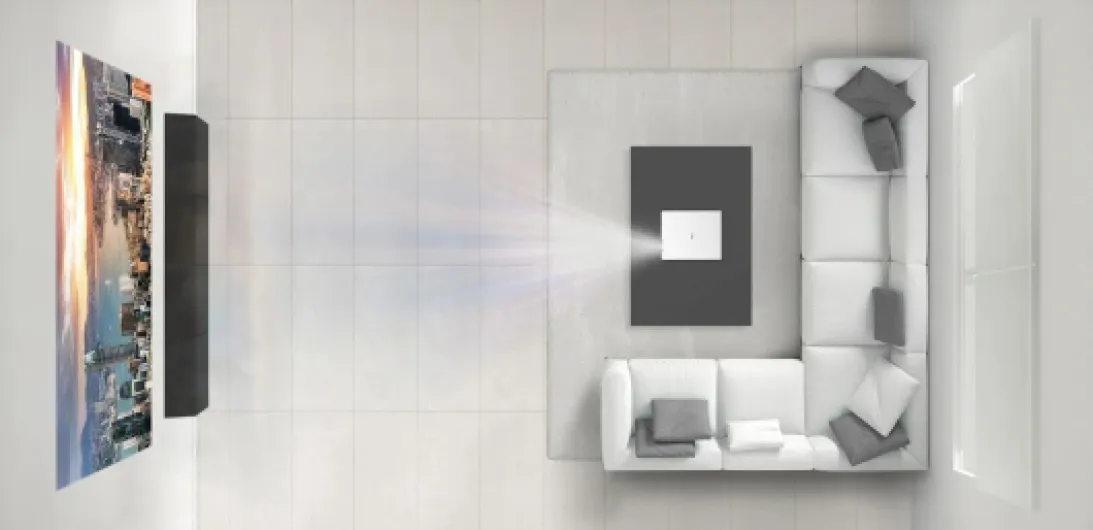
Big, heavy, and feels like proper hardware
Physically, the HU810PW is not a toy. It weighs around 11 kg and measures roughly 41 x 33.7 x 14.5 cm, so you feel it when you move it around. This is not a casual “put it on a stack of books” projector; if you want it on the ceiling, you need a decent mount, not a cheap plastic bracket. Several users mentioned the same thing, and I agree – the weight actually reassures me that there’s proper hardware inside, but you do need to plan where it goes.
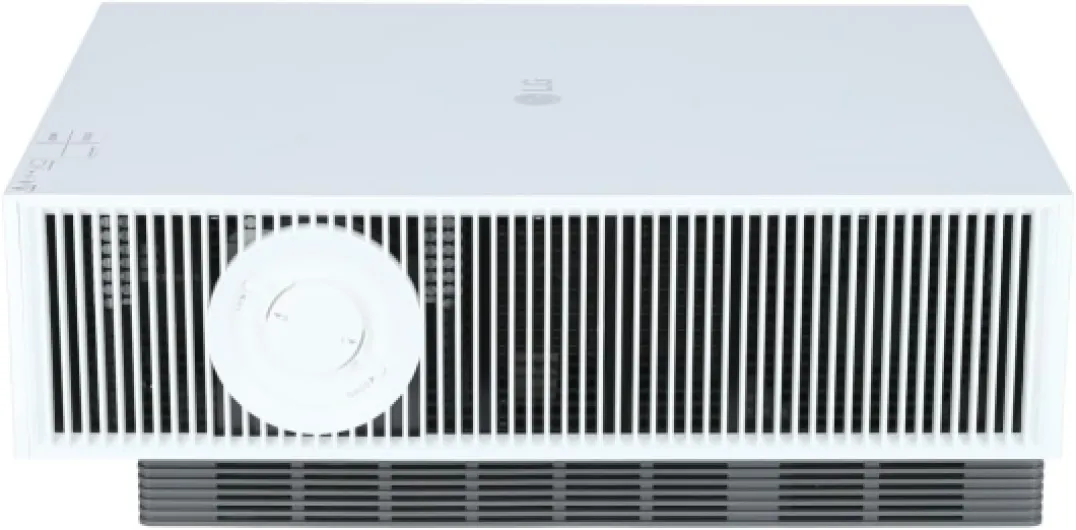
The design itself is pretty simple: white chassis, fairly clean lines, nothing flashy. It doesn’t scream “gamer” or “office projector”, it just blends in, which is nice in a living room. The lens is offset to one side, with manual levers and wheels on top for zoom, focus, and lens shift. No motorized lens here, so all the fine tuning is done by hand, standing on a ladder if it’s ceiling-mounted. Compared to something like an Epson with motorized lens controls, this feels more basic and a bit more fiddly.
One thing I noticed is that adjusting zoom and focus can be a bit annoying: when you move one lever, the whole lens assembly tends to wobble slightly, which means the image shifts a bit. So you tweak focus, then the image is no longer perfectly centered, then you fix position, and suddenly focus is a hair off again. It’s not dramatic, but it took me a bit of patience to get it right. Also, the optics seem to settle after the projector warms up, so I had to wait 10–15 minutes before doing the final focus; cold, the image is slightly softer and then sharpens as it reaches operating temperature.
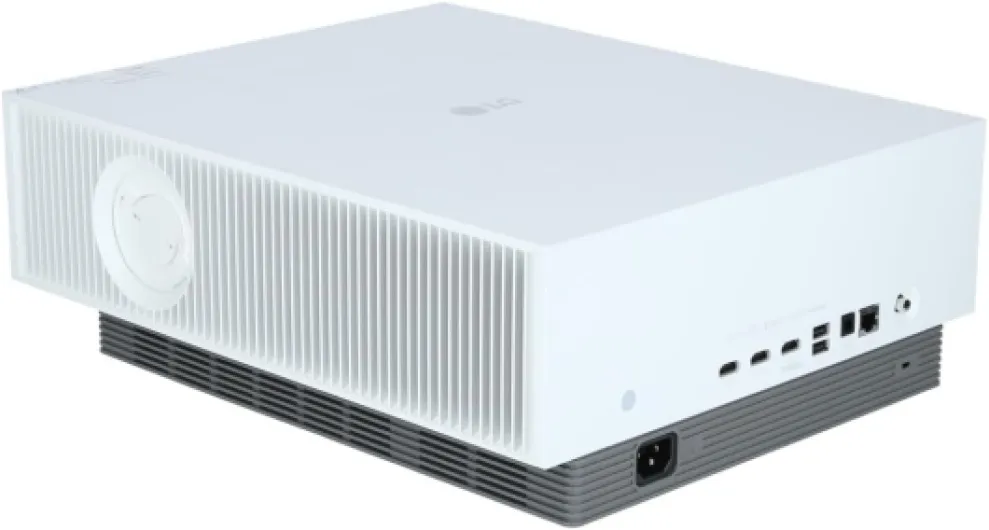
Ports and ventilation are laid out in a practical way. There are multiple HDMI ports, USB, audio out, network, Bluetooth, and the cooling uses three fans (two intake, one exhaust in the higher power mode). Airflow is well managed; the warm air goes out the back/side, so it doesn’t blow straight in your face if you sit behind it. Overall, the design is functional and serious, not pretty or fancy, but it feels like a proper piece of kit built to stay in place, not something you move every day.
Noise, heat, and everyday use
In daily use, the HU810PW is actually pretty comfortable to live with, as long as you manage expectations. Noise-wise, in the medium Eco mode it’s about on par with the quieter projectors I’ve had. Sitting around 2–2.5 m from it, I can hear a soft fan noise and a light electronic whirr from the XPR shifting if I focus on it, but during a movie with normal volume it fades into the background. In very quiet scenes you notice it a bit, but it never drove me crazy. If you crank it up to the highest brightness mode, the fans get more noticeable, but still reasonable for a projector this bright.
Heat is there, obviously – it’s a laser light source pushing a lot of lumens – but the chassis manages it well. The warm air goes out the side/back, so it doesn’t roast you on the sofa. The upside of the laser engine is the quick start: you get a bright image in seconds, and no slow lamp warm-up. Still, the optics take a bit of time to stabilize. Like one of the users said, the focus is slightly soft when cold and becomes crisp after roughly 10–15 minutes. So I learned to ignore the urge to refocus immediately after switching it on.
The Magic Remote is honestly a nice touch. It works like a Wii pointer, so navigating WebOS is fast and more natural than arrow-only remotes. For people who hate typing with arrows, it’s a relief. WebOS itself is usable but not as smooth as an Apple TV or a recent Fire TV stick. Apps launch in a reasonable time, but you feel some lag here and there. Also, not all streaming services are available, and AirPlay 2 is limited (sometimes only audio from iPhone), so I still recommend an external box if you’re picky about apps and performance.
One thing to note: the built-in speaker is basic and not very powerful. It’s okay for testing or a quick YouTube clip, but for films and games it feels flat and underpowered. Realistically, if you’re buying a 4K laser projector, you should plan for at least a soundbar or, better, an AV receiver and real speakers. Once that’s in place, using the projector daily feels natural: turn it on, pick your HDMI or app, and you’re good. It ends up feeling like a big TV with a couple of more steps (darkening the room, making sure nothing blocks the beam, etc.).
Build quality and long-term worries
On the durability side, the HU810PW gives off a solid, serious impression. The chassis is rigid, nothing creaks, and the weight adds to that feeling of a well-built device. The laser light source rated at about 20,000 hours is a big plus: even if you watch 4 hours a day, that’s more than 13 years on paper. No lamp replacements, no brightness falling off a cliff after a couple of thousand hours like older lamp-based models. That’s one of the key reasons I went laser, and it’s reassuring for long-term use.
The downside is more about potential annoyances than pure failure. The manual lens system with levers and wheels feels mechanically okay, but not super precise. Over time, I could imagine very slight play or drift if you bump the projector or if it’s mounted somewhere that vibrates (near a subwoofer, for example). It’s not a disaster, but it’s not the kind of thing you want to readjust every week. Also, the fact that focus changes slightly between cold and warm states is a reminder that the optics are moving with temperature; it’s normal, but it means you’ll always have that warm-up behavior.
Another long-term question mark is the laser sparkling issue. Some users ended up returning the projector after a few weeks because once they saw the red sparkle, they couldn’t unsee it, especially in menus and games. It’s not a classic “it will break” durability problem, but more a “will this visual quirk annoy me more and more over time” kind of thing. In my case, I got used to it for films but it did bug me in some games. The fact that LG later released the HU710 with a hybrid laser/LED system and no red laser says a lot about how they saw this problem.
Overall, I don’t see this projector as fragile. The fans seem decent, the case is sturdy, and LG is a big brand with at least some level of spare parts and support. But it’s still consumer electronics: if something serious fails out of warranty (laser module, DLP chip, power supply), repairs won’t be cheap. If you treat it as a semi-permanent installation, dust it occasionally, and don’t block the vents, it should hold up well. Just don’t expect bulletproof pro-cinema durability; it’s a well-built living room projector, not industrial gear.
Image quality: sharp, bright, but blacks are only decent
This is the part that matters most: how the image actually looks. In short, the HU810PW delivers a very sharp and bright picture, with strong colors, but the black level is just okay, not more. On a 3.5–4 m seating distance with a roughly 3.8 m wide image (like one of the Amazon reviewers), 4K content looks very detailed. Text in menus, subtitles, textures in games – everything is clean, no obvious pixel structure, thanks to the 4x XPR shifting on a Full HD DLP chip. It’s not native 4K like high-end Sony/JVC, but at this price I didn’t expect that, and honestly from normal distance it looks very good.
Brightness is where this projector shines (no pun intended). The 2700 lumens are clearly enough for a big screen in a living room with some ambient light, as long as you don’t have direct sunlight hitting the screen. During the day with blinds half closed, I can still watch sports or YouTube without feeling like I’m in a cave. For movies at night, I usually drop it to a more moderate Eco mode, which keeps it bright but a bit more comfortable and quieter. HDR content looks punchy when you tweak the settings: Dynamic Tone Mapping and the adjustable Iris mode help balance highlights and shadow detail.
The weak spot: black levels and contrast. If you darken the room, you quickly see that blacks are more like dark greys, especially on a white screen. Using the adjustable iris helps a lot; I ended up with two main profiles, one with the iris more closed for dark content and one more open for bright movies or sports. With that, I got a black level similar to mid-range Epson models I’ve used before, which is fine, but if you’re a contrast freak used to JVC, you will be disappointed. Also, there’s the famous “laser sparkling” on red or reddish areas: a slight glitter effect that shows up on static menus or UI elements. I noticed it more and more after a while; during fast scenes it’s barely visible, but in games or menus it can get on your nerves if you start looking for it.
Gaming performance is solid but not perfect. 1080p/120 Hz and 1440p/120 Hz work and feel smooth, so if you’re okay dropping resolution you can get a nice fluid experience on PS5/PC. Input lag is fine for casual and mid-core gaming; I’m not a pro e-sports player, but I didn’t feel held back. In 4K you’re stuck at 60 Hz, which is a pity given the HDMI 2.1 label. Motion interpolation (TruMotion) is there if you like the soap opera effect; I keep it low or off for films, but for sports it can be useful. Overall: very good sharpness and brightness, decent HDR, but only average blacks and that laser glitter that some people end up hating.
What this projector actually offers on paper
On paper, the LG HU810PW looks like a pretty serious home cinema machine. It’s a DLP laser projector with 4K UHD (3840x2160) via XPR shifting, 8.3 megapixels, and up to a 300-inch image. Brightness is rated at 2700 ANSI lumens, which is enough for a big screen in a dim or lightly lit room. The quoted contrast goes up to silly marketing numbers (millions to one), but in real life it’s more in line with mid-range DLPs. Let’s just say: okay, not mind-blowing.
It supports HDR10, HLG, Dynamic Tone Mapping, and HGiG, so it’s clearly designed with HDR content and gaming in mind. There’s HDMI 2.1, but don’t expect full-fat 4K 120 Hz; it handles 1080p and 1440p at 120 Hz, which is nice for console or PC gaming, but 4K is stuck at 60 Hz. The laser light source is rated for around 20,000 hours, so you can forget about lamp changes for a long time, which is one of the big reasons to look at laser in the first place.
On the smart side, it runs WebOS 5.0, same family as LG TVs, with apps like Netflix, Prime Video, Disney+ and co. There’s AirPlay, Miracast, Bluetooth, and the usual Wi‑Fi stuff. In theory you can ditch a streaming box, but in practice I still ended up using my Apple TV because WebOS is a bit slower and not all services or features are there. AirPlay is also limited: some users (and me too) noticed that full video mirroring from iPhone doesn’t always work as expected, sometimes you only get audio.
In short, the feature list is pretty complete for a modern living room projector: 4K, laser, HDR formats, smart OS, wireless options, and flexible image size up to 300 inches. The catch is that you have to live with the typical DLP weaknesses (black level, some rainbow effect for sensitive people, and in this case a bit of laser “sparkle” on reds) and accept that the HDMI 2.1 is not the full gaming dream some might expect.
Pros
- Very sharp and bright 4K image, usable even with some ambient light
- Long-life laser light source (~20,000 hours) with quick start-up
- WebOS with Magic Remote, built-in apps and decent gaming modes (1080p/1440p at 120 Hz)
Cons
- Black levels only average; dark-room performance is limited
- Visible laser sparkling on red tones for some users, especially in menus and games
- No true 4K 120 Hz despite HDMI 2.1, and built-in speaker is weak
Conclusion
Editor's rating
Overall, the LG CineBeam Laser 4K HU810PW is a solid all-round home cinema projector if your priorities are a big bright 4K image, long-life laser light source, and built-in smart features. In a typical living room where you can dim the lights but not create a perfect bat cave, it does a good job: sharp 4K, strong colors, enough brightness to handle some ambient light, and a noise level that stays reasonable. WebOS and the Magic Remote are handy if you don’t want to juggle too many boxes, even if an external streamer still gives a smoother experience.
Where it falls short is mainly black level and the laser sparkling on reds. Blacks are okay but not deep, and if you’re very picky or have a dark dedicated room, you’ll see the limits. The red sparkle might not bother everyone, but some users (and I get it) ended up returning it because once you notice it, you keep spotting it in menus and games. Add to that the lack of 4K 120 Hz despite HDMI 2.1, and it’s clear this is not the perfect gamer projector either.
Who is it for? People who want a big-screen TV replacement in the living room, who care more about size, brightness and convenience than perfect blacks. Also good for mixed use: movies, series, sports, some gaming. Who should skip it? Home cinema purists chasing deep blacks and contrast, and very sensitive users who hate any visual artifact – they’re better off with a higher-end JVC/Sony or maybe the newer HU710. At its current street price, I’d give it a 4/5: good package, good value, but with clear compromises you need to accept.