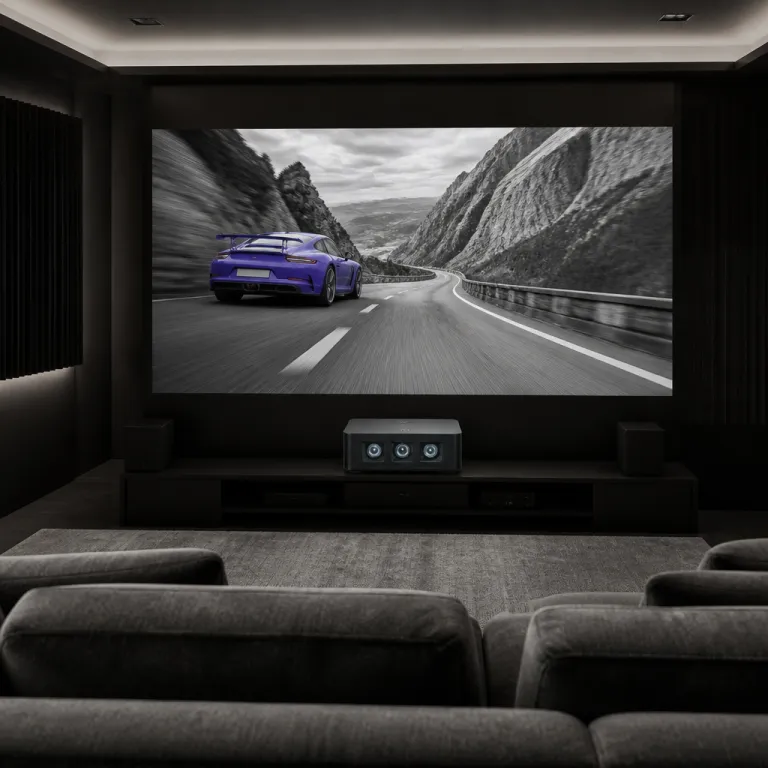

What sets a 4K triple laser projector apart in a home theater
A 4K triple laser projector can transform how a living room or media space feels. By combining native UHD resolution with three independent laser light sources, it delivers color volume and perceived brightness that traditional lamp-based projectors rarely match. This kind of advanced theater projector can turn even a modest wall-and-screen setup into something that approaches a commercial cinema experience.
In a triple-laser architecture, discrete red, green, and blue lasers generate pure RGB primaries, which reduces reliance on a spinning color wheel and helps cut rainbow artifacts. These RGB laser engines are now common in premium UST projector models, where the chassis sits ultra short from the wall yet still throws a 100‑inch or larger image. When you compare these laser projectors with older bulb-based designs, the jump in color saturation, uniformity, and usable brightness is immediately obvious in side‑by‑side viewing.
Many 4K triple laser projector packages are marketed as “laser TV” systems, but they are still projectors at heart. They depend on a dedicated ambient light rejecting screen to tame stray light and preserve contrast in brighter rooms. For anyone planning a purchase, understanding how the projector, the screen surface, and the room’s lighting interact is more important than chasing the lowest list price or the highest headline specification.
Brightness, lumens and real world image quality
Brightness claims around any 4K triple laser projector can be confusing. Manufacturers quote both ANSI lumens and ISO lumens, and the figures for these lumen ratings often differ significantly for the same chassis. In practice, a well‑calibrated laser projector with honest ANSI lumens measurements will usually look better than a harsh, overdriven model tuned only to win a spec‑sheet comparison.
ANSI lumens measure brightness using a standardized grid of points on the screen, while ISO lumens follow a slightly different protocol that can yield higher numbers. Independent tests from outlets such as ProjectorCentral, AVS Forum, and RTINGS routinely find that real ANSI readings come in roughly 10–30 percent below optimistic marketing claims. When you compare projectors like Hisense Pro models or a compact portable projector, always check whether the brand is quoting ANSI lumens or ISO lumens before you judge the brightness. A 4K triple laser projector rated at 2,500 ANSI lumens can outperform a rival claiming 3,000 ISO lumens once you factor in color accuracy, laser light modulation, and how much of that output is usable for accurate picture modes.
Short‑throw and ultra short throw optics also affect perceived brightness, because the same light is spread over different screen sizes and distances. A UST projector placed ultra close to the wall will often be tuned for a 100‑ to 120‑inch screen, while a long‑throw theater projector might be optimized for 150 inches or more. If you are considering a compact RGB laser portable model, detailed hands‑on testing from specialist reviewers can help you translate quoted lumens into real viewing comfort and understand how brightness holds up in different environments.
Ultra short throw, UST projectors and living room friendly setups
For many people in the United States, a 4K triple laser projector only becomes practical when it works in a bright, multipurpose living room. Ultra short throw designs, often called laser UST projectors, sit just a few centimetres from the wall yet create a massive image that can rival a large television. This short‑throw or ultra short throw geometry keeps cables tidy, allows the unit to sit on a low cabinet, and makes the projector feel more like a piece of furniture than a fragile device in the middle of the room.
Brands such as Hisense, AWOL Vision, and JMGO have pushed this UST category hard with pro‑level models. A Hisense Pro laser UST projector, for example, pairs a triple‑laser light engine with a dedicated ambient light rejecting screen to maintain contrast under ceiling lights and daylight spill. AWOL Vision and JMGO Ultimate systems follow a similar formula, using RGB laser light and carefully designed optics to deliver a bright, punchy image even when the room is not fully dark, while still offering cinema‑oriented picture modes for nighttime viewing.
Some enthusiasts look at models like the LTV Pro series, which combine a 4K triple laser projector engine with advanced gaming features and low input lag. Several recent UST units measured by specialist reviewers come in around 15–25 ms at 4K/60, which is fast enough for most console players. Others prefer more compact portable projectors that still use laser light but sacrifice some peak brightness for flexibility and easy transport. For a deeper look at how a modern triple‑laser UST projector behaves in a real living room, a detailed test from an independent lab is more useful than any marketing brochure or spec sheet.
Comparing key players: Hisense, JMGO, AWOL Vision and LTV Pro
Choosing a 4K triple laser projector often starts with comparing a few headline brands. Hisense has built a strong reputation in the United States with its Hisense Pro and other laser TV lines, which bundle a UST projector and screen into one purchase. These Hisense Pro systems focus on ease of use, integrated TV tuners, and familiar smart platforms, making them feel like a natural upgrade path for anyone moving up from a flat‑panel TV.
JMGO approaches the same 4K triple laser projector market with a more design‑driven philosophy. The JMGO Ultimate series and other JMGO projectors emphasize industrial design, quiet operation, and refined color tuning, which appeals to style‑conscious buyers who still care about image accuracy. AWOL Vision, by contrast, targets enthusiasts who want a theater projector with very high brightness, wide color gamut coverage, and flexible calibration controls for dedicated cinema rooms or light‑controlled dens.
The LTV Pro family and similar pro‑oriented laser projectors often add features such as 3D support, advanced motion processing, and gaming‑friendly low latency modes. When you read any review, pay close attention to how the tester describes black levels, color accuracy, and motion handling rather than just quoting lumens and list price. A well‑balanced 4K triple laser projector from Hisense, JMGO, AWOL Vision, or an LTV Pro competitor can all deliver excellent results, but the best choice depends on your room layout, your screen type, and your viewing habits, including how often you watch with lights on.
Price, value and what to check before you purchase
Budget planning for a 4K triple laser projector should include more than the sticker price. You need to factor in the cost of a proper screen, potential ceiling or furniture changes, and sometimes professional calibration for the theater space. A realistic total purchase budget often ends up 20 to 40 percent above the projector list price once everything is installed, wired, and tuned.
Laser projectors have a clear advantage over lamp‑based projectors when it comes to running costs and maintenance. A modern laser light engine is typically rated for 20,000 hours or more before dropping significantly in brightness, according to manufacturer specifications and long‑term lab testing from major review sites. That equates to many years of nightly use for most households. The long laser light lifespan also benefits portable projectors, where replacing a lamp would be impractical or impossible and downtime is more disruptive.
Before you purchase, check the warranty terms carefully, especially for the laser module and any UST‑specific optics or mirrors. Look for clear statements about ANSI lumens and ISO lumens, and be wary of vague brightness claims that do not specify the measurement standard or test conditions. If you are unsure whether a 4K triple laser projector or a large OLED panel suits your needs, a detailed explainer on what a so‑called laser TV really replaces can help you weigh long‑term value, room constraints, and viewing preferences.
Use cases beyond movies: gaming, business and education
A 4K triple laser projector is not only for film lovers. With low input lag and high‑refresh support, many modern theater projectors double as giant gaming displays for consoles and PCs. The combination of UHD resolution, strong brightness, and wide color reproduction makes fast‑paced video games feel more immersive than on most televisions, especially at screen sizes above 100 inches.
Some buyers in business and education also turn to laser projectors because of their reliability and low maintenance. In a lecture hall, training room, or hybrid classroom, a bright RGB laser UST projector can throw a huge, readable image from a short distance, avoiding shadows and glare from presenters walking in front of the beam. The same qualities that make a 4K triple laser projector attractive in a living room, such as instant‑on behavior, stable color over time, and long service intervals, translate well to classrooms and meeting spaces.
Portable projectors with laser light engines are especially useful for trainers and consultants who move between locations. They pack enough lumens to handle modest ambient light, while remaining compact enough to carry in a backpack or small case. When evaluating these portable projector options, look for honest ANSI lumens ratings, robust chassis design, and flexible short‑throw or ultra short throw lenses that suit varied rooms, from small offices to hotel conference spaces.
Practical setup tips for getting the best image
Getting the most from a 4K triple laser projector starts with the room itself. Darkening the walls and ceiling around the screen area, even slightly, can dramatically improve perceived contrast and depth. If you cannot fully control ambient light, pairing the projector with a high‑quality UST‑specific ambient light rejecting screen is essential for maintaining black levels and color saturation.
Placement matters just as much as brightness specifications. A UST projector must sit at the correct height and distance from the wall, otherwise focus and geometry will suffer, especially at the edges and corners of the screen. Many owners underestimate how sensitive ultra short throw optics are, so taking time with a tape measure, a spirit level, and the manufacturer’s placement chart is crucial to avoid keystone corrections that can soften the image.
Once the projector and screen are aligned, spend time in the picture menu rather than relying on the brightest preset. Choose a cinema or movie mode, then adjust brightness, contrast, and color temperature while watching familiar content such as a well‑mastered UHD Blu‑ray or high‑quality streaming video. A careful setup session, possibly guided by basic calibration patterns, can make a mid‑range 4K triple laser projector outperform a more expensive rival that is left in an overblown showroom mode with inaccurate colors.
Key figures about 4K triple laser projectors
- Many consumer 4K triple laser projector models quote light‑source lifespans around 20,000 to 30,000 hours before reaching half brightness, which equates to several hours of viewing every day for more than a decade according to typical manufacturer specifications and long‑term endurance tests.
- Premium UST projector systems from brands such as Hisense and AWOL Vision often target brightness levels between 2,000 and 3,000 ANSI lumens in calibrated modes, a range designed to balance vivid daytime viewing with acceptable black levels in dim rooms without pushing the laser engine to its harshest setting.
- Market analysts tracking the projector segment in the United States report that ultra short throw and laser projector categories have grown faster than traditional long‑throw lamp‑based projectors, reflecting a shift toward living‑room‑friendly theater setups and away from ceiling‑mounted installations.
- Independent lab tests on recent triple‑laser UST models show that many now cover close to or above the full DCI‑P3 color gamut, with some units approaching a large portion of the Rec. 2020 color space, which significantly exceeds the color coverage of most conventional televisions that typically target DCI‑P3 only.
FAQ: 4K triple laser projector
Is a 4K triple laser projector brighter than a traditional lamp projector ?
A 4K triple laser projector is not automatically brighter than a lamp‑based rival, but it usually maintains its brightness more consistently over time. Laser light sources also allow manufacturers to tune brightness more precisely and achieve higher color saturation at a given ANSI lumens level. When comparing models, always look at measured lumens in calibrated modes and real‑world reviews rather than assuming that “laser” automatically equals maximum brightness.
Do I need a special screen for a UST triple laser projector ?
A UST projector with a triple‑laser engine performs best with an ambient light rejecting screen designed specifically for ultra short throw optics. These screens use directional surface structures to reflect light from the projector toward the viewer while rejecting light from above and from side windows. Using a standard matte‑white screen or a bare wall can work in a dark room, but you will lose contrast, punch, and perceived sharpness in brighter spaces.
How long does the laser light source usually last ?
Most 4K triple laser projector models quote laser light lifespans between 20,000 and 30,000 hours before brightness drops to around half of the original level. For a typical household watching four hours of content per day, that translates to well over ten years of use. Unlike lamps, laser light sources do not usually fail suddenly, so the decline is gradual and often barely noticeable for casual viewers until very late in the product’s life.
Are 4K triple laser projectors good for gaming ?
Many recent 4K triple laser projector models are well suited to gaming, especially those marketed with Pro or LTV Pro style branding. They often support low‑input‑lag modes, high refresh rates at lower resolutions, and features such as variable refresh on some platforms. If gaming is a priority, check independent testing for input‑lag measurements—ideally under 30 ms at 4K/60—and motion handling before you purchase.
Is a 4K triple laser projector worth the higher price compared with a TV ?
The value of a 4K triple laser projector compared with a large television depends on your priorities. If you want a truly cinematic image size above 100 inches, a projector‑and‑screen combination usually offers better cost per inch than a premium OLED or Mini LED panel. If you mainly watch during the day in a very bright room and prefer a simpler, single‑box setup, a high‑quality television may still be the more practical and straightforward choice.