
Summary
Editor's rating
Is it worth the money compared to a big TV or cheaper projectors?
Design and build: looks premium, not a plastic toy
Unboxing, accessories and first contact
Build quality, reliability and long‑term feel
Picture quality and gaming: where it actually delivers
What this projector actually offers on paper
Smart features, setup, and everyday usability
Pros
- Very good 4K HDR picture quality once calibrated, with strong brightness and decent black levels for this category
- Fast and responsive for gaming with low input lag and 240 Hz support
- Solid build quality, useful auto setup features, and a practical carry case and remote
Cons
- Picture presets out of the box are not great and require manual tweaking for best results
- Some app and software quirks (e.g. BBC iPlayer issues, odd volume indicator behaviour over eARC)
- Heavy and not very portable at 7 kg, better suited as a semi‑permanent setup

Specifications
View full product page →| Brand | Valerion |
A projector for people who actually watch a lot of stuff
I’ve been using the AWOL Valerion VisionMaster Pro2 at home for a few weeks, mostly for films, series and some PC/PS5 gaming. I’m not a calibrator or a home cinema purist, just someone who’s owned a few projectors over the years (BenQ lamp models, then a cheaper LED/Yaber type) and wanted something properly 4K that could replace a big TV. So this is the angle of this review: does it work in a normal living room, is the picture actually good, and what’s annoying day to day.
The short version is: the Pro2 is clearly in a higher league than the usual budget projectors. You feel it as soon as you pull it out of the box and even more once you send proper 4K HDR content to it. But it’s not perfect: you need to spend time in the settings, it’s not the lightest thing to move around at 7 kg, and some software bits still feel a bit rough depending on the apps you use.
I used it in two setups: directly on a white wall at around 100–120 inches, and then on an ALR screen at roughly the same size. I also tried it briefly in daylight with blinds half open just to see how usable it was for casual TV. I paired it with an AV receiver + Atmos speakers most of the time, but I did test the built-in sound just to see if you can live with it out of the box.
If you’re hesitating between a big 77–83" TV and a projector, or between this and cheaper projectors, I’ll walk through what actually matters in practice: picture, gaming performance, noise, setup hassle, and whether the price feels justified once the honeymoon period is over.
Is it worth the money compared to a big TV or cheaper projectors?
Value is where opinions will split. This is not a budget projector. You’re paying a serious amount, roughly in the territory where you could also consider a large OLED or high‑end QLED TV, especially around 77". If you’re only going to watch the occasional film and mostly stick to a normal TV, then honestly, this is overkill and a cheaper projector or a mid‑range TV will do. But if you genuinely want a big‑screen experience at 100–150" on a regular basis, the Pro2 starts to make more sense.
Compared to cheaper LED projectors like the Yaber K2s mentioned in one of the reviews, the difference is clear. The Valerion has much better brightness, contrast, colour accuracy potential and motion handling. It also handles 4K HDR and Dolby Vision content properly, where cheaper models often just accept the signal but don’t really do it justice. One user who upgraded from a Yaber basically summed it up: the Pro2 is on a different level. If you care about films looking close to what you see in a decent cinema, that gap is worth paying for.
Against other more serious projectors like Dangbei or Hisense models, it’s a bit more nuanced. One reviewer coming from a Dangbei Pro 2 said the Dangbei looked better out of the box, but after tweaks the Valerion was superior, especially in HDR. So you’re paying partly for the hardware potential (triple laser, higher contrast, better blacks) and partly accepting that you’ll need to do some tuning yourself. If you hate diving into menus and you want perfection instantly, that might annoy you.
In my opinion, the Pro2 is good value if: you want a real home cinema setup at 100"+, you’re willing to invest in at least a decent screen and external sound, and you don’t mind tweaking settings. If you just want something cheap to throw on a wall for occasional sports, this is overkill. For serious film fans and gamers who want a big image without going into the ultra‑high‑end price bracket, the price/performance ratio is pretty solid, even if not "bargain" level.
Design and build: looks premium, not a plastic toy
Physically, the VisionMaster Pro2 feels like a solid bit of kit. At around 7 kg, it’s not a featherweight, so you’re not going to casually move it from room to room every night, but it also doesn’t feel like a fragile plastic box that will crack if you bump it. The casing has a more "home object" look than typical office projectors: clean lines, a nice finish, and some chrome details on the sides that actually look decent in person and don’t scream cheap chrome. One user review mentioned the different colour options; I tested a neutral tone that blends pretty well in a living room.
The layout is straightforward: ports on the back (multiple HDMI, USB, audio out, etc.), intake and exhaust vents where you’d expect them, and no weird design choices that make placement a pain. It’s clearly meant to sit on a low table or media unit facing the screen. There’s no ultra short throw trick here, so you still need distance, but with the optical zoom you’ve got some flexibility. The included remote is one of the nicer surprises: it feels solid, buttons are backlit, and the layout is simple. No "smart TV remote" nonsense with half the buttons hidden in menus.
In terms of noise and heat, the thermal management is decent. The fan is audible in a quiet room but not annoying once you have content playing at normal volume. It’s not whisper quiet, but it’s far from the old lamp projectors that sounded like a small vacuum. One user mentioned a faulty fan on a competitor’s model that kept shutting down; I didn’t see anything like that here. After a long film, the chassis is warm but not roasting, so it feels like the cooling is doing its job.
Overall, the design is pretty practical: it looks good enough to leave out permanently in a living room, and it doesn’t feel flimsy. The only downside is the weight if you’re planning to move it often or mount it on a ceiling; you’ll want a proper mount and you won’t enjoy hauling it up and down stairs every weekend.
Unboxing, accessories and first contact
The unboxing experience is clearly thought through. The projector arrives in a well‑padded box, and inside you get a proper carry case rather than a thin fabric bag. A couple of Amazon reviewers mentioned this as well, and I agree: it immediately feels like a higher‑end product when you see that case. The projector fits snugly inside with foam protection, so if you plan to occasionally take it to a friend’s house or use it at events, you can actually transport it without stressing too much.
In the box you basically get the essentials: the projector, power adapter/cable, remote, and documentation. No HDMI cable included, which is slightly annoying at this price point, but not a big deal since most of us have a few lying around. What I liked is that the remote feels solid and not like a cheap afterthought. Backlit buttons are a small thing, but in a dark room they make everyday use much nicer. The documentation is basic but enough to get you started; you won’t learn deep calibration tricks from it, but setup is simple enough that you probably won’t need much guidance.
Packaging protection is good. My unit arrived without any cosmetic damage, no loose parts, and no signs of rough handling. Considering one user did report a faulty unit (later replaced), I’d say the issue was more about internal component failure than packaging. In my case, everything powered on smoothly the first time, and there were no weird noises or rattles out of the box.
Overall, the packaging and included accessories match what you expect from a mid-to-high price projector: nothing overly luxurious, but practical and secure. The carry case is actually the standout here. Compared to the Hisense C2 ultra one reviewer mentioned (which apparently only came with a simple bag), Valerion clearly made an effort to make it feel like a complete product, not just a bare device thrown in a cardboard box.
Build quality, reliability and long‑term feel
Durability is always tricky to judge after only a few weeks, but there are a few signs. First, the projector just feels well built. No creaking when you pick it up, no loose panels, and the finish doesn’t pick up fingerprints too badly. The lens is recessed enough that you’re not constantly worried about scratching it when you move it. The dust‑proof claim is hard to verify quickly, but after moving it around and using it in a normal living room with pets, I didn’t see any obvious dust blobs or spots on the image, which is a good sign.
The cooling system seems well designed. Even after long sessions (two films back‑to‑back plus some gaming), the fans ramp up a bit but stay at a stable, reasonable noise level. I didn’t get any overheating warnings or random shutdowns. One Amazon review mentioned that a faulty unit was replaced quickly by Valerion support, which is reassuring: at least they seem to handle defects instead of leaving you stuck. The included 2‑year warranty is standard for this kind of product, not overly generous but not stingy either.
Laser light sources usually last much longer than traditional lamps, so in theory you’re looking at years of use before any big drop in brightness. Obviously I can’t confirm that yet, but if you’ve had old lamp projectors, you’ll appreciate not having to think about bulb replacements and their cost. In terms of software durability, the 4 GB RAM and 128 GB storage give it some headroom for future apps and updates, so it shouldn’t feel outdated immediately like some cheaper Android‑based boxes that start lagging after a year.
The only real durability concern I’d flag is the weight and size if you plan to mount it on the ceiling or move it a lot. At 7 kg, you need a proper mount and decent screws; I wouldn’t trust a flimsy generic bracket. If you’re careful with that and you keep it reasonably dust‑free, there’s nothing obvious that screams "this will fall apart". Based on my use and what I’ve seen from other owners, it gives the impression of a device you’ll keep for several years, not something disposable.
Picture quality and gaming: where it actually delivers
Let’s get to the main point: picture quality. Out of the box, I’d call the presets "okay but not great", especially for SDR. One Amazon reviewer said it straight: SDR and HDR presets aren’t impressive until you tweak them. I had the same feeling. Colours were a bit too aggressive, and the image had that "demo mode" look. Once I went into the settings, dialled back some of the processing, and adjusted brightness/contrast and colour temperature, it got much better. HDR10+ with Dynamic Tone Mapping looks very good once set up properly: bright highlights, detailed shadows, and no washed‑out look.
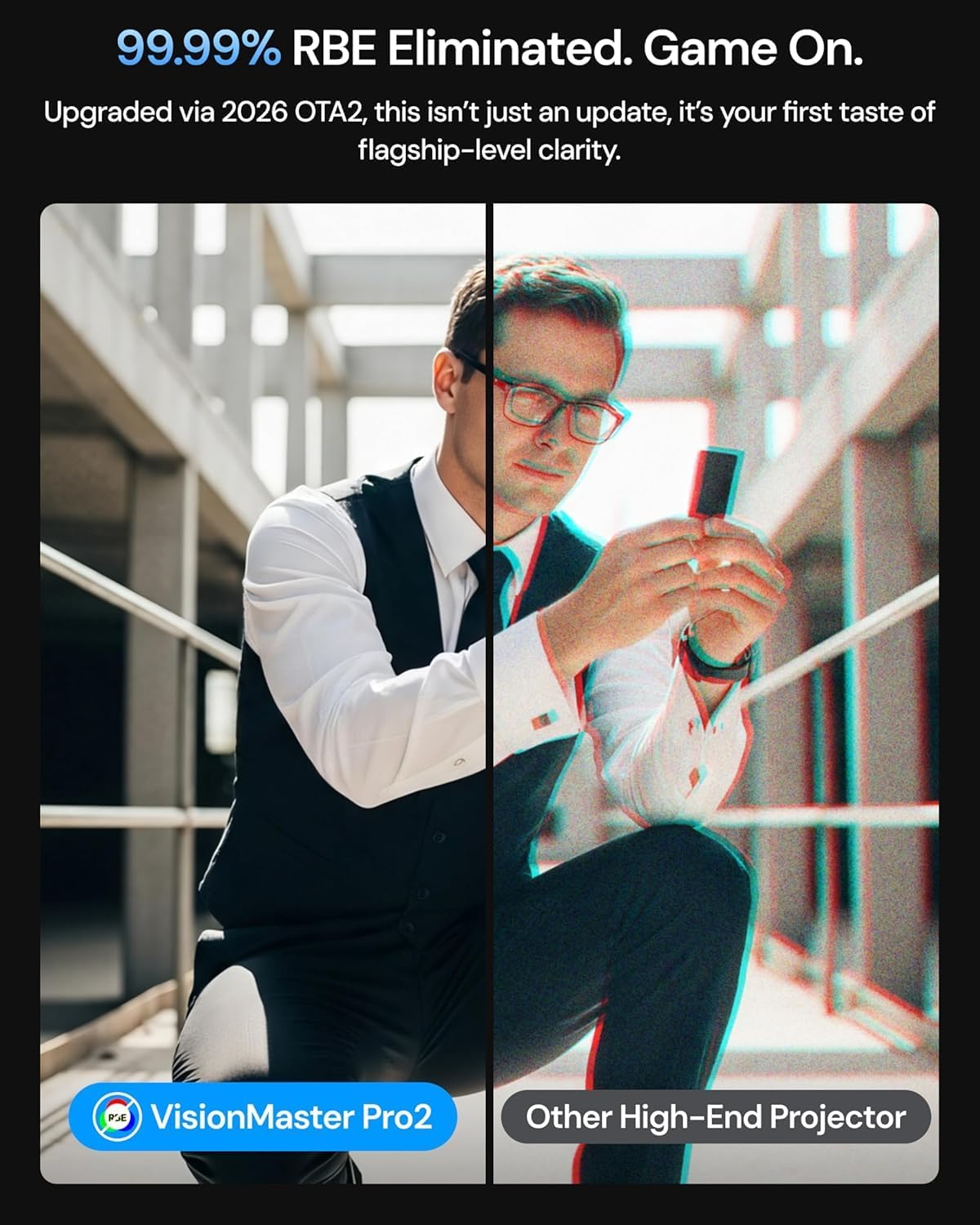
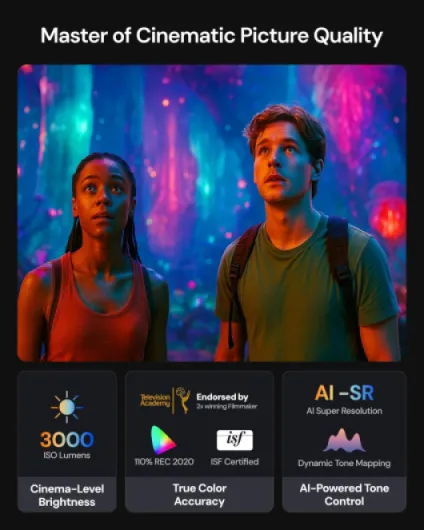
The triple-laser engine is the real strength here. Colours are very saturated, and the 110% Rec.2020 coverage is not just a random number – you can see it in animated content and nature documentaries. Greens, blues and reds have a lot of punch without looking cartoonish once you’ve tuned things. Black levels are clearly better than typical DLP projectors I’ve used, helped by the Enhanced Black Level (EBL) feature. Are the blacks as deep as a high‑end OLED TV? No. In a dark room you still see it’s a projector, but for this category, it’s pretty solid. I noticed some laser speckle on certain content with default settings, like another reviewer mentioned, but playing with brightness and some of the picture processing reduced it to the point where I didn’t really think about it anymore.
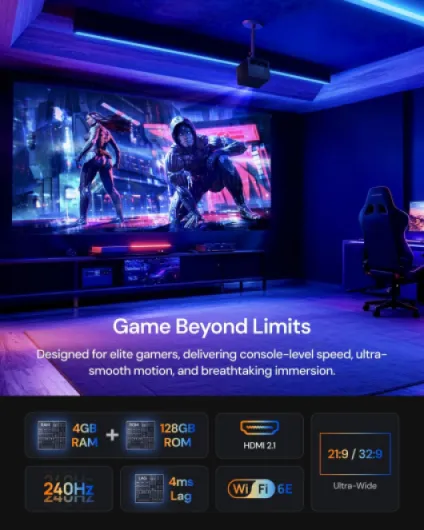
On the gaming side, the 4 ms input lag claim is always a bit marketing‑heavy, but in practice it feels very responsive. On a PC at high refresh rates or a PS5, fast shooters and racing games felt snappy, not sluggish. There are dedicated gaming modes (RPG, FPS, RCG) and a 21:9 / 32:9 support that some PC gamers will like. I tried a few matches in competitive shooters and didn’t feel handicapped by the projector at all, which is not something I can say about older 4K projectors I’ve used. Motion handling in films is also good, with no obvious smearing in fast scenes once motion interpolation is set reasonably or turned off if you hate the soap opera effect.
In day‑to‑day use, the 3000 lumens mean you can watch TV or sports with some ambient light. It’s not the same as a TV in full daylight, but with blinds half‑closed, the image is still clean and readable. On an ALR screen, the combination of brightness and contrast works very well. On a plain white wall, it’s still good, but you see more impact from room light and wall imperfections. Overall, once properly set up, the Pro2 delivers a genuinely strong home cinema picture and very good gaming performance, but you do need to invest 30–60 minutes in the settings to get away from the slightly harsh factory presets.
What this projector actually offers on paper
On paper the Valerion VisionMaster Pro2 ticks a lot of boxes: 4K (3840 x 2160), triple-laser light source, HDR10+ and Dolby Vision support, IMAX Enhanced label, 3000 ISO lumens (about 3000 ANSI listed too), and a 15,000:1 contrast ratio. It also claims 4 ms input lag at up to 240 Hz, which is clearly aimed at people who game on PC or console. Throw ratio is 0.9–1.5 with optical zoom, and you can go from about 40" up to 300" if you have the distance and the wall/screen.
On the smart side, it runs on an MT9618 chipset with 4 GB RAM and 128 GB storage. That’s more generous than a lot of cheaper projectors that still ship with 2 GB/32 GB, so menus and apps feel less sluggish. It supports the usual streaming standards (H.264, H.265, VP9) and you get Wi‑Fi, HDMI ports, USB 3.0, S/PDIF, and eARC. It also plays nice with smart home stuff: Google Home, Apple HomeKit, Alexa, Control4, AirPlay 2, Chromecast, Miracast – at least on paper.
It’s marketed as a projector that can do everything: business, gaming and home cinema. Realistically, it’s clearly tuned more for home cinema and gaming, but it’s bright enough for the occasional presentation or sports match with some lights on. The Amazon rating sits around 4.7/5 with just under a hundred reviews, which usually means people are largely happy but there are some recurring gripes, and you can already see some in the user comments: picture presets not great out of the box, one faulty unit replaced, some app issues like BBC iPlayer not working.
So overall, on specs, this thing is positioned above the cheap LED/laser toys and more in the area of serious home cinema projectors, but still below the truly high‑end JVC/Sony monsters in both price and probably pure black level. The key question is whether the real‑world performance feels as high as the spec sheet suggests or if it’s just numbers thrown around for marketing.
Smart features, setup, and everyday usability
In terms of "does it actually make your life easier", the automatic features help a lot. Auto focus, auto keystone, auto screen alignment and obstacle avoidance all work reasonably well. When you first power it on, it quickly sharpens the image and tries to square it to your screen or wall. It’s not perfect – sometimes you still need to tweak manually, especially if your projector isn’t perfectly centred – but compared to older projectors where you had to fiddle with knobs for 10 minutes, this is a clear step up. I’d say it gets you 80–90% of the way there automatically.
Connecting it to Wi‑Fi was straightforward for me, although one Amazon user mentioned initial issues that later got resolved. Once online, the interface is fairly smooth thanks to the 4 GB RAM and the MT9618 chipset. App switching is quick, and 4K streaming runs without stuttering as long as your internet is solid. That said, this is still a projector OS, not a top‑tier Apple TV or Nvidia Shield. Some apps are missing or limited depending on your region – for example the BBC iPlayer issue mentioned by a UK user – so if you rely heavily on specific regional apps, I’d still recommend using an external streaming box.
Smart home integration is a nice bonus rather than a must. Pairing with Google Home worked fine, and voice commands for power and basic control are handy when you’re already on the couch. Apple HomeKit and Alexa support are there on paper; I only tested Google and basic Alexa and both worked. It’s not the kind of thing you’ll use every day, but if you already have a smart home setup, it fits in without much drama.
For sound, the built‑in speakers are acceptable for casual use, but they don’t do justice to the picture. Dialogue is clear enough, but you won’t get real Atmos impact out of the internal audio. Over eARC into a proper soundbar or AV receiver, it’s much better. One annoyance another user pointed out is that the on‑screen sound level indicator doesn’t work properly when using eARC. I saw the same odd behaviour: the volume overlay sometimes doesn’t match what’s actually happening on the receiver. It’s not a deal‑breaker, but it’s the kind of small software quirk that reminds you this isn’t as polished as a top streaming box or TV OS.
Pros
- Very good 4K HDR picture quality once calibrated, with strong brightness and decent black levels for this category
- Fast and responsive for gaming with low input lag and 240 Hz support
- Solid build quality, useful auto setup features, and a practical carry case and remote
Cons
- Picture presets out of the box are not great and require manual tweaking for best results
- Some app and software quirks (e.g. BBC iPlayer issues, odd volume indicator behaviour over eARC)
- Heavy and not very portable at 7 kg, better suited as a semi‑permanent setup
Conclusion
Editor's rating
After using the AWOL Valerion VisionMaster Pro2 for a while, I’d describe it as a very capable home cinema and gaming projector with a few quirks you need to accept. The picture quality, once you’ve tuned it, is genuinely strong: sharp 4K, good HDR handling, bright enough for some ambient light, and much better blacks than the usual DLP suspects. The triple‑laser engine gives colours a lot of life without looking cartoonish if you take time to adjust the presets. For films and big‑screen series watching, it’s a real step up from budget projectors and older lamp models.
On the downside, the factory presets aren’t great, some apps are missing or flaky depending on region (like BBC iPlayer in the UK), and there are a few small software annoyances like the volume indicator with eARC. It’s also not a small or light device, so if you want something ultra portable, look elsewhere. But the build quality feels solid, the automatic setup tools save time, gaming performance is very responsive, and the smart home integration is a nice extra for people already in that ecosystem.
Who is it for? People who really want a big‑screen setup (100–150" and more), watch a lot of films or series, and play games enough to care about input lag. Also, people who don’t mind spending some time in the settings to get the best out of it. Who should skip it? Casual users who mostly watch TV with the lights fully on, or anyone who just wants plug‑and‑play simplicity at the lowest possible price. In short: a strong, well‑built projector that delivers a very satisfying home cinema experience if you’re the kind of user who will actually use its features and not just fire it up once a month.