
Summary
Editor's rating
Value for money: is it worth spending around a grand?
Design and build: compact box, no nonsense
Portability and power: good to move around, but don’t expect a built-in battery
Build quality and long-term feel
Picture quality and performance: where it actually shines
What this projector actually is (beyond the buzzwords)
Auto setup, OS and sound: does it actually work smoothly day to day?
Pros
- Sharp 4K picture with strong colours and decent contrast once calibrated
- Very good auto focus and auto keystone, quick to set up in any room
- Built-in apps (Netflix, YouTube, Disney+, etc.) and backlit remote make it easy to use as an all-in-one system
Cons
- VIDAA app store is limited, Plex and some niche apps don’t work well
- No built-in battery, needs mains power or power station for camping/outdoor use
- Potential DLP rainbow effect for users who are sensitive to it

Specifications
View full product page →| Brand | Hisense |
A £1k projector that doesn’t feel like a rip-off? Yep, this one’s close.
I’ve messed around with a few projectors over the years, usually in that £300–£700 range, and I’ve often ended up a bit disappointed. Either the picture looked washed out, the fan sounded like a hair dryer, or the software was so clunky I just gave up and plugged in a Fire Stick. With the Hisense 4K Laser Projector M2TUK Pro, I went in a bit sceptical because it’s not cheap, but the specs looked strong on paper: triple laser, 4K, Dolby Vision, built-in apps, and up to 200 inches.
I’ve been using it mainly for movie nights, a bit of gaming, and some casual TV in the bedroom and living room. I’ve also dragged it into the garden once for a test session on a sheet. So this isn’t a lab review, it’s just how it behaves in a normal life setup: dark-ish rooms, sometimes a lamp on, Wi‑Fi that’s not perfect, and kids randomly pressing buttons on the remote.
My overall feeling after a couple of weeks is that it’s a pretty solid home cinema machine for the price, especially if you don’t want to mess around with external boxes and calibration for hours. It does a lot of things right out of the box, and the few flaws it has are mostly on the software side or related to DLP tech in general, not deal-breakers for most people.
If you’re wondering whether it’s just overhyped or if it actually earns that 4.9/5 Amazon score: I wouldn’t go that high personally, but it’s definitely closer to that than to the usual over-marketed junk. Think more "very good and sensible purchase" than "perfect miracle gadget".
Value for money: is it worth spending around a grand?
Price-wise, this sits around the £800–£1,000 zone depending on promos, so it’s not an impulse buy. Compared to the random £300–£500 projectors I’ve used before, you do feel where the extra money goes: sharper 4K image, much better colour, quieter fan, stronger speakers, and a UI that isn’t painful. One Amazon reviewer who tried several more expensive models said this was the best one overall, and I get that. It hits a nice balance between performance, noise, and convenience.
Is it unbeatable value? Not quite. There are a few caveats: the VIDAA app store is limited, Plex is basically useless for local streaming, and if you’re into niche apps like Kodi or VLC you’ll probably end up adding a Fire Stick or similar. Also, if you’re super sensitive to rainbow effect, you might need to look at non-DLP options, which often cost more. Black levels and contrast are good for the price, but if you’re chasing reference-level home cinema quality, you’re in a different budget bracket anyway.
Where it makes sense is if you want a simple, all-in-one 4K projector that you can drop on a table, fire up Netflix, and get a big, clean image with decent sound and minimal fuss. In that use case, the price feels justified. If you already own a great streaming box and a sound system and you don’t care about portability, you might find better pure image-per-pound options by going for a bigger, more traditional home cinema projector.
Personally, I’d rate the value as very good but not mind-blowing. It’s the first projector around this price where I didn’t feel slightly cheated after a week of use. For most people wanting a serious upgrade over cheap 1080p projectors without entering crazy high-end territory, it’s a sensible buy.

Design and build: compact box, no nonsense
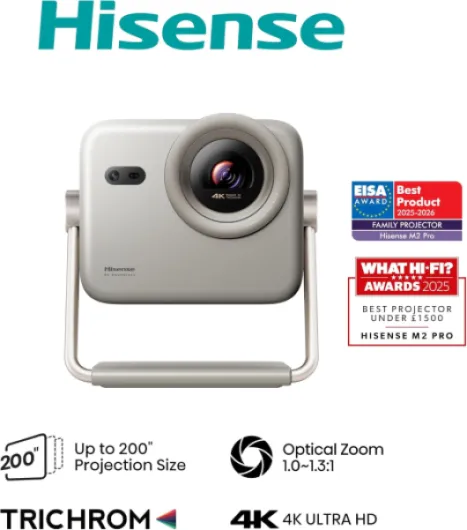
Physically, the M2TUK Pro looks like a compact, squared-off cube rather than a long traditional projector. Dimensions are roughly 19.3 x 21.8 x 23 cm, so it’s small enough to sit on a shelf or bedside table without dominating the room, but it’s not pocket-sized either. The titanium-grey colour is pretty low-key, which I liked. It doesn’t scream "gamer RGB" or "office equipment". It just blends in next to a speaker or a console.
The weight (about 3.9 kg) actually gives it a sturdy feel. When you pick it up, it doesn’t feel hollow or cheap. The vents are well placed, and during use I didn’t notice any hot air blasting directly at me. You can tell Hisense has been making TVs and projectors for a while; this doesn’t feel like a random white-label box. The tabletop mounting is simple: put it down, plug it in, done. No complex stand or weird feet to fiddle with, though I would have liked a bit more flexibility in height adjustment without stacking it on books.
The backlit remote deserves a mention. In a dark room, being able to see the buttons is a small but very welcome detail. The layout is clear: dedicated buttons for the main streaming apps, volume, navigation, and a voice button. It feels more solid than the usual plasticky remotes you get with cheaper projectors and even some TVs. Button presses register quickly, and I didn’t get that laggy "did it click or not" feeling.
Overall, the design is very practical: easy to move, easy to place, and no ugly design choices. It’s not some design icon, but it’s well thought out. If you plan to move it between bedroom, living room and garden, the included bag and the compact form factor make that totally doable without babying it every time.
Portability and power: good to move around, but don’t expect a built-in battery
Just to be clear: this projector does not have a built-in battery. You need mains power (around 200V, 120W usage). So if by "portable" you expect something you can run in a field with no power for two hours, this isn’t it. For camping, you’ll need either a power hookup or a decent power station. One of the Amazon reviewers uses it for camping trips and is clearly happy with it, but that assumes you’ve sorted power separately.
Where it is portable is in the practical, throw-it-in-a-bag sense. The included carrying bag is actually useful. The unit isn’t fragile-feeling, and at 3.9 kg it’s easy enough to move between rooms or take to a friend’s place. I moved it between bedroom, living room and garden without feeling like I was carrying a delicate piece of lab gear. This is more “grab and go” than classic home cinema projectors that you’d rather not touch once installed.
Because there’s no battery, there’s no battery degradation to worry about. The key "longevity" spec here is the 25,000-hour laser life. If you watch 3 hours a day, that’s over 20 years on paper. Realistically, something else (OS updates, HDMI standards, your own upgrade itch) will be the limiting factor before the light source dies. I didn’t notice any brightness fluctuations or weird start-up behaviour; it powers on and reaches usable brightness quickly.
So for portability: it’s good for room-to-room and car-to-campsite type use, not something you’d toss in a backpack for battery-powered use in the woods. If you’re okay always being near a plug or a power station, it’s flexible enough to use in different places without hassle.
Build quality and long-term feel
In terms of build, the M2TUK Pro feels solid and well assembled. There are no creaks when you pick it up, the plastics don’t feel thin, and all the ports fit snugly. The weight actually gives some confidence that they didn’t cheap out on everything inside. The carrying bag is padded enough that I didn’t feel nervous tossing it in the car for a trip.
The laser light source is rated for 25,000 hours, which is pretty standard for this class but still decent. That means you’re not dealing with bulb replacements like old-school projectors. I obviously haven’t run it for thousands of hours, but after extended sessions (3–4 hours of movies and gaming), it didn’t overheat or show any weird behaviour. The fan ramped up a bit after a long session, but stayed within a reasonable noise level and never sounded like it was struggling.
One thing to keep in mind is software support and spare parts. The listing mentions EU spare part availability of 2 years, which is not huge. Software update support is marked as unknown. VIDAA OS is still evolving, and I did see small software quirks (like the home apps layout resetting). None of that broke the projector, but it makes me think of this more as a solid hardware unit that might not get years of fancy new features via updates.
Overall, if you treat it like a normal piece of home electronics – not dropping it, not blocking the vents, and transporting it in the bag – I don’t see obvious red flags for durability. The laser engine, sturdy case and respectable cooling suggest it should hold up fine for regular home use and occasional travel.
Picture quality and performance: where it actually shines
This is where the Hisense M2TUK Pro justifies its price. Picture quality is genuinely strong for this budget. The 4K image is sharp, with no obvious blur in the corners, and the triple-laser setup gives you punchy colours once you tweak them a bit. Out of the box, it’s a bit heavy on the reds and slightly oversaturated, but that’s an easy fix in the settings. After five minutes of adjusting, skin tones looked more natural and the whole image felt more balanced.
Brightness at 1300 ANSI lumens is fine for what it’s meant to do. In a dark or dim room, it looks great. With some ambient light (lamp on, curtains half-open in the evening), it’s still very watchable. In full daylight with sun coming in, like any projector at this level, it starts to wash out. If you want a daytime TV replacement in a bright room, this is not magic. But for night-time movies, gaming, and camping / garden sessions after sunset, it’s more than enough. I usually ran it around 50–60% brightness and didn’t feel the need to max it out.
Contrast is decent. Blacks are not OLED-level, obviously, but in dark scenes the projector holds up well enough to enjoy movies without feeling like everything is grey. Dolby Vision and HDR10 content benefit from the extra dynamic range. You see more detail in shadows and highlights compared to a cheap 1080p LED projector. One Amazon reviewer mentioned that compared to much pricier units, the blacks are a bit behind, and I agree: if you’re a hardcore home cinema nerd, you’ll see the difference, but for regular users, it’s more than acceptable.
The only visual downside that might matter for some is the DLP rainbow effect. One reviewer said they were quite sensitive to it and noticed it. Personally, I only spotted it occasionally in high-contrast scenes when moving my eyes quickly. If you know you’re very sensitive to rainbow effect, keep that in mind. But if you’ve used DLP projectors before without issues, this will be on the same level or slightly better. Overall, in terms of pure image quality for movies and series, it punches above most of the sub-£700 competition I’ve tried.
What this projector actually is (beyond the buzzwords)
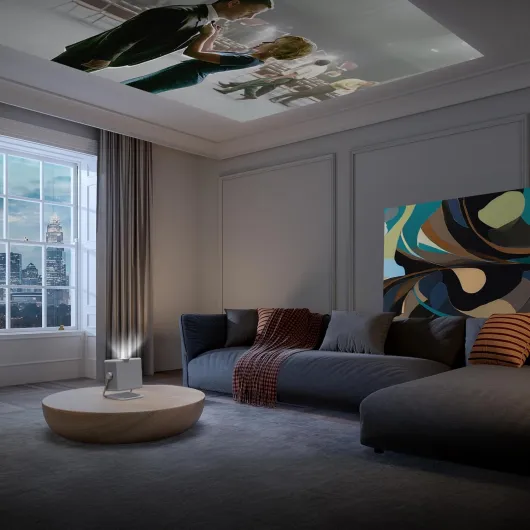
On paper, the Hisense M2TUK Pro is a portable 4K laser projector that can throw an image from 65" up to 200". It uses a triple-laser light source (Hisense calls it TriChroma / LPU) with 1300 ANSI lumens, supports Dolby Vision, HDR10, HLG, IMAX Enhanced, and runs on Hisense’s VIDAA OS with built‑in apps like Netflix, YouTube, Disney+, Prime Video, Apple TV, etc. So in theory, you don’t need any extra streaming stick to start watching stuff.
Connectivity is fairly complete for a compact unit: Wi‑Fi (802.11 b/g/n), Bluetooth 5, HDMI, USB 3.0. It works with game consoles, laptops, phones, and tablets. You get voice control, a remote (backlit, which is actually very handy), and you can also control some things via app. It’s rated at 25,000 hours of life for the laser, which basically means years of use before you even think about it. Brightness is 1300 ANSI lumens, which isn’t on the level of big living-room light cannons, but for home cinema in a dim room it’s plenty.
The projector is around 3.9 kg and not ultra-mini, but still in the “portable” zone. It comes with a carrying bag, adapter, remote, user manual and warranty card. It’s clearly built to be moved between rooms or even taken on trips, not just bolted to a ceiling. Throw distance goes from 1.44 m to 5.75 m with a 1.0–1.3 optical zoom, so you have some flexibility in how big you want your image without losing 4K sharpness.
In practice, this sits in that middle zone: more serious than the cheap portable LED toys, but not as bulky and overkill as a dedicated home cinema projector that lives on a ceiling mount. If you want something you can set on a table, press power, and have Netflix in 30 seconds, this fits that use case pretty well.
Auto setup, OS and sound: does it actually work smoothly day to day?
On the "does this thing just work" front, the M2TUK Pro is surprisingly user-friendly. The automatic keystone and focus are genuinely good. You drop it on a table, angle it towards a wall or screen, and within a few seconds it lines up the image and sharpens it. One user said it’s the best auto-alignment they’ve seen, and I’m inclined to agree. I tried it from the side, slightly off-axis, and it still managed to give a properly rectangular, focused image without me digging into menus every time.
The VIDAA OS is better than I expected. It’s not as polished as Google TV or Apple TV, but it’s fast enough and doesn’t feel clunky. Apps like Netflix, YouTube, Disney+ and Prime Video ran smoothly for me. Menus respond quickly, and I didn’t feel any real need to plug in a Fire Stick unless I wanted more niche apps. The downside is the app store is limited: no Kodi, no VLC, and one user mentioned the Plex app is basically broken for local streaming (tries to go remote and ask for a subscription). Also, some minor quirks like home apps rearranging themselves after a reboot. Not deal-breaking, but a bit annoying.
Sound-wise, the built-in speakers are better than average for this size. There’s some bass, mids are clear, and treble is decent. For bedroom use, camping, or casual living-room viewing, I didn’t feel forced to connect external speakers. For proper movie nights where you want more impact, a soundbar or external speakers via HDMI/optical/Bluetooth will obviously give a better experience, but you can absolutely live with the internal audio for a while.
Fan noise is low and, more importantly, has a low, non-whiny tone. Sitting about two feet away from it at the side of the bed, I could hear it in a silent room, but at even 1–2% volume it basically vanished behind the audio. Compared to some XGIMI and other small projectors I’ve tried that have a high-pitched whine, this one is much less annoying. For a projector you might keep near your head on a nightstand, that’s a big plus.
Pros
- Sharp 4K picture with strong colours and decent contrast once calibrated
- Very good auto focus and auto keystone, quick to set up in any room
- Built-in apps (Netflix, YouTube, Disney+, etc.) and backlit remote make it easy to use as an all-in-one system
Cons
- VIDAA app store is limited, Plex and some niche apps don’t work well
- No built-in battery, needs mains power or power station for camping/outdoor use
- Potential DLP rainbow effect for users who are sensitive to it
Conclusion
Editor's rating
The Hisense 4K Laser Projector M2TUK Pro is a strong all-rounder if you want a big, sharp picture without turning your living room into a full-time cinema room. The triple-laser 4K image looks clean and detailed once you tweak the colours, brightness is solid for evening and night use, and the fan noise is low enough that it doesn’t ruin quiet scenes. Built-in apps on VIDAA OS mean you can watch Netflix, YouTube, Disney+ and more straight away, and the auto focus/keystone actually works well, which makes a big difference in everyday use.
It’s not perfect. The app store is limited, Plex is basically a miss for local content, and people sensitive to DLP rainbow effect might notice it. Blacks and contrast are good for the money but not on the level of much pricier home cinema gear. There’s also no built-in battery, so "portable" here means easy to move and pack, not off-grid ready. Still, for the price, it offers a balanced mix of picture quality, convenience, and build that many competitors don’t.
I’d say this is ideal for: people who want a reliable, easy-to-use 4K projector for movie nights, casual gaming, and occasional outdoor sessions, without having to bolt it to the ceiling or juggle too many extra boxes. It’s less ideal for hardcore home cinema enthusiasts chasing perfect blacks and advanced calibration, or folks who rely heavily on niche streaming apps and Plex. If you’re in the first group, it’s a very solid option that feels like money reasonably well spent.