
Summary
Editor's rating
Is the TK705i worth the money?
Boxy look, practical layout, some placement quirks
Power use and noise instead of a battery story
Build quality, lamp life and long-term concerns
Image, brightness and gaming: where it actually shines
What you actually get with the TK705i
Does it really replace a TV for movies and everyday use?
Pros
- Sharp 4K image with good brightness for evening living-room use (3000 ANSI lumens)
- Very low input lag with HDMI 2.1, actually good for PS5 and other consoles
- Built-in Google TV with major streaming apps, no need for external dongle
Cons
- No Ethernet port, fully dependent on Wi‑Fi for streaming
- Vertical image offset and reliance on keystone can make placement tricky
- Built-in speaker is only decent, external audio is basically required for a proper setup

Specifications
View full product page →| Brand | BenQ |
Big screen at home without going full cinema geek
I’ve been using the BenQ TK705i for a few weeks in my living room, mostly for Netflix, sports and PS5. I’m not a hardcore home-cinema nerd, I just wanted a clean 4K image that’s easy to set up and doesn’t sound like a jet engine. In practice, this thing delivers a pretty solid mix of brightness, sharpness and ease of use, with a few annoyances you should know about before spending this kind of money.
The main thing I noticed right away is how simple the setup is. You drop it on a coffee table, plug in power, connect Wi‑Fi, sign into Google TV, and you’re basically ready. The auto focus and auto keystone do most of the work, especially if your projector isn’t perfectly centered. It’s not magic, but it saves a lot of time compared to older projectors where you spend 20 minutes tweaking corners.
On the image side, 4K content looks sharp and the 3000 ANSI lumens help a lot if you have some ambient light. It’s still way better in a dark room, but you don’t have to close every curtain in the house to see what’s happening. Color-wise, it’s punchy out of the box. I still had to tweak a couple of settings for PS5 HDR, but once done, it looked very good for games and sports.
It’s not perfect, though. It depends on Wi‑Fi only (no LAN port), the projector has the typical BenQ vertical offset that can be annoying if your screen is fixed, and the built-in speaker is just okay. But overall, as a plug-and-play 4K Google TV projector that can handle movies and gaming without too much hassle, it gets the job done really well.
Is the TK705i worth the money?
Price-wise, the TK705i sits in that mid-to-upper range for 4K home projectors. It’s not bargain-bin cheap, but it’s also not in the crazy high-end territory. For what you pay, you’re getting: 4K resolution, 3000 ANSI lumens, HDMI 2.1 with very low input lag, and built-in Google TV. If you tried to piece that together with a cheaper projector plus a separate streaming box, you might save a bit, but you’d probably lose the same level of image quality and brightness, especially for gaming.
Where it feels like good value is if you actually use what it’s good at: big 4K movies in the evening and console gaming. If you spend your time watching 720p TV channels in daylight, you’re wasting what you paid for. Compared to a large 77–83 inch 4K TV, the projector gives you a bigger image for similar or less money, but with the usual projector trade-offs (needs darker room, lamp/light source wear over time).
On the downside, at this price I would have liked an Ethernet port and maybe slightly better speakers. The built-in speaker is okay for quick use or a bedroom, but for a main living room setup, you’ll almost certainly end up using a soundbar or AV system. So realistically, factor in some extra cost for audio if you don’t already have something decent.
Overall, I’d say the TK705i offers good value for money if your goal is a big-screen home cinema and gaming setup and you’re ready to use it mainly in the evening or in a controlled light environment. If you just want a casual projector for occasional backyard movies, this is probably overkill. If you’re serious about a 4K big screen but don’t want to dive into ultra-high-end projectors and separate streaming gear, this hits a pretty nice sweet spot.

Boxy look, practical layout, some placement quirks
Design-wise, the TK705i is pretty straightforward. It’s a rectangular, slightly boxy unit in a light color (more silver/white than black). It weighs about 3.8 kg and measures 25 x 22.9 x 16.8 cm, so it’s not tiny, but you can still move it around the house without feeling like you’re carrying gym equipment. On a coffee table or TV unit, it looks fine, nothing flashy, just a typical home projector vibe.
The lens is on the front with basic zoom and focus controls around it. You also get auto focus and auto keystone, so you don’t need to touch the lens often once you’ve set it up. One thing that annoyed me a bit is the typical BenQ offset: the image is projected above the lens line by about 10–15 degrees. That means if your screen is low or you’re projecting directly on a wall, you’ll probably need to adjust the projector height or angle. You can fix some of it with keystone, but the more you use keystone, the more you lose a bit of sharpness at the edges.
Ports are on the back, with HDMI 2.1, power, and audio out. The big miss for me is the lack of an Ethernet (LAN) port. It’s Wi‑Fi only for network, which is fine if your Wi‑Fi is solid, but if your router is far or your signal is flaky, you’ll feel it in streaming apps. I had one evening where Netflix buffered more than I’d like, and I know it wouldn’t have happened on wired Ethernet.
In terms of noise and heat, the design holds up well. In Eco mode, the fan is very quiet (BenQ claims 24 dBA, and subjectively it’s low – you hear it if you listen for it, otherwise it blends into the room). The projector gets warm but not crazy hot, even after a long movie. Overall, the design is practical, but if you’re picky about alignment and screen height, the lens offset and dependence on keystone correction can get a bit annoying.
Power use and noise instead of a battery story
Just to be clear: the TK705i does not have a battery. It’s a classic home projector that needs to be plugged into the wall at all times. So if you were thinking of using it in the garden or moving it around without power, this isn’t a portable battery-powered model. It pulls around 250 watts when running, which is pretty standard for this type of brightness and lamp setup.
What matters more here is how it behaves during long sessions. I’ve used it for full-length movies, sports evenings and gaming sessions of 3–4 hours straight. The fan noise in Eco mode is low enough that you forget about it once the sound is on. In higher brightness modes, you hear the fan more, but it’s still not crazy loud. Compared to some older projectors I’ve had, this one is definitely on the quieter side, especially given the 3000 lumen rating.
Heat output is noticeable if you’re close to it, but it doesn’t turn the room into an oven. The airflow is well managed, and as long as you don’t block the vents, it just gets warm around the device, nothing more. If you plan to put it in a small closed cabinet, forget it – you need ventilation. On a shelf or table with space around, it’s fine.
So, no battery life to talk about, but in terms of practical power/thermal behavior, it’s decent. Expect your electricity bill to go up a bit if you use it instead of a TV for several hours a day, but that’s the trade-off for a big, bright image. For occasional use (movies, matches, weekend gaming), the power draw is reasonable and the low noise level helps a lot for comfort.

Build quality, lamp life and long-term concerns
The TK705i feels solid enough for a living-room device. The plastic shell doesn’t flex much when you move it, and the buttons and lens ring don’t feel loose. It’s still plastic, so don’t expect some metal tank, but for a projector that will mostly sit on a table or be ceiling-mounted, it’s fine. I moved it around a few times between rooms and didn’t feel like I had to baby it.
The specs mention 7 years of spare part availability in the EU, which is a good sign for long-term support. BenQ generally has a decent reputation for projectors, and looking at user reviews (4.4/5 on Amazon, 32 ratings), most people seem satisfied so far. Obviously, I haven’t owned it for years, so I can’t comment on actual failure rates, but nothing in my unit felt cheap or fragile during use.
Like most lamp-based or high-brightness DLP projectors, you have to think about lamp life (or light source life). The exact hours aren’t listed in the data you gave me, but typically you’re looking at several thousand hours before brightness starts to drop. For normal use (a few hours a day), that means years of service. If you run it every evening for long sessions, you’ll eventually need maintenance or a lamp/module replacement, which can cost a bit, so keep that in mind when comparing to a big TV.
On a smaller note, the finish doesn’t pick up fingerprints too badly, and the vents haven’t clogged quickly with dust in my time with it, but like all projectors you’ll want to keep the area around it reasonably clean. Overall, I’d say the durability looks good on paper and feels decent in hand, but if you plan to move it constantly or use it in a dusty environment, you’ll want to be a bit careful and maybe invest in a basic cover when not in use.
Image, brightness and gaming: where it actually shines
On pure image quality, the TK705i is pretty solid for living-room use. 4K content looks sharp, especially on a 100–120 inch image. You can see fine details in movies and sports, and text from a connected laptop is clean enough if you ever use it for presentations or browsing. The HDR processing helps a bit with contrast and highlights, but don’t expect OLED-level blacks – this is still a projector, so dark scenes in a non-perfectly-dark room will look more grey than true black.
The 3000 ANSI lumens rating isn’t just numbers on the box. In practice, in the evening with a couple of lamps on or some ambient light from the hallway, the image remains very watchable. For sports or casual YouTube, it’s totally fine. If you want to enjoy a movie with proper depth and color, you still benefit a lot from dimming the lights or using blackout curtains. In full daytime with strong sunlight on the wall, like every projector, it struggles. So yes, it’s brighter than many cheaper models, but it’s still not a TV replacement for bright, sunlit rooms.
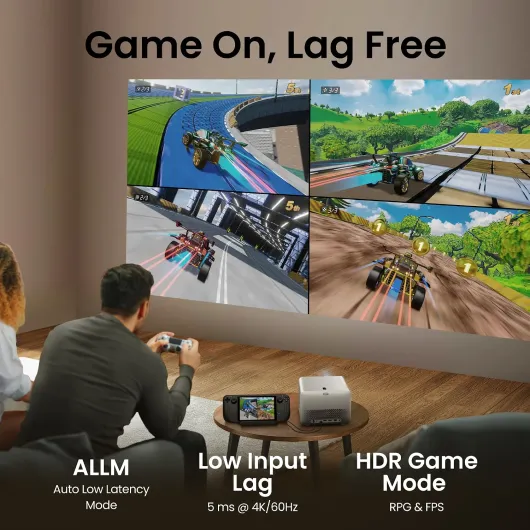
For gaming, this projector is one of the strong points. With HDMI 2.1 and ultra-low input lag (around 5 ms at 4K/60), playing on PS5 felt responsive. I tested fast-paced games and didn’t feel that usual sluggishness you get on older projectors or TVs in the wrong mode. You do need to go into the PS5 settings and set RGB to full and HDR correctly, otherwise the image can look washed out. Once tuned, it’s smooth and looks good. There’s also Auto Low Latency Mode, so it switches into a gaming-friendly mode when it detects a console.
Motion handling with sports is decent. There’s MEMC and a specific Sports mode. Personally, I’m not a fan of heavy motion smoothing, so I toned it down, but for football or tennis, it helps keep the ball easier to track. Fans will either like it or turn it off. Overall, in terms of performance, it’s strong on three fronts: brightness (for its class), sharpness, and gaming responsiveness. Contrast and black levels are okay but not mind-blowing, which is normal at this price point and technology.
What you actually get with the TK705i
The TK705i is a 4K DLP projector with native 3840 x 2160 resolution, rated at 3000 ANSI lumens. On paper, that means it’s bright enough for a living room, and in real life that’s fairly accurate as long as you’re not in direct sunlight. It supports HDR (HDR10, HDR10+) and uses BenQ’s CinematicColor and HDR-PRO processing, which basically means it tries to squeeze better contrast and color out of typical streaming content and UHD sources.
It’s positioned as a home cinema and gaming projector. You get HDMI 2.1 with ultra-low input lag, around 5 ms at 4K/60Hz with Auto Low Latency Mode. I mainly used it with a PS5 and a streaming stick, but you can also connect laptops, Blu-ray players, or other consoles. The throw ratio is short enough to get roughly 120+ inches from around 3–3.5 meters, which is nice for smaller living rooms where you don’t have a huge distance to the wall.
What sets this model apart from older projectors is the Google TV integration. You get Netflix, YouTube, Prime Video and the usual apps directly on the projector, no extra dongle needed. The system is fairly snappy, not on the level of a high-end streaming box, but good enough that you don’t feel like you’re waiting forever when switching apps. It also has Bluetooth, so you can pair a soundbar or headphones pretty easily.
Out of the box, you get the projector, a remote, an HDMI cable and a power cord. No fancy carry bag, no ceiling mount – it’s clearly meant to be either table-mounted or used with your own mounting hardware. The specs also mention 7 years of spare part availability in the EU, which is reassuring if you’re planning to keep it long term. Overall, it’s a fairly complete package for someone who wants a 4K projector that can work alone without extra boxes hanging off it.
Does it really replace a TV for movies and everyday use?
In daily use, the question for me was: can this projector realistically replace a big TV for most of what I watch? After a few weeks, I’d say: partly yes, partly no. For movies, series and sports in the evening, it’s great. I ended up watching way more content on the projector than on my regular TV, just because a 110–120 inch image makes even a random series feel more engaging. For casual daytime viewing with blinds half-open, it’s usable but not ideal – a decent TV will still look better in a bright room.
The auto image adjustments help a lot with practicality. The 8-way smart image adaptation (auto focus, auto 2D keystone, auto screen fit, etc.) means you can move the projector a bit, or place it slightly off-center, and still get a corrected rectangular image in under a minute. It’s not flawless – sometimes the corners are a tiny bit off and I had to tweak manually – but for someone who doesn’t want to spend 30 minutes lining up the picture every time, it’s a big plus.
For family use, it works well. Built-in Google TV means anyone can grab the remote, open Netflix or YouTube and watch without thinking about HDMI inputs or external boxes. The interface is familiar if you’ve used any Android/Google TV device before. The only thing is, if your Wi‑Fi is weak, you’ll feel it quickly because everything depends on streaming. You can always plug in a Blu-ray or USB source, but most of us use streaming 90% of the time now.
So in terms of effectiveness: as a main evening screen for content and gaming, it works very well. As a full-time TV replacement in a bright room, not really – but that’s the case for almost any projector. If you’re okay pulling the curtains a bit and mostly watch in the evening, it can easily become your main way of watching stuff at home.
Pros
- Sharp 4K image with good brightness for evening living-room use (3000 ANSI lumens)
- Very low input lag with HDMI 2.1, actually good for PS5 and other consoles
- Built-in Google TV with major streaming apps, no need for external dongle
Cons
- No Ethernet port, fully dependent on Wi‑Fi for streaming
- Vertical image offset and reliance on keystone can make placement tricky
- Built-in speaker is only decent, external audio is basically required for a proper setup
Conclusion
Editor's rating
The BenQ TK705i is a solid choice if you want a 4K projector that’s bright enough for a living room, easy to set up, and decent for console gaming. The image is sharp, the 3000 ANSI lumens help a lot with moderate ambient light, and the low input lag with HDMI 2.1 makes it actually enjoyable for PS5, Xbox and similar. Google TV built-in keeps things simple: no dongles, no extra remotes, just log in and watch. Fan noise is low in Eco mode, so it doesn’t ruin quiet scenes.
It’s not perfect. The lack of Ethernet is annoying if your Wi‑Fi isn’t great, the typical BenQ image offset can complicate placement if your screen is fixed, and the built-in speakers are only okay. Also, like all projectors, it really comes into its own in a dark room – in bright daylight, a TV still wins. But if you mostly watch in the evening and are ready to use a soundbar or external audio, the overall experience is very good for the price.
I’d recommend the TK705i to people who want a straightforward 4K home cinema and gaming projector with integrated streaming, without getting into super complex setups. It’s especially suited for living rooms where you can dim the lights and sit 3–4 meters from a 100–120 inch image. If you need something truly portable, battery-powered, or mainly for use in bright rooms, this isn’t it. If you’re okay with the usual projector compromises and want a big, sharp picture with low-latency gaming, it’s a pretty solid option.