
Summary
Editor's rating
Value for money: strong feature set, but with clear trade-offs
Design and build: compact and practical, but feels budget
No built-in battery: portable, but always tied to a socket
Build, dust issues and long-term worries
Picture quality, brightness and smart features in real use
What you actually get out of the box
Pros
- Native 1080p with short throw (around 100" at ~1.5 m), great for small rooms
- Built-in Android 14 with WiFi 6 and Bluetooth 5.4, no need for extra streaming stick
- Compact and light with adjustable stand and fast auto focus/keystone, easy to move and set up
Cons
- Brightness and contrast are only average, really needs a dim or dark room
- Build feels budget, with potential dust issues and questionable long-term durability
- Brand support and documentation feel weak compared to bigger projector brands

Specifications
View full product page →| Brand | Salange |
A small Android projector that tries to do everything
I’ve been using this Salange Short Throw Projector 2026 for a couple of weeks as my main "TV" in the bedroom and for a couple of movie nights in the living room. I bought it because I wanted something compact, short throw, with built-in apps so I wouldn’t have to drag around a Fire Stick everywhere. On paper it ticks a lot of boxes: native 1080p, short throw ratio, Android 14, WiFi 6, Bluetooth 5.4, and auto focus/auto keystone. In real life, it’s good in some areas and clearly compromised in others.
The first thing that stood out is how small and light it is. At just over 1 kg and roughly the size of a chunky Bluetooth speaker, it’s genuinely easy to move from room to room. I’ve had it on a shelf, on a bedside table, and even on a stack of books pointing at the ceiling. The built-in 180°/270° style stand actually makes this practical, you don’t need a tripod or ceiling mount right away.
But once you get past the size, you start noticing the usual budget-projector trade-offs. The brand shouts "15000 lumens" and "600 ANSI" all over the listing, while the spec sheet also says 350 ANSI, which is confusing. In practice, brightness is fine for dim rooms and evening use, but this is not a serious daytime projector unless you like washed-out images. Also, contrast is only 2000:1, so dark scenes never look deep black.
Overall, my first impression is that it’s a pretty solid bedroom / casual home cinema projector with smart features that actually work, but you need to be realistic: it’s not going to compete with a proper home cinema projector that costs two or three times more. If you go in expecting a compact, all-in-one box that gets the job done for Netflix, YouTube and console gaming in a dim room, it makes sense. If you’re picky about contrast, motion handling, or build quality, you’ll probably find its limits quite fast.
Value for money: strong feature set, but with clear trade-offs
In terms of price, this thing usually sits under the 200–250 range (depending on promo), which is important context. For that money, you’re getting: native 1080p, short throw, Android 14 with built-in apps, WiFi 6, Bluetooth 5.4, auto focus, auto keystone, and a compact form factor. On paper, that’s a lot of features compared to entry-level projectors from big brands that sometimes don’t even include smart features or short throw at this price.
Where Salange saves money is obvious: cheaper plastics, average contrast, confusing brightness claims, and a brand that isn’t exactly known for rock-solid support. If you compare it to a more expensive Epson or BenQ, you’ll see the difference in image depth, motion, and build quality. But those models also often cost double or more, and usually don’t have Android built in, so you end up buying a streaming stick on top anyway.
For someone who just wants a simple home cinema setup without extra boxes, this Salange offers pretty good value. You plug it in, log into your apps, connect a Bluetooth speaker if you want better sound, and you’re done. No extra cables, no extra remotes. If you already own a good streaming stick and don’t care about Android built in, you might get better pure picture quality by spending the same money on a non-smart projector from a stronger brand.
Personally, I’d say the value is good but not mind-blowing. It’s a nice package for casual users, students, renters, or families who want a big screen for movies in the evening without blowing the budget. If you’re picky about black levels, long-term reliability, and brand support, you might want to stretch your budget or accept fewer features from a better-known manufacturer.
Design and build: compact and practical, but feels budget
From a design point of view, this Salange is clearly trying to look like a modern mini home-theater gadget. The grey finish is neutral and blends in easily on a shelf or bedside table. It’s not ugly, but it does feel like a typical Chinese OEM projector with a different sticker on it. The user who complained about generic rebranding isn’t wrong: there’s nothing about the body or branding that screams original design. It’s a simple plastic shell with vents and a lens on the front, that’s it.
The big design plus is the adjustable stand / rotating body. Being able to tilt it up to project onto a wall or even the ceiling without a separate tripod is honestly one of the best parts. I’ve spent a couple of evenings watching shows projected on the bedroom ceiling, and that worked surprisingly well. You just rotate, let the auto focus do its thing, and you’re done. For renters or people who don’t want to drill the ceiling, this is genuinely useful.
On the downside, the plastic feels a bit cheap. There’s some flex if you squeeze the casing, and the buttons don’t feel premium. It doesn’t feel like it will fall apart tomorrow, but compared to brands like Epson or BenQ, the difference is obvious. The finish on my unit had a couple of minor imperfections where panels meet, nothing dramatic but you can see it’s made to a price. Also, the fan vents are quite open, which is probably why some users mention dust getting inside and showing up as spots on the image.
In day-to-day use, the compact form factor wins. It’s easy to grab with one hand, move between rooms, or pack into a backpack if you’re visiting friends. If you want something you can leave on a coffee table without it dominating the room, this form factor is good. Just don’t expect fancy materials or premium feel. It’s functional plastic, no more, no less.
No built-in battery: portable, but always tied to a socket
Just to be clear: this projector does not have a built-in battery. The listing calls it "mini portable", which is true in terms of size and weight, but you still need to be near a power socket or use an external power solution. If you were hoping to throw it in a bag and do a movie night in the woods with no power, that’s not going to happen unless you bring a power station or a long extension cord.
For my use, this wasn’t a big issue, because I mostly used it in the bedroom, living room, and once on a covered patio where I had easy access to power. But it’s worth mentioning because "portable projector" often makes people think of fully wireless devices. Here, "portable" mostly means compact and easy to move, not battery-powered. I ran it for movie nights of 2–3 hours straight with no overheating shutdowns, so at least the power management and cooling system are stable.
Fan noise is comparable to a mid-range laptop. You hear a constant hum, especially in quiet scenes, but after a while my brain tuned it out. At normal volume the built-in speaker masks most of it. There’s no eco vs high brightness mode exposed in a clear way like on some bigger projectors, so you don’t really get to trade brightness for less fan noise; it’s basically one standard behavior. The upside is you don’t need to think about settings much, you just turn it on and watch.
If you specifically want something for fully off-grid use or outdoor camping without power, I’d look at dedicated battery projectors instead. If you just want something light that you can carry between rooms or bring to a friend’s house where power is available, then the lack of battery isn’t a deal-breaker, it just defines what “portable” really means here.
Build, dust issues and long-term worries
Durability is the part where I’m a bit on the fence. The projector doesn’t feel like it’s going to snap in half, but it also doesn’t give that solid, sealed impression you get from bigger brand models. The casing is light plastic with plenty of ventilation holes, and that’s probably why some users report dust getting inside and showing up as blurry spots on the image. One Amazon review even mentioned having to open it several times to clean dust off the optics.
During my tests, I didn’t get visible dust spots, but I can see how it could happen over time, especially if you use it in dusty rooms or smoke near it. There is mention of a multi-layer dust filter, but it’s clearly not a fully sealed optical path like on more expensive units. If you’re the kind of person who doesn’t mind opening a device and using a can of compressed air, you’ll probably manage. If you want a zero-maintenance unit, this might annoy you after a few months.
Another weak point is the brand’s reputation and support. One user review talked about no response from customer service after multiple attempts, and called out Salange as basically a third-party seller rebranding generic projectors. I can’t fully confirm that, but I will say the branding and documentation feel very generic. Warranty terms are not super clear, and that’s something to keep in mind if you’re thinking about long-term use. If something serious fails after a year, I’m not totally confident support will be quick or generous.
That said, for normal home use—movie nights a few times a week, some gaming, some presentations—I don’t see it falling apart physically anytime soon. The fan didn’t start rattling, the ports feel okay, and the lens stayed aligned. Just be aware: this is not a "buy it and forget it for 5–10 years" type of device. It feels more like a solid 2–3 year gadget if you treat it decently and keep it in a relatively clean environment.
Picture quality, brightness and smart features in real use
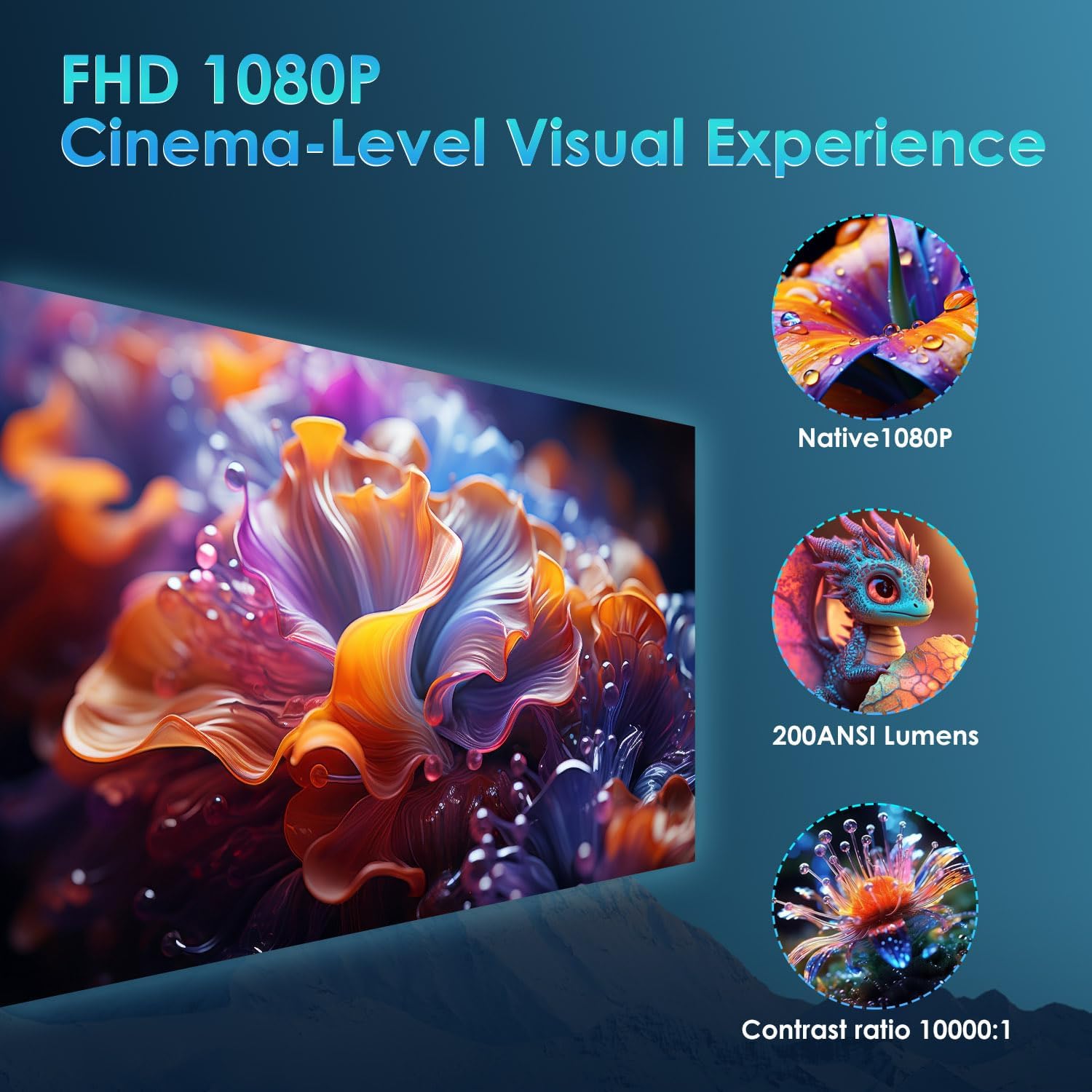
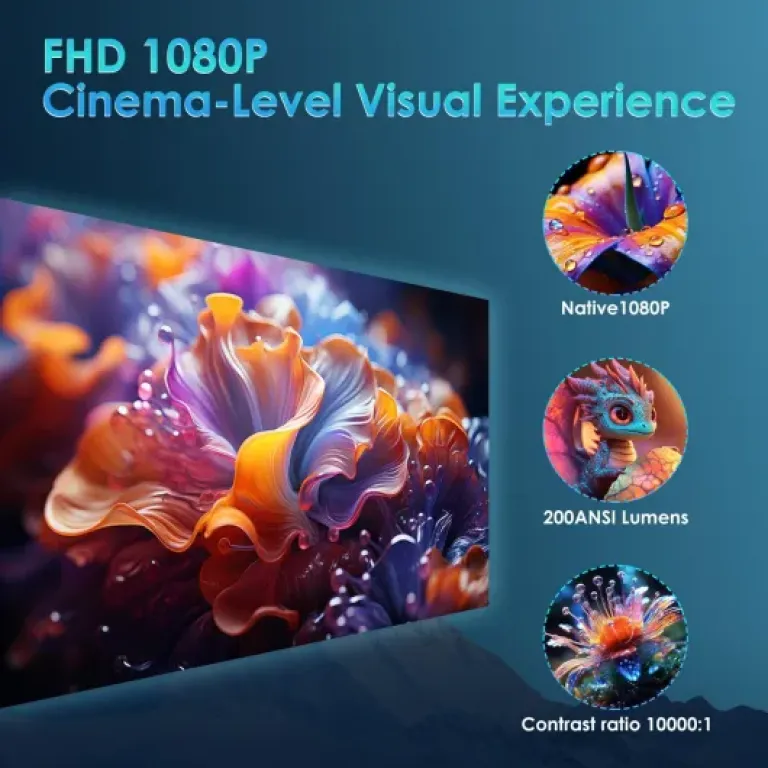
Let’s talk about what matters: how it actually looks. The projector is native 1080p and can accept a 4K signal. In practice, 1080p content looks sharp enough on a 80–100 inch image. Text in menus is clear, subtitles are easy to read, and gaming interfaces (PS5, Switch) are legible. Don’t expect the crispness of a 4K projector, but for movies and series it’s perfectly fine. Compared to the cheap 720p LED projector I had before, this is a noticeable step up in clarity.
Brightness is where you feel the marketing vs reality gap. The listing talks about 15000 lumens and 600 ANSI, but the specs also list 350 ANSI. From my eyes, I’d say it’s roughly in the typical 300–400 ANSI range. In a dark or dim room, it’s absolutely usable and looks good, especially around 60–100 inches. On a rainy afternoon with blinds half-closed, the image is still watchable, but blacks wash out and colors lose punch. In a bright room with sun on the walls, forget it; you’ll see a faded image. If you mainly watch at night, you’re fine. If you want daytime sports with curtains open, this is not the right tool.
Contrast and black levels are average. The 2000:1 ratio feels about right: dark scenes in Netflix shows look more dark-grey than deep black. You’ll notice it if you’re used to OLED TVs or good DLP projectors. Colors are okay out of the box, slightly cool, but you can tweak them. Motion is decent enough for movies and casual sports; I didn’t see crazy judder, but this is not a high-end cinema projector. For gaming, input lag is not advertised, but for casual PS5 or Switch titles I didn’t feel a big delay. For competitive shooters, you’d still want a TV or gaming monitor.
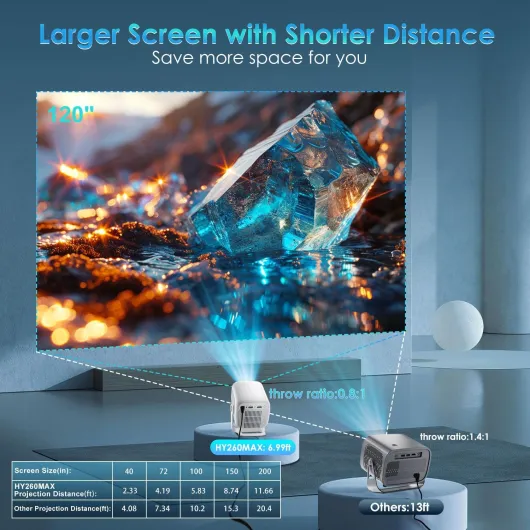
The short throw part is real and useful. With a 0.8:1 ratio, I was getting roughly a 100-inch image at about 1.5 m from the wall. That’s very handy in a small bedroom or living room where you can’t push the projector too far back. Having that big of an image from a coffee table distance is one of the main reasons to pick this model. I also liked the auto focus and AI keystone: you drop it down, it adjusts itself in less than a second, and the image is mostly square and sharp. It’s not perfect if the wall is very uneven, but it saves a lot of manual tweaking.
What you actually get out of the box
Out of the box, the package is pretty standard: projector, power cable, remote, and some basic paperwork. Nothing fancy, but everything you need to start. The remote is light plastic, not premium at all, but it works and has the usual Android TV-style layout with directional pad, back, home, and volume. Mine also had hotkeys for the main streaming apps, which is handy when you just want to drop on the sofa and launch Netflix without digging through menus.
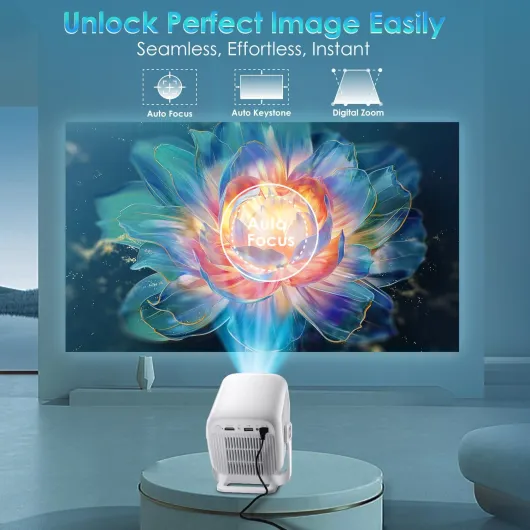
Setup is straightforward. You plug it in, it boots into Android 14, and a wizard guides you through WiFi and Google account login. I had it connected to WiFi 6 in a couple of minutes. The AI auto focus kicks in almost immediately every time you move the projector. It takes maybe half a second to sharpen the image, and it’s accurate enough that I almost never had to fine-tune manually. Auto keystone and the 4D/4P correction are also there, useful if you’re projecting slightly from the side or from a low table.
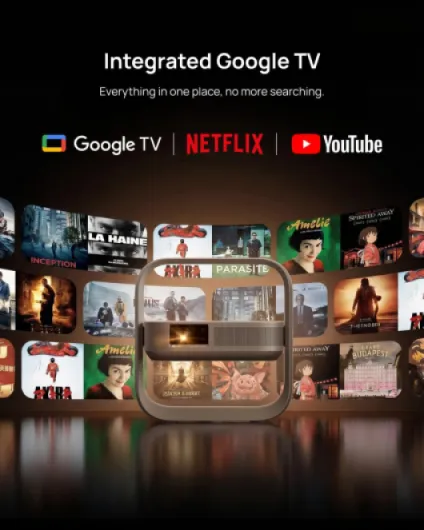
The Android system is the big selling point. You get built-in apps (Netflix, Prime Video, YouTube and so on). I installed a couple of extra apps through the store without any major issue. Interface is not as slick or smooth as a dedicated Chromecast or Fire TV, but it’s perfectly usable. There were a few moments where menus lagged for a second when jumping between apps, but nothing that made me want to throw the remote. For someone who doesn’t want an extra streaming stick, this is genuinely convenient.
Connectivity is decent for the size. You’ve got HDMI, USB, USB-C (depending on batch), 3.5 mm audio, WiFi 6, and Bluetooth 5.4. I tested it with a PS5 via HDMI, a laptop, and screen mirroring from an Android phone. HDMI is obviously the most stable and gives the best picture. Wireless screen mirroring works, but there’s a tiny bit of latency, so I wouldn’t use it for fast gaming. Overall, as a product package, it feels like a compact all-in-one media box that saves you from buying extra gadgets, but you can still plug in your console or stick if you want.
Pros
- Native 1080p with short throw (around 100" at ~1.5 m), great for small rooms
- Built-in Android 14 with WiFi 6 and Bluetooth 5.4, no need for extra streaming stick
- Compact and light with adjustable stand and fast auto focus/keystone, easy to move and set up
Cons
- Brightness and contrast are only average, really needs a dim or dark room
- Build feels budget, with potential dust issues and questionable long-term durability
- Brand support and documentation feel weak compared to bigger projector brands
Conclusion
Editor's rating
After using the Salange Short Throw Projector 2026 in real conditions—bedroom TV replacement, living room movies, a bit of gaming—I’d sum it up like this: it’s a compact, feature-packed projector that works well for casual home use, as long as you keep your expectations realistic. The native 1080p image is sharp enough, the short throw is genuinely handy in small rooms, and the built-in Android 14 with WiFi 6 means you can stream Netflix, Prime, and YouTube without extra hardware. Auto focus and auto keystone also make setup quick; you don’t spend ten minutes tweaking every time you move it.
On the flip side, brightness and contrast are only decent, not impressive. It’s clearly made for dim or dark rooms, not bright daytime viewing. The build feels budget, dust ingress is a real risk over time, and the brand’s support doesn’t inspire a lot of confidence based on some user feedback. There’s better pure picture quality out there if you’re ready to spend more or skip the built-in smart features.
I’d recommend this projector to people who want an all-in-one, easy setup big screen on a modest budget: students, renters, small flats, bedroom setups, or families doing regular movie nights. Pair it with a cheap Bluetooth soundbar and a simple screen or white wall and you’re good. If you’re serious about home cinema, very picky about black levels, or want something that feels more long-term and "brand safe", I’d look at bigger names and maybe spend a bit more, even if that means adding a separate streaming stick.