
Summary
Editor's rating
Value for money: where it makes sense and where it doesn’t
Design & usability: small, light, and the 180° rotation is actually useful
Build quality, noise, and long-term concerns
Picture quality & overall performance: good enough in the dark, average in daylight
What this projector actually offers (without the marketing gloss)
Does it actually replace a TV for casual use?
Pros
- Compact and very light with a useful 180° rotating design for wall or ceiling projection
- Built-in Android 14 with WiFi and Bluetooth so you can stream without extra devices
- Decent 720p picture in a dark room and good value for casual bedroom or kids’ use
Cons
- Noticeable fan noise and average built-in speaker, with no AUX output for wired audio
- Interface can be laggy and brightness is too weak for comfortable use in bright rooms

Specifications
View full product page →| Brand | Magcubic |
A tiny “TV” for the bedroom and random movie nights
I’ve been using the Magcubic Android 14 Mini Projector mainly in my bedroom and living room for a couple of weeks. I didn’t go into it expecting a high-end home cinema, more like a cheap way to throw Netflix on the wall without dragging the TV around. With that in mindset, it’s actually been pretty decent. It’s not perfect, but for the price I paid, I wasn’t expecting perfection anyway.
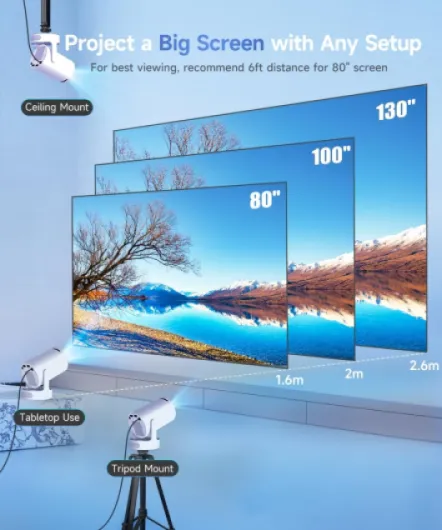
The first thing that stood out is how small and light it is. You can literally hold it in one hand and move it from room to room without thinking about it. I’ve used it on a shelf, on a tripod, and even just dropped it on the bed pointing at the ceiling. That 180° rotation is not a gimmick; I actually used it a lot for lazy ceiling watching at night.
Picture quality is clearly entry-level: native 720p, supports 1080p input, and you feel that. It’s fine for casual series, YouTube, cartoons, and some light gaming, but if you’re picky about sharpness or you’re used to a good TV, you’ll see the difference. Still, in a dark room with an 70–90 inch image, it’s pretty enjoyable, especially for the money.
So overall, my mindset with this thing is simple: it’s a cheap little projector that gives you a big screen without much setup. If you expect a proper 4K home cinema, you’ll be disappointed. If you just want to watch stuff on a wall or ceiling and you’re okay with a few compromises (noise, sound, menu lag), it does the job well enough.
Value for money: where it makes sense and where it doesn’t
Price-wise, this thing sits in the budget mini projector category, and that’s where it makes sense. You get Android 14, WiFi 6, Bluetooth 5.4, a rotating design, and a 5W speaker in one compact box. For a casual user who wants a simple way to watch Netflix on a big wall without buying a separate streaming stick and fancy mount, it’s pretty good value. You plug it in, connect WiFi, and you’re watching stuff in 10–15 minutes.
Where the value is strong is for people who mainly watch in a dark room and don’t care that much about 4K or perfect blacks. If your expectations are: "I want a cheap cinema feeling in my bedroom or for occasional outdoor nights", then the price-to-fun ratio is solid. The fact that it’s so light and easy to move around adds to that value. You can use it in different rooms, lend it to a friend, or take it on a trip without much hassle.
On the downside, there are compromises that might matter depending on your priorities. No AUX out means you’re stuck with Bluetooth for external audio. The fan noise is noticeable. The interface can lag, and the 720p resolution is clearly behind mid-range 1080p projectors. If you’re ready to pay more, you can find sharper, brighter projectors with better sound and less noise. So if you’re already thinking in terms of “serious home cinema”, this might feel too limited, even if it’s cheap.
For me, considering the price, I’d say value is good but not mind-blowing. It’s fair. You get what you pay for, plus a few nice touches like the rotatable design and air mouse remote. If you want a plug-and-play, low-cost big screen mainly for bedroom use, it’s a sensible buy. If you’re picky about image and sound, or plan to use it as your main living room screen, you’re better off saving more and going for a higher-end model.
Design & usability: small, light, and the 180° rotation is actually useful
Design-wise, it’s very compact and light, around 0.88 lb. It doesn’t feel premium, but it doesn’t feel like a toy either. The white plastic casing is pretty standard, nothing fancy. It’s the kind of device you don’t mind throwing in a backpack or moving around the house because you’re not scared of scratching some polished metal finish. It’s clearly built to be practical, not pretty on a shelf.
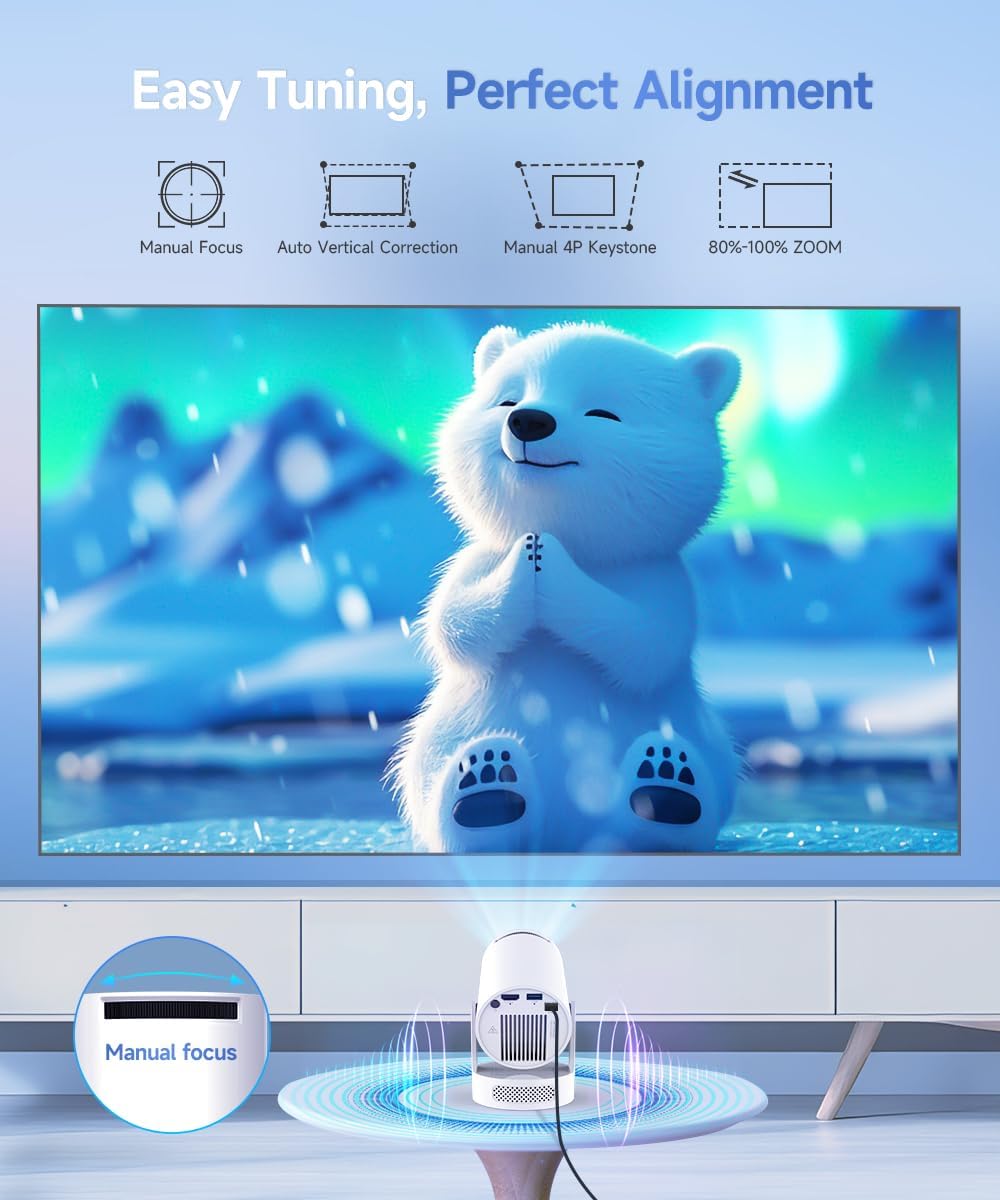
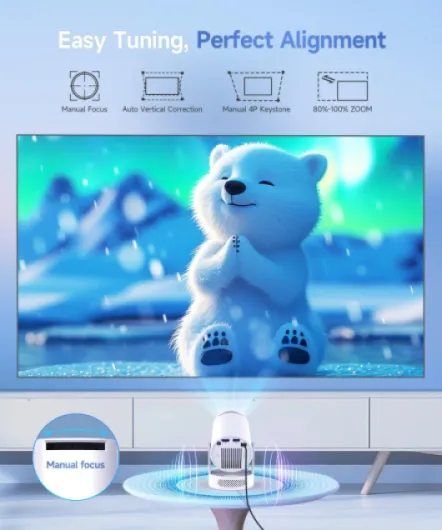
The 180° rotatable body is one of the best parts. I’ve used it on a coffee table pointed at the wall, then tilted it up to project on the ceiling when lying in bed. You don’t need a fancy mount or a stack of books to get the angle right. Just rotate the head until the image lands where you want. Combined with the auto vertical keystone, it makes setup faster, even if you still end up doing a bit of manual adjustment to get it just right.
The remote is an “air mouse” style. That means you move a cursor by waving the remote in the air, like a Wii controller. At first it’s a bit weird, but once you get used to it, navigating Android apps becomes easier than with a basic directional pad. It has voice control too, which works okay for basic stuff, but I didn’t rely on it much. The main downside is that the interface can lag a bit, so sometimes you overshoot menus because the cursor reacts with a slight delay.
In terms of ports and practicality, it’s fine but not perfect. You get USB and WiFi/Bluetooth, but no AUX audio jack, which is annoying if you have wired speakers. You’re basically pushed towards Bluetooth for better sound. Also, there’s no built-in battery, so forget about true wireless outdoor use unless you bring a power bank with AC output. For home use, I didn’t mind, but it’s something to keep in mind if you wanted full portability.
Build quality, noise, and long-term concerns
In terms of build, this is clearly budget plastic, but it doesn’t feel like it’s going to fall apart in your hands. The rotating mechanism feels decent; it doesn’t wobble excessively and holds its position well enough once you set the angle. I moved it around the house quite a bit, tossed it into a backpack once, and it handled that without issues. No weird creaks, no parts coming loose so far.
The fan, on the other hand, is both a durability and comfort point. It’s a bit loud for such a small device, which makes me wonder how hard it’s working inside. That said, it never overheated or shut down during my use, even after longer sessions of 3–4 hours. So cooling seems effective, just not very quiet. Long term, dust buildup might be a concern like with most cheap projectors, and there’s no fancy filter system that I can see, so you’ll probably want to keep it in a relatively clean spot.
The LED light source should, in theory, last thousands of hours, but obviously I haven’t tested it that long. What I can say is that brightness and color didn’t change during my test period. The ports still feel tight, the buttons respond correctly, and the remote hasn’t shown any weird behavior. The only thing that feels “cheap” is the clickiness of the remote buttons and the general plastic feel, but that’s expected at this price.
Overall, I don’t see this as a projector you keep for 10 years, but more as a 2–3 year casual device for bedroom or kids’ use. If you treat it decently, don’t drop it, and avoid super dusty or humid environments, it should hold up fine. It’s not fragile, but it’s also not built like pro equipment. Basically: good enough for home use if you’re not brutal with your gear.
Picture quality & overall performance: good enough in the dark, average in daylight
On the image side, you feel straight away that it’s a 720p projector. Text is not razor sharp, but it’s readable. For movies and series, it’s fine; you’re not counting pixels from your bed. With a 70–90 inch image in a dim or dark room, I found it quite enjoyable. Colors are decent out of the box, and you can tweak them a bit in the settings if you want. Black levels are what you expect from a cheap LED projector: more dark grey than true black, but still okay for casual viewing.
Brightness is where the marketing really exaggerates. They claim 8000 lumens, which is clearly not real ANSI lumens. In practice, in the evening with the curtains drawn, it’s great. With some daylight in the room, the image is washed out quite fast. You can still watch cartoons or YouTube, but if you want a decent movie experience, you basically need to darken the room. Compared to a more expensive 1080p projector I’ve tried, this one is less sharp and less bright, but still usable for its price range.
In terms of responsiveness, it’s not a gaming projector, but I did plug in a console and played some slower games. Input lag is noticeable if you play fast shooters or rhythm games, but for casual racing games, platformers, or party games, it’s okay. Streaming performance is fine as long as your WiFi is solid; I didn’t have major buffering issues on Netflix or YouTube. Occasionally an app would stutter or the interface would freeze for a second, but it never fully crashed on me.
Fan noise is something you should be aware of. It’s not insane, but you hear it. In quiet scenes, especially if you use the built-in speaker, the fan hum is present. When I connected Bluetooth speakers and raised the volume, it became less of a problem. So overall: picture performance is decent for dark rooms, not suited for bright living rooms, and the whole experience is clearly targeted at relaxed bedroom watching rather than “serious” home cinema.
What this projector actually offers (without the marketing gloss)
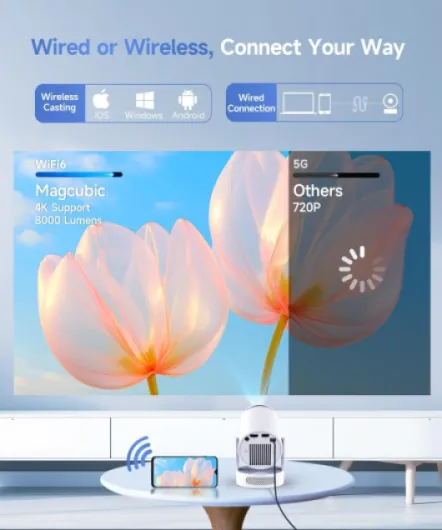
On paper, the Magcubic Android 14 mini projector looks pretty stacked for the price. You get Android 14 built-in, WiFi 6, Bluetooth 5.4, a 5W speaker, auto vertical keystone, and a 180° rotating body. Resolution is native 1280 x 720, but it accepts up to 1080p and even 4K files. Realistically, you’re watching 720p. It claims 8000 lumens and 8000:1 contrast, which is clearly marketing talk, but in a dark room the image is bright enough and usable.
The Android system is what makes it convenient. You don’t need to plug in a Fire Stick or anything. There are built-in apps and you can install more. I mostly used Netflix, YouTube, and Prime Video. Once connected to WiFi, it behaves more or less like a small Android TV box. It’s not the fastest system in the world, but it’s usable. Bluetooth works fine with speakers and earbuds, which is important because the internal speaker is okay but not great.
Throw distance is around 1 to 4 meters, with the sweet spot for me around 1.6 m to get roughly 70–80 inches. They recommend about 5.2 ft (1.6 m) for an 80" screen, and that lines up with my use. Past 100 inches, you start seeing the limits of 720p and brightness. For a bedroom wall, it’s more than enough. The auto vertical keystone helps if your projector is slightly angled, but you’ll probably still tweak things manually for best focus and shape.
Big picture: in terms of features, it’s pretty loaded for something in this price range. But you have to remember it’s still a budget projector: 720p, some system lag, average sound, and fan noise. If you accept that from the start, the feature list is actually quite good and covers most casual uses: movies, series, YouTube, and kids’ content.
Does it actually replace a TV for casual use?
In daily use, the question I kept asking myself was: can I just use this instead of a TV in the bedroom or for occasional movie nights? For my use, the answer is mostly yes, with a few compromises. The built-in Android and streaming apps mean I can just plug in power, connect to WiFi once, and that’s it. No need to mess around with HDMI sticks or laptops every time. For binge-watching a show in bed, it’s genuinely convenient.
The auto vertical keystone helps when you move it around a lot. You put it down, it tries to straighten the image, and usually gets pretty close. I still did manual keystone and focus adjustments, but it reduced the setup time. The sweet spot is when you leave it more or less in the same place and just rotate the head; then you barely touch the settings. Boot time is a bit long and the interface is not super snappy, but once the show is running, you forget about it.
As a “bedroom TV replacement”, I’d say it works if you’re okay with: darkening the room, living with fan noise, and sometimes restarting an app when it gets laggy. If you’re picky about image sharpness and motion, you’ll notice its limits quickly. For kids’ rooms or a second screen in the house, it’s honestly pretty solid. I used it several evenings in a row and never felt the urge to go grab the actual TV, as long as the room was dark enough.
For more serious movie sessions or sports with friends, I’d still prefer a better projector or a proper TV. But as a cheap and flexible big-screen solution for casual watching, it does the job. It’s the kind of device you happily use a few times a week without feeling like you made a bad purchase, as long as your expectations stay in line with the price and the specs.
Pros
- Compact and very light with a useful 180° rotating design for wall or ceiling projection
- Built-in Android 14 with WiFi and Bluetooth so you can stream without extra devices
- Decent 720p picture in a dark room and good value for casual bedroom or kids’ use
Cons
- Noticeable fan noise and average built-in speaker, with no AUX output for wired audio
- Interface can be laggy and brightness is too weak for comfortable use in bright rooms
Conclusion
Editor's rating
Overall, the Magcubic Android 14 Mini Projector is a solid budget option if you know what you’re getting into. It’s compact, easy to move, and the 180° rotation actually makes it practical for bedroom walls or even the ceiling. The built-in Android and streaming apps mean you don’t need extra devices, and once you set it up on WiFi, it works like a basic smart TV, just projected on a big surface. In a dark room, the 720p image is perfectly watchable for series, movies, and YouTube.
On the other hand, it’s still a cheap projector: noticeable fan noise, average internal speaker, no AUX output, and a user interface that can lag. Brightness is fine for evenings but not for bright rooms, and if you’re used to a good 1080p or 4K TV, you’ll see the drop in sharpness. So it’s not a miracle device, but it’s honest for the price.
Who is it for? People who want a low-cost, flexible big screen mainly for bedroom use, kids’ rooms, or occasional movie nights, and who don’t mind using Bluetooth speakers and watching in the dark. Who should skip it? Anyone looking for a main home cinema setup, picky users who hate fan noise or lag, and those who want true 1080p or better. If your expectations are realistic, you’ll probably be happy with it. If you expect premium performance, you’ll be underwhelmed.