
Summary
Editor's rating
Is it worth the money compared to other options?
Compact box with a handy 360° stand
Build quality, heat and long‑term concerns
Image quality, brightness and noise in real use
Specs on paper vs what you actually get
Smart functions, Wi‑Fi, Bluetooth and daily usability
Pros
- Native 1080p image with decent sharpness for movies, series and casual gaming
- Built-in Android, Wi‑Fi and Bluetooth let you stream without extra devices
- Compact body with 360° stand and auto keystone makes setup quick and flexible
Cons
- Real brightness is closer to 300 ANSI lumens, so weak in bright rooms despite the “20000 lumens” claim
- Built-in speaker and Android interface are basic; Netflix support can be finicky

Specifications
View full product page →| Brand | Wielio |
A budget smart projector that looked a bit too good on paper
I’ve been using this Wielio AE211B smart projector for a bit over two weeks, mostly in the living room and bedroom, plus one backyard movie night. I bought it mainly as a cheap all‑in‑one option: something with built‑in Android, Wi‑Fi, and Bluetooth so I don’t have to mess with a Fire Stick or extra cables every time. The product page is full of big claims: “20000 lumens”, ultra‑quiet fan, Android 14, 4K support, all that. I’ll be honest: that kind of spec sheet from a brand I’ve never heard of usually means you have to filter out the nonsense.
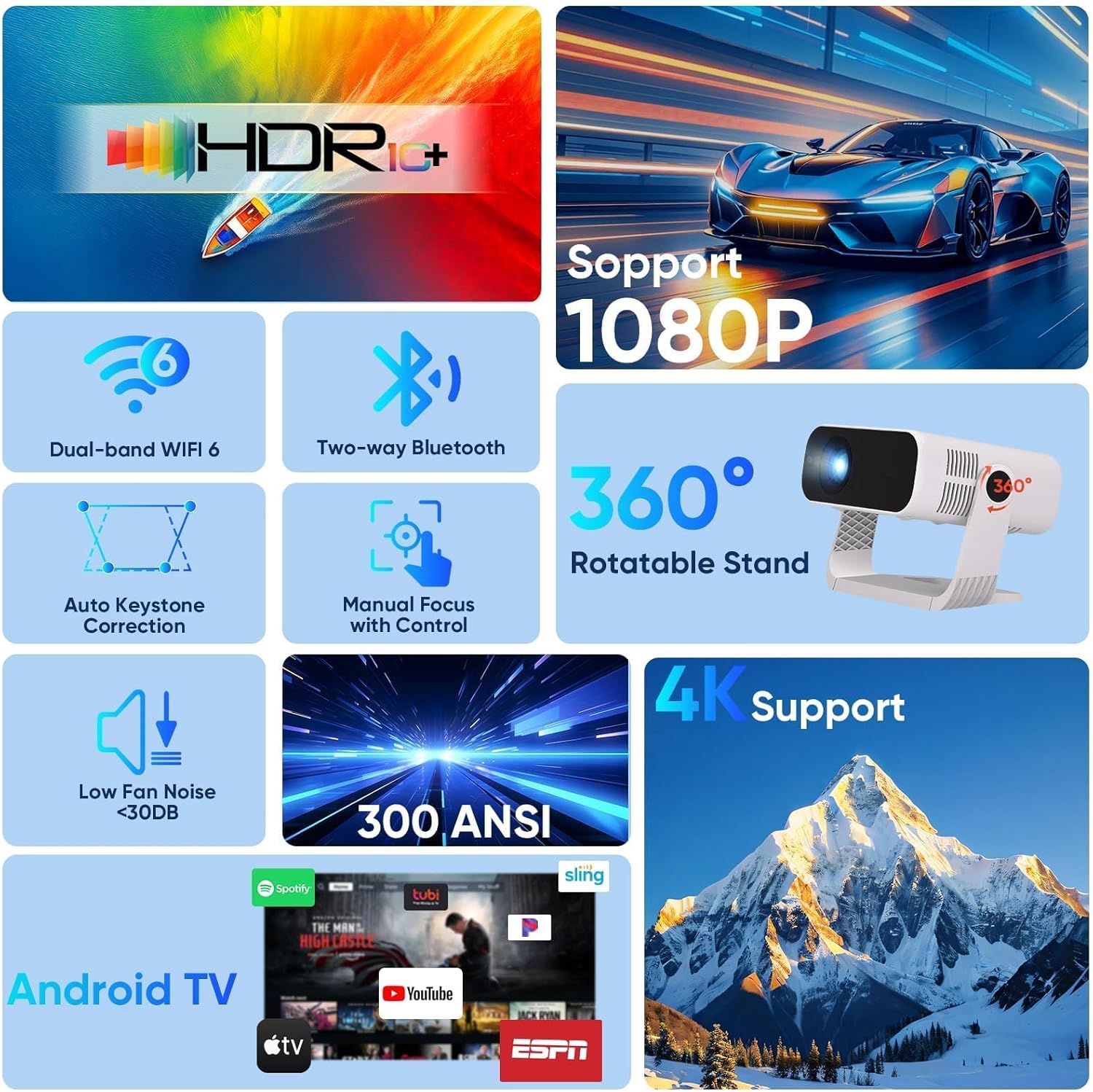
In practice, it’s closer to what you’d expect from a budget 1080p projector than from the crazy numbers in the description. The box itself says 300 ANSI lumens, which is much more realistic than “20000 lumens” plastered all over the listing. So if you’re hoping to replace your TV in broad daylight, that’s not happening. But used like a normal cheap home cinema projector (curtains drawn, lights down), it does the job pretty well.
My use case: movies and series at night, some Switch and PS5 gaming, and a couple of quick PowerPoint slides on a white wall for work. I didn’t baby it; I moved it around a lot, used Wi‑Fi and HDMI, and paired it with a Bluetooth speaker. So this isn’t lab testing, it’s just everyday use. I’ll go through what actually works well and where the compromises are.
Overall, it’s not perfect, it feels like a budget device, but for the price it’s honestly better than I expected. If you go in with realistic expectations (entry‑level brightness, decent 1080p, smart features that are “good enough”), you’ll probably be satisfied. If you take the marketing literally, you’ll be disappointed.
Is it worth the money compared to other options?
Looking at what it costs versus what it does, I’d say this projector offers good value if your expectations are realistic. You’re getting native 1080p, a built‑in Android system, Wi‑Fi, Bluetooth, auto keystone, and a 360° stand, all in one box. For someone who just wants a simple setup for movie nights without buying extra gear, that’s pretty attractive. You add a white wall and maybe a cheap Bluetooth speaker, and you’re ready.
Where you feel the low price is in the brightness and polish. If you add 50–100 more in budget, you can find projectors from bigger brands (XGIMI, Anker, some Epson models) that have better brightness, better software, or better color accuracy. But those often don’t have all the smart features built in at this price, or they’re bulkier. Here, you’re trading some performance and finesse for a lower entry price and an all‑in‑one compact unit.
If you already own a good streaming stick (Fire TV, Chromecast, Apple TV) and decent speakers, you might actually be better off buying a “dumber” projector with better brightness and using your own ecosystem. If you don’t want to deal with multiple devices, this Wielio is more interesting. It especially makes sense for:
- Students or renters who want a cheap big screen without drilling or buying a TV
- Families looking for an occasional movie night setup
- People who move the projector between rooms and need something lightweight
So, value wise, I’d call it pretty solid for beginners and casual users. Power users and image quality fanatics will quickly hit its limits, but they’re also the ones who should probably save up for a more serious model anyway.
Compact box with a handy 360° stand
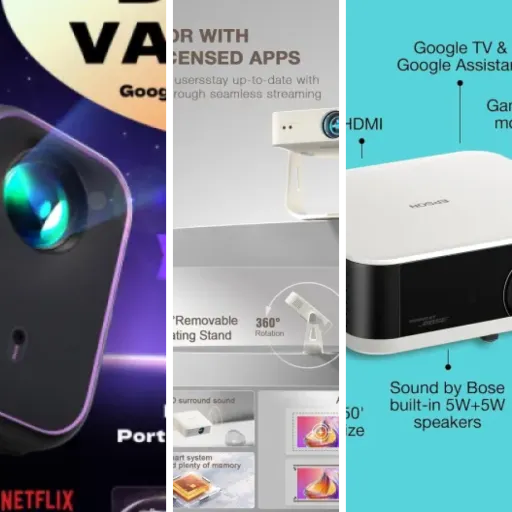
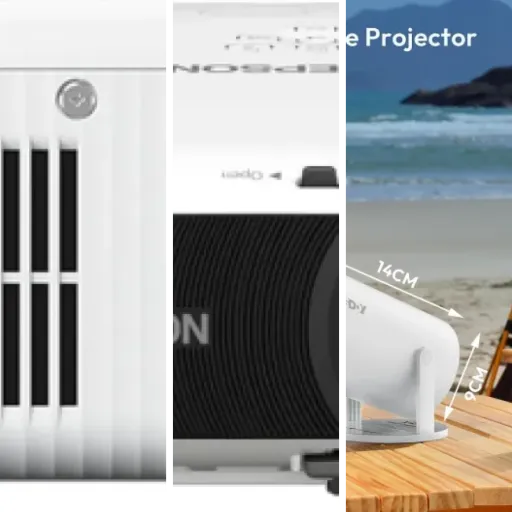
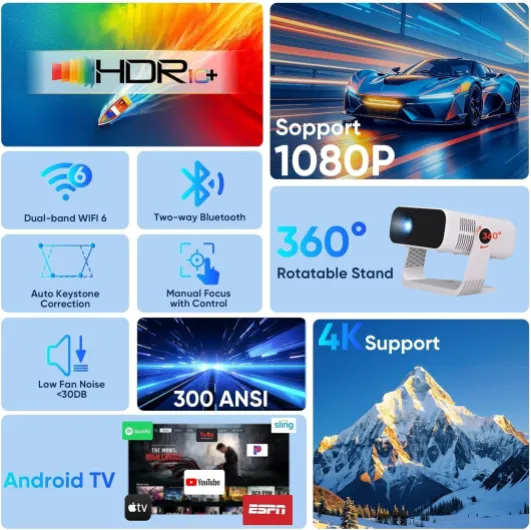
Physically, the projector is pretty compact and light. It’s not pocket‑sized, but it’s easy to grab with one hand and move from the living room to the bedroom. The black‑white finish is basic but fine; it looks like a typical budget projector, nothing fancy, nothing ugly. It’s mostly plastic, which you feel right away when you pick it up, but for the price I wasn’t expecting metal anyway. The upside of the plastic is that it’s light and doesn’t feel like a brick in your bag.
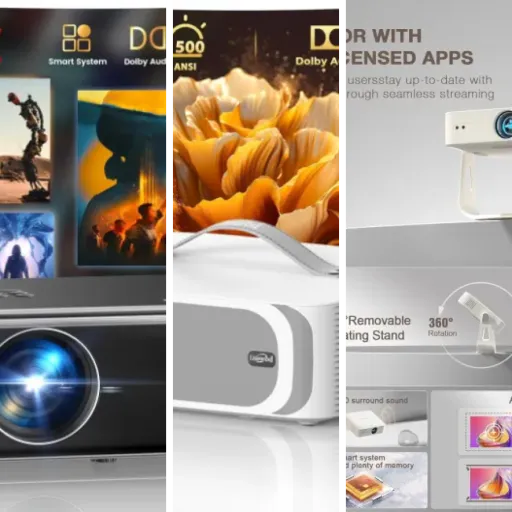
The 360° rotatable stand is actually one of the best parts of the design. Instead of stacking books or messing with a separate tripod, you just twist the built‑in bracket to point it at the wall or even the ceiling. I did a couple of lazy movie sessions projecting onto the bedroom ceiling, and it held its position without drooping. It’s not industrial‑grade solid, but it’s stable enough as long as you don’t keep bumping the table.
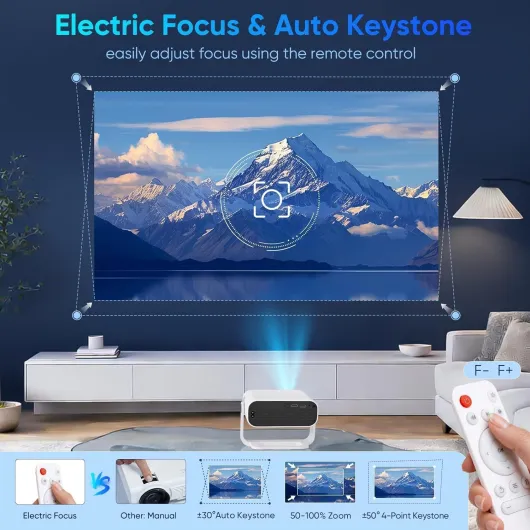
Port layout is straightforward: HDMI, USB, power, and audio out are all accessible on the side, so you’re not blindly searching around the back. The focus and keystone are controlled electronically rather than with big manual wheels, which gives it a slightly more modern feel. The remote is very light and feels cheap, but it works. Buttons are clear enough: navigation, volume, home, back, etc. I didn’t need the app control personally, but it’s there if you want to control it from your phone.
In terms of size and practicality, it’s good for small flats, students, or anyone who wants to move it between rooms. It fits easily on a small coffee table or bedside table. If you’re expecting premium build quality, you’ll be disappointed, but if you just need something compact and practical, the design does the job. It feels like a tool, not a showpiece, which is fine by me.
Build quality, heat and long‑term concerns
Two weeks isn’t enough to judge true long‑term durability, but there are a few things you can already feel. The plastic shell doesn’t scream premium, but there are no weird creaks when you pick it up or adjust the stand. The buttons click properly, the ports don’t feel loose, and the stand hinge hasn’t sagged yet despite me flipping it around a lot between wall and ceiling projections. So far, everything is holding together as expected for a budget device.
Heat management is often a weak point on cheap projectors, but this one seems okay. After a two‑hour movie, the casing is warm but not burning hot. The fan kicks in consistently, but as I said earlier, it isn’t too loud. I didn’t notice any flickering or brightness drops as it warmed up. The manufacturer talks about a dustproof design; I can’t really verify that, but the lens hasn’t collected obvious dust spots yet, and I haven’t seen any big dust blobs in bright scenes, which is a good sign.
The brand promises a 2‑year service with replacement and support. I obviously haven’t tested the after‑sales service, but it’s still better than the usual 1‑year vague warranty you get with some random brands. That said, availability of spare parts and long‑term firmware updates are always a question mark with brands like this. If something goes wrong after the warranty, repairs will probably not be worth it compared to just buying another cheap projector.
In short, durability feels acceptable for the price. I wouldn’t throw it in a backpack without some padding or leave it in a damp shed, but for normal home use (on a table, moved occasionally between rooms), it should last a few years. Just treat it as a budget electronic: good enough if you take care of it, but don’t expect it to survive abuse like a rugged pro projector.
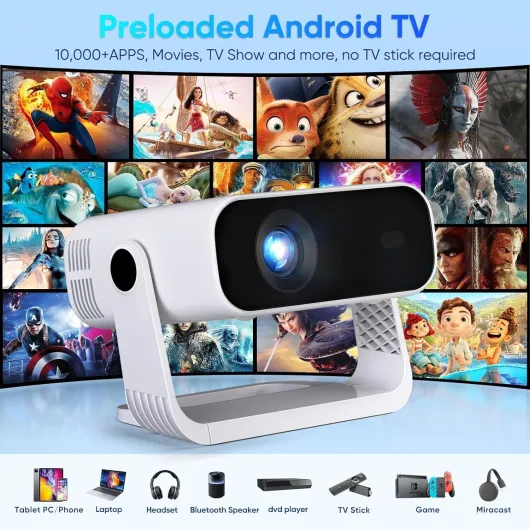
Image quality, brightness and noise in real use
I’ll start with brightness because that’s where the marketing is the most misleading. This is not a “20000 lumens” monster; it behaves exactly like a roughly 300 ANSI lumen projector. In a bright room with sun coming in, the image is washed out and you’ll be squinting to see darker scenes. With curtains drawn or blinds half‑closed, it’s usable for casual viewing. In the evening or with lights off, it’s actually pretty enjoyable, especially between 80 and 100 inches. So: great for movie nights in a dim room, weak for daytime sports with full daylight.
Resolution is where it does okay. The native 1080p is real – text from a laptop is readable, menu icons are crisp enough, and 1080p content from YouTube or a console looks sharp at a reasonable size. Don’t expect the clarity of a high‑end DLP projector, but for the price range it’s more than acceptable. Colors are decent out of the box, a bit on the cool side (slightly bluish whites), but you can tweak them in the settings. Blacks are more dark grey than true black, which is normal for a cheap LCD projector.
The auto keystone and focus help a lot. I put it on a low coffee table, slightly off‑center, and it automatically corrected the trapezoid effect most of the time. Sometimes it needed a manual tweak, but it got me 80% of the way there. Zoom between 50% and 100% is handy when you don’t have much space to move the projector itself. For gaming (Switch and PS5), input lag is noticeable if you’re super picky, but for casual games and racing it was fine. I wouldn’t use it for competitive shooters, but Mario Kart and FIFA were absolutely okay.
Noise level is surprisingly decent. The fan is audible but not annoying. They claim under 30 dB; I didn’t measure it, but sitting a couple of meters away, the sound from the built‑in speaker or my soundbar covered it easily. You do hear a soft whoosh in very quiet scenes if you pay attention, but it’s not a dealbreaker. Overall, performance is solid for the price as long as you accept the limits: low brightness and average contrast, good sharpness for 1080p, and noise that’s under control.
Specs on paper vs what you actually get
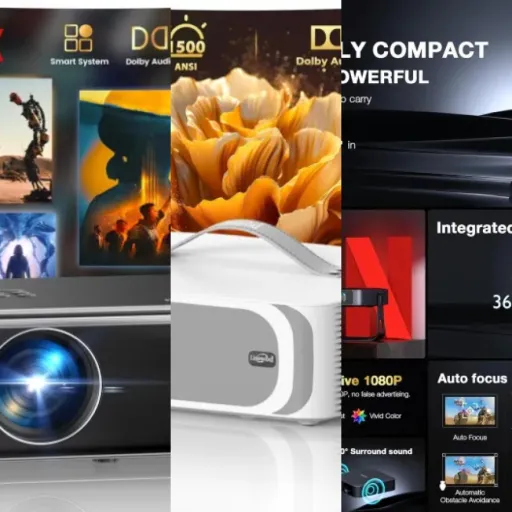
On paper, this thing looks loaded: native 1080p, 4K supported, Android 14, WiFi 6, Bluetooth 5.2, auto keystone, electric focus, 360° stand, low fan noise, etc. The Amazon page also shouts about “20000 lumens”, but the detailed specs say 300 ANSI lumens, which is the number that really matters. So think of it as an entry‑level, compact 1080p projector with smart features, not a professional cinema monster.
In terms of image, it outputs 1920 x 1080 natively, and it will accept 4K input from a PS5 or streaming app, but it obviously downscales it to 1080p. Contrast is listed as 2000:1, which is pretty standard for cheap LCD projectors. You get up to a 200‑inch image, but honestly the sweet spot is more like 80–120 inches; beyond that it’s watchable but softer and dimmer. Throw distance is 1.3 to 10 meters, so it’s flexible enough for small rooms.
Connectivity is decent: HDMI, USB, Wi‑Fi, Bluetooth. I used HDMI for console and laptop, and Wi‑Fi for built‑in apps and phone casting. It has a built‑in speaker, but I quickly switched to a Bluetooth soundbar because the internal sound is okay for casual use but a bit thin. The Android interface claims to be Android 14; in use it feels like a basic Android TV‑style skin. There’s an app store, YouTube works fine, Prime Video is okay, Netflix is hit or miss depending on updates (typical story on these off‑brand projectors).
So the main takeaway: the feature list is long, but in real life it’s a compact, 1080p, low‑brightness but usable smart projector. The smart part works, but don’t expect the polish of a Google TV or Fire TV device. It’s more like “nice bonus” than “reason to buy on its own”.
Smart functions, Wi‑Fi, Bluetooth and daily usability
For me, the big test was: can this replace a separate streaming stick and just work on its own? The short answer: mostly yes, but with some quirks. The Android system boots in under a minute, and you land on a simple home screen with tiles for YouTube, Prime Video and a few other apps. The built‑in app store isn’t Google Play, it’s some generic store, but it had the basics I needed. YouTube runs smoothly in 1080p, Prime Video worked fine, but Netflix was a bit of a mess: it installed, then complained about compatibility once, then worked at lower resolution. That’s pretty standard with these no‑name Android projectors.
Wi‑Fi 6 sounds fancy, but practically it just means the connection was stable. I streamed full HD YouTube videos and a football match on Prime Video without buffering, on a 5 GHz network, about 8 meters from the router through one wall. Screen mirroring from my Android phone worked decently for photos and simple videos, but for long movies I still prefer using the built‑in apps or an HDMI device. Mirroring from iOS also worked, but with a tiny bit more delay and occasional stutter.
Bluetooth 5.2 pairing was straightforward. I tested it with a small JBL speaker and a soundbar; both paired quickly and reconnected automatically after the first setup. There is a tiny audio delay with Bluetooth (as usual), but for movies it didn’t bother me too much. For gaming, I’d plug in a wired speaker or use HDMI ARC on a better system if you have one. The internal speaker is okay for a bedroom, but it’s very mid‑heavy and lacks bass, so don’t expect a cinema feel from it.
Day to day, the projector is easy to live with. It remembers Wi‑Fi passwords, resumes apps where you left off, and the remote is simple enough for non‑techy people to use. It’s not as smooth or polished as something like a Chromecast with Google TV, but for casual users it gets the job done. If you’re picky about app support and updates, you might still want to plug in an external streaming stick, but as a standalone unit it’s more than usable.
Pros
- Native 1080p image with decent sharpness for movies, series and casual gaming
- Built-in Android, Wi‑Fi and Bluetooth let you stream without extra devices
- Compact body with 360° stand and auto keystone makes setup quick and flexible
Cons
- Real brightness is closer to 300 ANSI lumens, so weak in bright rooms despite the “20000 lumens” claim
- Built-in speaker and Android interface are basic; Netflix support can be finicky
Conclusion
Editor's rating
Overall, the Wielio AE211B is a decent budget smart projector that does what most people need: watch movies and series in the evening on a big screen without too much hassle. The native 1080p image is sharp enough, the colors are fine after a bit of tweaking, and the built‑in Android system plus Wi‑Fi and Bluetooth make it easy to use without extra boxes and cables. The 360° stand and auto keystone make setup quick, even if you’re just plonking it on a coffee table.
On the downside, the brightness is clearly entry‑level, so forget about using it in very bright rooms. The marketing claims like “20000 lumens” and perfect 4K support are exaggerated; it’s a 300‑ANSI 1080p machine, nothing more. The internal speaker is acceptable but not great, and the Android interface feels a bit generic compared to more polished streaming devices. Long‑term support and updates are also a question mark with a smaller brand.
If you want a simple, portable home cinema setup on a tight budget, and you mainly watch content at night or with curtains closed, this projector is a reasonable pick. If you’re very picky about brightness, color accuracy, Netflix compatibility or you want a true TV replacement for daytime use, you should probably look higher up the range and be ready to spend more. As long as you ignore the marketing fluff and see it for what it is, it offers fair value.