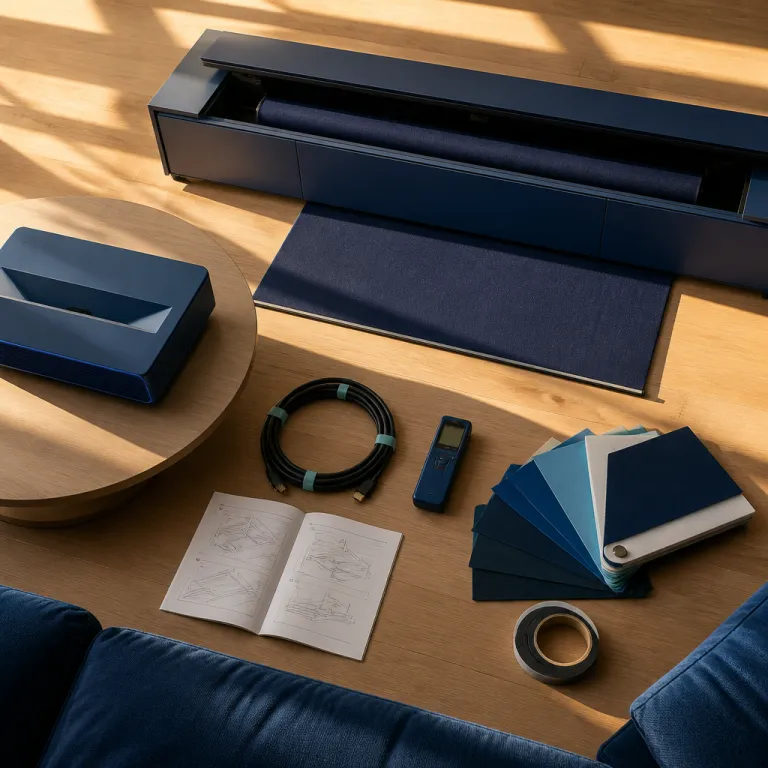
Why a floor rising projector screen completes a UST living room
A floor rising projector screen turns a UST setup from “projector on a cabinet” into something much closer to a disappearing television. When the rising screen retracts into the low housing behind your console, the room reads as a normal living space rather than a dedicated theater, yet the moment it lifts you get a defined frame, calibrated gain and controlled ambient light behavior. That contrast between invisible hardware and a high impact image is exactly why many AV enthusiasts upgrade from basic projector screens or a painted wall.
With ultra short throw projectors, the light comes from just a few centimeters in front of the wall, so the screen material has to be tuned for that steep angle rather than for a traditional long throw projector across the room. A dedicated floor rising ALR projector screen uses a structured surface that redirects the ultra short throw light toward the seating while rejecting ambient light from the ceiling and side lamps, which is something a regular matte white screen simply cannot do in a bright living room. When you pair the right ALR projector screen with a calibrated UST projector, you get a picture that holds up under real family use, not just in a dark demo room.
The practical upside is simple yet powerful. You keep your floor space mostly clear, the housing sits at a regular height behind the furniture, and you avoid drilling into walls or ceilings for fixed projector screens or tab tension motorized units. For many buyers, the extra price over a basic pull down feels justified the first time they watch a game with the lights on and see that the screen, not the wall, is doing the heavy lifting against ambient light.
CLR versus standard ALR screen materials for UST projectors
Not every ALR screen is built for ultra short throw projectors, and this is where many first time buyers get burned. Standard ALR projector materials are designed for a long throw projector mounted on the ceiling or at the back of the room, so they expect light to arrive from above or straight on, while a UST projector fires light upward from the cabinet, which completely changes how the screen must redirect that light. When you put a UST projector onto a regular ALR screen meant for long throw projectors, you often see hot spotting, crushed blacks and uneven brightness across the viewing angle.
Ceiling Light Rejecting, or CLR, surfaces are a specific subset of ALR screen designs tuned for the geometry of UST projectors. These ALR screens use microscopic sawtooth or lenticular structures that accept light from the ultra short throw projector sitting on the floor and send it toward the seating, while aggressively rejecting ambient light from overhead fixtures and windows, which is why they are often marketed as UST projector screens. If you are comparing screen reviews, always check whether the manufacturer explicitly rates the ALR projector material for UST projectors, not just for generic high gain or ambient light rejection claims.
Brands like Elite Screens and Awol Vision have leaned into this CLR category with dedicated UST lines, and their technical sheets usually specify gain values around 0.5 to 0.8 with a wide viewing angle. That lower gain compared with a regular white screen is not a flaw; it is how the material trades raw brightness for better ambient light control and deeper perceived contrast in a lit theater style living room. For a deeper dive into how gain and viewing angle behave on a traditional fixed frame screen, you can look at this detailed test of a 1.1 gain 120 inch wall mounted projection screen, then mentally invert the behavior for a low gain CLR surface.
| Feature | CLR screen for UST | Standard ALR / matte white |
|---|---|---|
| Optimized for UST angle | Yes, sawtooth / lenticular structure | Usually tuned for ceiling or rear projection |
| Ambient light rejection | Strong against overhead light | Moderate to low in bright rooms |
| Typical gain | Approx. 0.5–0.8 | Approx. 1.0–1.3 |
| Risk with UST projectors | Low if rated for UST | Higher chance of hot spots and uneven blacks |
Screen gain, viewing angle and real seating positions
Gain and viewing angle on a floor rising projector screen are not abstract lab numbers; they decide who in your room actually gets a good picture. A high gain screen can make a dim projector look brighter on axis, but with UST projectors and ALR materials, pushing gain too far usually narrows the viewing angle and exaggerates hot spots, which punishes anyone sitting off center on a sectional sofa. In a wide living room, a lower gain CLR surface around 0.6 to 0.8 often gives a more even image across multiple seats, even if the spec sheet lumens look less impressive.
Think about your seating map before you think about price or brand. If your main couch is centered and close, a slightly higher gain ALR screen might work, but if you have chairs flanking the sides, you need a material with a generous viewing angle so that the ambient light rejection does not collapse at the edges, which is a common complaint in screen reviews from families with open plan spaces. When you read those reviews sale pages, pay attention to comments about side viewing and not just about peak brightness, because the latter is easy to market while the former exposes real world compromises.
Floor rising projector screens aimed at UST projectors often publish both nominal gain and half gain viewing angle, and you should treat those as seriously as you treat throw ratio or input lag on the projector itself. A pro level buyer who calibrates their projector will usually accept a slightly lower gain if it means more stable blacks under ambient light and better uniformity from seat to seat. If you are coming from a basic electric projector screen like the one tested in this 120 inch motorized projector screen review, expect the CLR viewing experience to feel less punchy straight on but far more controlled once the room lights come up.
Mechanics of a rising screen: housings, tab tension and triggers
The hardware inside a floor rising projector screen is closer to a motorized blind than to a fixed frame, but the details matter for long term reliability. A good rising screen uses a rigid aluminum housing that sits on the floor behind your console, with a motor that lifts the screen from the base and a tab tension system that keeps the surface flat, while cheaper designs skip tab tension and develop edge curl over time. If you care about precise focus from a 4K UST projector, you want that tab tension and a robust Kestrel Tab style mechanism rather than a loose fabric that waves every time someone walks past.
Look closely at the housing dimensions before you buy, because many floor rising projector screens are around 10 to 15 centimeters tall and need enough floor depth behind the furniture to sit flat. Some models marketed as Kestrel Tab or similar rising screen designs include adjustable feet and side handles, which help you level the housing and align the projector screen with the projector lens, while others assume a perfectly flat floor that few real living rooms actually have. The more adjustment you get at the base, the less you will fight geometry and keystone later.
Triggers are the other mechanical detail that separates a polished setup from a clumsy one. USB or 12 volt sync modules let the screen rise automatically when the projector powers on, so you do not juggle a second remote or forget to deploy the screen before starting a movie, and some UST projectors even support wireless triggers for cleaner cable routing. If you are already managing a lamp module replacement or thinking about long term reliability, it is worth reading guides such as this one on choosing a reliable projector lamp module for home cinema performance, because the same mindset about parts quality applies to motors and control boards inside a floor rising screen.
Installation realities: floor space, light control and room layout
Installing a floor rising projector screen is easier than mounting a ceiling cassette, but it is not plug and play. You need enough floor depth behind your console for the housing, a nearby power outlet for both the screen and the UST projector, and clear vertical space so the screen can extend to its full height without hitting shelves or a soundbar, which sounds obvious until you see how many screen reviews mention blocked centers. Measure the path of the rising screen carefully, especially if you have a center channel speaker or décor on the wall.
Ambient light control is the second half of the equation. A CLR style ALR projector screen can reject a lot of overhead light, but it cannot fight direct sunlight blasting the screen from the side, so you still need basic window treatments if your theater space doubles as a bright family room, and you should think about lamp placement to avoid shining straight onto the screen. The goal is to let the ALR screen handle diffuse ambient light while you handle the worst offenders with curtains and dimmers.
Room layout also dictates throw distance and projector placement, even with UST projectors. Ultra short throw models still have a defined throw ratio, so a 100 inch image might require the projector to sit 20 to 30 centimeters from the wall, and you must ensure the floor rising housing does not push the projector too far forward, which would overshoot the screen. Before you commit to a sale price or regular price on a specific rising screen, mock up the floor footprint with tape and cardboard to confirm that the projector, screen and furniture can coexist without awkward compromises.
Value, pricing and how to read real world reviews
A floor rising projector screen with a proper CLR ALR surface is not cheap, and you should go in with realistic expectations about price. For a 100 to 120 inch UST compatible rising screen from a reputable brand, you are typically looking at a regular price in the 600 to 1 500 dollar range, with occasional sale price drops that shave a few hundred dollars off but rarely turn a premium model into a budget buy. When you see a sale that cuts the price in half compared with the usual price regular listings, assume compromises in motor quality, tab tension or screen material consistency.
Reading screen reviews with a critical eye helps separate marketing from reality. Focus on comments about long term use, such as whether the tab tension has kept the screen flat, whether the motor noise is acceptable in a quiet theater, and whether the ALR performance against ambient light still impresses after the honeymoon period, because those details matter more than the unboxing photos that dominate many reviews sale pages. Pay attention to owners who pair the screen with specific UST projectors like Awol Vision or other pro oriented models, since their expectations for uniformity and viewing angle tend to be higher.
Brands such as Elite Screens and others in the same tier usually publish clear specifications for gain, viewing angle and UST compatibility, and they tend to back their rising screen products with better warranties than no name imports. That does not mean every high priced projector screen is automatically better, but it does mean you should weigh the cost of a replacement motor or a failed control board against the initial discount, especially when the screen is central to your living room. In the end, the value of a floor rising projector screen is not just the number on the invoice; it is the way the screen quietly disappears when you are done and then returns to make movie night feel like a real event.
Key figures for floor rising ALR and UST projector setups
- Most ultra short throw projectors require roughly 20 to 30 centimeters of distance from the wall to produce a 100 inch image, so a floor rising housing that adds even 10 centimeters behind the console can materially change your furniture layout (manufacturer specifications across multiple UST models confirm this range).
- Typical CLR style ALR screen gains for UST use fall between 0.5 and 0.8, which is lower than the 1.0 to 1.3 gain of many regular white screens, but this trade off improves perceived contrast in rooms with moderate ambient light according to manufacturer contrast measurements rather than independent lab standards.
- Independent lab tests of ALR projector screens reported by major brands indicate that properly designed CLR materials can reject more than 85 percent of overhead light compared with a matte white reference, which is why they maintain usable black levels under ceiling fixtures that would wash out a standard screen.
- Motorized projector screens, including floor rising designs, are often advertised with rated lifespans of 10 000 to 20 000 up down cycles, which translates to many years of daily use if you raise and lower the screen once per viewing session, based on typical manufacturer durability claims rather than field failure data.
- Market analyses of home theater accessories from industry research firms suggest that ALR and CLR projector screens now account for more than 30 percent of premium screen sales by revenue, reflecting the rapid growth of UST projector adoption in living rooms rather than in dedicated dark theaters.
FAQ about floor rising ALR screens and UST projectors
Do I really need a CLR ALR screen for my UST projector ?
If you watch mostly at night in a dark room, a regular matte white screen can work, but in a typical living room with lamps and windows, a CLR style ALR screen designed for UST geometry makes a dramatic difference. It improves perceived contrast, reduces washout from overhead light and makes HDR content look closer to a large television than to a washed out projector image. For most UST buyers using the projector as a daily TV replacement, a dedicated CLR ALR surface is worth prioritizing.
How big should my floor rising projector screen be for comfortable viewing ?
For a seating distance of about 3 meters, a 100 to 120 inch diagonal floor rising projector screen usually hits the sweet spot between immersion and eye comfort. If you sit closer than 2.5 meters, 100 inches is safer, while larger rooms can comfortably handle 120 inches or more as long as the UST projector supports the size. Always confirm that the projector throw range and the floor space behind your console can physically accommodate the chosen screen size.
Will a floor rising screen work if I already have a center channel speaker ?
Yes, but you need to plan the vertical path of the rising screen carefully. In many setups, the center channel sits on the console in front of the projector, so the floor rising housing must sit behind both the speaker and the projector, which increases the required floor depth. Alternatively, some users wall mount the center channel just above the fully extended screen frame, but that requires precise measurements before purchase.
Are floor rising projector screens noisy in a quiet room ?
Noise levels vary by brand and model, but most quality floor rising projector screens produce a brief motor sound comparable to a motorized blind, which is noticeable but not disruptive. The screen is only moving for 20 to 30 seconds at the start and end of a session, so it does not affect actual viewing. If you are sensitive to noise, look for models that publish decibel ratings or mention quiet motors in long term user reviews.
How do floor rising screens compare to ceiling mounted motorized screens ?
Ceiling mounted motorized screens free up floor space and can work well in rooms where you can run power and mounting hardware overhead, but they are more invasive to install and harder to hide when retracted. Floor rising screens sit behind furniture, avoid ceiling work and pair naturally with UST projectors that already live on the console, which makes them ideal for renters or for living rooms where you want the theater to vanish when not in use. The trade off is that you must reserve some floor depth behind the console for the housing and manage power at floor level.