
Summary
Editor's rating
Is it worth the money compared to other options?
Long, white box that looks more like furniture than office gear
Build, lifespan and long-term worries
Image quality, brightness and gaming: good, but clearly for dark rooms
What this projector actually offers in real life
How it actually behaves day to day (noise, smart TV, ease of use)
Pros
- Very sharp 4K image with good contrast and natural colours in a dark room
- Quiet operation and long-life laser+LED light source (no frequent bulb changes)
- Useful lens shift, zoom and smart webOS features with a good remote
Cons
- Brightness too limited for bright living rooms or heavy daytime use
- No lens cap despite motorised lens, which is annoying for dust and protection
- Price is still relatively high compared to brighter but less refined competitors

Specifications
View full product page →| Brand | LG |
A mid-range 4K projector that actually feels thought-through
I’ve been using the LG CineBeam HU710PW for a few weeks as my main "TV" in the living room and for some movie nights in a darker room. I bought it because I wanted to move away from noisy, hot lamp projectors and have something more modern with decent smart features. I’m not a hardcore calibrator, but I’ve had a few projectors over the years (BenQ, Epson, Optoma), so I have some reference points. I plugged this one in, pointed it at a 100" screen and a plain white wall, and tried to live with it like a normal person, not as a lab test.
What struck me right away: the image is sharp and clean, and the colours look good out of the box. I didn’t have to spend an hour in menus to get something watchable. Compared to cheaper DLP 4K models I had before, the blacks are clearly better, and dark scenes show more detail instead of just a big grey mush. On the other hand, the brightness is clearly not made for daylight. With curtains open in the afternoon, the image is washed out pretty fast.
I used it mainly for Netflix, Disney+, Plex, some 4K Blu-ray via an Xbox, and a bit of PS5 gaming. I also tested screen sharing from a phone and a laptop via HDMI and Wi‑Fi. In practice, it really feels like a home cinema projector first, not a “TV replacement for a bright living room”. If you expect that, you’ll likely be disappointed. If you’re okay with dimming the lights, it starts to make more sense.
Overall, it’s a pretty solid mid-range choice with some clear strengths (image quality, noise level, lens shift, webOS), but it’s not perfect. The brightness limit and the lack of lens cover are annoying, and the price is still high enough that you think twice. I’ll go through the details, but that’s the context: good device for movie lovers in a dim room, not an all-rounder for every situation.
Is it worth the money compared to other options?
On the value for money side, it really depends where you’re coming from and how you use it. Around the 2,000 € mark (prices move, but that’s roughly where it sits), it’s not a budget product. You can find cheaper 4K DLP projectors from BenQ or Optoma that are brighter on paper. But after living with those, I can say the LG brings some clear upgrades: better black levels, much lower noise, much nicer colour out of the box, and a light source you don’t have to worry about. If you care about movie quality in a dark room, that matters.
Compared to LG’s own HU810, some users actually prefer this HU710 because it avoids the red laser “sparkle” and is cheaper. You do lose some brightness, so again, this pushes it more towards dedicated cinema rooms or at least evening use. If your room is not well controlled and you watch a lot during the day, you might feel you’re not getting full value because the image will often be washed out, no matter how good the tech is on paper.
For me, the biggest pros for the price are: the hybrid light source with long life, the very decent contrast and colour for movies, the quiet operation, and the smart TV features that actually work well enough to skip an external box. The main cons: limited brightness for bright rooms, no lens cap, and the price that still stings if you’re not a real movie enthusiast. There is better image quality out there if you go higher in price or to dedicated high-end cinema projectors, and there are brighter living-room projectors for less if you’re ready to sacrifice black levels.
So in terms of value, I’d say it’s good but not insane. If you specifically want a quiet, 4K, long-life home cinema projector for a dim room and you’ll really use it several times a week, the price starts to make sense. If you just want something casual for occasional sports with the lights on, or if you’re very price sensitive, there are cheaper options that will “do the job” even if they’re less refined.
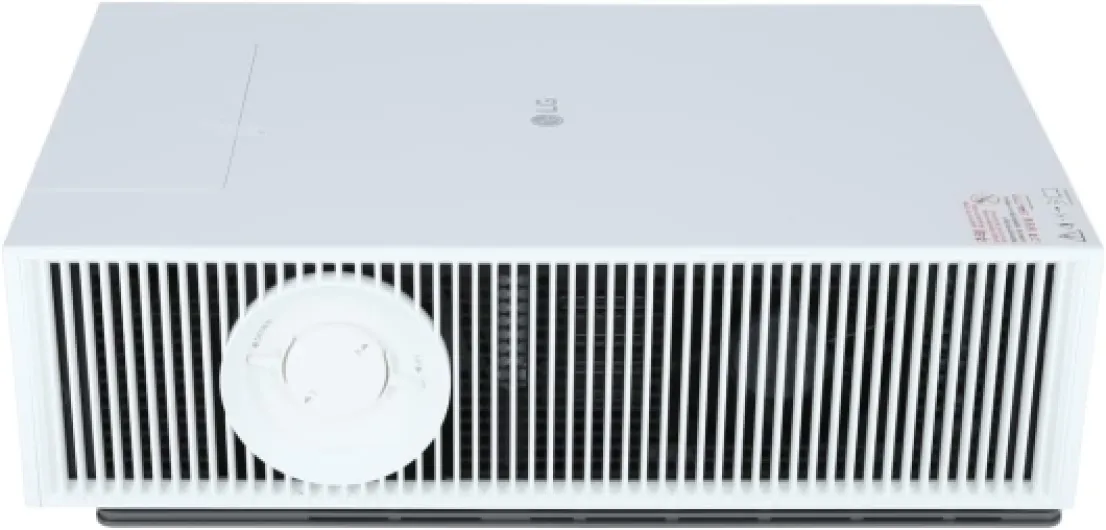
Long, white box that looks more like furniture than office gear
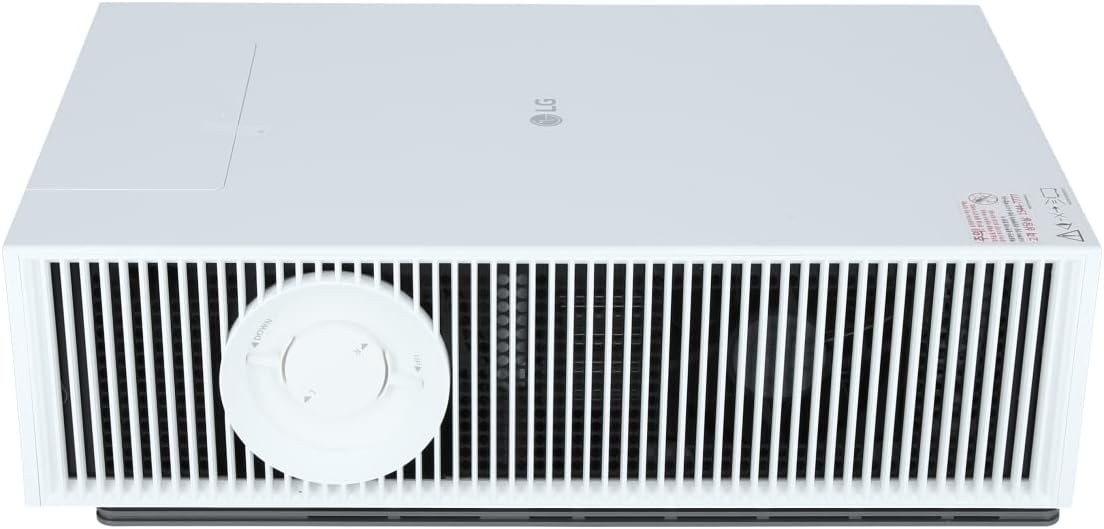
Design-wise, the HU710PW is a bit unusual compared to a lot of other projectors I’ve had. It’s longer in depth than in width, so it looks like a low, stretched-out box rather than a big square. At around 6.5 kg, it’s not ultra-light, but you can still move it around the room if needed. I mostly used it on a low table in the middle of the room and occasionally on a ceiling mount. It doesn’t scream “office projector”; it blends in fairly well in a living room because of the plain white shell.
The build quality feels solid. The plastics don’t creak, the ventilation grilles are well integrated, and the lens area looks clean. However, one thing that annoyed me and that other users mention: the lens is motorised and there is no lens cap. For a device at this price, that’s a bit lazy. If you leave it on a shelf, you’ll constantly worry about dust or someone touching the lens. I ended up putting a soft cloth over the front when not in use, which is not very elegant but better than nothing.
On the top you’ve got some basic controls, but in practice you use the Magic Remote for everything. The remote feels good in the hand, has direct buttons for some streaming services, and you can use it like an air mouse to move the cursor. I got used to it quickly, and compared to boring IR remotes from other brands, it’s more pleasant to use. Also, you don’t need to point it exactly at the projector, which is nice when it’s ceiling-mounted.
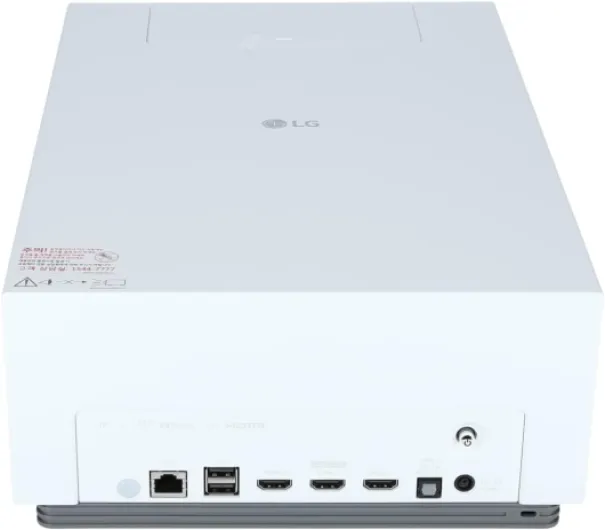
In terms of layout, the connections are on the side/back, which helps with cable management if you put it near a wall. The ventilation blows out the back and side, and I never felt hot air on me when sitting behind it, unlike with some Optoma units that turned my sofa into a sauna. Overall, the design is practical and fairly discreet, but the lack of lens cover and the slightly awkward long shape might bother some people when trying to place it in tight spaces or on narrow shelves.
Build, lifespan and long-term worries
I obviously haven’t used this projector for years, but based on a few weeks and my experience with similar devices, I can give a sense of durability. The chassis feels rigid, nothing flexes when you move it around, and the finish doesn’t feel cheap. The buttons on top and the connectors don’t wobble. It gives the impression of a device you can keep for several years without it falling apart, which is the minimum you expect at this price to be honest.
The big theoretical advantage is the 30,000-hour rated light source. That’s way more than traditional lamps, which usually die around 3,000–5,000 hours and cost a lot to replace. If you watch 3 hours a day, 30,000 hours is over 25 years on paper. Realistically, brightness will drop over time and you probably won’t keep it that long, but the peace of mind is there. After long sessions (3–4 hours straight), I didn’t notice any colour shift or flicker, and the casing was only warm, not burning hot.
Dust is always a concern with projectors. Since there is no lens cap, you have to be a bit careful. I found myself cleaning the lens with a microfiber cloth every few days because I’m paranoid. I didn’t see any dust blobs inside the image, which is good, but long term, I’d prefer a proper cover. The air filters and vents seem well designed; I vacuumed around them once and didn’t see huge dust buildup in that short time.
In terms of software, LG usually supports webOS devices for a while, but like any smart system, apps can break or change over the years. The good news is you have enough HDMI ports to add an external box later if the built-in apps get outdated. So even if the smart side ages, the hardware side (light source, optics, lens shift) should still be useful. Overall, durability looks decent, with the main weak point being the unprotected lens and the usual uncertainty around long-term software support.
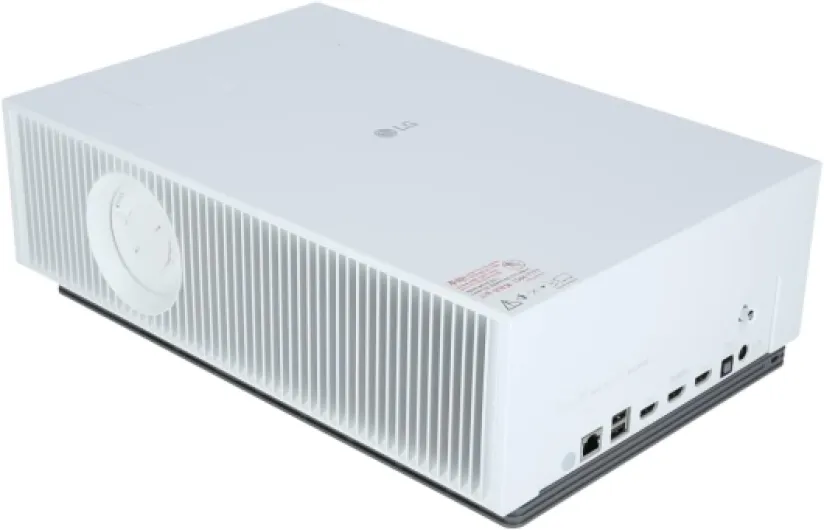
Image quality, brightness and gaming: good, but clearly for dark rooms
Let’s talk about performance, because that’s why you buy this thing. In a dark or well-dimmed room, the picture is genuinely very good for this price range. The sharpness is excellent across most of the screen; I didn’t notice the usual softness in the corners that I had on older 4K DLP models. Text from menus, subtitles and HUD elements in games are crisp. Out of the box, the colours are already quite natural. I barely touched the settings, just switched to a cinema mode and slightly adjusted brightness and contrast.
Where you really feel the difference with cheaper models is contrast and black level. It’s still a projector, so blacks are more like dark grey on a white wall, but on a proper screen in a dim room, dark scenes in movies like "The Batman" or "Blade Runner 2049" are much more readable than on my previous Optoma. You see details in shadows instead of just blobs. LG’s dynamic contrast and Adaptive Picture Pro work fairly well; the projector adjusts brightness and contrast depending on content. Sometimes you can feel the iris working in very fast changes, but it didn’t bother me much.
On the downside, the brightness is limited. Rated at 2,000 ANSI lumens, it’s fine in the evening with lights off or very low, but in a bright living room with white walls and daylight, it struggles. I tested a football match on a Sunday afternoon with curtains half closed, and the image was washed out. You can push the lamp mode to high and open the iris, but then you get more fan noise and still not enough punch to fight direct light. If you want a daytime projector, I’d look elsewhere.
For gaming, input lag is acceptable but not ultra-low like on some gaming-focused models. In Game mode, with a PS5 on HDMI 2.1, it felt fine for casual gaming and even some shooters, but if you’re super sensitive to lag, you might notice a bit of delay. Motion interpolation (TruMotion) is decent for sports and TV shows, but I turned it off for movies because I don’t like the soap opera effect. Overall, performance is strong in its intended use case: movies and series in a dark room, with gaming as a nice extra, not the main focus.
What this projector actually offers in real life
On paper, the LG HU710PW throws out 4K UHD (3840 x 2160) with a hybrid laser + LED light source, rated at around 2,000 ANSI lumens (some listings say 2,700, but in use it feels closer to the 2,000 figure). The contrast ratio is advertised at 2,000,000:1, which in marketing terms doesn’t mean much, but practically, blacks are better than on many entry-level 4K DLP units I’ve tried. It projects from 40" up to 300", but honestly, if you go much above 120" in anything but a dark room, you’re pushing it.
In daily use, the big plus is that it’s basically a smart TV without a panel. It runs webOS 6.0, so you get apps like Netflix, YouTube and others directly on the projector. You also have 3x HDMI (one 2.1), 2x USB-A, optical audio out, LAN, Wi‑Fi and Bluetooth. I plugged in an Xbox and a streaming stick on top of the built-in apps just to see, but most of the time I ended up using webOS because it was simpler and the remote is handy.
LG advertises HDR10, HLG, HGiG, Dynamic Tone Mapping and all that. In practice, HDR content looks clearly better than SDR, but don’t expect an OLED TV level of punch. The tone mapping is decent: you see more detail in highlights compared to older projectors, and dark scenes are easier to follow. The TruMotion interpolation is also there; if you like smoother motion for sports or TV shows, it does the job with fewer artifacts than some cheaper models I’ve used.
One important point: this is clearly built as a home cinema device. LG even puts “Home Cinema” in the recommended use. For office presentations or a bright meeting room, I’d skip it. For movie nights, series binges, and console gaming in a dim or dark room, it’s much more in its comfort zone. If you come from a cheap 4K DLP lamp projector, the jump in overall refinement (noise, heat, colour, smart system) is pretty noticeable, but if you already own a bright living-room TV, this is more of a dedicated cinema toy than a replacement.
How it actually behaves day to day (noise, smart TV, ease of use)
In terms of everyday effectiveness, the HU710PW is pleasant to live with, which isn’t always the case with projectors. The noise level is clearly lower than my older lamp-based projectors. In Eco or medium mode, I barely noticed the fan once the movie started. In high brightness mode, you hear it more, but it’s a steady noise, not a high-pitched whine. Sitting around 2.5–3 meters away, it didn’t bother me, even during quieter scenes.
The hybrid laser/LED light source is another practical plus. You don’t have to think about bulbs burning out after 3,000–4,000 hours. LG claims up to 30,000 hours. Obviously I haven’t tested that, but it’s nice not to feel guilty for watching a couple of episodes every evening. Also, the image reaches its full sharpness fairly quickly after power on. With some older lamp models, I had to wait several minutes for the focus to stabilise; here it’s sharp in about a minute.
The webOS 6.0 interface is easy enough to use. Apps launch quickly, navigation is smooth, and the Magic Remote with pointer makes entering passwords and searching much less painful. I installed a few main apps and used Plex a lot. The only small annoyance: like one Amazon reviewer, I also had a bit of trouble with Prime Video at first (had to reinstall and sign in twice), but once it worked, it stayed stable. Screen sharing via AirPlay 2 and Miracast worked fine for me, with a bit of lag for fast content but okay for photos and casual video.
Setup is helped by lens shift, 1.6x zoom, and corner correction. The vertical and horizontal lens shift is a big plus; it makes placement way easier than on cheap DLP projectors where you’re stuck with keystone only. I managed to align a 100" image on my screen without weird distortion even with the projector slightly off-centre. Corner correction is there, but I’d avoid relying on it too much because it slightly degrades sharpness. All in all, as a daily device, it’s effective and not frustrating, as long as you accept the brightness limits and plan to use it mainly in the dark.
Pros
- Very sharp 4K image with good contrast and natural colours in a dark room
- Quiet operation and long-life laser+LED light source (no frequent bulb changes)
- Useful lens shift, zoom and smart webOS features with a good remote
Cons
- Brightness too limited for bright living rooms or heavy daytime use
- No lens cap despite motorised lens, which is annoying for dust and protection
- Price is still relatively high compared to brighter but less refined competitors
Conclusion
Editor's rating
The LG CineBeam HU710PW is a solid 4K home cinema projector if you use it the way it’s meant to be used: in a dark or at least well-dimmed room, mainly for movies and series. The image is sharp, colours are convincing out of the box, and the contrast is clearly better than on many cheaper DLP 4K models I’ve tried. Add to that the quiet operation and the long-life laser+LED light source, and you get a device that’s pleasant to live with and doesn’t constantly remind you of bulb costs or fan noise.
The flip side is clear: brightness is limited for a projector in this price range, and it struggles in bright living rooms or during daytime if you can’t darken the room properly. The lack of a lens cover feels a bit cheap at this level, and gamers who are very sensitive to input lag might prefer something more specialised. It’s also not a bargain device; you pay for the mix of image quality, silence and convenience, not for raw lumen output.
If you’re the type who watches films in the evening with lights off, cares about good blacks and low noise, and wants an all-in-one solution with webOS and a decent remote, the HU710PW is a strong candidate. If you mainly watch sports during the day, need a projector for presentations, or just want the brightest thing for the price, you should probably look elsewhere. For home cinema fans with a controlled room, though, it offers a pretty balanced package.