
Summary
Editor's rating
Is it worth the money compared to other options?
Compact box, practical but clearly budget
Power and portability: not truly wireless
Build quality, noise, and long-term concerns
Image quality, brightness, and real-life use
What you actually get with the NP One
How well it works as an everyday “TV replacement”
Pros
- Built-in Google TV with licensed apps (Netflix, YouTube, etc.) so you don’t need a separate streaming stick
- Auto focus and auto keystone make setup very quick and easy
- Decent 1080p image quality in a dark room and fairly quiet operation
Cons
- Low brightness (250 ANSI lumens) limits use in bright rooms or with lights fully on
- Plastic build and basic speakers feel clearly budget
- No internal battery despite the “portable” marketing, so it always needs to be plugged in

Specifications
View full product page →| Brand | NothPJ |
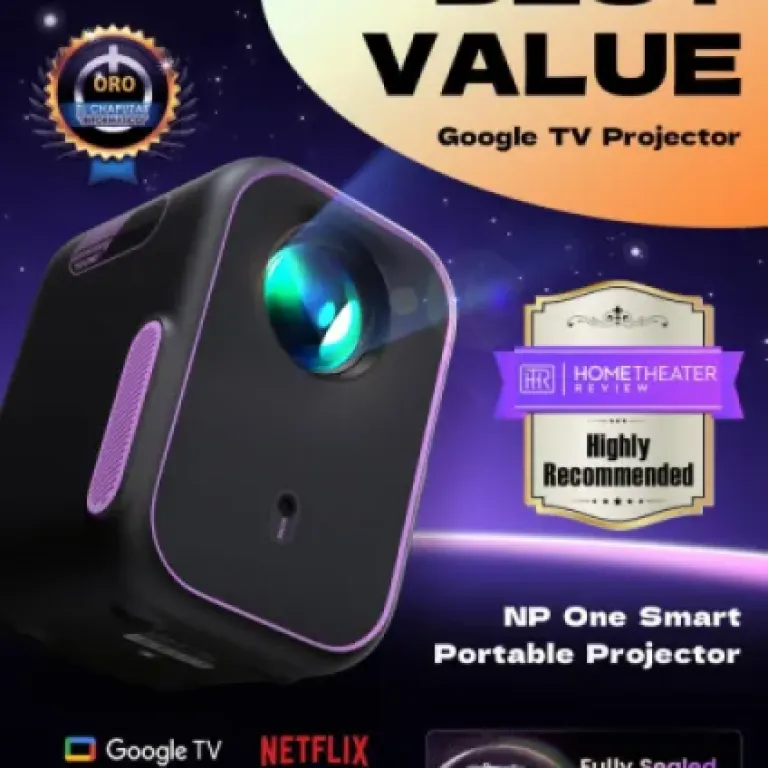
A budget Google TV projector I actually used instead of my TV
I’ve been using the NothingProjector NP One for a couple of weeks as my main "TV" in the living room, and also dragged it to a friend’s place for a movie night. So this isn’t just a quick unboxing impression. I actually watched full movies, some football, YouTube, and played a bit of PS5 on it. In short: it’s pretty solid for casual home cinema, as long as you understand its limits, especially the brightness.
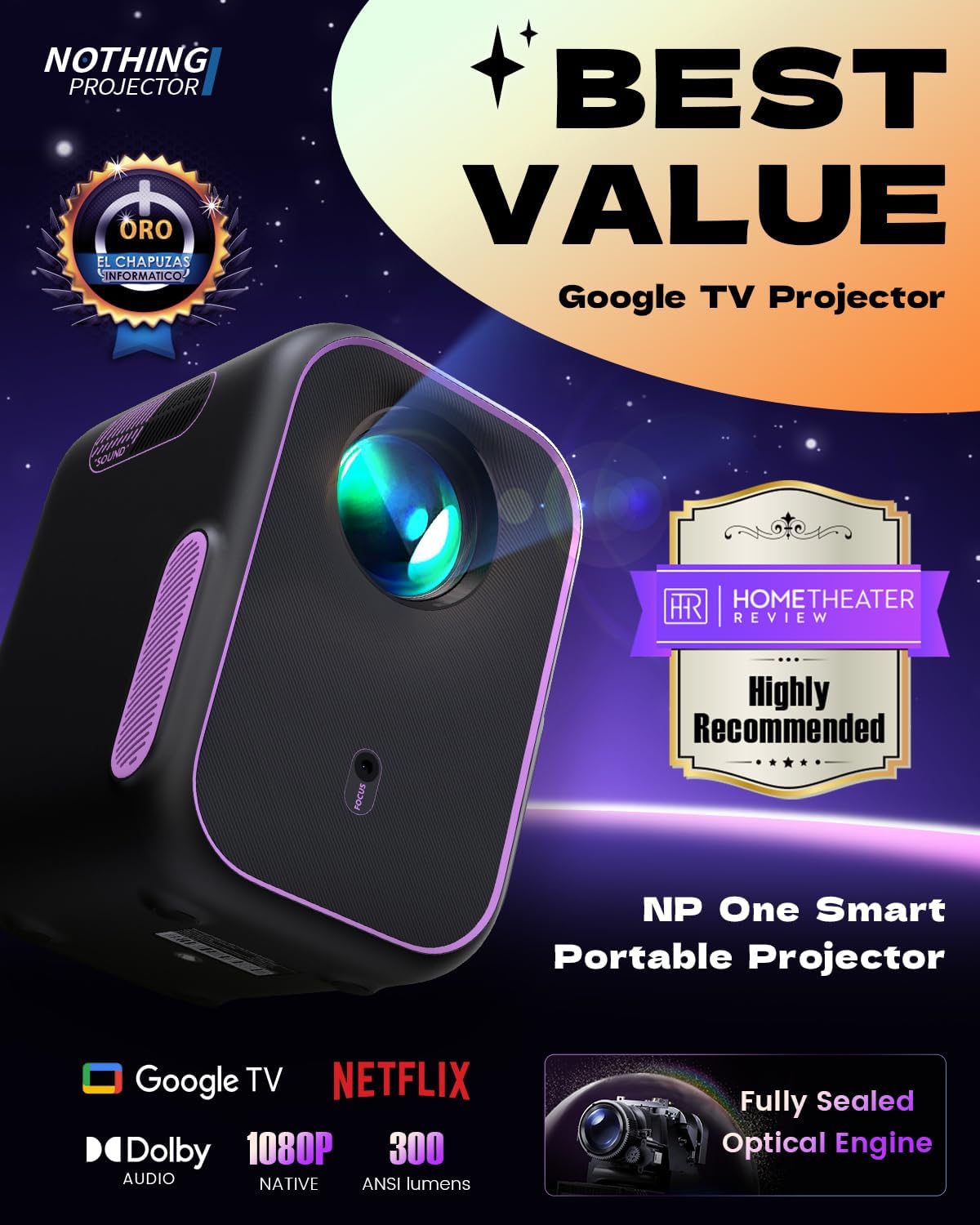
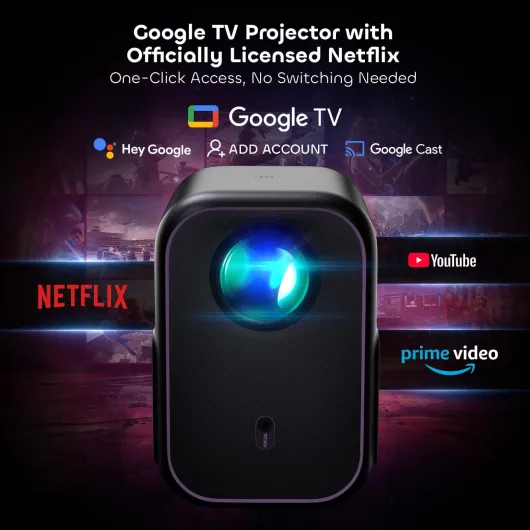
The main thing that pushed me to test this one is the built-in Google TV. I’m tired of random Android-based projectors with sketchy app stores. Here you get proper Google TV, with Netflix, Prime, YouTube, etc., like a normal streaming box. That’s a big plus because you don’t need to plug in a separate Fire Stick or Chromecast, and it feels more reliable than the no-name smart interfaces I’ve seen on cheaper projectors.
On paper, it ticks a lot of boxes: 1080p native, supports 4K input, WiFi, Bluetooth, auto focus, auto keystone, and all that. The specs look nice, but what matters is how it behaves in a normal flat with white walls, some ambient light, and normal people walking around, not a perfectly dark demo room. In that kind of real situation, it does the job, but it’s not a miracle machine.
If you expect it to fully replace a bright TV in the middle of the day, you’ll be disappointed. If you mostly watch in the evening with the lights dimmed and you want something simple to set up and carry around, then it starts to make sense. I’d say it’s a good value for a first projector or a secondary setup, as long as you accept a few compromises on brightness and sound depth.
Is it worth the money compared to other options?
Price-wise, the NP One sits in that mid-budget projector zone: not dirt-cheap, not premium. For what you pay, you’re mainly getting three things: true 1080p resolution, built-in Google TV with proper licensed apps, and convenient auto calibration (focus, keystone, alignment, obstacle avoidance). Those three together are what give it decent value. If you had to buy a separate streaming stick and a more basic projector, you’d get close to the same total cost anyway.
Where it clearly cuts corners is brightness and contrast. 250 ANSI lumens is just okay and clearly behind some competitors that offer 400–600 ANSI in a similar or slightly higher price bracket. If you often watch with lights on, you might be better off spending a bit more for a brighter model. Also, the built-in speakers are fine but unremarkable, and the plastic feel won’t impress anyone. So you’re not paying for luxury here, you’re paying for convenience and smart features.
Compared to an older 2015-era projector I had (720p, no smart features), this is a clear upgrade: sharper image, quieter fan, way easier to use. Compared to some newer brand-name projectors (Epson, BenQ, etc.), it loses on pure image quality and brightness but wins on price and integrated Google TV. If you’re picky about picture performance, you’ll probably want to step up to a better-known brand and accept spending more.
Overall, I’d rate the value for money as good but not mind-blowing. If your priority is “simple, all-in-one streaming projector for evening use” and you don’t want to overthink it, this makes sense. If you’re hunting for the absolute best image for movies or need daytime brightness, you’ll quickly hit its limits and might regret not saving up for something stronger. For a first projector or a casual home theater on a budget, though, it’s a pretty solid deal.
Compact box, practical but clearly budget
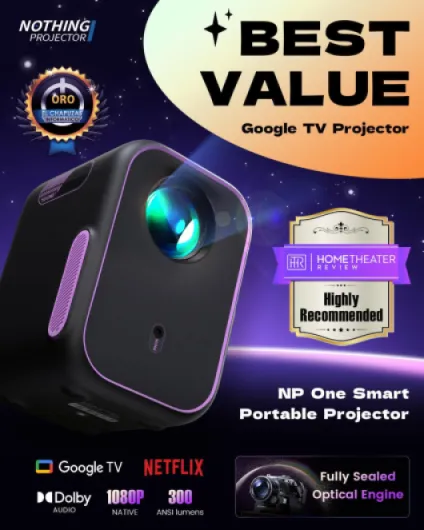
Physically, the NP One is small and fairly light (around 2.3 kg), so moving it from room to room is easy. I kept it on a shelf most of the time, then brought it to a friend’s house in a backpack with a hoodie wrapped around it. No damage or weird noises afterwards. The dimensions (about 14 x 12 x 17 cm) make it easy to slot into a TV cabinet or put on a coffee table without it dominating the room like some bigger projectors do.
The look is pretty simple: dark gray plastic body with some colored accents. It’s not ugly, but it also doesn’t feel premium. The plastic is clearly entry-level, a bit hollow sounding when you tap it. Vent grilles are visible on the sides, and you can tell it’s built more for utility than style. That said, the lens is slightly elevated which is handy: you can put it on a low table and still project higher on the wall without stacking books underneath.
Controls on the unit are minimal, so you’ll be using the remote for basically everything. The remote is light, works fine, but again feels cheap. Buttons are clicky enough and it didn’t lose connection or anything, but don’t expect the feel of a high-end TV remote. You get the usual Google TV layout with a dedicated Google Assistant button for voice controls, which actually worked decently for searching YouTube and opening apps.
From a practical point of view, the design is focused on portability and simplicity. It’s easy to grab, easy to place, and doesn’t need a special stand most of the time. On the downside, there are no built-in adjustable feet worth mentioning, no ceiling mount kit included, and the whole thing is clearly plastic. If you want something that looks fancy in a designer living room, this won’t impress anyone. But if you just want a compact box that projects a big picture and can be moved around easily, it gets the job done.
Power and portability: not truly wireless
Just to be clear: the NP One does not have an internal battery. You need to keep it plugged into power (19V adapter) all the time. The product page talks about being portable, and yes, it’s easy to move around physically, but you still need an outlet nearby or an external power station. If you were imagining taking it to the park and projecting movies without any power source, that’s not happening unless you bring a battery pack that can handle the wattage.
Power consumption is listed around 65W, which is fairly reasonable for a projector. I ran it a few hours every evening and didn’t notice any crazy spike on my energy monitor. It gets warm but not scorching. The fan noise is advertised as ≤30 dB, and I’d say that’s roughly right: you hear a soft whoosh in quiet scenes, but once the movie starts, you mostly forget it’s there, especially if you’re using external speakers with a bit more volume.
In terms of “portable use”, I did one test where I powered it from a medium-sized power station (the kind you take camping) and it worked fine for a full movie and some YouTube. So technically you can make it portable if you invest in that kind of gear, but out of the box, it’s a plug-in device, not a battery projector. I think the marketing around “outdoor portable” is a bit optimistic unless you already have the rest of the setup.
So, if your plan is to move it between rooms, bring it to a friend’s place, or use it in the garden near an outlet, it’s perfectly fine. If you wanted a fully cordless cinema-on-the-go, this is not the right product. For my own use (mostly living room and bedroom, sometimes a friend’s house), the lack of battery wasn’t a big issue, but it’s worth knowing before you buy.
Build quality, noise, and long-term concerns
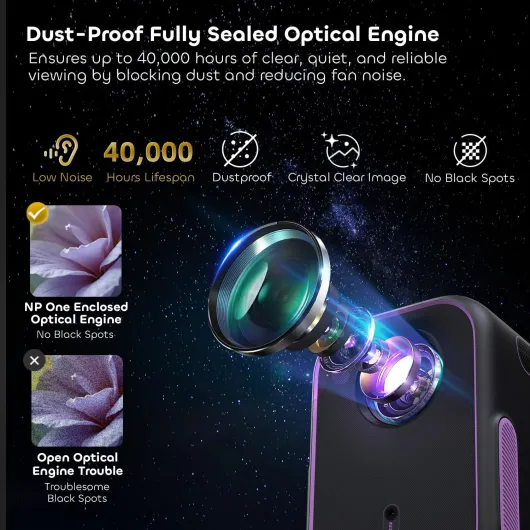
The projector claims a 40,000-hour lamp life, which on paper is huge. In reality, that just means: if you use it a few hours every evening, it should last you years before the brightness starts to drop. I obviously haven’t tested it for thousands of hours, but after a couple of weeks of daily use, there was no sign of flickering, weird color shifts, or anything like that. For an LCD projector in this price range, that’s standard, not exceptional.
The sealed light engine is a nice touch. A lot of cheap projectors start getting dust spots inside the image after a while because dust sneaks into the optical path. This design is supposed to avoid that. I can’t confirm long-term yet, but at least it shows they thought about a common failure point. After moving it around a few times and using it in a not-so-clean living room (cat hair, dust, the usual), I didn’t see any dust blobs on the image, which is a good sign so far.
Build quality overall is acceptable but clearly budget. The plastic casing doesn’t feel fragile, but it’s not the kind of thing you want to drop. The buttons and ports are aligned properly, nothing was loose, and the HDMI connection held firmly even when I accidentally tugged the cable. The fan noise stayed consistent; it didn’t get louder over the weeks. I ran it for about 5–6 hours straight on a weekend and it didn’t overheat or shut down.
I’d say durability is likely okay for normal home use: moving it occasionally, not throwing it in a bag without protection, and keeping it out of very dusty or humid environments. If you plan to use it in a classroom or business setting where it gets moved and plugged in every single day, I’d be a bit more cautious. But for home cinema and casual use, it feels solid enough, just don’t expect tank-like construction.
Image quality, brightness, and real-life use
The projector is 1080p native with support for 4K input, which basically means you can feed it a 4K stream, but it will display it at 1080p. For the size and price, the sharpness is actually decent. Text in menus is clear, subtitles are readable, and for movies and series it looks fine. Don’t expect the crispness of a high-end 4K projector, but for a 40–100 inch image, it’s perfectly watchable and better than the old 720p budget projectors I’ve tried before.
The big limitation is the brightness: 250 ANSI lumens. In real life, that means: in a dark or very dim room, it’s good; in a room with blinds half-open during the day, it’s usable but washed out; with strong daylight or lights fully on, it struggles a lot. I ended up mostly using it in the evening with lights off or a single lamp in the corner. At around 80 inches diagonal on a white wall, the image looked nice for Netflix and YouTube. Pushing it to the max 120 inches is possible, but the image gets visibly dimmer and loses punch.
The contrast ratio (1500:1) is also on the low side. Blacks are more like dark gray, and in very dark scenes you lose some detail. HDR10 support is mentioned, but don’t expect real HDR impact with this brightness and contrast; it’s more of a compatibility thing. For cartoons, sports, and bright content, it looks fine. For dark, moody movies, you’ll see the limits quickly. Motion for sports was okay, not super smooth, but not horrible either.
Auto focus, auto keystone, and auto screen alignment are honestly the part that made daily use less annoying. You move the projector a bit, it refocuses itself and tries to square the image. It’s not perfect, but it saves a lot of manual tweaking. For casual home cinema and occasional gaming, the NP One’s performance is good enough, especially in a dark room. If you want punchy brightness for daytime viewing or you’re picky about deep blacks and contrast, you’ll need to look at a higher-end, more expensive model.
What you actually get with the NP One
In the box, you get the projector itself, a power adapter, power cord, a small remote, and a basic user manual. No carry bag, no HDMI cable, nothing fancy. It’s very “here’s the minimum, deal with it”. For the price bracket it sits in, I’m not shocked, but if you’re buying this as a gift, just know it looks a bit barebones when you open it. The manual is short but clear enough to get you started if you’ve never used a projector before.
The projector runs Google TV natively, which is the real star here. Setup is like a standard Google TV: you log into your Google account, install your streaming apps, and that’s it. Compared to older projectors I’ve used where you need to plug in a Roku or Fire Stick, it’s way cleaner: one remote, one interface. I didn’t hit any weird app limitations; Netflix, Prime Video, YouTube, and Disney+ all worked as expected.
On the connection side, you’ve got HDMI, USB, 3.5 mm audio, WiFi, and Bluetooth. I plugged in a PS5 over HDMI, streamed from Google TV over WiFi, and paired a Bluetooth speaker. All worked fine. Latency over HDMI for gaming felt ok for casual play, not for hardcore competitive shooters. The built-in speakers are there, but I ended up using Bluetooth speakers most of the time for better sound.
Overall, in terms of features, it’s well equipped for the price: full HD, licensed streaming, auto calibration tricks, and multiple inputs. There’s no fancy lens shift or high-end home cinema stuff, and the contrast and brightness are clearly in the budget category. But if your main goal is: “plug it in, log in to Google, watch Netflix on a big wall”, it delivers that pretty cleanly without much hassle.
How well it works as an everyday “TV replacement”
I tried to use the NP One like a normal TV for two weeks: news in the evening, YouTube while cooking, series before bed, and some weekend movies. As a main screen in a bright room, it’s not ideal. As a main screen in a room where you’re willing to dim the lights a bit, it’s actually pretty decent. My routine ended up being: lights off for anything I really wanted to enjoy, and small lamp on for background YouTube or Twitch. In those conditions, it did the job without me getting annoyed.
The built-in Google TV makes it effective as a standalone device. No juggling with HDMI sticks, no weird casting issues. You turn it on, it boots into Google TV, and you’re in. WiFi was stable on my dual-band router; streaming 1080p on Netflix and Prime didn’t stutter. The only time I had buffering issues was when someone else in the house was hammering the connection, which is more of a network problem than the projector itself.
Sound-wise, the 2×3W speakers are okay for a small room. Dialog is clear enough and you can watch a whole movie on them, but they lack bass and feel a bit flat. At around 60–70% volume they’re fine; above that, you start to feel the limits. I quickly paired a Bluetooth speaker, and that improved the whole experience a lot. If you’re planning to use this seriously, I’d just assume you’ll use external speakers or headphones for better sound.
As an everyday device, I’d say it’s effective if you adjust your expectations: great for night-time movies, binge-watching, or occasional gaming; average for anything in bright light. It’s not replacing a good LED TV in terms of brightness and contrast, but it gives you that big-screen feeling without needing a giant panel on the wall. For the price range, the overall experience is solid but not mind-blowing, which is fair enough.
Pros
- Built-in Google TV with licensed apps (Netflix, YouTube, etc.) so you don’t need a separate streaming stick
- Auto focus and auto keystone make setup very quick and easy
- Decent 1080p image quality in a dark room and fairly quiet operation
Cons
- Low brightness (250 ANSI lumens) limits use in bright rooms or with lights fully on
- Plastic build and basic speakers feel clearly budget
- No internal battery despite the “portable” marketing, so it always needs to be plugged in
Conclusion
Editor's rating
The NothingProjector NP One is a practical, no-nonsense projector for people who mainly watch content in the evening and want something easy to set up. The combination of 1080p resolution, built-in Google TV, WiFi, Bluetooth, and auto focus/keystone makes it very straightforward to live with. You plug it in, sign into your Google account, and you’re basically done. For movie nights, series, and casual gaming in a dim room, it does the job and feels like a decent upgrade if you’re coming from older or very cheap projectors.
On the other hand, the 250 ANSI lumens brightness and modest contrast clearly limit it. It’s not a good choice if you want TV-like visibility in a bright room, or if you’re very picky about deep blacks and HDR. The speakers are serviceable but nothing more, and the plastic build screams “budget” rather than premium. There’s also no built-in battery, so the “portable” label only really applies to moving it between rooms or houses, not to fully off-grid usage.
If you’re a casual user who wants a simple all-in-one streaming projector for nighttime use, movie nights, and occasional gaming, this is a good fit and offers solid value. If you care a lot about picture punch in daylight, top-tier contrast, or you want something that feels high-end, you should probably skip this and look at brighter, more established brands, even if it costs more. In short: good for a first or secondary projector, not the final word in home cinema.