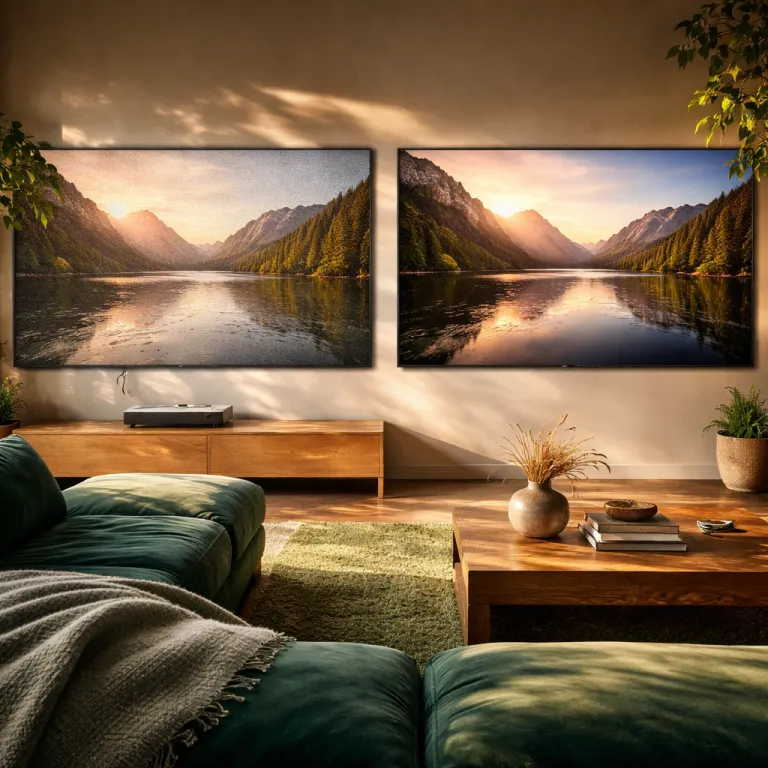
UST projector vs OLED TV: when size and value change the game
TL;DR: Above roughly 85 inches of screen size, a well chosen ultra short throw (UST) laser projector plus ambient light rejecting (ALR) screen usually delivers a larger, more cinematic image for similar or lower cost than a premium OLED television, according to price snapshots from major European retailers in late 2023 and early 2024. At that point, the home cinema decision stops being only about perfect black levels and starts revolving around immersion, room layout, and how you actually watch movies in your living room.
For anyone weighing a UST projector vs OLED TV, the first hard truth is simple. Once you cross roughly 85 inches of screen diagonal, an ultra short throw (UST) laser projector with a proper screen usually delivers a bigger, more cinematic picture for less money than a premium OLED television. That is the pivot point where the home theater equation stops being about pure black levels and starts being about immersion, room layout, and how you actually watch movies in your living room.
Think about the numbers rather than the marketing gloss on TVs and projectors. A good 83 inch OLED television often sits between roughly 2 500 and 4 000 euros, while a solid UST projector bundle like the Hisense PX4 PRO or an AWOL Aetherion paired with an ambient light rejecting (ALR) screen can give you a 100 inch big screen image in the same price band, sometimes lower if you already own a suitable projector screen. Cost per inch is brutal here; a 100 inch UST projector setup often lands at 25 to 40 euros per inch, while the OLED television hovers much higher once you factor in wall mounting, cable management, and potential future upgrades, based on aggregated pricing from several large online electronics chains in Germany, France, and Spain.
That price gap widens again if you dream of a 120 inch wide screen theater experience. Traditional long throw projector options can reach that size cheaply, but an ultra short throw laser projector keeps the chassis in the room against the wall, avoids ceiling mounts, and still throws a sharp, bright picture from a short throw distance of around 20 to 40 centimeters. For an AV enthusiast upgrading from a lamp based traditional projector, the move to a laser UST model feels like stepping from a noisy decade old office beamer into a quiet, instant on cinema appliance that finally respects both your ears and your décor.
There is a second layer to the UST projector vs OLED TV decision that many posts and quick buying guides skip. A projector, even an ultra short throw projector, is not just a display; it is a system made of a light source, optics, a screen, and the room itself, while an OLED television is a self contained slab that simply hangs on the wall. When you read detailed posts from serious reviewers, you see the same pattern repeated again and again in their measurement based tests and long term notes about how ambient light and viewing distance reshape the story.
In a bright living room during the day, an OLED television still looks punchy and contrasty with almost no setup, while many UST projectors need an ambient light rejecting screen to keep black levels from washing out. Yet once the lights go down and the movie starts, that 100 or 120 inch image from a well calibrated UST laser projector pulls you in a way even the best mini LED or OLED TVs struggle to match at sane prices. The tradeoff is clear: OLED wins the absolute black level contest, but UST wins the sheer theater scale that makes a movie night feel like an event rather than just another post work streaming session.
For buyers who already own a 1080p traditional projector, the question is not whether a new OLED panel looks better in a vacuum. The real question is whether shrinking from a 100 inch projector screen to an 83 inch OLED television will feel like an upgrade once you sit down in the last row of your room and hit play on your favorite movie. In most real living rooms, that answer tilts toward a carefully chosen UST projector and screen pairing, especially when you care more about cinematic immersion than about the last few percentage points of contrast in a dark HDR scene.
Contrast, HDR and ambient light: where OLED still fights back
When you compare a UST projector vs OLED TV in a controlled dark room, OLED still owns native contrast and near black detail. Each pixel on an OLED panel is its own light source, so black areas of the image can switch completely off while bright HDR highlights stay intense, which is something even the best UST laser projector cannot fully match because it always pushes some light through its optics and onto the screen. That is why dark, moody movies with lots of shadow detail still look more three dimensional on a high quality OLED television than on most UST projectors, even when the projector claims HDR10 or Dolby Vision support on the box.
However, that lab perfect scenario rarely matches a real living room or multi use theater room. In practice, a UST projector paired with a good ambient light rejecting screen can claw back a surprising amount of perceived contrast, because the ALR material reflects light from the ultra short throw angle of the projector while rejecting much of the overhead or side light in the room. The result is not OLED black, but it is often closer than you would expect, especially with bright UST projectors like the Hisense PX4 PRO rated around 3 500 lumens or the AWOL Aetherion at roughly 3 300 ISO lumens, which have enough output to punch through mild ambient light without crushing shadow detail, according to manufacturer datasheets and cross checked lab measurements from specialist home cinema reviewers.
Screen choice becomes the hidden deciding factor in this equation, and it is where many quick posts and spec sheet comparisons go wrong. A cheap matte white projector screen in a bright living room will sabotage even the best UST laser projector, while a well matched ALR screen diagonal of 100 or 120 inches can make a mid range UST projector look like a far more expensive model. If you are comparing TVs and projectors seriously, you should treat the screen as part of the budget, not an afterthought, because a 500 to 1 500 euro ALR screen often does more for your picture than jumping one whole tier up in projector price.
There is also the question of how you actually use the system during the day. If you watch a lot of sports or news with the curtains open, an OLED television or a high end mini LED television with strong anti reflection coatings will still look more consistent than most UST projectors, even with ambient light rejecting screens. On the other hand, if your main priority is movie night with controlled light and a big screen, the slightly lower contrast of a UST projector vs OLED TV becomes less important than the extra immersion and the ability to seat more people comfortably in the room.
Gamers and streaming heavy users should also think about processing and smart platforms. Many UST projectors now run Android TV or similar Android apps platforms, but their chipsets and motion handling often lag behind the best OLED televisions, which means you might prefer to use an external Android box or a dedicated console for serious gaming. If you want a sense of how modern televisions handle motion, HDR tone mapping, and smart features, a detailed smart Fire TV review such as this Hi QLED 4K UHD smart Fire TV test offers a useful reference point for what a well tuned flat panel can do in mixed content.
One more nuance rarely mentioned in short marketing posts is how ambient light interacts with viewing angles. OLED televisions maintain contrast and color even when you sit off axis, while many ALR screens for UST projectors have a narrower optimal viewing cone, so people sitting far to the side of the room may see a slightly dimmer or more washed out image. That is not a deal breaker in most living room layouts, but it is a reminder that the UST projector vs OLED TV debate is not just about specs; it is about how the whole system behaves with real people in real seats on a real movie night.
Installation, room fit and everyday living: the real world tradeoffs
Once you move past pure picture metrics, the UST projector vs OLED TV decision becomes a question of furniture, cables, and how your room actually works. An OLED television usually ends up wall mounted at eye level, with a low profile bracket and a tangle of HDMI and power cables that you either chase into the wall or hide with surface channels. A UST projector instead sits on a low console just below the screen, throwing an ultra short beam up onto the wall, which means you must think carefully about furniture height, projector placement, and how people move through the living room.
For many households, that console based installation is actually easier than a ceiling mounted traditional projector. You avoid drilling into joists, running long HDMI cables across the room, and dealing with fan noise above your head, because the UST projector lives right under the screen where your TVs used to sit. The tradeoff is that the projector becomes a visible object in the room, so its industrial design, noise level, and how it handles dust and fingerprints matter more than they did with a small box hidden on the ceiling.
There is also the question of what happens when you are not watching a movie. A large OLED television is always a big black rectangle on the wall, while a UST projector paired with a dedicated ALR screen can sometimes retract or blend more gracefully into a theater style décor, especially if you choose a screen with a slim frame that mimics a minimalist picture frame. Some UST projectors even integrate decent speakers and basic Android apps, so they can double as a casual music or news hub during the day without needing to power up a full AV receiver and speaker array.
Smart platforms and external devices add another layer of complexity. Many UST projectors ship with Android TV or similar systems, but their app support and update cadence can lag behind dedicated streaming boxes, so serious users often prefer to connect an external Android box or a Google TV dongle to handle streaming, gaming, and play IPTV services. If you want guidance on that front, a focused guide such as this how to choose the right Google TV projector article shows how to evaluate HDMI ports, latency, and HDR handling when you rely on external Android hardware.
Room geometry and seating distance also shape the decision more than most quick posts admit. A 100 inch screen diagonal in a 3,5 metre deep room feels comfortably cinematic, while the same size in a tiny living room can feel overwhelming, so you must balance ambition with ergonomics when choosing between a big screen projector and a slightly smaller OLED television. The rule of thumb is simple: if you can sit at least 2,5 to 3 times the screen height away, a 100 to 120 inch UST projector setup will feel natural, but if your sofa is pressed against the opposite wall, an 83 inch OLED may actually be the more comfortable choice for everyday viewing.
Finally, think about how often you rearrange furniture or move home. An OLED television with a standard VESA mount is relatively easy to remount in a new room, while a UST projector plus ALR screen combination requires more careful alignment each time you shift the console or the screen. That said, once you have lived with an ultra short throw setup that turns your living room into a genuine theater space at the click of a remote, going back to a smaller flat panel often feels like a downgrade, even if the OLED panel still wins the lab test charts.
Longevity, maintenance and long term value: where UST pulls ahead
Over a five to ten year horizon, the UST projector vs OLED TV debate shifts from pure picture quality to questions of light source life, burn in risk, and how often you really want to upgrade. Modern UST laser projectors typically quote light source lifespans of 20 000 to 30 000 hours, which translates to several hours of viewing every day for well over a decade before brightness drops significantly. OLED televisions, by contrast, can suffer from image retention or permanent burn in if you watch a lot of static content like news tickers, sports scoreboards, or game HUDs, especially at high brightness settings in a bright room.
That does not mean every OLED panel will fail early, but it does mean you must think about your content mix. If your home theater doubles as a gaming den where you leave a console paused for long stretches, or if you run IPTV channels with static logos all day, a UST projector with a robust laser light source may age more gracefully than an OLED television. For mixed movie and series viewing in a dim theater room, both technologies can last many years, but the projector has the advantage that its screen can be upgraded independently if you later decide to change size or move to a different ambient light rejecting material.
Maintenance is another area where real world experience matters more than spec sheets. A UST projector will need occasional dusting of its intake vents and perhaps a filter clean, while an OLED television mostly just hangs there, but the projector rewards that small effort with a replaceable or upgradable ecosystem of screens, external Android devices, and audio systems. If you start with a 100 inch ALR screen and later want a 120 inch wide screen, you can usually swap the screen while keeping the same projector, something you simply cannot do with a fixed size OLED panel.
Resale value and flexibility also tilt toward the projector side once you think like an AV enthusiast rather than a casual buyer. A well maintained UST projector from a reputable brand can be resold to another home theater fan who wants to step up from a traditional projector, while your ALR screen can either stay on the wall or move with you to a new room. By contrast, an aging OLED television competes with ever cheaper new TVs on the used market, and its fixed size and potential burn in history make it harder to position as a premium second hand item.
For those chasing high brightness performance, curated lists such as this guide to top high brightness home theater projectors show how far modern laser projector designs have come in real ANSI lumen output and color stability. When you combine that progress with the falling cost of ALR screens and the growing ecosystem of Android apps, external Android boxes, and streaming platforms that plug into any HDMI port, the long term value of a UST projector vs OLED TV becomes hard to ignore if you care about a big screen theater experience. In the end, the best home cinema is not the one with the most nits on paper, but the one that still makes you smile on the thousandth movie night when the lights go down and the opening credits roll.
Key figures for UST projectors vs OLED TVs
- For screens above 85 inches, a typical 100 inch UST projector and ALR screen bundle costs between 2 000 and 4 500 euros, while an 83 inch OLED TV usually ranges from 2 500 and 4 000 euros, meaning the cost per diagonal inch is often 20 to 40 percent lower for the UST setup according to major European retailer price surveys conducted in the fourth quarter of 2023.
- Modern UST laser projectors commonly specify light source lifespans of 20 000 to 30 000 hours, which at four hours of viewing per day equates to roughly 14 to 20 years of use before significant dimming, based on manufacturer documentation from brands such as Hisense, LG, and Epson.
- Independent measurements from review laboratories show that premium OLED TVs can achieve near infinite native contrast ratios because individual pixels fully switch off, while high end UST projectors with ALR screens typically reach effective on off contrast ratios in the low thousands to one in real rooms, depending on ambient light and screen material.
- Ambient light rejecting screens for UST projectors usually add between 500 and 1 500 euros to a system cost, but can improve perceived contrast by a factor of two or more in bright rooms compared with a standard matte white screen, according to side by side tests published by specialist home theater magazines.
- Input lag measurements from gaming focused reviewers indicate that many recent OLED TVs achieve latency figures in the 10 to 20 millisecond range in game mode, while UST projectors often sit between 30 and 50 milliseconds, which is acceptable for casual console gaming but less ideal for competitive players.