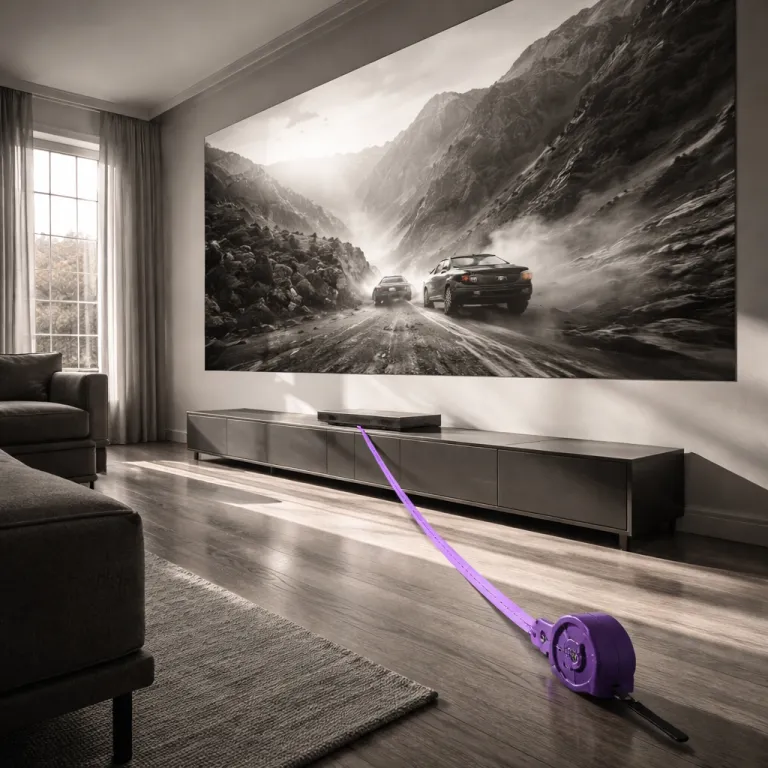
Why an ultra short throw projector suits small spaces
An ultra short throw projector turns a cramped living room into a credible theater without ceiling mounts or dangling cables. This type of throw projector sits just 15 to 40 cm from the wall yet can fill a 100 inch screen, which makes it ideal for renters who cannot drill or run cables through walls. Compared with traditional long throw projectors that need several metres of throw distance, ultra short models keep all the light engine, sound system connections and controls on a low cabinet right against the wall.
Most UST projectors use a laser light source, which means instant on, stable brightness and no lamp replacements every few thousand hours. That laser illumination also enables higher peak brightness in ansi lumens, so a modern ust projector can compete better with ambient light in a typical apartment than an older lamp based beamer. When you read review impressions from long term owners on AVS Forum or Reddit, the recurring theme is that a good ultra short throw projector feels closer to a large laser TV than to a fragile portable projector.
For renters, the biggest advantage is flexibility in placement and removal of the system. You can slide the ultra short throw projector and its screen off a low board, move apartments and rebuild the theater without leaving holes in the ceiling or walls. Because the best ust projectors integrate a basic sound system and smart TV apps, they can replace both a television and a separate streaming box for many people.
Placement math for short throw and ultra short throw projectors
Every ultra short throw projector has a specific throw ratio, which defines how far it must sit from the wall to create a given image size. As a rule of thumb, most ust projectors need roughly 20 to 25 cm of throw distance from the back of the chassis to the wall for a 100 inch screen, around 30 cm for 120 inches and close to 40 cm for 130 to 150 inches. Short throw projectors that are not ultra short usually sit 1 to 1.5 m away for the same 100 inch image, so they still save space compared with classic projectors but demand more floor area than a true ust projector.
Manufacturers publish detailed throw distance tables, and you should treat them as non negotiable geometry rather than marketing fluff. Before buying any throw projector, measure your TV bench depth, the distance from wall to the front edge and the available wall height, then compare those données with the projector’s throw chart to confirm that your desired 100 or 120 inch image will fit. If you plan a 150 inch theater scale picture, remember that some ultra short models simply cannot focus sharply at that size, even if the throw distance math suggests they can.
Short throw and ultra short throw projectors also differ in how sensitive they are to millimetre level shifts. Move a ust projector by just 5 mm and the image can jump several centimetres on the screen, which makes careful placement and a stable cabinet essential. When you read review notes from experienced users, you will often see complaints about alignment drift that actually come from wobbly furniture rather than from the projector optics themselves.
For a deeper dive into how a 4K laser short throw projector behaves in a real home theater, you can consult this detailed guide on a 4K laser short throw projector for home cinema, which walks through throw distance, placement and room constraints in practical terms. That kind of resource helps translate abstract throw ratios into concrete furniture layouts and shows how short throw projectors can coexist with existing décor in a small living room.
Screen choices, ambient light and when a white wall is enough
The screen you pair with an ultra short throw projector matters as much as the projector itself. UST projectors fire light upward at a steep angle, so a dedicated UST ambient light rejecting screen uses a sawtooth structure to reflect that laser light toward viewers while rejecting light from ceiling fixtures and windows. In a bright living room with white walls and no blackout curtains, a proper ust screen is the only way to get consistent hdr highlights, rich color and usable contrast during the day.
There are exceptions where a simple white wall can work with ultra short throw projectors, but they are narrower than marketing suggests. If your room has excellent light control, dark paint and you mostly watch at night, a smooth matte wall can deliver surprisingly even brightness and decent dynamic range, especially with a bright laser light source rated above 2 500 ansi lumens. In that scenario, you can start with the wall, live with it for a few months, then upgrade to a fixed frame screen once you understand your viewing habits and preferred image size.
Short throw projectors that sit farther from the wall are less picky about screen type, because their light hits the surface at a more conventional angle. They still benefit from a grey screen in rooms with ambient light, but they do not require a specialised ust screen to avoid hot spots and colour shifts. If you read review comparisons between white, grey and UST ALR screens on sites like ProjectorCentral and RTINGS, you will see that the biggest gains appear in mixed lighting, where the right screen can make a mid range projector look like one of the best laser TVs.
For users who plan to connect a PC or gaming console, it is worth checking how an adjustable projector mount or stand interacts with your chosen screen height, and this guide to a PC compatible adjustable projector setup explains how to align image geometry with seating and desk positions. That kind of planning prevents keystone correction from eating into hdr sharpness and ansi contrast. It also keeps the projector’s light path clear of shelves, soundbars and decorative items.
Brightness, ansi lumens and real world hdr performance
Brightness claims on ultra short throw projector boxes are notoriously optimistic, so you need to read them with scepticism. Many ust projectors quote peak lumens in their brightest, least accurate mode, which destroys hdr color accuracy and dynamic range even as it inflates the ansi lumens figure. In a calibrated cinema mode, the same projector might deliver only 60 to 70 percent of the advertised brightness, which is still enough for a 100 inch screen in moderate ambient light but far from the marketing promise. RTINGS and ProjectorCentral both publish side by side measurements that illustrate this gap between spec sheet and real world output.
Models like the Hisense PX4 PRO, the NexiGo Aurora Pro MKIII and the AWOL Vision Aetherion Pro sit in the upper tier of laser light output, and they are designed to function as laser TVs in living rooms rather than as occasional theater projectors. The NexiGo Aurora Pro, often shortened to NexiGo Aurora in forums, uses a triple laser light source to push both brightness and color volume, while the AWOL Vision flagship leans on high ansi lumens and aggressive tone mapping to keep hdr highlights visible under ambient light. Hisense’s PX4 PRO balances its 3 500 lumen rating with gaming features like FreeSync, which we will address later, making it one of the best compromises between brightness, input lag and price.
If you want to understand what record breaking ansi lumens actually mean in a living room, a technical breakdown such as this analysis of 6000 ansi lumens in a home environment is more useful than any spec sheet. It explains why doubling ansi lumens does not double perceived brightness, and why screen gain, ambient light and throw distance all shape the final image. In practice, a well tuned 2 500 to 3 000 ansi lumen ultra short throw projector on a good ust screen will look more cinematic than a harsher 4 000 lumen model blasting onto a shiny white wall.
Hdr formats such as HDR10 and Dolby Vision also behave differently on projectors than on OLED televisions. A ust projector with solid native contrast, careful tone mapping and accurate color will often produce a more pleasing hdr image than a brighter but less controlled rival, especially in dark theater style viewing. When you read review measurements from professional calibrators on RTINGS or ProjectorCentral, pay attention to sustained brightness at 10 percent and 25 percent windows, not just the single peak number that manufacturers highlight.
Gaming, motion and audio realities with ust projectors
Ultra short throw projectors have quietly become viable gaming displays, but only if you pick the right models. The Hisense PX4 PRO stands out because it supports FreeSync variable refresh rate, which reduces tearing and stutter when paired with compatible consoles and PCs at large screen sizes. On a 100 or 120 inch screen, that smoother motion makes fast paced games feel less like a compromise and more like a legitimate big screen upgrade.
Input lag still varies widely between ust projectors, so gamers should read review measurements rather than trusting vague “game mode” labels. Some laser TVs prioritise image processing and dynamic contrast over latency, which can push lag above 50 ms and make competitive shooters feel sluggish, while better tuned models sit closer to 15 to 20 ms and feel responsive. Short throw projectors that are not ultra short sometimes have an advantage here, because they share gaming oriented chipsets with portable projectors and do less heavy handed frame interpolation.
Audio is the other major reality check for anyone treating a ust projector as a TV replacement. Built in sound systems have improved, with some models offering Dolby Vision compatible video pipelines paired with Dolby Atmos capable speakers, but most still lack the low frequency impact and clarity you expect from a dedicated theater system. Budget at least 200 to 500 euros for a sound system upgrade, whether that means a compact soundbar under the screen or a slim AVR plus satellite speakers, because the best picture deserves better sound. RTINGS and audio measurement sites provide frequency response and maximum SPL charts that show just how limited most integrated speakers are.
Heat and fan noise are also more noticeable with ultra short throw projectors than with ceiling mounted units, simply because you sit closer to the chassis. Triple laser light engines like those in the NexiGo Aurora Pro and some Formovie Theater variants run hotter than single laser phosphor designs, which can push fan noise into the foreground during quiet scenes. If you are sensitive to noise, look for measured sound pressure levels below 30 dB in eco mode in RTINGS or ProjectorCentral tests, and consider placing the projector on a solid, vibration damped cabinet to reduce resonance.
Model landscape: from Epson EpiqVision Ultra to Formovie Theater and beyond
The ultra short throw projector market now spans mainstream brands and ambitious upstarts, which makes sorting real value from hype challenging. Epson’s EpiqVision Ultra line uses 3LCD panels with pixel shifting to simulate 4K, trading absolute sharpness for excellent color brightness and freedom from DLP rainbow artifacts that bother some viewers. In contrast, DLP based ust projectors like the Formovie Theater, NexiGo Aurora Pro and many AWOL Vision models lean on single chip designs with laser light sources to achieve razor sharp images and high ansi lumens.
Formovie Theater has earned a reputation among enthusiasts for its strong native contrast, accurate color out of the box and support for Dolby Vision, which is still rare in projectors. The NexiGo Aurora Pro pushes harder on brightness and dynamic tone mapping, aiming to function as a primary TV in rooms with more ambient light, while AWOL Vision’s premium ust projectors target large screen sizes and high end theater systems with external sound. Short throw projectors from these brands often share similar processing pipelines, so the main differences come down to throw distance flexibility, fan noise, and how their hdr tone mapping handles challenging content.
Epson’s approach with EpiqVision Ultra models appeals to viewers who prioritise natural color and motion over the last word in sharpness. Their 3LCD light path avoids the sequential color wheel of many DLP projectors, which can reduce eye strain for sensitive users, though it may not reach the same peak brightness as the most aggressive laser TVs. When you read review roundups that compare EpiqVision Ultra, Formovie Theater, NexiGo Aurora and AWOL Vision side by side, focus on calibrated brightness, black level and long term reliability rather than on whichever marketing term, whether “pro cinema” or “dynamic laser light”, happens to be printed on the box.
Practical buying roadmap for renters and small space viewers
Choosing an ultra short throw projector for a small apartment starts with the room, not the spec sheet. Measure your wall width and height, the depth of your TV bench and the viewing distance from sofa to screen, then decide whether 100, 120 or 130 inches makes sense for your theater. Once you know the target size, you can shortlist ust projectors whose throw distance and focus range match that geometry, instead of falling for the biggest advertised number.
Next, assess ambient light honestly across the day, because that will dictate whether you need a dedicated ust screen or can live with a painted wall. If you watch a lot of daytime sports with blinds half open, prioritise a bright laser light source, at least 2 500 to 3 000 ansi lumens in calibrated mode according to RTINGS or ProjectorCentral measurements, and budget for a proper ambient light rejecting screen to protect contrast and hdr detail. Night only viewers in darker rooms can lean toward models with better native contrast and quieter fans, even if their peak lumens are lower, because the perceived brightness difference shrinks once the lights go down.
Finally, plan the whole system rather than just the projector. Set aside money for a sound system upgrade, whether that is a compact soundbar or a slim AVR plus speakers, and consider cable management, streaming devices and game consoles as part of the same ecosystem. The best ultra short throw projector setup is not the one with the highest ansi lumens on paper, but the one that fits your room, your habits and your friends on the last row on movie night.
Key figures for ultra short throw projector setups
- Most ultra short throw projectors require roughly 20 to 25 cm of throw distance from the back of the chassis to the wall for a 100 inch image, increasing to about 30 cm for 120 inches and close to 40 cm for 130 to 150 inches, according to manufacturer throw ratio charts published for models like Formovie Theater, Hisense PX4 PRO and Epson EpiqVision Ultra.
- Calibrated brightness on many ust projectors measures around 60 to 70 percent of the advertised ansi lumens, based on independent lab tests from specialist review sites such as RTINGS and ProjectorCentral, which means a 3 000 lumen claim often translates to about 1 800 to 2 100 usable lumens in cinema mode.
- Input lag on gaming capable ultra short throw projectors typically ranges from 15 to 50 ms, with better tuned models like the Hisense PX4 PRO landing near the lower end in RTINGS style measurements, making them suitable for console gaming at 60 Hz and even 120 Hz in some modes.
- Dedicated ust ambient light rejecting screens can improve perceived contrast by a factor of two to three in bright rooms compared with matte white walls, according to side by side measurements from projector review laboratories that track black level and peak white under controlled ambient light.
- Sound system upgrades in the 200 to 500 euro range, such as mid tier soundbars or compact 3.1 packages, typically deliver 5 to 10 dB more headroom and significantly lower distortion than built in projector speakers, based on frequency response and maximum SPL measurements from audio testing organisations and RTINGS home theater reviews.
FAQ: ultra short throw projector choices for home theater
Is an ultra short throw projector good enough to replace a TV ?
An ultra short throw projector can replace a TV if you pair it with the right screen and control ambient light. In a bright living room, you will need a ust ambient light rejecting screen and a projector with at least 2 500 to 3 000 calibrated ansi lumens to maintain contrast during the day, as confirmed by RTINGS and ProjectorCentral brightness tests. Night focused viewers in darker rooms can achieve a very cinematic experience with slightly lower brightness, as long as the projector has solid native contrast and accurate color.
Do I really need a special ust screen, or will a white wall work ?
A white wall can work with ultra short throw projectors in dark rooms with good light control, especially if the wall is smooth and painted with matte neutral paint. In mixed or bright ambient light, a dedicated ust screen with ambient light rejecting properties dramatically improves black levels, hdr highlights and overall dynamic range. For renters, starting with a wall and upgrading to a screen later is a reasonable path, but the final step to a true theater look almost always involves a proper screen.
How loud are ultra short throw projectors during normal use ?
Most ultra short throw projectors measure between 28 and 35 dB at one metre in their standard modes, which is audible but often masked by movie soundtracks. Triple laser models and high brightness modes tend to be louder, so sensitive listeners should look for eco or quiet modes that drop fan noise closer to 28 dB in independent tests. Because the projector sits near the seating position, cabinet choice and placement can also influence how much fan noise you perceive.
What is the difference between short throw and ultra short throw projectors ?
Short throw projectors usually have throw ratios around 0.5 to 0.8, which means they sit roughly 1 to 1.5 m from the wall for a 100 inch image. Ultra short throw projectors use much more aggressive optics with throw ratios near 0.2, allowing them to sit just 15 to 40 cm from the wall for similar screen sizes. For renters and small rooms, ultra short models are easier to integrate on a low cabinet, while short throw units may still require ceiling mounts or floor space that some apartments cannot spare.
How much should I budget for a complete ust projector setup ?
A solid mid range ultra short throw projector typically costs between 1 800 and 3 000 euros, depending on brightness, hdr support and brand, based on current pricing tracked by RTINGS, ProjectorCentral and major retailers. Adding a ust ambient light rejecting screen can add 400 to 1 000 euros, and a decent sound system upgrade usually requires another 200 to 500 euros. In total, a well balanced ust theater system often lands between 2 500 and 4 500 euros, which is comparable to a premium 77 to 83 inch television but delivers a much larger image.
References
- ProjectorCentral – comparative reviews, throw distance calculators and brightness measurements for short throw and ultra short throw projectors.
- RTINGS – objective testing of projector brightness, contrast, input lag, fan noise and color accuracy, including models like Formovie Theater, Hisense PX4 PRO and Epson EpiqVision Ultra.
- AVS Forum – long term owner reports, calibration discussions and real world placement tips for models such as Formovie Theater, Epson EpiqVision Ultra, NexiGo Aurora Pro and AWOL Vision laser TVs.