
Summary
Editor's rating
Value: strong picture for the money, weak if you hit support issues
Design: big modern grey slab on the wall (in a good way)
Materials & build: decent frame, hit-or-miss screen fabric
Durability & assembly: strong once mounted, annoying to get there
Performance: picture quality boost, but know your projector
What you actually get with the Aeon CineGrey 3D
Pros
- Clear improvement in contrast and perceived black levels compared to a white wall or basic white screen
- Large 135" size with a thin frame gives a clean, modern home-theater look
- Good performance in semi-dark rooms; still watchable with some ambient light
- Frame and tensioned PVC material feel solid and flat once fully assembled
Cons
- Assembly is long and fiddly, especially with all the springs on a 135" frame
- Quality control issues reported (swirl marks, mis-sized material batches)
- Customer service feedback is mixed, making defects more painful to resolve
- Not compatible with ultra short throw projectors despite some confusing listings

Specifications
View full product page →| Brand | Elite Screens |
A grey screen that actually changes the picture (but not your patience level)
I’ve been running projectors for years, mostly on white walls or cheap pull-down screens, so I went into the Elite Screens Aeon CineGrey 3D pretty curious. On paper, a 135" fixed-frame, grey, ambient-light-rejecting screen that mounts flat to the wall sounds like the right move if you don’t want to black out your living room every time you watch something. The Amazon rating sits around 3.5/5, so not exactly a slam dunk, but not trash either. That usually means the product itself is decent and the pain points are around setup or quality control.
In day-to-day use, the first clear thing is this: if you’re coming from a white wall, the difference is big and very visible. Contrast looks better, blacks don’t wash out as quickly with a bit of light in the room, and overall it feels more like a giant TV than the usual washed-out projection look. A couple of the positive reviews match what I saw: for regular long-throw or standard throw projectors in a semi-controlled room, the screen does what it promises.
Where it gets less fun is everything around that image. Assembly is not hard in terms of understanding the steps, but it’s long, repetitive, and a bit stressful if you’re not used to pulling fabric tight without damaging it. You’re dealing with a big 135" frame, dozens of springs, and you really want the screen perfectly flat before you clip on the last frame pieces. If you rush, you’ll see ripples and they’ll annoy you every time a bright scene comes on.
So overall, my first impression is: picture quality upgrade is real, but you pay for it with time, effort, and a bit of risk around defects and customer service. If you’re handy and patient, this can be a pretty solid upgrade. If you hate DIY or expect flawless quality control, you might get frustrated fast.
Value: strong picture for the money, weak if you hit support issues
From a pure picture-quality-per-dollar angle, the value is pretty solid. You’re getting a 135" fixed-frame ALR-ish grey screen that clearly boosts contrast and usability compared to a white wall or cheap white screen. People using mid-range projectors (BenQ, Epson, etc.) in semi-controlled rooms will likely see a clear upgrade without spending the kind of money big-name high-end screens charge. For most home users who don’t want to blow the budget on a screen, this sits in a sweet spot: not dirt cheap, not luxury, but reasonable for the size and performance.
Where the value drops is when you factor in time, hassle, and potential defects. If you get a flawless unit and you’re fine spending half a day assembling it, the price feels fair. If you get swirl marks, mis-sized fabric, or trim issues, suddenly the “good deal” starts to look less attractive. One pro installer even mentioned they tried multiple times to get warranty help from Elite and heard nothing back, which is not great when you’ve got a 135" product already on a client’s wall.
Compared to more expensive brands, you save a lot of money, but you’re also taking on more risk and more DIY effort. Compared to ultra cheap Amazon no-name screens, you get better engineering, better material, and a more serious home-theater look, but the brand’s customer service seems hit-or-miss based on the reviews. If you’re the kind of person who hates dealing with returns or support, that’s something to think about before hitting “buy.”
So in my view, the value is good if you’re lucky and reasonably handy, and only average if you factor in the possibility of defects and slow support. If you want a big improvement over a white wall and are willing to accept some hassle, it’s worth considering. If you want a stress-free, plug-and-play experience with ironclad support, you might be better off saving up for a pricier brand or going smaller but more premium.
Design: big modern grey slab on the wall (in a good way)
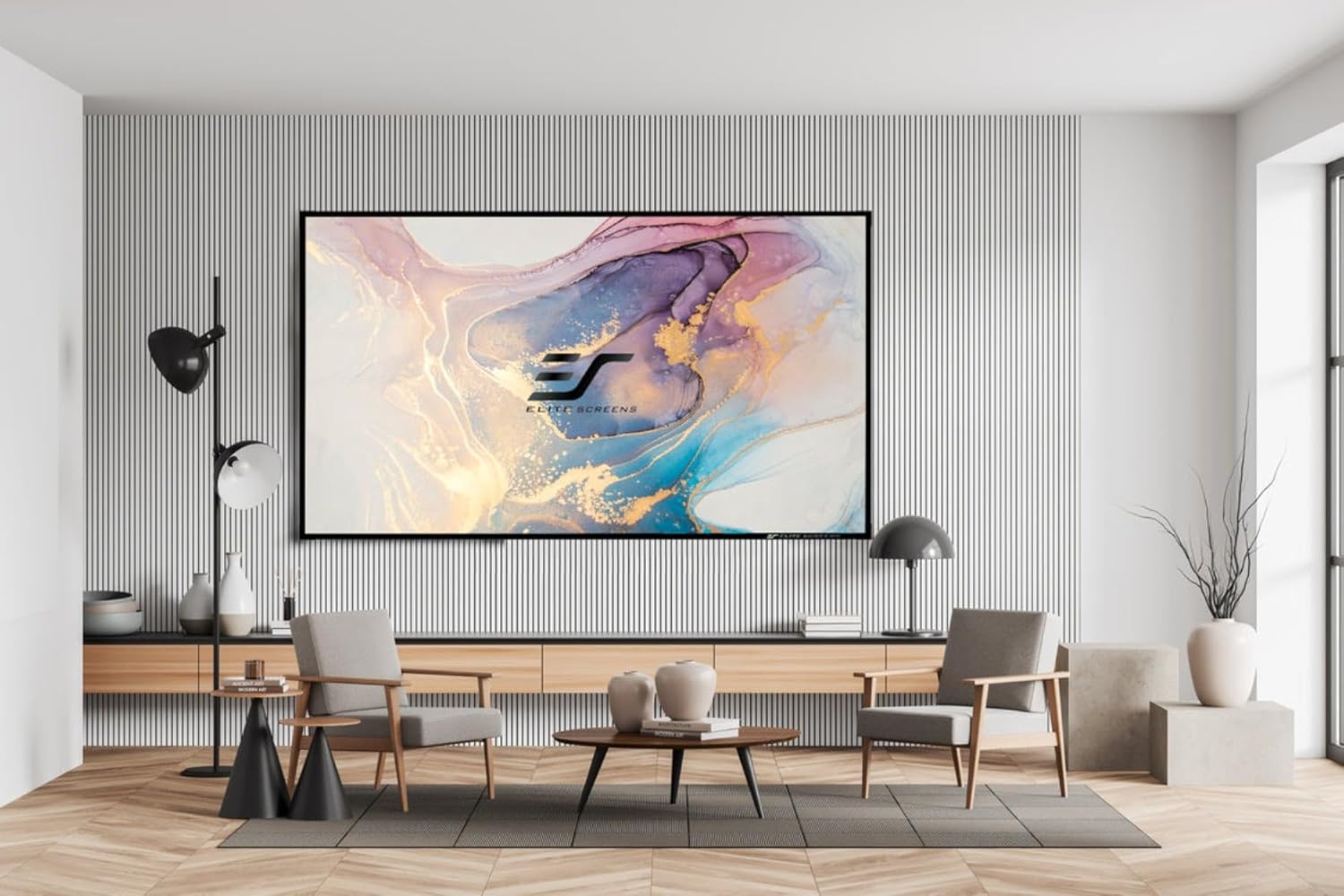
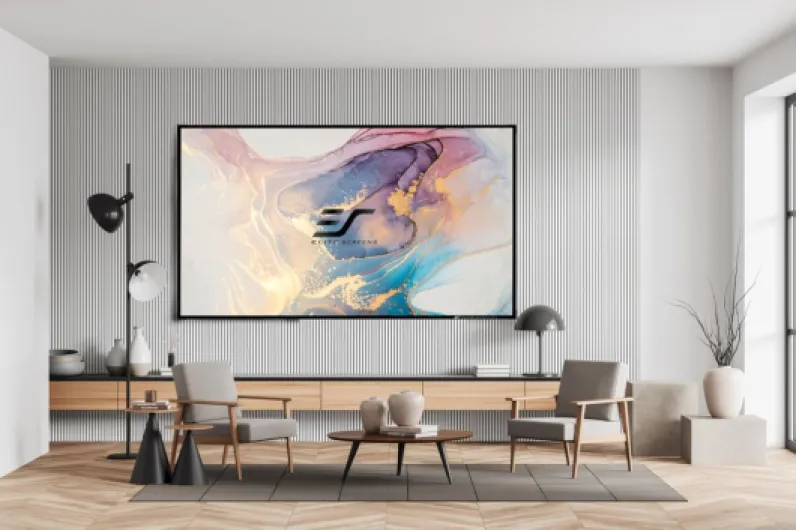
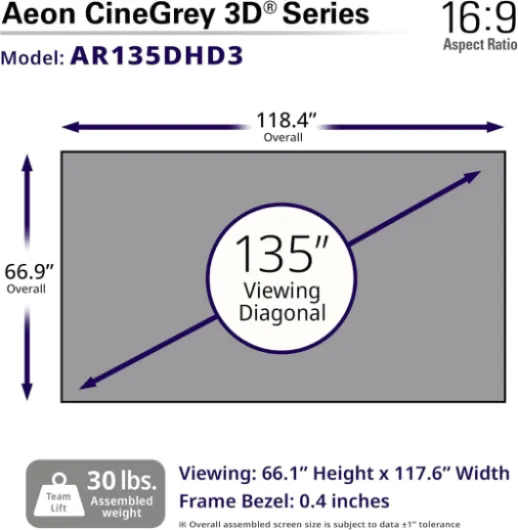
Design-wise, the Aeon CineGrey 3D is pretty straightforward: thin black frame, large grey surface, very minimal look. Once it’s on the wall, it honestly looks more like a giant modern panel than a classic projection screen. The bezel is slim enough that it doesn’t scream “office projector,” which is nice in a living room. One reviewer even said they liked how it looked when not in use, and I get that – it’s just a clean grey rectangle, not a wrinkly white roll-up hanging around.
The frame itself goes together with metal corner brackets and screws. When you’re assembling it, it feels decent but a bit flexible until everything is tightened and the screen is tensioned. After tensioning, it stiffens up and feels more solid. The trim that clips onto the edge is probably the weakest part design-wise. Some people mentioned it feels flimsy and barely hangs on. I had to press it firmly all around and re-seat a couple of sections that wanted to pop out. Once it’s in, it stays, but it doesn’t give a high-end impression during assembly.
From a viewing perspective, the thin frame plus grey surface works well. The grey helps your eyes lock onto the image, and the little black border gives enough contrast without being bulky. If you’re used to big black frames from TVs, this will look more discreet. Also, because the screen is matte and not glossy, you don’t get annoying reflections from room lights, which is important if you’re not in a totally dark space all the time.
Overall, I’d say the design is simple, functional, and modern, but you can feel this is a cost-conscious product once you’re up close and handling the parts. On the wall, it looks good. In your hands, especially the trim, it feels a bit budget. If your main goal is a clean, home-theater look without drawing attention to the hardware, it does the job well enough.
Materials & build: decent frame, hit-or-miss screen fabric
The frame is made from aluminium, which keeps it light enough to handle but still reasonably rigid once everything is tightened. The finish on my unit was consistent: no sharp edges, no obvious dents, and the corners lined up fine. You can tell it’s not super thick premium aluminium, but for a wall-mounted frame that doesn’t move, it’s enough. The hardware (screws, brackets) is basic but acceptable – nothing fancy, but nothing that felt like it would fail under normal use.
The screen surface is PVC with a matte grey CineGrey 3D coating. In practice, the material feels slightly thicker and more structured than cheap white screens I’ve used before. Once fully tensioned, it sits flat and doesn’t sag. That part is good. Where things get dicey is consistency. Some Amazon reviews mention circular mechanical swirl marks on the material right out of the box, and these weren’t just dust or light smudges – they didn’t come off with microfiber cleaning. That points to some manufacturing or handling issues at the factory level.
There are also reports of screen material cut to the wrong size (about 1.5 inches too short on width) and springs tearing the material around the edges on different models from the same brand. That’s not something I personally ran into, but it’s mentioned enough times that I’d take it seriously. It means you might get a perfect panel, or you might get a defective one and have to go through customer service, which isn’t fun with something this big and fiddly.
So in terms of raw materials, I’d rate it as pretty solid for the price, but with real quality control risks. If you get a good unit, the aluminium + PVC combo is totally fine for a fixed-frame screen, and it should hold up well as long as you don’t poke or scratch the surface. If you’re unlucky and get swirl marks or a mis-sized sheet, you’re going to spend more time fighting with support than actually enjoying the screen, which is the annoying part of this product line.
Durability & assembly: strong once mounted, annoying to get there
Durability here is split into two parts: how it survives assembly, and how it holds up once it’s on the wall. Once the frame is built, the springs are all attached, and the screen is tensioned, the whole thing feels stable. The aluminium frame doesn’t bend under its own weight, and the material stays flat. If nobody pokes it, scratches it, or throws things at it, it should last years without much change. There are no moving parts, no motor, nothing to wear out mechanically.
The risky part is really the assembly process. Several users mention assembly taking 4–5 hours, and that sounds about right if you’re being careful and doing it mostly alone. You’re stretching PVC material and hooking many springs around the edges. If you rush or misalign things, you can get ripples, or in worse cases, small tears near the spring holes (especially on some of the other Elite models). There was also that case where the tension rods and springs were the wrong sizes on a CineWhite variant, which turned assembly into a complete nightmare. On this CineGrey 3D, if everything is cut correctly, it’s more tedious than dangerous, but you still need patience.
In terms of long-term durability, the main enemies are: dust, scratches, and accidental impacts. The surface is not something you want to scrub hard. A soft microfiber cloth and gentle dabbing is as far as I’d go. If kids are throwing toys or controllers, this is not the screen you want at their height. It’s not fragile like glass, but it’s not bulletproof either. The frame and wall mounts, however, feel solid enough that you don’t worry about the thing falling off if it’s anchored correctly.
Overall, I’d say durability is fine once installed, but the combination of long assembly time and the chance of encountering a bad batch of material or mis-sized panels means there’s a bit of risk. If you’re unlucky and have to disassemble and re-pack for a return, that’s where this product becomes a huge pain, simply because of its size and how many springs and parts you’ve already put together.
Performance: picture quality boost, but know your projector
This is the part where the Aeon CineGrey 3D actually delivers. Compared to projecting on a white wall, the difference in contrast and perceived black levels is pretty clear. With a standard throw projector (think BenQ HT3550 or similar), in a room with some light control (blinds, but not total darkness), the image looks stronger and less washed out. One user summed it up well: with this screen, they can watch movies during the day instead of waiting until after sunset. I had a similar experience – the grey surface and ALR behavior help cut down some of the ambient light issues.
The matte finish and wide viewing angle mean that if you sit off-center, the picture doesn’t suddenly get weird or lose all its punch. Colors stay fairly consistent across the screen, and you don’t get hotspotting or shiny reflections like on some glossy panels. In a darker room, the image starts to look a lot like a very big TV. No, it doesn’t magically erase all ambient light, but it definitely holds up better than basic white screens.
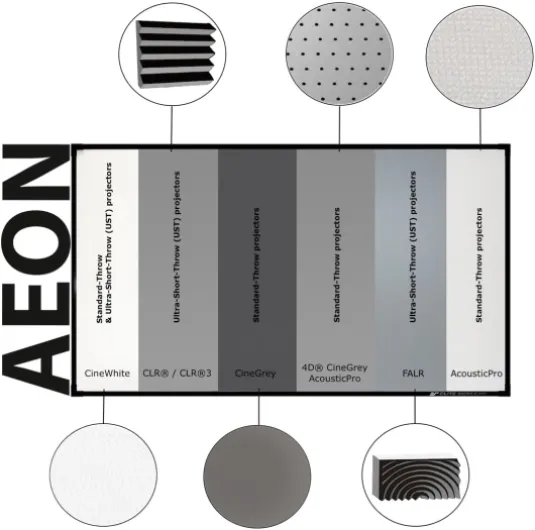
Important warning: this CineGrey 3D surface does not play nice with ultra short throw (UST) projectors. At least one review points this out very clearly. If you’re running a UST projector that sits right under the screen, this is the wrong material – you’ll get bad uniformity, hotspotting, or other artifacts. For UST you need a dedicated UST ALR screen, which is a different product line. So if you’re in the UST camp, skip this one entirely.
Day-to-day, I’d say the performance is good value for what you pay. It’s not on the level of high-end ALR screens that cost several times the price, but you also aren’t paying that kind of money. For normal throw projectors and mixed usage (movies at night, sports with a bit of light), it gets the job done and is a noticeable step up from a wall or basic white fabric. Just don’t expect miracles in a super bright room – at that point, no projection screen will save you.
What you actually get with the Aeon CineGrey 3D
On the specs side, this is the AR135DHD3 version: 135-inch diagonal, 16:9 ratio, with viewable dimensions around 299 x 168 cm. The frame is the Aeon style, which means a very thin bezel (about 1 cm visible), so you basically get a big grey rectangle on the wall instead of a chunky TV-like frame. The screen material is CineGrey 3D, designed for standard or short-throw projectors (but not ultra short throw), and it’s meant to help with ambient light compared to a classic matte white surface.
The structure is aluminium, and the screen itself is PVC, tensioned with a bunch of springs that you clip all around the frame. The viewing angle is listed as 180°, which in practice just means you can sit off to the side without losing too much brightness or color. Operation is fully manual – it’s a fixed-frame screen, so you mount it and it stays there, no motor, no roll-up, nothing fancy. Weight is about 13.7 kg, so not crazy heavy, but large enough that you’ll want at least two people to lift and hang it safely.
Out of the box, you get the frame pieces, corner brackets, tension rods, springs, the screen material rolled up, and a thin black border trim you can choose to install or skip. One user mentioned they didn’t even bother with the extra black border because the built-in bezel was enough, and I felt the same. The included hardware for wall mounting is basic but usable if your wall is solid. If you’re dealing with weak drywall or weird studs, you might want to buy better anchors separately.
In terms of expectations, I’d describe it like this: this is not a luxury screen, but it doesn’t feel cheap either. It sits in that middle zone: good enough materials, decent finish, but you can tell they cut some corners on quality control and packaging based on the number of reviews mentioning damaged or mis-sized fabric. If you go in thinking “mid-range product, mid-range consistency,” you’ll be less surprised than if you expect perfection out of the box.
Pros
- Clear improvement in contrast and perceived black levels compared to a white wall or basic white screen
- Large 135" size with a thin frame gives a clean, modern home-theater look
- Good performance in semi-dark rooms; still watchable with some ambient light
- Frame and tensioned PVC material feel solid and flat once fully assembled
Cons
- Assembly is long and fiddly, especially with all the springs on a 135" frame
- Quality control issues reported (swirl marks, mis-sized material batches)
- Customer service feedback is mixed, making defects more painful to resolve
- Not compatible with ultra short throw projectors despite some confusing listings
Conclusion
Editor's rating
Overall, the Elite Screens Aeon CineGrey 3D does what most people actually want: it makes a projector setup look more like a proper home theater and less like a washed-out wall. The grey CineGrey 3D surface gives a clear bump in contrast and makes content more watchable in rooms that aren’t fully dark. With a decent standard-throw projector, the image looks sharp, colors hold up well, and the thin frame gives a clean, modern look on the wall. For the price bracket, the on-screen result is honestly the strong point here.
On the flip side, you pay for that with time, patience, and some risk. Assembly is long and a bit tedious, especially on a 135" version. Quality control is not perfect – some people got panels with swirl marks or wrong sizing – and Elite’s customer service reviews are mixed at best. If you’re unlucky and run into a defect, dealing with a return or fabric replacement on a screen this big is a real hassle. Also, this material is not for ultra short throw projectors, so UST users should skip it outright.
If you’re handy, patient, and using a regular or short-throw projector in a semi-controlled room, I think this screen gets the job done and gives good value for money. If you’re easily frustrated by DIY, expect white-glove service, or are running a UST projector, it’s probably better to look elsewhere, even if it means spending more or going down a size.