
Summary
Editor's rating
Is it worth the money compared to other cheap DACs?
Small, metal, and easy to hide behind the TV
Build quality and heat, plus the power adapter situation
Daily use, reliability and noise issues over time
Sound quality and real-life use with TV, console and CD player
What this DAC actually does (and what it doesn’t)
Pros
- Solid metal housing with stable optical and RCA connectors
- Clean enough stereo output over RCA for TV, movies and casual music
- Handles both optical and coaxial inputs with simultaneous RCA and 3.5 mm outputs
Cons
- Noticeable background hiss on the 3.5 mm jack with sensitive headphones
- No 5V 1A power adapter included, and TV USB power can add some noise

Specifications
View full product page →| Brand | PROZOR |
A tiny box that fixes a very modern problem
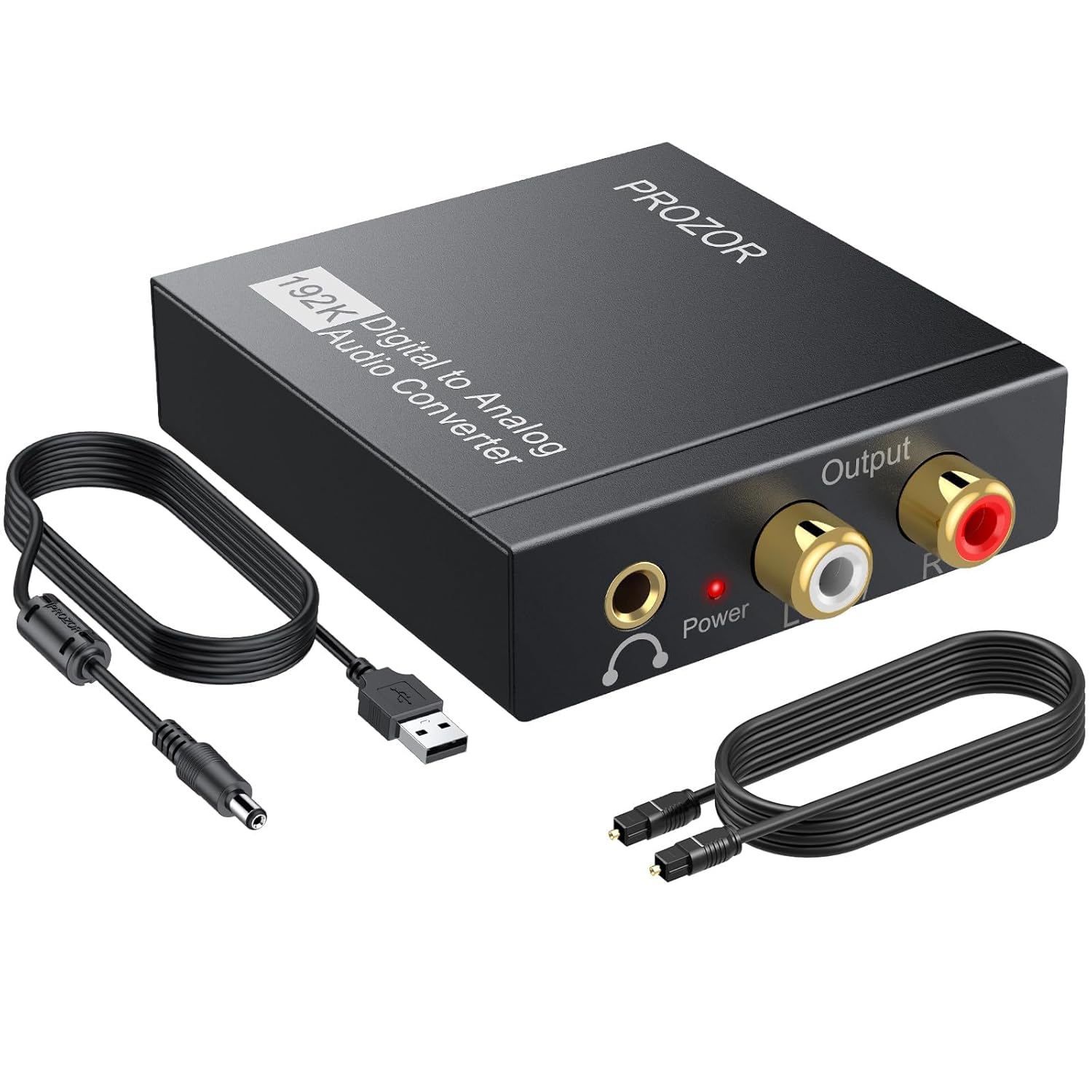
The short version: this PROZOR 192KHz DAC is that small, boring-looking box you end up buying when your nice new TV has only optical out, and your old speakers or amp only take RCA or 3.5 mm jack. That’s exactly why I picked it up. I didn’t want to replace decent speakers just because TV manufacturers decided to kill the headphone jack and analog outputs.
In my case, I tested it between an LG TV (optical out) and a pair of active bookshelf speakers that only have RCA inputs, plus a cheap amp for a sub. I also tried it briefly with a PS4 and a Blu-ray player just to see if it behaves any differently. Spoiler: it doesn’t, and that’s a good thing. It’s basically plug, set audio to PCM, and forget it.
The main thing to understand is that this is a basic stereo DAC, not some audiophile toy and not a 5.1 home cinema decoder. It takes digital optical or coaxial in, spits out analog stereo on RCA and 3.5 mm at the same time. That’s it. No volume knob, no fancy settings, no remote, nothing smart. It just sits there and does the conversion.
After a couple of weeks of use, my overall feeling is: it’s not perfect, but it does what I bought it for, and for the price I paid, I’m fine with the small flaws. If you expect studio-grade sound, you’ll be disappointed. If you just want to get sound from a modern TV into older speakers without headaches, it’s a pretty solid option.
Is it worth the money compared to other cheap DACs?
In terms of value, I’d say this PROZOR DAC sits in that sweet spot of “cheap but not total junk.” There are slightly cheaper no-name converters on Amazon and eBay, usually in flimsy plastic housings with questionable reviews. I’ve tried one of those before: it worked, but the optical port was loose, and it introduced a faint buzz that drove me nuts at low volume. This PROZOR costs a bit more, but you get the metal case, more consistent sound, and better overall build.
What you’re paying for here is mainly: reliability, metal housing, support for both optical and coaxial, and dual outputs (RCA + 3.5 mm). If you just need the absolute cheapest way to get any sound at all, you can gamble on a lower price model. But for a living room setup you use every day, I’d rather spend a few extra euros on something that doesn’t feel like it’ll break in six months. For me, the price-to-annoyance ratio is good: I installed it once, set the TV to PCM, and haven’t had to touch it since.
On the downside, you do have to factor in the cost of a 5V 1A adapter if you don’t already own one. That can eat a bit into the value. And if you’re picky about sound or want a cleaner headphone output, you might want to jump to a slightly more expensive DAC with a volume knob and dedicated headphone stage. Those exist and are better suited for desk listening.
For the typical use case—connecting a modern TV or console to older speakers, a mini amp, or a small sub amp—this thing is good value for money. It’s not trying to compete with hi-fi DACs; it’s a practical bridge between digital and analog. If you accept that and don’t expect magic, the price makes sense and is easy to justify compared to buying a whole new sound system.
Small, metal, and easy to hide behind the TV
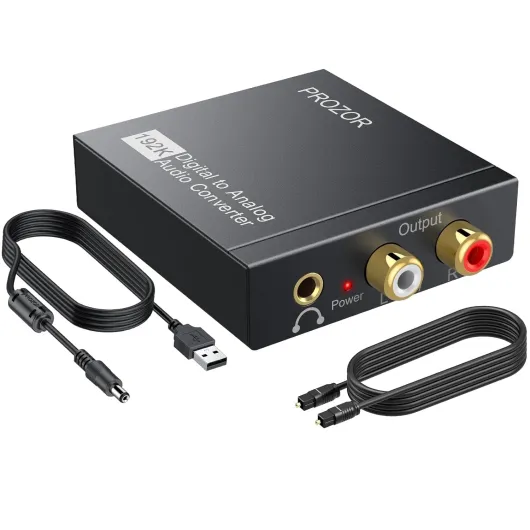
Design-wise, the main thing I noticed is how small and light this thing is. It’s roughly the size of a matchbox, maybe a bit thicker, and weighs almost nothing. That’s nice if you want to hide it behind a TV or tape it to the back of a piece of furniture. On the flip side, because it’s so light, the weight of stiff RCA or optical cables can pull it around a bit, so I ended up using a bit of double-sided tape to keep it in place.
The housing is aluminum alloy, which is a plus compared to all the plastic DACs in the same price range. It doesn’t feel fancy, but it does feel more solid than the usual cheap plastic boxes. The metal case should help a bit with electromagnetic noise and heat dissipation. In practice, it only gets slightly warm even after several hours of use, nothing alarming. I had it sitting between a modem, a console, and a TV, and it behaved fine.
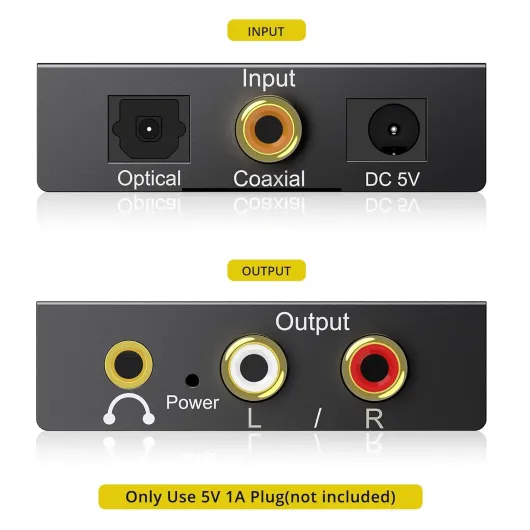
Connectors are straightforward: optical and coax on one side, RCA and 3.5 mm on the other, plus the power jack. The RCA connectors are gold-plated, which is nice mostly for corrosion resistance and repeated plugging/unplugging. I didn’t hear a night-and-day difference compared to normal RCAs, but it’s not a bad thing to have. The optical port feels reasonably tight; the cable clicks in and stays put, not loose like some very cheap boxes I’ve tried before.
There’s a tiny power LED that shows when it’s on. No input selector, no switches, no volume. It auto-detects the input you use; you just plug either optical or coax, not both. Overall, the design is functional and no-nonsense. It’s clearly made to disappear into your setup, not to be shown off. For what it is, I’m happy with the form factor and the fact that it’s metal and not flimsy plastic.
Build quality and heat, plus the power adapter situation
The materials are pretty straightforward but better than the usual bottom-of-the-barrel stuff. The aluminum alloy case is the main positive point. It feels solid enough that I’m not worried about it cracking or flexing if it gets knocked around while cleaning behind the TV. I’ve had cheaper plastic DACs where the casing started to creak or the connectors got loose after a few cable swaps; this one feels more robust, and the connectors stay tight.
The RCA jacks being gold-plated is a small touch, but it’s still a plus, especially if you plan to leave it connected for years in a dusty TV cabinet. Corrosion shouldn’t be an issue, and repeated plugging/unplugging feels firm with no wobble. The optical port is also decently made; the cable clicks in solidly and doesn’t fall out with a light tug on the wire. That’s not always the case on cheaper gear, where the optical cable barely holds.
On the power side, the included cable is fine, but there is no 5V 1A adapter provided. That’s one of the downsides. I get that it keeps the cost down, but it also means you either use a spare phone charger or the TV’s USB port. PROZOR says to avoid using the TV USB and to use a proper adapter instead. I tried both. With a cheap phone charger, it was stable and quiet. With the TV USB, the DAC still worked, but I felt the 3.5 mm output was a bit noisier. Not a huge difference, but noticeable with headphones.
Heat and durability-wise, after several sessions of 3–4 hours, the box was only slightly warm, never hot. It sat on a wooden shelf with other electronics around, and I didn’t see any weird behavior, dropouts, or random resets. Given the metal casing and the very simple electronics inside, I’d expect it to last a while unless the power supply you use is junk. So overall, materials and build are pretty solid for the price, with the only real complaint being the missing wall adapter.
Daily use, reliability and noise issues over time
I’ve been using this DAC almost daily for a couple of weeks in a pretty typical living room setup: TV, console, Wi‑Fi router, and a bunch of cables all tangled together. So far, no dropouts, no random shutdowns, no overheating. It just turns on with the TV, does its job, and I forget it’s there. That’s honestly what I want from a little converter like this.
The metal housing gives a bit of confidence in terms of long-term durability. I’ve accidentally tugged on the cables a few times while rearranging things, and nothing loosened up. The RCA ports still feel tight, and the optical cable hasn’t started to wiggle or lose connection. On really cheap plastic DACs I’ve used before, I’ve had the optical port get flaky after a few months, where the slightest touch would kill the sound. No sign of that here yet.
The only small concern in terms of “long-term comfort” is the background noise on the 3.5 mm jack. It’s always there at a low level when using sensitive headphones, even with a decent 5V adapter. It doesn’t seem to be getting worse over time, it’s just how this DAC is built. Through RCA into an amp or powered speakers, the noise floor is much lower and basically disappears in normal use. So if you plan to use this mainly as a headphone DAC, I’d say look for something else. As a TV-to-speakers bridge, it’s fine.
Given the low price, I wasn’t expecting miracles in terms of component quality, but the fact that it’s been stable, doesn’t run hot, and doesn’t feel fragile is already a good sign. If something fails in the long run, my bet would be on the cheap power adapter most people will use, not the DAC itself. For now, I’d call the durability decent and reassuring enough for a small, always-on box behind the TV.
Sound quality and real-life use with TV, console and CD player
On performance, my main observation is: it gets the job done for everyday use, with some minor noise on the 3.5 mm output but nothing dramatic on RCA. I used it mainly from an LG TV optical out into a pair of active speakers via RCA, and occasionally into a small subwoofer amp. For movies and casual listening, it sounded clean enough. Voices are clear, no obvious hiss from a normal sitting distance, and no audio delay that I could notice compared to the TV’s internal speakers.
To push it a bit, I also hooked up an older CD player through coaxial into a cheap mini amp that doesn’t have its own DAC. Compared to using the amp’s analog input directly from the CD player’s headphone out, the PROZOR gave a noticeable improvement: less background noise, better channel balance, and overall a more stable sound. It’s not some big revelation, but for a low-cost box, it’s decent. One Amazon reviewer called it junk; honestly, for this price range, I think that’s harsh unless you’re very picky.
Where it’s weaker is the 3.5 mm jack. Like another user mentioned, there is a bit of background noise if you plug sensitive headphones or a small powered speaker directly. With my in-ear headphones, I could clearly hear a low-level hiss when nothing was playing. Through RCA into an amp, the noise was much lower and basically inaudible at normal listening volume. So my takeaway: use the RCA outputs whenever you can, and keep the 3.5 mm as a backup or for non-critical use.
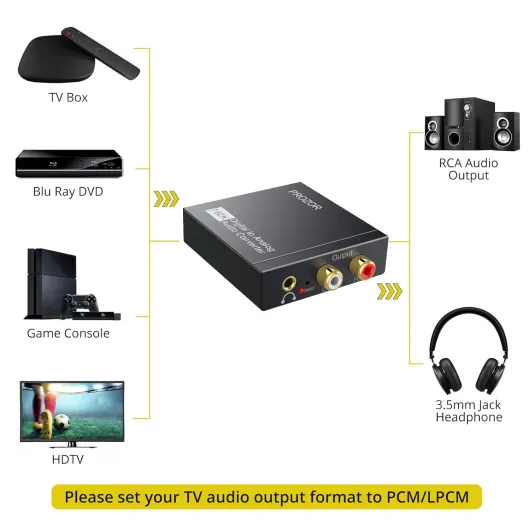
Latency-wise, I didn’t run into any lip-sync issues. I watched Netflix and some YouTube through the TV using optical + PROZOR + speakers, and lips matched the sound fine. Just remember to set your TV audio output to PCM, and sometimes you’ll need to adjust the digital output volume in the TV settings since the TV remote volume often won’t control the optical output directly. Once I tweaked that, it behaved consistently. For TV, gaming, and casual music, I’d rate the performance as “good enough” and better than I expected at this price.
What this DAC actually does (and what it doesn’t)
The main factual point: this box converts digital audio (optical/coaxial) to analog stereo (RCA + 3.5 mm). That’s all. It supports up to 192 kHz / 24-bit PCM, but in normal TV use you won’t really think about those numbers. What matters is: if your TV or console has optical out and your speakers/amp only have RCA or aux, this sits in the middle and makes them talk to each other.
On the back you’ve got: one Toslink optical input and one coaxial input. On the other side, two RCA outputs (left/right) and a 3.5 mm jack. Power comes from a micro-USB-like cable (included), but no wall adapter is in the box. You’re supposed to use a 5V 1A adapter. It can be powered from a TV USB port, but the brand clearly says to prefer a proper adapter. I tried both. It worked from the TV USB, but I did notice a bit more background noise on the 3.5 mm when powered that way.
Important limitation: it only handles stereo PCM/LPCM. If your TV or console is set to Dolby Digital, DTS, or some 5.1 format, you’ll get silence or weird noise. On my LG TV I had to go into sound settings and force the optical output to PCM. Same thing with the PS4 – switch output format from bitstream to PCM and it’s fine. Once you’ve done that, it just works and you don’t touch it again.
So in practice, the PROZOR DAC is a small utility piece of gear. It’s not trying to be a high-end Hi-Fi DAC, and if you keep that in mind, it makes sense. It’s for people who want to reuse existing speakers, add a subwoofer amp to a TV, or feed a basic mini-amp from a digital source. If you need surround decoding or fancy features, this is the wrong product.
Pros
- Solid metal housing with stable optical and RCA connectors
- Clean enough stereo output over RCA for TV, movies and casual music
- Handles both optical and coaxial inputs with simultaneous RCA and 3.5 mm outputs
Cons
- Noticeable background hiss on the 3.5 mm jack with sensitive headphones
- No 5V 1A power adapter included, and TV USB power can add some noise
Conclusion
Editor's rating
Overall, the PROZOR 192KHz DAC is a practical little box that solves a common problem: new TVs and consoles only have digital outputs, while many decent speakers and amps are still analog. It converts optical or coaxial to RCA and 3.5 mm cleanly enough for everyday use, without fuss and without a pile of settings. The metal housing, gold-plated RCA ports, and stable behavior make it feel a step above the really cheap plastic converters.
Sound quality is fine for TV, movies, gaming, and casual music. Through the RCA outputs into an amp or powered speakers, noise is low and there’s no obvious delay. The 3.5 mm jack is the weak point, with some audible hiss on sensitive headphones, so I’d avoid using it as a primary headphone DAC. You also need to remember to set your TV or console to PCM output, and you’ll probably have to dig into your TV settings to adjust optical volume, since the remote often doesn’t control it directly.
If you want to reuse old speakers, add a subwoofer amp to a TV, or feed a simple mini amp from a digital source, this DAC makes sense and offers good value for money. If you’re chasing audiophile sound, need 5.1 decoding, or want a super clean headphone output with a volume knob, you should look at higher-end models instead. For most everyday users, though, this is a small, cheap fix that quietly does its job.