
Summary
Editor's rating
Value for money: where this screen makes the most sense
Design and assembly: not hard, but not a 10-minute job either
Build quality and materials: good where it matters
Durability and long-term use: what seems solid and what might age
Image performance: how it actually looks with a projector
What you actually get with this 120" Silver Ticket screen
Does it actually improve your setup compared to a wall or cheap screen?
Pros
- Sturdy aluminum frame with black velvet border that hides minor projector misalignment
- Flat, tensioned 1.1 gain white surface that gives a clean, uniform image at 120"
- Good price-to-quality ratio for a fixed-frame screen, with decent materials and hardware
Cons
- Assembly is a bit physical and time-consuming, especially tensioning the material and installing the support bar
- Not acoustically transparent and not an ALR screen, so limited for bright rooms or behind-screen speaker setups

Specifications
View full product page →| Brand | Silver Ticket Products |
A big screen upgrade without going broke
I picked up the Silver Ticket STR Series 120" (STR-169120) because I was tired of projecting on a bare wall and on a cheap pull-down screen that always had waves and wrinkles. I use it mainly for movies and sports in a living-room-style setup, not a fully treated home theater. I mounted it with a ceiling projector (Epson-style LCD, similar to what a lot of people use) at about 12–13 feet back. So this is coming from someone who actually built and mounted the thing, not just unboxed it and stared at it.
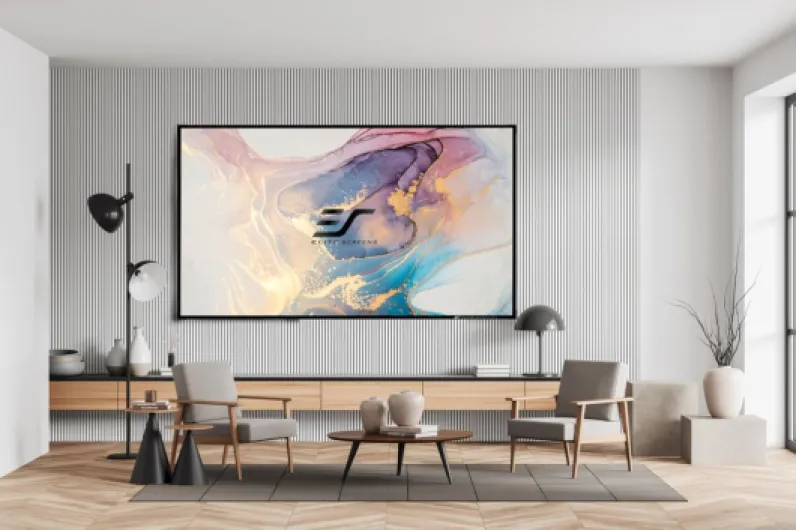
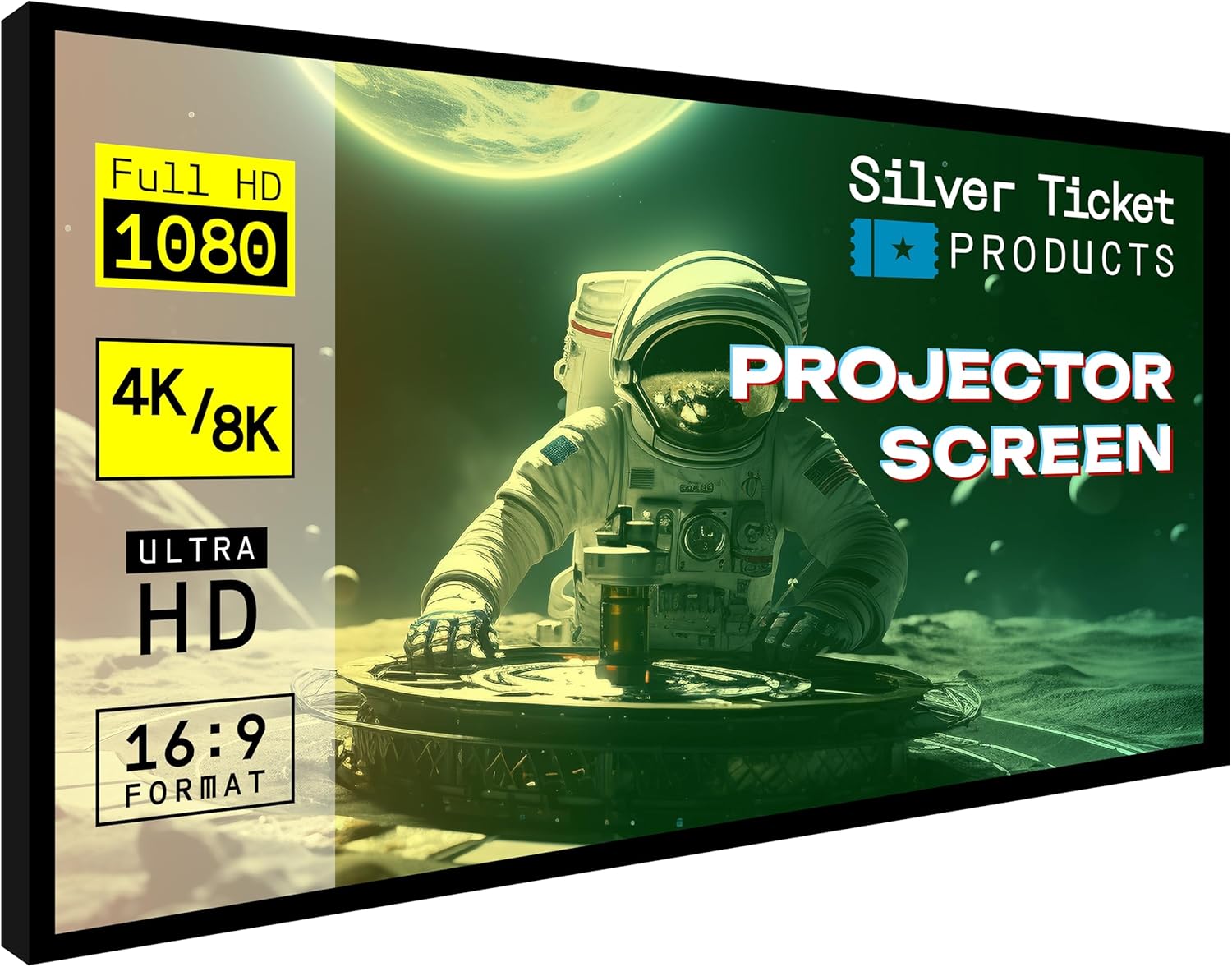
First impression: it’s big, it’s not light, and it looks more "serious" than the price suggests. The frame is aluminum with black velvet, and once it’s on the wall it gives a clean, TV-like look, just much larger. I didn’t measure with pro tools, but compared to my old 100" manual screen, the image looks sharper and the colors pop more simply because the surface is flatter and more uniform.
Assembly and mounting took me roughly two hours with breaks, and I’d say that’s realistic for most people. It’s not complicated, but it is a bit physical: you’re on the floor, stretching vinyl, snapping in rods, then lifting a 120" frame onto a wall. If you expect "five minutes and done", you’ll be disappointed. If you’re okay with a little DIY, it’s fine. I did need a second person to help hang it; doing that step alone with a 120" size is asking for a dent in your wall or frame.
Overall, my early feeling after a few evenings of watching movies and some gaming is that this screen is pretty solid for the money. It’s not perfect, and you can definitely spend more to get fancier materials or acoustically transparent fabric, but for a straightforward 16:9 120" fixed screen, it hits a good balance between price, build, and image quality. In the rest of the review I’ll go through the build, the image, how annoying the assembly really is, and who I think this is suited for.
Value for money: where this screen makes the most sense
Considering the build quality and size, the value is pretty good. You’re getting a 120" fixed frame with a solid aluminum structure, decent screen material, and a clean look on the wall, without paying the premium of high-end brands or fancy ALR fabrics. If you’re upgrading from a blank wall or a cheap pull-down, the improvement justifies the cost in my opinion, as long as you actually use your projector regularly.
Where this screen really hits the sweet spot is for people with mid-range projectors (Epson, Optoma, BenQ, Sony entry lines, etc.) who want a proper dedicated surface without diving into the high-end home theater rabbit hole. For that crowd, the price-to-result ratio is strong. You’re not paying for marketing gimmicks; you’re paying for a sturdy frame and a flat, neutral white surface that lets your projector do its job.
If you need acoustic transparency, ALR performance, or a different aspect ratio, then this model is less interesting. You’d have to spend more on specialized materials. Also, if you’re in a very casual setup where you only watch a movie once a month, a cheaper manual screen or even a painted wall might be “good enough,” and the extra spend here might feel overkill.
For my use—movies and sports several times a week in a semi-dark room—I’d say the screen offers good value for money. It’s not the cheapest way to get an image on a wall, but it’s a relatively affordable way to get a proper, fixed, home-theater-style screen that looks and feels more serious than its price tag suggests. Just factor in the time and minor hassle of assembly as part of the “cost.”
Design and assembly: not hard, but not a 10-minute job either
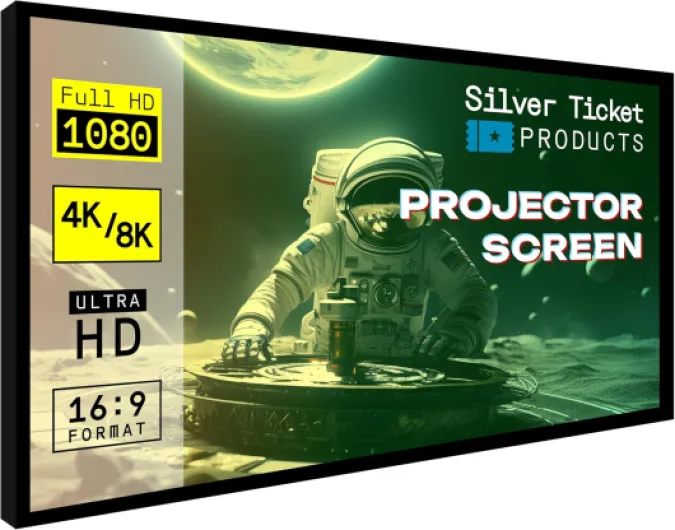
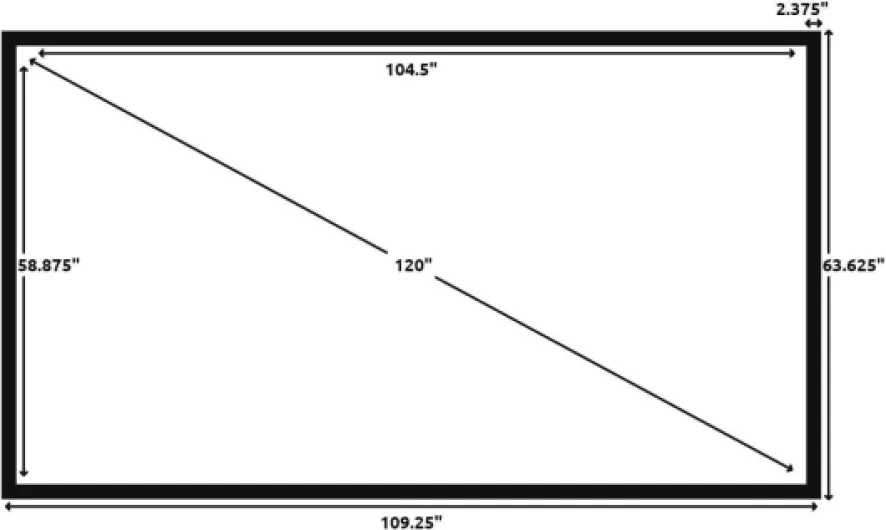
Design-wise, the screen is pretty straightforward: thick aluminum frame, black velvet wrap, white vinyl center. Nothing fancy, but it looks clean. The 2 3/8" beveled frame is actually a nice touch because it hides small projector alignment errors; if your image spills a bit over the white area, the velvet just absorbs it. In my case, I didn’t have to obsess over perfect keystone and lens shift because the frame forgave a few millimeters of slop.
Assembly is where you spend most of your time. You lay everything on the floor, connect the frame pieces with metal brackets, then lay the screen material inside and start inserting the tension rods around the edges. After that, you clip the material to the frame with a bunch of small plastic tabs. The first side feels easy, but by the last side you’re stretching the material quite a bit. It’s not impossible, but your fingers will feel it. I’d say the tensioning rod system works well, because once all clips are in place the screen is flat and wrinkle-free. Just don’t rush it, or you’ll misplace a clip and have to backtrack.
The center support bar is the part a lot of people complain about, and I get why. If you follow the instructions, it’s fine: you slot it into the top and bottom rail and may need a rubber mallet or some pushing to get it fully seated. I had to loosen a few clips, nudge the bar in, then re-clip the material. It’s a bit fiddly but doable. If you try to improvise and ignore the instructions, that’s when you’ll get annoyed. My advice: actually read the manual once before starting, and keep it next to you.
Once assembled, the frame feels solid and rigid. There’s no wobble when you lift it, and the corners line up straight. On the wall, it looks like a giant flat TV, which for a dedicated space is exactly what you want. It’s not a design object you stare at with the lights on, but in practice it looks clean and "finished" enough that it doesn’t scream cheap DIY, which is what I was trying to avoid.
Build quality and materials: good where it matters
For the price bracket this screen sits in, the materials are pretty solid. The frame is extruded aluminum, not flimsy tin. When you tighten the corner brackets, the whole structure locks up well. I didn’t notice any flex once everything was screwed together. The black velvet wrap on the frame is evenly applied and does a decent job absorbing stray light. If you run your hand along it, it feels like basic velour, not luxury stuff, but visually it does the job: you don’t get bright reflections on the border, and it hides minor focus or alignment issues.
The white vinyl screen material is slightly stretchy and has a smooth finish. Up close, you can see a light texture, but from normal viewing distance (say 10–12 feet for a 120" screen) it just looks uniform. I didn’t see any obvious hotspots or shiny patches once the projector was on. The 1.1 gain rating feels realistic to me: it’s a touch brighter than my old matte white pull-down, but not so much that it kills black levels.
The plastic clips and tension rods are the weaker-feeling parts in the hand, but they still function fine. The clips are small and a bit stiff the first time you use them, but they hold tension well and I didn’t break any during assembly. You also get a few spares in the box, which is reassuring. The support bar is just a simple metal bar, nothing fancy, but it keeps the center of the screen from bowing in or out, which is what you want in the long run.
Packaging was decent: everything was well protected, no dents on the frame pieces, and the screen material arrived clean with no marks or creases that wouldn’t pull out during tensioning. For a mid-priced fixed screen, I’d rate the materials as good value for money. You can find more premium fabrics or acoustically transparent weaves, but then you’re also spending a lot more. Here, you’re getting a sturdy frame and a clean surface that doesn’t feel like a toy.

Durability and long-term use: what seems solid and what might age
I haven’t had this screen for years, but after assembling it and using it regularly for a while, I can at least judge how it feels and what’s likely to hold up. The aluminum frame is the main reason I’m not worried: once it’s on the wall, it’s not going anywhere unless you physically knock it down. There’s no moving parts like on a motorized screen, so there’s very little to break in normal use.
The vinyl screen material is under constant tension from the rod and clip system. That’s good because it keeps the surface flat, but it also means all those clips are doing real work. So far, the tension has stayed consistent, and I haven’t seen any sagging or wrinkling reappear. The center support bar should help keep it from bowing over time. If something were to wear out, my guess would be the clips or maybe the vinyl stretching slightly over several years, but the design gives you a bit of headroom because the material starts fairly tight.
The velvet on the frame will attract dust and the odd fingerprint, but that’s mostly a cosmetic issue. A lint roller or gentle vacuum takes care of it. I don’t see the velvet peeling off easily unless you scrape it against something sharp. As long as you don’t keep hitting the frame with furniture, it should look fine for a long time.
One practical note: this thing is about 33 pounds and quite large, so mounting it properly matters for durability. Use decent wall anchors or go into studs, especially at this width. If you half-ass the mounting and the frame falls, that’s on the install, not the product. Overall, for a fixed screen, there isn’t much that can mechanically fail, and the materials feel robust enough that I’d expect it to last several years without drama in a normal home setup.
Image performance: how it actually looks with a projector
In day-to-day use, the image quality is clearly better than a bare wall or a cheap pull-down screen. I ran it with a bright 4K-capable projector in a semi-light-controlled room (curtains but white walls and ceiling). With lights dimmed and curtains closed, the picture looks sharp and contrasty enough for movies and gaming. Black levels obviously depend on your projector, but the screen is neutral enough that it doesn’t wash things out more than necessary. Compared to my old wall setup, darker scenes in movies finally look like they should, without that grey haze.
The claimed 160° viewing angle seems believable. I sat off to the side, almost at the edge of the couch, and the brightness drop-off wasn’t dramatic. Colors stayed consistent too, which matters if you have friends over and not everyone is centered. This is where a simple matte white surface does well: it spreads light evenly instead of trying to boost gain and narrowing the sweet spot.
On content: 1080p Blu-rays, 4K streaming, and console gaming all look clean. I didn’t notice any obvious texture or sparkle, even on bright scenes like snow or sky. A couple of users mentioned pairing it with Epson and Sony projectors and getting good results, and I’d agree. For HDR content, keep your expectations in check—projectors are limited there—but the screen itself doesn’t get in the way. It just reflects what the projector gives it.
Where it’s less ideal is in bright rooms with lots of ambient light. This is a standard white material, not an ambient light rejecting (ALR) surface. If you leave blinds open during the day, blacks will lift and the image will look flatter. In my room, with curtains closed, it’s fine. With curtains open on a sunny afternoon, it’s watchable for sports but not great for dark movies. So in performance terms, it’s strong in a dim or dark room, decent in moderate light, and not the right tool if you want a “daytime TV replacement” without light control.
What you actually get with this 120" Silver Ticket screen
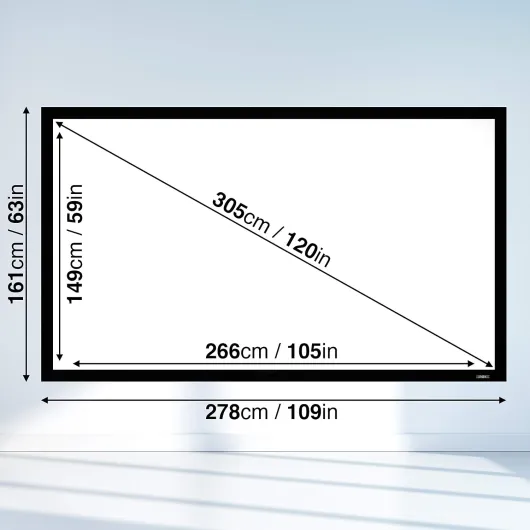
This specific model is the STR-169120, a 120" diagonal, 16:9 fixed-frame projection screen. The outer dimensions are roughly 109.25" wide by 63.6" tall, so it’s a big rectangle on your wall. The viewing area is a bit smaller (about 104.5" x 58.9"), which matches the usual 120" 16:9 format. It’s designed to be wall-mounted only: there are no legs, no stand, and no way to use it as a portable screen unless you start hacking something together yourself.
The frame is made from aluminum sections wrapped in black velvet. Inside that frame, you have a white vinyl screen material with a rated 1.1 gain and a quoted 160° viewing angle. In normal words: it’s a slightly brightened matte white surface that doesn’t narrow the viewing cone too much, so people sitting off to the side can still see a decent picture. It supports Full HD, 4K, 8K, and 3D, but honestly any half-decent screen does that; the point is that it’s smooth enough that you don’t see texture from normal viewing distance.
The mounting system is simple: two horizontal brackets that you screw to the wall, then the frame hooks onto them and can slide left and right for final adjustment. There’s no up/down adjust once the screws are in, so you want to measure your height before drilling. The screen material is tensioned by a rod and clip system: you slide rods into the edges of the fabric, then hook them to the frame with plastic clips all around, plus a central support bar to avoid sagging.
On the compatibility side, the listing says it works with long, short, and ultra short throw projectors, but they also warn that some UST projectors are not compatible with the STR frame and recommend the S7 frame series for UST. Personally, I’d take that warning seriously. If you’re using a UST, I’d double-check clearance and maybe look at the S7 instead. For regular ceiling or shelf-mounted projectors with native 16:9, this model fits right into the usual home setup without drama.
Does it actually improve your setup compared to a wall or cheap screen?
In practice, the big question is: does this screen make a noticeable difference compared to just using a wall or a budget roll-down? For me, yes. The first thing I noticed was how much more uniform the image looked. My old manual pull-down had slight waves, and during panning shots you could see the light bending in weird ways. With this fixed frame, everything is flat, so motion looks smoother and you don’t get those distracting ripples.
Color and contrast also benefit from the more neutral and consistent surface. On my off-white wall, whites were never really white, and colors had a slight tint. On this screen, whites look closer to what they should be, and skin tones are more stable. A couple of 4K movies I know well (like big outdoor scenes and dark interiors) clearly looked more controlled. It’s not that the screen is performing miracles; it’s just not messing things up, which is what you want.
For gaming, the screen keeps things sharp enough that HUD elements and small text are easy to read from a normal couch distance. There’s no added lag from the screen itself, obviously, but the cleaner image makes fast-moving games easier on the eyes. For sports, the wide viewing angle is handy: people scattered around the room still see a decent picture without having to fight for the middle seat.
Where the effectiveness is limited is in rooms with poor light control. If you have white walls, no curtains, and ceiling lights on, this screen won’t magically fix that. You’ll still get washed-out blacks. Also, the material is not acoustically transparent, so if you dream of hiding speakers behind the screen, this model isn’t the right pick. But if your main goal is to get a flat, neutral, and decent-looking 120" surface that makes good use of a mid-range projector, it absolutely gets the job done.
Pros
- Sturdy aluminum frame with black velvet border that hides minor projector misalignment
- Flat, tensioned 1.1 gain white surface that gives a clean, uniform image at 120"
- Good price-to-quality ratio for a fixed-frame screen, with decent materials and hardware
Cons
- Assembly is a bit physical and time-consuming, especially tensioning the material and installing the support bar
- Not acoustically transparent and not an ALR screen, so limited for bright rooms or behind-screen speaker setups
Conclusion
Editor's rating
Overall, the Silver Ticket STR-169120 120" screen is a solid fixed-frame option if you want a big, clean-looking image without spending crazy money. The aluminum frame is sturdy, the black velvet border helps hide small alignment errors, and the white 1.1 gain material gives a flat, neutral surface that works well with most 16:9 projectors. In a dim or dark room, the picture looks sharp and uniform, and the wide viewing angle keeps things watchable even for people sitting off to the side.
It’s not perfect. It’s not acoustically transparent, it’s not an ambient light rejecting screen, and the assembly takes some effort, especially stretching the material and dealing with the center support bar. If you have a very bright room or you want speakers behind the screen, this is not the right product. But if you have at least some light control and you’re okay with a bit of DIY, you get a big, stable 120" screen that feels more premium than the price suggests.
I’d recommend it to anyone with a mid-range projector who actually uses it several times a week and wants a more “real” home theater feel. I’d skip it if you’re just dabbling with projection, if you’re in a fully bright living room all the time, or if you specifically need advanced features like acoustic transparency or ALR surfaces. For a straightforward, wall-mounted, 16:9 120" setup, it gets the job done well and should last for years.