
Summary
Editor's rating
Value: worth it if your projector and room justify it
Big, black, heavy – looks pro but you feel the weight
Materials and build: solid base, delicate screen surface
Durability and long-term feel after a few weeks
Picture performance: big jump over a wall, especially in daylight
What you actually get out of the box
Everyday effectiveness: syncing, noise, and actual ease of use
Pros
- Strong ALR performance with UST projectors, making daytime viewing much more comfortable than on a white wall
- Motorized floor-rising design hides the screen when not in use and requires no wall or ceiling drilling
- Large 120-inch size with good flatness once fully extended and wide usable viewing angle for group viewing
Cons
- Very large and heavy base, not easy to move and needs a lot of floor and wall space
- Pricey compared to fixed ALR screens; not great value if you only watch in a dark room or have a low-brightness projector
- Manual only in English and included wall supports may be too weak for secure wall mounting of such a heavy unit

Specifications
View full product page →| Brand | NothingProjector |
A serious screen if you’re done projecting on the wall
I’ve been using this NothingProjector 120-inch motorized ALR screen for a few weeks with an ultra short throw laser projector, after years of just projecting on a painted wall and then on a basic white pull-down screen. I’ll be blunt: going from wall/cheap screen to this kind of ALR UST screen is not a small upgrade, it’s a pretty big visual jump, especially in a bright living room. But it’s also a big, heavy piece of kit that needs a bit of planning and isn’t exactly cheap, so it’s worth knowing what you’re getting into.
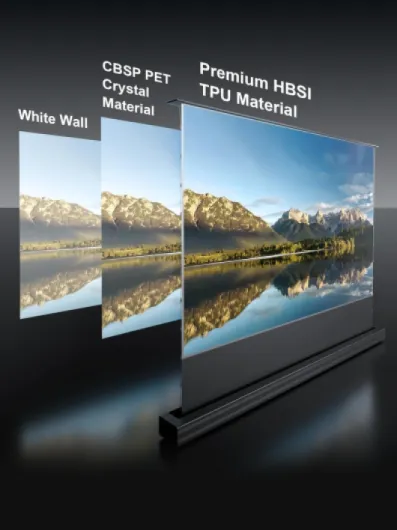
In day-to-day use, the main thing that hits you is how much ambient light it cuts compared to a normal white screen. With blinds half-open in the afternoon, I can still watch football or YouTube without the image washing out like it used to. Before, I had to dim the room to get decent contrast. Now I only really need to darken the room for movies when I want that proper cinema vibe. So on the performance side, it gets the job done pretty well.
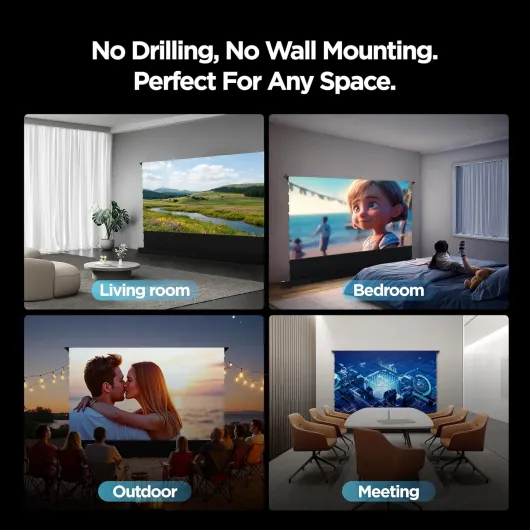
On the practical side, this is a floor-rising motorized screen, not a roll-down from the ceiling. You just put the base on the floor, plug it in, and the screen lifts itself up. No drilling, no messing with ceiling joists. That’s the good part. The downside is that the base is long, heavy, and you need a good stretch of floor clear in front of your wall or TV bench. Moving it around isn’t fun; it feels more like moving a piece of furniture than an accessory.
Overall, after a few weeks, I’d say I’m happy with the picture and the convenience of hiding it away when not in use, but it’s not perfect. The weight, the price, and the fact you really need a UST projector that matches it are things to think about. If you just have a basic budget projector or only watch at night in a dark room, this might be overkill. If you’ve got a bright UST laser in a bright living room, it suddenly makes a lot more sense.
Value: worth it if your projector and room justify it
On the value for money side, this is not a budget item. You’re paying a clear premium for ALR material, motorization, and the floor-rising design. If you’re just starting with projection and using a cheap 1080p projector in a dark room, I honestly think this is overkill. A decent white fixed screen or even a painted wall will do for a while. This screen makes sense if you already invested in a good UST 4K/laser projector and you want to actually see what it can do, especially in a living room with ambient light.
Compared to a fixed ALR UST screen, you’re paying more for the motorized, retractable format and the ability to hide it when not in use. If you have a dedicated cinema room where the screen can stay on the wall permanently, a fixed frame ALR might give you similar picture quality for less money. In a shared living space where you don’t want a big grey panel on the wall 24/7, this product starts to make more sense. That’s basically the trade-off: pay more for flexibility and a cleaner look when it’s off.
In daily use, I do feel like I’m getting what I paid for in terms of image improvement over a wall or a basic screen. Contrast is better, daytime viewing is less annoying, and the whole setup feels more like a big TV alternative than a “projector compromise”. The 120-inch size also adds to the feeling of getting your money’s worth, as long as you have the space. You’re not going to outgrow this size quickly.
On the downside, you have to factor in that it’s heavy, not very portable, and there’s always the risk of motor issues long-term. Also, the included wall supports seem a bit weak for such a heavy screen according to one buyer, so if you plan to mount it, you might have extra costs for better brackets. All in all, I’d say value is good if you: 1) already own a solid UST projector, 2) watch a lot with some light in the room, and 3) care about being able to hide the screen. If you don’t tick those boxes, there are cheaper and simpler options that will make more sense.
Big, black, heavy – looks pro but you feel the weight
Design-wise, it’s pretty straightforward: a long black metal bar on the floor, and a dark grey/black ALR fabric that rises out of it. No fancy chrome, no design statement, it just looks like a serious piece of AV gear. I actually prefer that – it blends into the room when it’s closed, kind of like a low-profile black bench in front of the wall. When it’s up, it looks like a proper cinema screen with black borders and a decent frame effect.
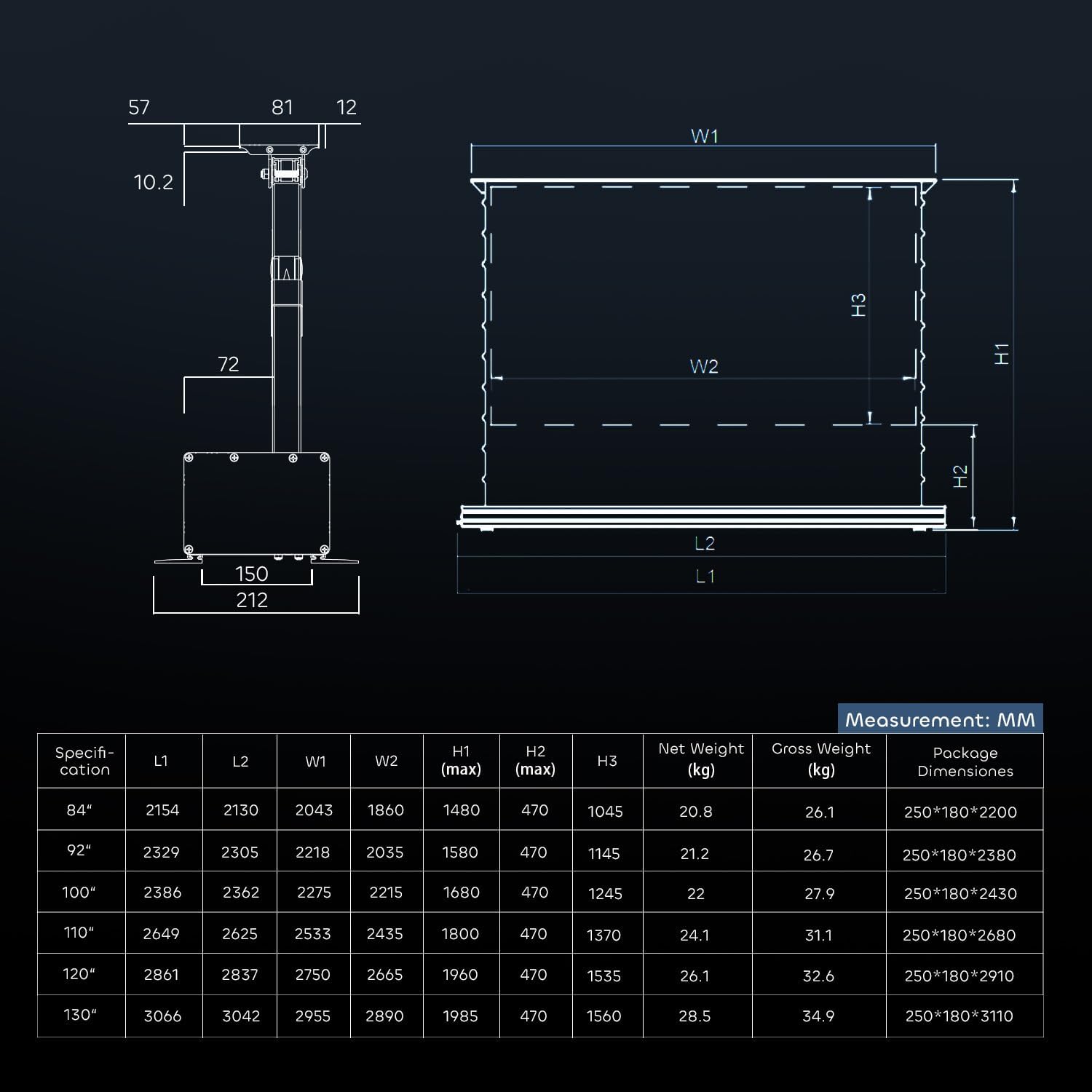
The footprint is the main thing to think about. At almost 3 meters wide, the base will run across most of a wall. You can’t easily hide it in a small room. You also need enough distance behind it for your UST projector, unless you’re putting the projector on the same piece of furniture. In my case, I placed the projector on a low TV stand directly in front of the screen base, and it fits, but it’s tight. If your furniture is too high or too deep, you may struggle to line things up correctly.
In terms of mechanics, the rising system is smooth, but not instant. You press the button, and it takes a few seconds to reach full height. During the rise, you do see some waves in the fabric, which is normal on this type of screen. Once it’s fully extended and the tension is set, it flattens out nicely. I didn’t see any serious waves or wrinkles in actual viewing, even on bright panning scenes, which is important. A couple of users mentioned the same: waves while rising, flat when fully up – that matches what I saw.
The look is quite “home cinema” and not very living-room-friendly if you’re trying to keep things minimal. But the fact that you can retract it completely means the wall behind it is free when you don’t watch anything. That’s the main design advantage compared to a fixed frame ALR screen. If you’re in a multi-use living room and don’t want a giant grey rectangle on the wall 24/7, this format makes sense, as long as you accept the long base on the floor.
Materials and build: solid base, delicate screen surface
The enclosure is made of PET (polyethylene terephthalate) with a metal feel and finish, and it comes across as pretty solid. The whole unit feels like it can handle being moved occasionally, but you don’t want to drag it around every weekend. It’s heavy enough that once you set it down, you’ll probably leave it there. The corners and edges are decently finished; I didn’t notice sharp bits or cheap plastic parts sticking out, which is reassuring given the price.
The screen surface itself is where things get serious. It’s an ALR (Ambient Light Rejecting) material with a carbon black/ST style surface. To the touch, it feels a bit textured and not like a smooth white screen. That’s normal for ALR and part of how it rejects light from above and the sides. You can also tell it’s fairly thin but tensioned. I wouldn’t go poking it or cleaning it aggressively; it feels like something you treat gently, not like a rugged tarp. From the back, it’s opaque enough that no light from behind bleeds through, which is good if your screen is in front of a window or a light-colored wall.
The micro-perforation is meant for sound transparency if you put speakers behind the screen. The holes are very small (0.4 mm according to the spec), and from a normal seating distance I couldn’t see them in the image. Up close, you can see the pattern, but it didn’t bother me at all during viewing. In terms of sound, it doesn’t block much; my center speaker behind the screen still sounded clear, and I didn’t feel like I had to crank the volume compared to a normal setup. So on that point, it does what it says: lets sound through without killing brightness too much.
Overall, build quality feels decent to good, especially the base and the motor. The screen material does what ALR should do, but it’s also something you’ll want to protect from kids, pets, and dust. I wouldn’t call it fragile, but it’s not bombproof either. For the price, I would have liked maybe slightly thicker casing or better feet to stabilize it, especially if you have uneven floors. One Amazon buyer also mentioned the supplied wall supports were not strong enough for wall mounting; I’d agree this thing is heavy enough that if you want to attach it to a wall, you should invest in serious brackets, not rely on the bare minimum.
Durability and long-term feel after a few weeks
I obviously haven’t owned this screen for years, but after a few weeks of daily use (up and down at least once a day), I can give a rough idea of how solid it feels. The motor still behaves the same as day one, no strange grinding noises, no slowing down. The casing hasn’t warped or flexed, and the feet stay stable on my laminate floor. I’ve nudged the base a couple of times moving furniture, and it didn’t feel like it was going to break or dent easily, so the structure seems up to the job.
The screen fabric is the part I’m more cautious about. ALR coatings can be sensitive to scratches and bad cleaning. I already had a minor dust issue and used a very soft microfiber cloth lightly, without pressing hard. That worked fine, but I wouldn’t go wild with cleaning products or rough cloths. If you have kids with sticky fingers or pets that like to jump, you’ll want to be quite protective of the screen when it’s up. When it’s retracted, at least it’s safe inside the housing, which is one of the big advantages over a fixed frame screen.
In terms of mechanical wear, the lifting arms and tensioning system feel reasonably robust. You can see metal arms guiding the screen as it rises. They don’t wobble too much, and they lock pretty firmly at the top. I didn’t notice any loosening over time so far. Still, given the weight and complexity, I’d treat it as a semi-permanent piece of gear, not something you open and close ten times a day just for fun. Once or twice a day seems fine, but nonstop up-and-down might shorten its life, like with any motorized screen.
Other buyers mention that the mechanism seems reliable but want to see how it holds up long-term; I’m in the same boat. Nothing I’ve seen gives me a bad feeling about durability, but at this price point you always worry about what happens in 3–5 years if the motor or electronics fail. There’s no obvious user-serviceable part, so if something goes wrong, you’re relying on the brand’s support. The positive is that a couple of reviews say the customer service is responsive, which is reassuring. Still, I’d say durability looks decent so far, but I can’t call it bulletproof without a year or two of use.
Picture performance: big jump over a wall, especially in daylight
Performance is where this screen starts to justify its price. With my UST laser projector (around 2,500–3,000 lumens), the contrast and perceived black levels are clearly better than on my old matte white screen and miles better than a painted wall. In a dark room, blacks look deeper and colors look more saturated, without me having to push the projector settings too hard. Fine details in 4K content show up nicely; small text in menus stays sharp, and textures in movies and games stand out more than before.
The real difference, though, is in ambient light. With blinds half-open in the afternoon, I could still watch a movie and actually enjoy it. On a white screen, the whole image would look washed out and grey. On this ALR surface, the bright parts still pop enough, and the black bars don’t turn light grey as quickly. It’s not magic – if you flood the room with sunlight, your image will still suffer – but for a typical living room with some windows, it definitely helps. A few Amazon users also mentioned they can watch “in full daylight” and I’d say that’s mostly true if your projector is strong enough and you’re not in direct sun.
The viewing angle is advertised at 170°, and realistically, you can sit pretty far off to the side without losing much brightness or color. In my setup, people sitting well off-center still saw a decent image, so for family movie nights it works fine. I didn’t notice weird color shifts from normal seating positions. If you go really extreme to the side, of course, things drop off, but nothing dramatic. For a 120-inch screen, it’s good enough that a whole couch can sit comfortably in front.
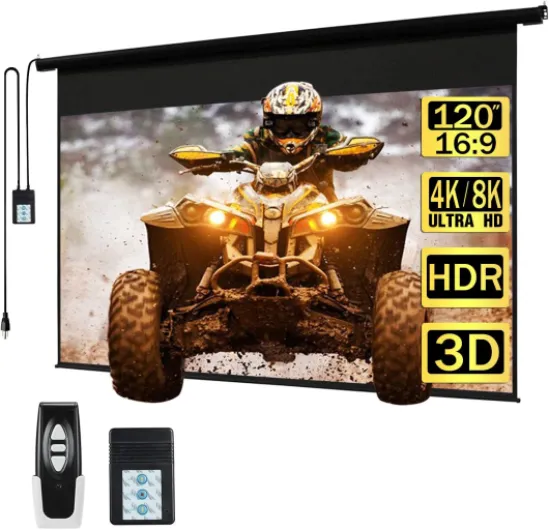
3D and 4K content look good. I don’t really care about 8K marketing, but for 4K HDR movies, the screen doesn’t seem to soften the image. It’s not adding anything magical; it just lets the projector do its job without washing everything out. One thing to keep in mind: if your projector is low-brightness or older, this screen won’t fix that. It might even make a very dim projector look weaker because ALR materials can eat a bit of light. So this screen makes more sense with a bright 4K/laser UST. If you’ve got that, it really helps you get close to a TV-like image size-wise, especially in non-ideal lighting.
What you actually get out of the box
Out of the box, you’re basically getting a big metal base unit with the screen rolled inside, a power cable, a remote, and a wireless trigger to sync with your projector. That’s pretty much it. No crazy accessories, no fancy extras. The base is just under 3 meters wide (about 2.91 m) and almost 2 meters high when the screen is fully up, so it’s really not a small object. You need to measure your room properly before ordering, especially ceiling height and the distance between your UST projector and the screen.
The setup is actually straightforward. You put the unit on the floor where you want the screen, plug it into power, and you’re basically ready. With the remote, you can raise or lower the screen and also stop it at different heights, which is handy if your projector sits a bit higher or lower than average. I didn’t have to drill anything or mount anything on the wall, which I liked a lot. For renters or people who don’t want to destroy their walls, that’s a clear plus.
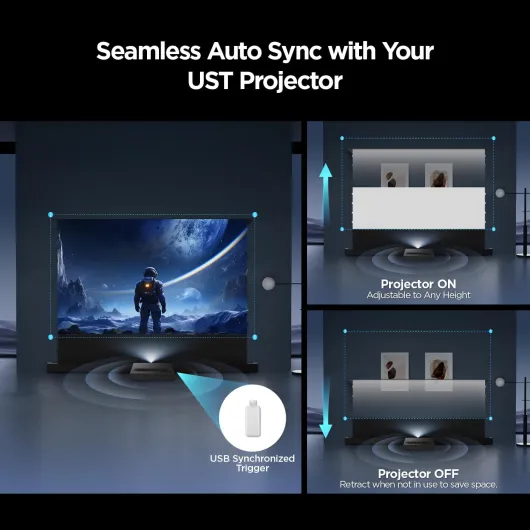
The wireless trigger is a nice touch: it’s supposed to make the screen go up automatically when the projector powers on and go down when it turns off. In my case, it worked after a bit of fiddling. It’s not rocket science, but you do need to read the (English-only) manual and pair it correctly. Once it’s set up, it’s pretty convenient – the screen just “follows” the projector. If you hate pressing extra buttons, you’ll appreciate that. If you’re more old-school, the remote is enough.
One thing to note: this is clearly designed for ultra short throw projectors, not your typical long-throw ceiling projector. The ALR coating is oriented for light coming from below/close, not from the back of the room. If you try to use it with a regular projector across the room, you’ll likely get mediocre brightness and weird reflections. So if you don’t already own a UST projector or you plan to move between setups, this is probably the wrong type of screen for you.
Everyday effectiveness: syncing, noise, and actual ease of use
On a daily basis, the motorized system is what you interact with the most, and overall it behaves well. The screen goes from fully down to fully up in a reasonable time – not instant, but quick enough that you’re not standing there bored. The motor noise is audible but not crazy loud; it’s a low mechanical hum that lasts a few seconds and then it’s done. Once it’s up, there are no strange creaks or rattles from the base. You can control it with the remote or let the wireless trigger handle it when the projector turns on and off.
The auto-sync (trigger) function is handy when it works. In my case, it took a couple of tries to pair it properly and get the projector’s USB/trigger port to wake it up reliably. After that, it was fine: turn on the projector, screen rises; turn it off, screen goes down. If your projector doesn’t support trigger or USB power in standby, you might not be able to use this feature, so check your projector’s specs first. If you’re okay just pressing a button on the remote, it’s not a big deal, but the automation is a nice comfort feature once set up.
In terms of stability and flatness, after the screen is fully extended, it stays pretty flat. I checked for waves with test patterns and bright uniform backgrounds, and while you might see very slight imperfections if you go looking for them, it’s nothing that bothered me in normal viewing. One German reviewer mentioned waves during extension that disappear when fully up – that’s exactly what I saw too. If your floor isn’t level, you might have to shim the base a bit so the screen doesn’t lean forward or backward.
On the downside, the size and weight make it less “plug-and-play” than it sounds. Yes, there’s no wall drilling, but you still need to clear space, position it precisely, align the projector, adjust height, and maybe tweak settings a few times before you’re happy. Once done, it’s great, but the first setup session took me a good hour or so including projector alignment. The manual is only in English, which a few buyers pointed out; if you’re not comfortable with English, it might be annoying, but the system isn’t overly complex. Overall, as a daily-use screen, it’s effective: press a button, big screen appears, picture looks good, then it hides again. Just don’t expect it to feel light or ultra-portable.
Pros
- Strong ALR performance with UST projectors, making daytime viewing much more comfortable than on a white wall
- Motorized floor-rising design hides the screen when not in use and requires no wall or ceiling drilling
- Large 120-inch size with good flatness once fully extended and wide usable viewing angle for group viewing
Cons
- Very large and heavy base, not easy to move and needs a lot of floor and wall space
- Pricey compared to fixed ALR screens; not great value if you only watch in a dark room or have a low-brightness projector
- Manual only in English and included wall supports may be too weak for secure wall mounting of such a heavy unit
Conclusion
Editor's rating
After living with the NothingProjector 120-inch Motorized ALR UST screen for a while, my overall take is pretty clear: it does its main job well. The image looks much better than on a wall or a basic white screen, especially in a bright room, and the ability to retract it into the base keeps your living room from looking like a permanent cinema. The ALR surface helps a lot in daytime or with lights on, and if you pair it with a bright 4K or laser UST projector, you get a very watchable picture even when the room isn’t fully dark.
It’s not perfect, though. The unit is big and heavy, setup takes some thought, and you really need the right type of projector and room to benefit from it. The motorized system works well and the auto-sync trigger is handy once configured, but long-term durability of the motor and electronics is always a question mark at this price point. Also, if you have a dedicated dark room or a basic projector, a cheaper fixed screen will probably give you better value.
So, who is this for? It’s for people who already have (or plan to buy) a good UST projector, want a 120-inch image, and use it in a living room or bright space where ALR really helps. Also for those who like the idea of hiding the screen when it’s off. Who should skip it? Anyone on a tight budget, people with standard long-throw projectors, or those with a fully light-controlled cinema room. In those cases, your money is better spent elsewhere. For the right setup, though, this is a pretty solid piece of kit that does what it promises without too much fuss once installed.