
Summary
Editor's rating
Is it worth the money?
Design and mechanism: clean look, some quirks
Build quality and screen material: solid case, mixed impressions
How it holds up and potential long-term concerns
Image quality and ALR: good, but not magic
What you actually get out of the box
Everyday usability: setup, sync, and small annoyances
Pros
- Very easy to install: floor-standing, no drilling or wall mounting needed
- Motorized rise with USB trigger sync makes it feel like a big TV on power-on
- Decent ALR performance and good image quality with UST projectors in moderate light
Cons
- High price compared to fixed-frame ALR or simpler screens
- Ambient light rejection and acoustic transparency are not as strong as marketing suggests
- Potential issues with screen ripples, noise during operation, and patchy backing

Specifications
View full product page →| Brand | AWOL VISION |
A giant screen in a box on your floor
I’ve been using the AWOL VISION 120" Motorized Floor Rising Screen for a little while with an ultra short throw projector in a living-room setup, not a dedicated dark cinema room. Think normal apartment: windows, some light during the day, TV use in the evening, and not a ton of wall space to mount a fixed frame screen. That’s the kind of context where this product is supposed to shine: big image, no drilling, and it disappears when you’re not watching.
In practice, the big selling points are pretty clear: it’s motorized, it rises from the floor, it claims to reject up to 95% of ambient light, and it’s marketed as 4K/8K ready with decent gain. On paper, it’s the all-in-one solution if you want a “TV replacement” experience with a UST projector without turning your living room into a bat cave.
Reality is a bit more mixed. The screen is definitely usable and the size is very impressive once it’s up. The mechanism works, the remote does what it should, and the USB trigger sync with the projector is genuinely handy. But some of the big promises, especially around ambient light rejection and acoustic transparency, feel oversold once you actually live with it day to day.
So this review is from the angle of: does it justify the high price compared to either a fixed ALR screen or just using a wall / cheaper screen? Short answer: it’s a nice piece of kit, but you’re paying a big premium for the motorized floor-rising convenience, and the performance isn’t as magical as the marketing suggests.
Is it worth the money?
This is where the AWOL VISION 120" floor-rising screen gets harder to defend. It’s not cheap, and you’re basically paying for three things: the ALR material tuned for UST, the motorized floor-rising mechanism, and the fact that it hides away when not in use. If those three things are crucial for you, then the price might be acceptable. But if you’re mostly chasing image quality for the lowest cost, this is not the best way to spend your budget.
Several users clearly hint at this. One person said that a white wall at night actually looked better than this screen, and that in modest light settings it’s useful but probably not worth the price. Another buyer loved the home cinema feel and said it was "worth every penny" for them, but even they admitted it’s expensive and hoped it would become more affordable over time. So you have a split: people who really value the convenience and form factor are happy, while more price-sensitive or performance-focused users feel it’s overpriced.
If you compare this to a fixed-frame ALR screen of similar size, you can often get better or equal picture performance for less money, at the cost of drilling holes and living with a permanent screen on your wall. If you compare it to a basic manual pull-down or a simple white screen, the AWOL will look more premium and be more practical, but the jump in cost is huge. You have to honestly ask yourself how often you need the screen to disappear and whether that justifies the extra hundreds (or thousands) you’re spending.
For me, the value is decent only if you are in a very specific situation: you can’t or don’t want to mount anything to the walls or ceiling, you absolutely need a retractable solution, and you already invested in a good UST projector. In that scenario, it’s a neat package that does what you need. For everyone else, especially if you can handle a fixed screen or paint a projection wall, there are cheaper options that give you similar or better picture quality without the motorized bells and whistles.
Design and mechanism: clean look, some quirks
Design-wise, the concept is pretty straightforward: a long rectangular case on the floor, with the screen rolling up from inside. The case itself looks decent – kind of like a long, low TV cabinet without doors. It’s not fancy, but it doesn’t look cheap either. If you keep a relatively minimal living room, it blends in as “some kind of AV furniture” rather than screaming “projector gear”. That’s a plus if you share the space and don’t want a giant white panel on the wall 24/7.
The motorized mechanism works, but it’s not whisper quiet. Several owners mention the noise, and I agree: when it rises or retracts, you clearly hear the motor and the screen unrolling. It’s not deafening and it only lasts a few seconds, but if you imagined something super smooth and silent, that’s not what you get. One user also reported that the first raise made a kind of sticky, tearing sound, like the screen layers were stuck together. That’s not exactly reassuring the first time you use a very expensive screen.
The wire tension system is supposed to keep the surface very flat, “like glass” according to the marketing. In reality, the majority of the screen is flat enough for normal watching, but there are reports of ripples at the bottom corners. One reviewer got visible ripples bottom left and right after a week. AWOL sent tension strips that apparently fixed it, but to me, that’s something that should not show up this early on a premium product. The design relies on tensioning from the sides and base, so if anything gets slightly off, you see it in bright scenes.
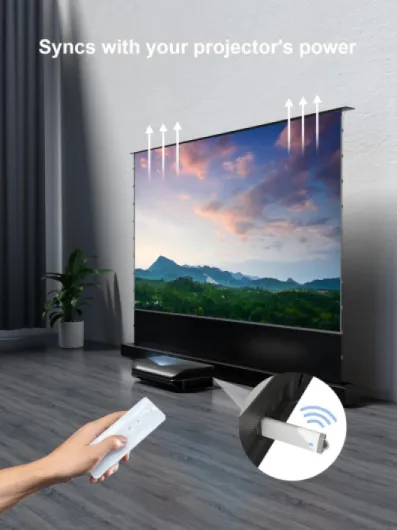
On the plus side, the remote and the USB trigger integration are practical. The screen rising automatically when the projector turns on feels natural, like powering on a big TV. You can also define the upper limit so it doesn’t fully extend if you don’t need the full height. Overall, the design idea is solid and convenient, but the noise, weight, and occasional flatness issues make it feel a bit less polished than the price suggests.
Build quality and screen material: solid case, mixed impressions
The case itself feels sturdy and heavy, which is reassuring in one way and annoying in another. At around 36 kg, you’re definitely dealing with metal and glass, not a flimsy plastic box. Once it’s in place, it doesn’t wobble or feel unstable, even when the screen is fully extended. For something that’s supposed to last years and handle repeated up/down cycles, that’s a good base to start from.
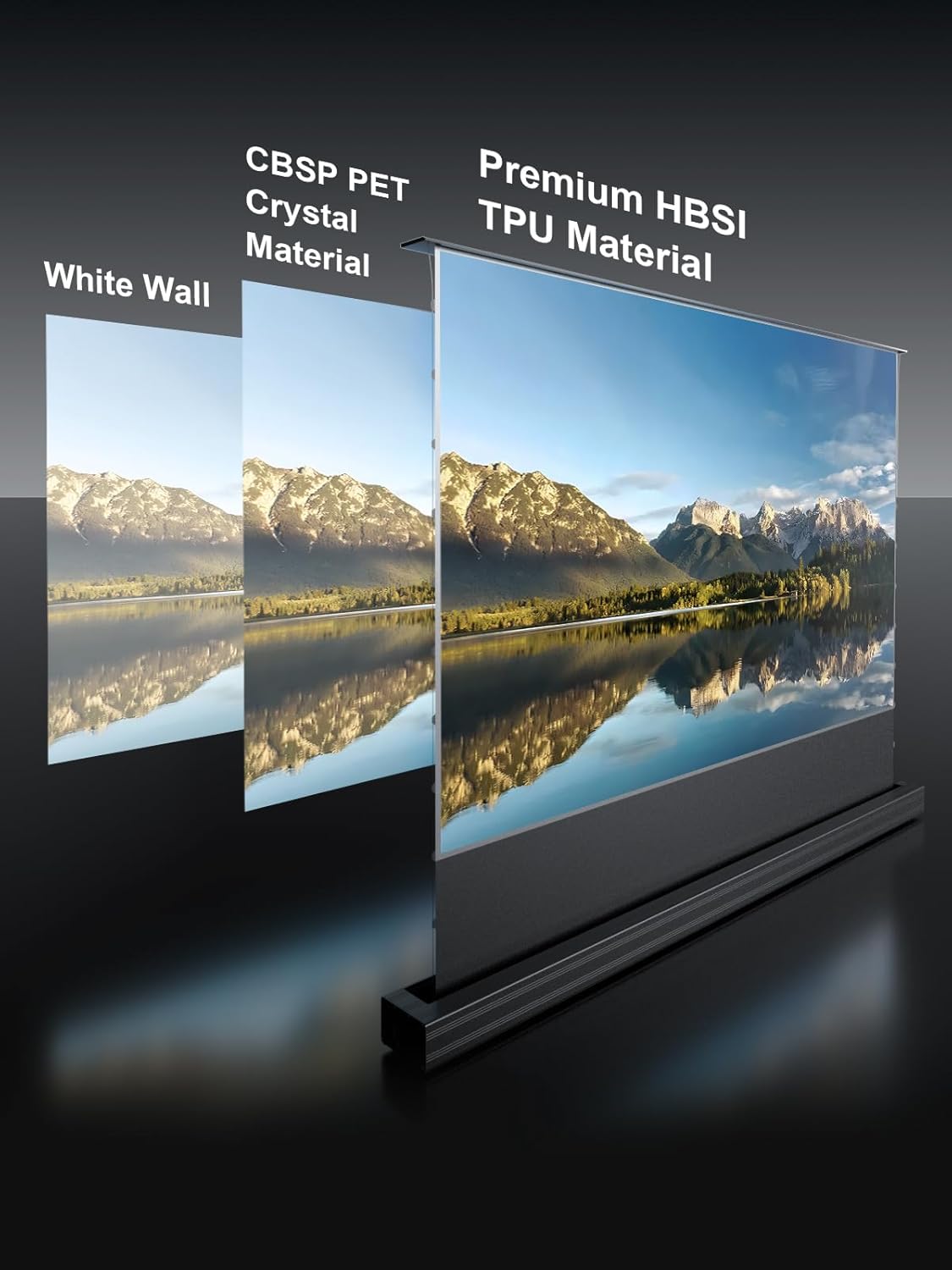
The screen material is where things get a bit more debatable. It’s the brand’s HBSI ALR material with a serriform (sawtooth-style) optical structure designed for UST projectors. The surface is grey with a specific texture to manage light. On the front, it looks fine once you’re sitting at normal viewing distance. But one user noted that when daylight hit the back (because they forgot to close the blinds behind it), they could see patchy areas, like someone sprayed something on the back unevenly. That doesn’t show up much during normal viewing if you control backlight, but it doesn’t give a great impression of uniformity.
Another point: AWOL’s own listing and general marketing sometimes suggest audio transparency, but one buyer pointed out that only the black mesh at the bottom is actually acoustically transparent. The main ALR surface is not. So if you were planning to put speakers directly behind the active screen area, that’s not going to work the way an acoustically transparent fixed-frame screen does. In other words, the materials are focused on ALR and gain, not on letting sound through.
In terms of perceived quality, I’d call it pretty solid but not perfect. The case and mechanics feel like they’ll hold up, but the screen fabric shows that this is still a rolled-up system, not a permanently stretched frame. You trade some absolute flatness and uniformity for the convenience of hiding the screen. For the price, I expected slightly better consistency in the screen coating and less need for “tension strip” fixes after the fact.
How it holds up and potential long-term concerns
Durability is a bit tricky to judge without years of use, but we can look at what’s already visible from user feedback and the design itself. The heavy case and metal structure suggest that the base will last. It’s not flimsy and it doesn’t flex when you move it carefully. The motorized mechanism also seems reliable so far; I haven’t seen reports of motors failing quickly, and the basic up/down operation is simple enough that it shouldn’t be overly fragile if they used decent components.
The screen fabric and tension system are more of a question mark. The fact that at least one owner saw ripples within a week, and that AWOL had to send extra tension strips, shows that the system can drift from perfectly flat to slightly wrinkled pretty fast. That’s with a brand-new unit. It makes you wonder what it will look like after hundreds of cycles or a couple of summers in a warm room. Rolled screens always have this risk: the fabric is constantly being coiled and uncoiled, and gravity pulls on it when extended.
Another durability concern is the patchy appearance when backlit that one user mentioned. While that might not affect picture quality much in normal conditions, it does hint at an uneven coating process. If the coating is not perfectly consistent, you might see more visible differences over time as the material ages, especially if exposed to sunlight or temperature changes. Hard to say yet, but it’s not the kind of thing that inspires total confidence.
On the positive side, AWOL’s support seems responsive. The user with the ripple issue got a reply within hours and received parts from California. That doesn’t fix fundamental design limits, but at least they’re not ghosting customers when problems appear. Overall, I’d rate durability as “probably fine for a few years if you treat it gently,” but I wouldn’t be shocked to see more ripples or minor issues over the long term, especially given it’s a rolled ALR screen, not a rigid panel.
Image quality and ALR: good, but not magic
This is the section that matters most: does the screen actually improve your viewing experience compared to a wall or a basic screen? With a proper UST projector, the image looks sharp, and the 4K content comes through clearly. The screen doesn’t blur anything; resolution-wise, it handles what it claims. Colors are decent, and contrast can be good once you dial in your projector settings. One user did say they had to tweak contrast to get it looking right compared to a smaller AWOL screen they owned, and even then it didn’t quite match their expectations out of the box.
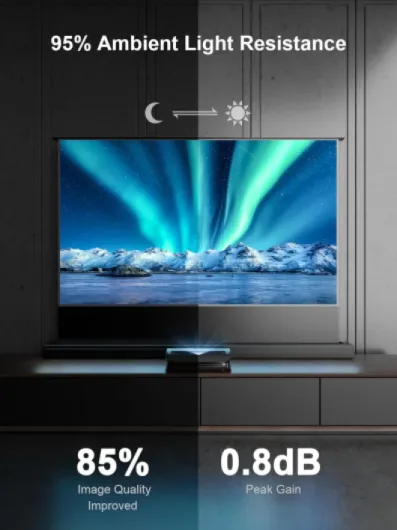
On ambient light rejection, I’d say it helps, but it’s nowhere near the “95% rejection” level the marketing language makes you imagine. One reviewer was pretty blunt: with a bright window and no blinds, the screen is basically washed out and unwatchable. Even with shutters closed on a sunny day, it’s just okay, not some miracle. They also said that at night, in a dark room, a plain white wall actually looked better in terms of brightness and maybe perceived contrast. That’s a bit harsh, but it shows the gap between claims and real-world use.
Where it does make sense is in moderate light conditions: blinds pulled but not total darkness, overcast days, or early evening. In those scenarios, the ALR coating does improve contrast compared to a cheap matte white screen. Blacks are deeper, and you don’t get as much washout from ceiling light. But you are paying a lot for that improvement, and it’s not like you can watch with sunlight blasting in from the side and expect a TV-like image. You still need some light control.
Viewing angles are wide enough for normal living-room seating. People off to the side can still see a decent image, which matches the claimed 170-degree viewing angle. Overall, performance is “good but not mind-blowing”. If you come from projecting on a bare wall, you’ll see a difference. If you already have a solid fixed-frame ALR screen, this is more about convenience than any big upgrade in picture quality.
What you actually get out of the box
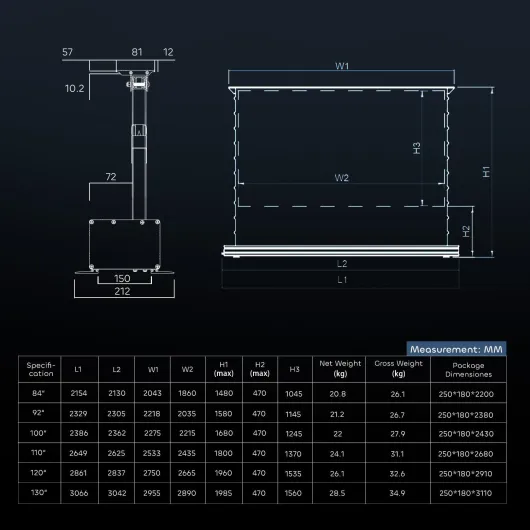
The AWOL VISION 120" Motorized Floor Rising Screen is basically a long, heavy metal case that sits on the floor, with a screen that pops up vertically when you hit the remote or trigger it via USB from your projector. No wall mounting, no ceiling mounting, no frame assembly. You plop it down, plug it in, and that’s about it. The manufacturer lists the product weight around 36 kg, and you feel every bit of that when moving it. This is not something you casually reposition every weekend.
The viewing area is a 120" diagonal 16:9 screen (about 177.8 x 72 inches), with ALR material tuned for ultra short throw projectors. The idea is that the special surface rejects light from above and the sides and reflects light from the UST projector sitting low in front of it. On top of that, AWOL claims 95% ambient light rejection, ISF certification, 1.1 gain, and support for 4K/8K and active 3D. All the buzzwords are there.
You also get a remote, the USB sync trigger cable, and some basic documentation. A few users mention receiving tension strips later from support to fix ripples, so that’s not in the base package, it’s more of a support fix if you complain. Setup itself is dead simple: find a flat floor, get a second person to help you carry it, plug power, and test the up/down function. There’s no complicated assembly, which is a plus if you hate fiddling with frames and fabric.
In daily use, the product sits like a big low bench against the wall when the screen is down. If you’re in a rental or you don’t want a big fixed screen permanently hanging on your wall, this approach makes sense. Just be aware: this is still a bulky, heavy object that needs a clear floor area the full width of the screen, and you can’t hide that part. You’re trading wall clutter for floor clutter.
Everyday usability: setup, sync, and small annoyances
In day-to-day use, the screen does its main job: you press a button (or power on the projector) and a big 120" image area appears at the right height. Setup is genuinely quick. You don’t need to drill, you don’t need to square a frame, and you don’t need to paint a wall. For renters or people who change furniture often, that alone can justify considering this kind of product. The USB trigger that makes the screen rise when the projector turns on is one of the nicest practical features. It makes the whole setup feel like one system instead of separate pieces you have to manage manually.
However, there are a few small things that add up. First, the noise: the motor and fabric unrolling are clearly audible. It’s not a deal-breaker, but it removes some of the “premium” feeling. Second, the first-time use issues some people saw – screen sticking together, or early ripples – make you question the quality control for something in this price range. It’s good that support sends tension strips quickly, but you’d rather not need them at all.
As for the ALR effectiveness in real life, it works best if you treat this like a projector setup that still needs basic light control. If you keep your expectations realistic – blinds down on sunny days, no strong light directly hitting the screen – it’s fine. If you were hoping to replace a high-end TV in a bright room without changing your habits, you’ll likely be disappointed. One user flat-out said they wouldn’t recommend it at this price because the benefit over cheaper screens doesn’t feel big enough.
So in terms of overall effectiveness, it gets the job done: big image, quick deployment, no installation hassle. But the “premium” promises (silent operation, perfect flatness, true ALR miracles) don’t fully match what you actually get. You end up with a very convenient but somewhat compromise-heavy solution.
Pros
- Very easy to install: floor-standing, no drilling or wall mounting needed
- Motorized rise with USB trigger sync makes it feel like a big TV on power-on
- Decent ALR performance and good image quality with UST projectors in moderate light
Cons
- High price compared to fixed-frame ALR or simpler screens
- Ambient light rejection and acoustic transparency are not as strong as marketing suggests
- Potential issues with screen ripples, noise during operation, and patchy backing
Conclusion
Editor's rating
The AWOL VISION 120" Motorized Floor Rising Projector Screen is a cool idea that mainly sells convenience: big ALR screen, no drilling, and it disappears into a floor case when you’re done. The motorized system, USB trigger, and overall simplicity of setup are the strong points. If you’re renting, hate wall mounts, or just want your living room to look normal when you’re not watching anything, this product fits that brief pretty well.
Where it falls short is in the gap between the marketing and reality. The ambient light rejection is helpful but not magic, and you still need to control light with blinds or curtains. The screen is not truly acoustically transparent except for the bottom mesh, the motor is a bit noisy, and some units show ripples or patchy backing that you wouldn’t expect at this price. Image quality is good and perfectly watchable, but not dramatically better than what you can get from cheaper fixed-frame ALR screens or even a well-prepared wall in a dark room.
I’d recommend this mainly to people who prioritize form factor and ease of installation over raw value: apartment dwellers, design-conscious living rooms, or anyone who wants a big screen that can hide away without touching the walls. If you’re on a tighter budget, or you have a dedicated room where a fixed screen is possible, I’d look elsewhere. You can get equal or better performance for less money if you’re willing to give up the motorized floor-rising trick.