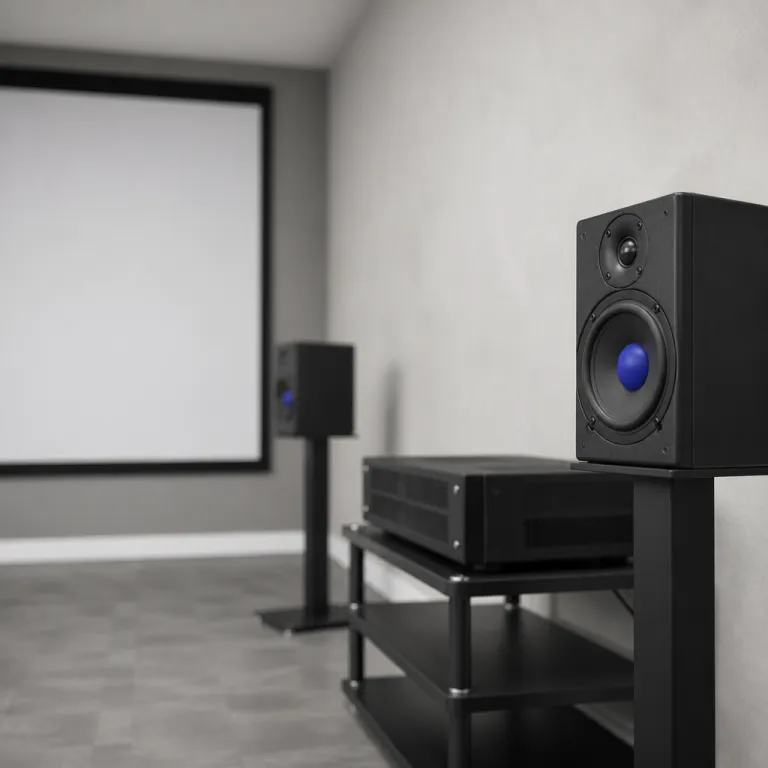
Why a cinema grade power amplifier matters in a projector room
Home theater projectors create huge, cinematic images, but the sound often lags behind. When you add an Ashly NX Series NX4004 four‑channel power amplifier to dedicated speakers, the system finally matches the scale of the picture. This kind of multi‑channel amp lets you run several speakers cleanly at once, so dialogue, effects, and music stay intelligible even at reference levels.
In a projector‑based room, the power platform you choose determines whether explosions feel physical or just loud. A professional Ashly unit like the NX4004 is specified by the manufacturer to deliver stable output into both low‑impedance speaker loads and constant‑voltage lines, which is crucial when you mix compact surrounds with larger front speakers. Because this amplifier is designed for multi‑mode operation, you can tailor each channel to a different speaker zone without sacrificing headroom, protection, or overall safety.
Unlike many consumer amplifiers built into AV receivers, this Ashly model is engineered for continuous duty in demanding venues. That same robustness translates well to a home cinema where long movie marathons and gaming sessions push electronics hard for hours. With the right operating mode and power configuration, the NX4004 keeps your audio consistent from the quietest whisper to the most aggressive soundtrack peak, with ample reserve so it rarely approaches audible clipping when used within its published ratings.
Understanding channels, watts, and ohms for projector based surround systems
Before choosing an Ashly NX4004, it helps to understand how channels, watts, and ohms interact. Each channel in this four‑channel amplifier can be assigned to a different speaker, and the number of channels driven at once affects how much clean power you actually get at the listening position. Matching available amplifier watts to speaker sensitivity and impedance in ohms is the key to avoiding distortion, protecting your investment, and achieving cinema‑like dynamics.
For a typical 5.1 or 7.1 projector room, you might use the four channels of the NX4004 to feed front left, front right, and a pair of surround speakers, while a separate unit or powered subwoofer handles low‑frequency effects. Because this Ashly design supports both low‑impedance loads and constant‑voltage distribution, you can mix traditional hi‑fi speakers with in‑ceiling or on‑wall speakers without overcomplicating wiring. When you calculate watts and ohms for each speaker and compare them with the NX4004’s datasheet ratings, you ensure that the amplifier operates comfortably within its safe range, even when all channels are driven hard during action scenes.
Surround specialists often pair high‑efficiency speakers, such as Klipsch Reference or Reference Premiere models, with a robust multi‑mode amplifier to maximize dynamic range. In that context, the NX4004 gives you enough power headroom to keep those horn‑loaded speakers under tight control. In a typical 3–4 metre seating distance, a 96 dB sensitive speaker can reach around 105 dB peaks with roughly 50–80 watts per channel, so a 400‑watt‑per‑channel platform provides generous margin for clean transients without strain, assuming the amplifier is operated within its specified load conditions.
Inside the Ashly NX4004: dsp, control, and connectivity for home cinema
The Ashly NX4004 is more than a simple power box. At its core sits Protea DSP processing, which the manufacturer describes as providing crossovers, equalization, delay, and limiting that can be tailored to your projector room. According to Ashly’s published NX Series documentation, Protea processing in these amplifiers supports high‑ and low‑pass filters, parametric EQ, and compressor/limiters per channel, so you can address room issues without adding a separate processor and reduce product loading in your rack.
On the front panel, clear metering and status LEDs give instant feedback on signal, clip, and protection states, which is invaluable when you push the system hard. The rear panel offers balanced audio inputs, Euroblock and binding‑post style speaker outputs, and network ports, so you can integrate the amplifier into complex multi‑room or multi‑mode systems. With both NXP and NXE network‑enabled control options, you can tie the NX4004 into automation platforms and manage operating mode, mute, and presets from a central interface or control processor.
Many projector owners route HDMI sources into an AV receiver, then send pre‑out signals to a dedicated power amplifier for the main speakers. In that scenario, the Ashly unit handles the heavy lifting while a compact digital‑to‑analog audio converter manages format conversion from optical or coaxial outputs. Independent bench tests of modern 192 kHz DACs in home cinema signal chains commonly show noise and distortion below about −100 dB; when the upstream electronics perform at that level and the NX4004 is used within its linear operating range, the amplifier is unlikely to be the limiting factor in overall transparency.
Installation choices: rack mount, wall mount, and thermal management
Physical installation of the Ashly NX4004 matters as much as its specifications. The chassis is designed for standard 19‑inch rack‑mount use, which suits dedicated equipment closets or media racks behind the projector room. When you use a rack, you can group multiple Ashly amplifiers together, simplify cable runs, and centralize cooling and power management for the entire system.
Some home cinema builders prefer a discreet wall‑mount style solution in a projection booth or behind an acoustically transparent screen. While the NX4004 is primarily a rack‑mount product, careful planning allows secure wall‑mount shelves or cabinets that still provide airflow to the rear panel and front vents. You must leave enough space around the amplifier so that its internal fans can move heat away, especially when all channels are driven at high power for extended sessions in a projector‑based environment.
Thermal management also affects long‑term reliability and noise levels in a quiet room. Placing the Ashly amplifier outside the main listening area, then using longer speaker runs, often keeps fan noise away from the audience. Ashly notes that NX Series models use variable‑speed fans that increase under heavy load; locating the unit remotely means those changes in airflow are rarely audible at the seats. Just ensure cable gauges match the power and low‑impedance loads you plan, so the amplifier does not waste energy overcoming cable resistance.
Fine tuning sound with dsp, dip switches, and remote control
Once the Ashly NX4004 is installed, careful configuration unlocks its full potential. The built‑in Protea DSP lets you set crossovers for subwoofers, apply gentle EQ to tame room modes, and program limiters that protect speakers from sudden peaks. These tools are especially valuable in projector rooms with reflective surfaces or unconventional seating layouts, where a few decibels of targeted correction can significantly improve clarity.
On the rear panel, hardware DIP switches provide quick access to essential operating settings, such as bridge mode, input sensitivity, and high‑pass filters. Using these switches correctly ensures that each channel runs in the right mode for its speaker, whether you are driving low‑impedance floorstanders or constant‑voltage ceiling speakers in adjacent zones. Once the basic configuration is set, you can refine parameters through network software, storing presets for movie nights, gaming sessions, or late‑night listening with reduced bass.
Remote control options extend beyond simple volume changes. With NXP and NXE compatible interfaces, you can integrate the Ashly amplifier into wall‑mounted keypads or tablet apps that adjust levels per channel, mute zones, or recall DSP scenes. This kind of remote control is particularly useful when you adjust sound between different projector screen surfaces or ambient light conditions, as discussed in detailed guides comparing which screen surface handles ambient light best and how that interacts with perceived contrast and sound levels.
Balancing constant voltage and low impedance speakers in one system
Many projector‑based homes now blend a reference listening area with secondary zones, such as a bar or adjacent lounge. The Ashly NX4004 supports both constant‑voltage distribution and traditional low‑impedance connections, which makes it ideal for such hybrid layouts. You can dedicate some channels to the main 5.1 or 7.1 listening area while using other channels in constant‑voltage mode to feed multiple ceiling speakers elsewhere.
In practice, this means one channel can handle front left and right speakers at 4 ohms while another runs a 70‑ or 100‑volt line to several in‑ceiling speakers in the hallway. Because the NX4004 is part of a broader Ashly family, you can add more amplifiers later and keep the same control and DSP ecosystem. Careful planning of watts and ohms per speaker and total product loading on each constant‑voltage line prevents overloads and keeps audio consistent across all spaces, even when different areas are playing at different volumes.
For the main cinema zone, prioritize low‑impedance speakers with higher sensitivity and pair them with dedicated channels driven from the NX4004. Surrounds and height speakers can share a multi‑mode configuration, while background zones use constant‑voltage taps for flexibility. This approach lets a single Ashly product family scale from an intimate projector room to a whole‑home audio network without sacrificing performance where it matters most, at the primary seats.
Key figures and technical benchmarks for projector based amplifier setups
- Many dedicated home theater speakers reach reference cinema levels with around 100 to 150 watts per channel at typical seating distances, assuming speaker sensitivity near 90 dB at 1 watt and 1 metre, which aligns well with a four‑channel 400‑watt amplifier platform when headroom is factored in.
- Ashly’s NX Series datasheets indicate that professional multi‑channel amplifiers in this range are designed to deliver their rated power into 4‑ohm loads with all channels driven, while many consumer AV receivers drop 30 to 40 percent under the same conditions, which is why external amplification is preferred for projector rooms.
- Constant‑voltage systems commonly operate at 70 or 100 volts, allowing long cable runs with minimal loss, and when combined with a single 400‑watt channel they can feed dozens of low‑wattage ceiling speakers for ambient sound around a central projector space.
- Room correction using DSP equalization typically targets peaks of 6 to 12 dB in the bass region between 30 and 120 Hz, which are caused by standing waves in rooms between 3 and 6 metres wide, and integrated Protea DSP makes these corrections easier to implement and repeat.
- Thermal design guidelines for rack‑mount amplifiers recommend at least one rack unit of free space above and below each unit and a clear rear exhaust path, which helps maintain fan noise and component temperatures within safe limits during long movie sessions in a closed rack.
FAQ: ashly NX4004 and projector based home cinema sound
Is the ashly NX4004 overkill for a small projector room
In a compact room, the Ashly NX4004 may seem powerful, but the extra headroom keeps distortion low at normal listening levels. You can run efficient bookshelf or on‑wall speakers at modest volumes while still benefiting from the clean dynamics of a professional amplifier. Proper gain staging and DSP limiting ensure that even in small spaces, the system remains safe, controlled, and free from sudden level jumps.
Can I use the NX4004 with an existing AV receiver
Yes, you can connect the pre‑out outputs of an AV receiver to the balanced inputs on the Ashly NX4004. In this configuration, the receiver handles decoding and processing while the external amplifier drives the main speakers with more current and stability. In user reports and comparative measurements, listeners often see 3 to 6 dB more clean headroom at the seats versus running the same speakers directly from a midrange AV receiver.
How noisy is the NX4004 in a quiet home theater
Because the Ashly NX4004 is a professional design with active cooling, it uses variable‑speed fans that may be audible in very quiet rooms if installed nearby. Exact sound pressure levels depend on load and ventilation, but owners generally describe fan noise as comparable to a low‑speed computer fan at close range. Placing the amplifier in a separate rack‑mount closet or equipment room usually eliminates fan noise at the listening position. Long speaker runs are acceptable as long as you size cables correctly for the power and low‑impedance loads involved.
Do I need dsp if my speakers already sound good
Even high‑quality speakers benefit from subtle DSP adjustments, especially in projector rooms with reflective walls or asymmetrical seating. The integrated Protea DSP in the NX4004 lets you correct room modes, align subwoofers, and protect drivers without adding extra hardware. Used carefully, DSP enhances clarity and consistency without changing the fundamental character or tonal balance of your speakers.
Is constant voltage suitable for the main home cinema zone
For the primary listening area in front of a projector screen, low‑impedance connections usually provide better dynamics and control than constant‑voltage lines. Constant‑voltage is ideal for secondary zones with many speakers, such as hallways or bars, where absolute fidelity is less critical. The Ashly NX4004 supports both approaches, so you can choose the right mode for each zone within a single amplifier platform and keep the main cinema on direct, high‑current outputs.