
Summary
Editor's rating
Value for money: worth it at the right price
Design & build: small, cylinder-shaped, and surprisingly quiet
Ports, power, and wireless: flexible but no built‑in battery
Durability, noise, and long-term feel
Image quality & performance: good in the dark, mediocre in light
What you actually get with the HY300 Ultra 2026
Everyday use: movies, streaming, and a bit of gaming
Pros
- Compact, lightweight design that’s easy to move and set up anywhere
- Decent picture in a dark room for movies and casual gaming, despite 720p resolution
- Good connectivity: HDMI, USB, Wi‑Fi, Bluetooth, and built‑in Android 11 for basic streaming
Cons
- Real brightness is low (170 ANSI lumens) so you basically need a dark room
- Native 720p resolution despite marketing around 1080p/4K support
- Built‑in smart interface is clunky and better replaced by an external streaming device

Specifications
View full product page →| Brand | Technyon |
A tiny Android projector that’s all over TikTok… but is it actually any good?
I’ve been seeing this HY300 ultra 2026 / Technyon projector everywhere, so I grabbed one to see if it’s actually usable or just another random cheap gadget. I’ve used it for about two weeks for Netflix, a bit of football, some Mario Kart on Switch, and a few YouTube sessions in the bedroom. I’m not a home cinema nerd, I just wanted something small, simple, and not too expensive for casual movie nights.
On paper, it sounds huge for the price: Android 11, Wi‑Fi, Bluetooth, screen mirroring, up to 130 inches, 4K support, auto keystone, and they shout about “12000 lumens” and “Full HD”. In reality, the specs are a bit dressed up. The native resolution is 1280 x 720, and the real brightness is 170 ANSI lumens, which is much more honest than the marketing number. So you have to read between the lines.
In daily use, it’s actually not bad at all if you know what you’re buying. It’s a budget, small LED projector for dark rooms, not a daylight cinema machine. If you expect it to replace a real TV in a bright living room, you’ll be disappointed. If you want something to throw a 60–80 inch picture on a white wall in the evening, it gets the job done.
I’ll go through what I liked and what annoyed me: the design is pretty clever, the built‑in Android is usable but clunky, the image is decent for the money, and the sound is just okay. It’s one of those products where you have to accept the compromises: for casual use and at the right price, it makes sense. If you’re picky about image quality or want serious brightness, it’s probably not for you.
Value for money: worth it at the right price
This projector lives or dies on price. A lot of reviewers mention getting it for under £45, sometimes as a used or discounted unit. At that kind of price, the value is pretty solid. You get a compact projector with Android, Wi‑Fi, Bluetooth, and HDMI that can give you a 60–100 inch image in the dark. It’s not perfect, but for casual use it’s more than enough. If you’re just dipping your toes into projectors and don’t want to spend hundreds, it makes sense.
Where it becomes less attractive is if the price creeps up too close to better‑known brands or higher‑spec 1080p models. There are other Chinese projectors that cost a bit more but offer real 1080p resolution and slightly better brightness. One Amazon reviewer said they compared it to more expensive Chinese projectors and felt this one held its own on price/performance, and I mostly agree, as long as you keep expectations realistic and don’t pay over the odds.
For me, the best way to look at it is: it’s a cheap way to get a big screen experience for movie nights, kids’ cartoons, or occasional gaming. The compromises are clear: 720p native, limited brightness, clunky Android interface, average sound. If you can live with that and you’re okay using an external streamer or console, it’s good value. If you want something brighter and sharper for everyday TV watching, you’re better off saving more and going for a mid‑range 1080p projector from a reputable brand.
So, value rating depends heavily on the deal you get. Under about £60, I’d say it’s good value for money. Much above that, you start entering the territory where there are better options, especially if you care about resolution and long‑term reliability. As a cheap, fun gadget that actually gets used, though, it does make sense.
Design & build: small, cylinder-shaped, and surprisingly quiet
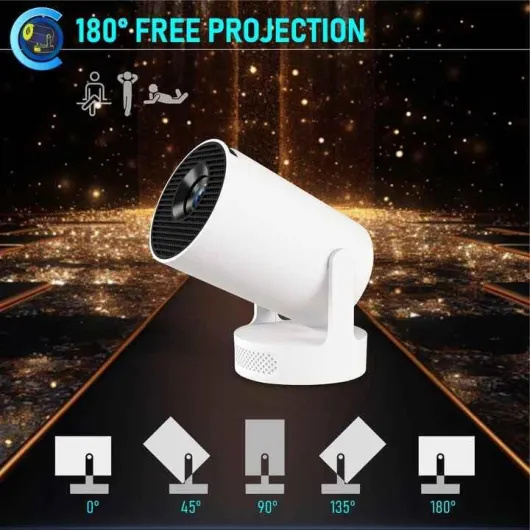
The design is actually one of the things I liked the most. It’s a small white cylindrical unit, which looks more like a Bluetooth speaker than a classic projector. On a shelf or bedside table, it doesn’t scream “giant nerdy gadget”, it just blends in. The form factor makes it easy to pick up with one hand and move around the house. I’ve moved it between bedroom and living room several times without hassle, just grabbed the power cable and remote and that’s it.
The build quality is fine for the price. It’s all plastic, but it doesn’t creak or feel like it’s going to crack in your hand. There’s no premium feel, but also nothing that made me think “this is going to fall apart next week”. The lens is on the front with a small ring around it, and the venting is built into the sides and back. There are rubber feet on the bottom so it doesn’t slide around, and a standard thread so you can mount it on a tripod if you want a bit more stability or need to raise it.
One good point: the fan noise is relatively low. It’s not silent, but during a movie at normal volume, I didn’t really notice it, especially if you use an external speaker. For a small cheap projector, that’s decent. It doesn’t overheat either; after a two‑hour film, the casing was warm but not crazy hot. The airflow system seems to be doing its job. You can hear a light whirring if you’re sitting very close, but from a couple of meters away it’s not annoying.
Controls are simple: you mostly use the remote. There are some basic buttons on the unit, but I ended up using the remote for everything. The only minor annoyance is the remote feels very cheap and lightweight, and you need to point it roughly at the projector for it to respond properly. Range is okay in a normal room, but don’t expect it to behave like a fancy TV remote. Still, for this price bracket, the overall design and usability are pretty solid and not overcomplicated.
Ports, power, and wireless: flexible but no built‑in battery
Important point: there is no built‑in battery. This isn’t a fully wireless projector like some pico models. You have to plug it into the mains (220V) all the time. For me that wasn’t a big deal because I mainly used it at home, but if you were imagining taking it to the park and using it anywhere without power, that’s not going to happen unless you bring a power station. So it’s portable in size and weight, not in the sense of being self‑powered.
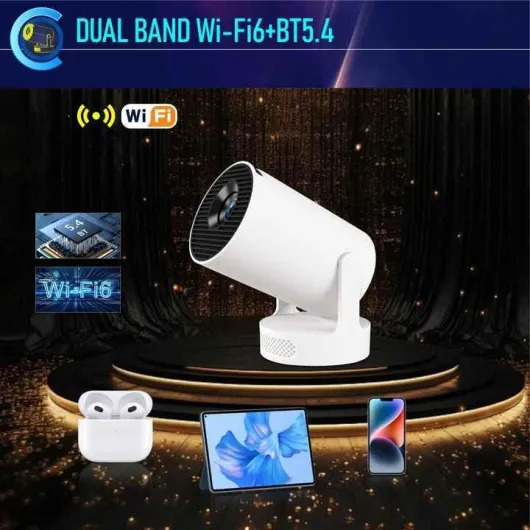
On the connectivity side, it’s pretty well equipped. It has HDMI, USB, AV input, Wi‑Fi, and Bluetooth. I used HDMI for the Apple TV and Switch, USB for a couple of movie files on a stick, and Bluetooth to pair an external speaker. Everything worked without too much hassle. One of the Amazon reviewers mentioned that Wi‑Fi and Bluetooth connect seamlessly, and I had a similar experience: once you pair a device, it reconnects quickly next time.
The Wi‑Fi performance is fine for streaming in 1080p. I didn’t have major buffering issues on Netflix or YouTube as long as my router wasn’t under heavy load. The internal Android system handles basic streaming okay, but you feel that the hardware is not very powerful when several apps are open. Bluetooth also behaved well: I connected a small soundbar and a portable speaker, and both stayed in sync with the image. There is a tiny bit of audio delay, but nothing that bothered me for movies.
Power consumption is modest: it uses a 30W LED lamp and around 60W total. It doesn’t trip breakers or heat up the room. After a couple of hours, the casing is warm but not scary hot. From a practical point of view, you just need a plug and, ideally, a nearby surface to project on. So, no battery, but plenty of ways to connect stuff and not much fuss once it’s set up.
Durability, noise, and long-term feel
The projector claims a lamp life of 50,000 hours, which is the usual big number you see on LED projectors. I obviously haven’t run it that long, but LED light sources do tend to last a lot longer than old bulb projectors. If you watch 2–3 hours a day, in theory you’re good for many years. The key question is more about the electronics and fan rather than the LED itself. After two weeks of use, I didn’t notice any weird smells, flickering, or sudden fan speed jumps, which is a good sign.
The fan noise stays consistent. It’s there, but not aggressive. If you’re sitting right next to it, you’ll hear a steady whirr. At a couple of meters, with content playing, it fades into the background. I didn’t notice the fan ramping up and down all the time, which can be annoying on some cheap projectors. So from a comfort and durability perspective, I’d say the cooling system is decently tuned.
Physically, the casing feels sturdy enough for regular moving around the house. I carried it one‑handed, tossed it gently into a backpack with some clothes around it, and it survived just fine. I wouldn’t drop it from a height on purpose, but for normal use, it doesn’t feel fragile. The lens is exposed, though, so I’d be careful not to scratch it. A simple lens cap or pouch would have been nice, but at this price I get why it’s not included.
There’s a 1‑year warranty from the manufacturer, which is pretty standard. Given the number of positive Amazon reviews and a 3.8/5 average rating, it seems most units don’t die instantly. However, with any no‑name brand, I wouldn’t expect the same after‑sales service as from Epson, BenQ, or other big brands. So I’d treat it as a budget gadget that you enjoy while it lasts, not as a 10‑year investment. For the price point, that’s acceptable in my view.
Image quality & performance: good in the dark, mediocre in light
Let’s be straight: this thing performs like a budget 720p LED projector, not like a high‑end cinema machine. In a dark room, the image is actually quite pleasant up to around 80–90 inches. Colors are decent, not super accurate, but for Netflix, YouTube, and casual movies it’s fine. Text on menus and subtitles are readable and not too fuzzy, though you can see the limits of 720p if you’re used to a 4K TV. For the price, I was okay with it after a couple of evenings; my brain adjusted.
Brightness is the main constraint. With the stated 170 ANSI lumens, you really need a dim environment. I tried watching a match with some daylight leaking around the curtains and the picture looked washed out. You can still see what’s going on, but you lose a lot of contrast and detail. At night, with lights off, the experience jumps a level and feels much more like a proper movie setup. So if you plan to use it mainly in the evening, it’s workable. If you want to use it randomly during the day without controlling light, you’ll be disappointed.
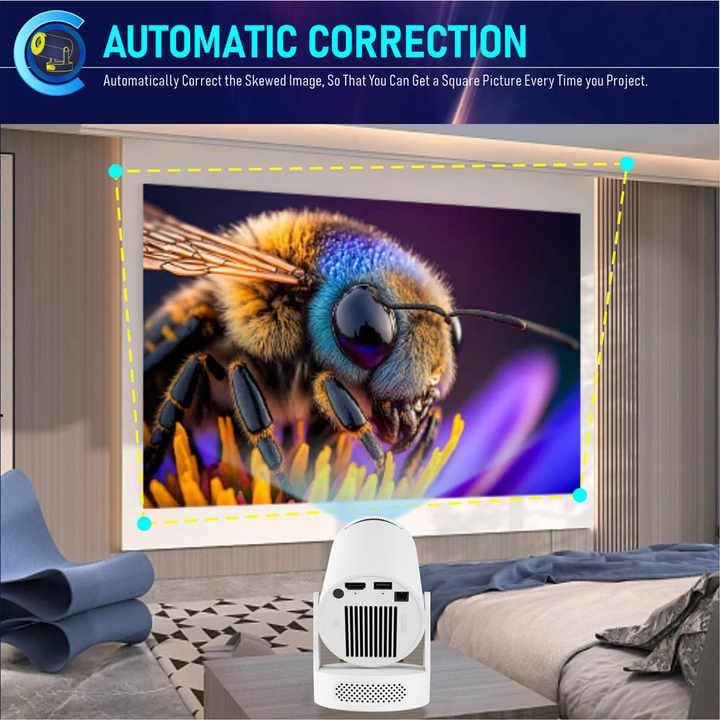
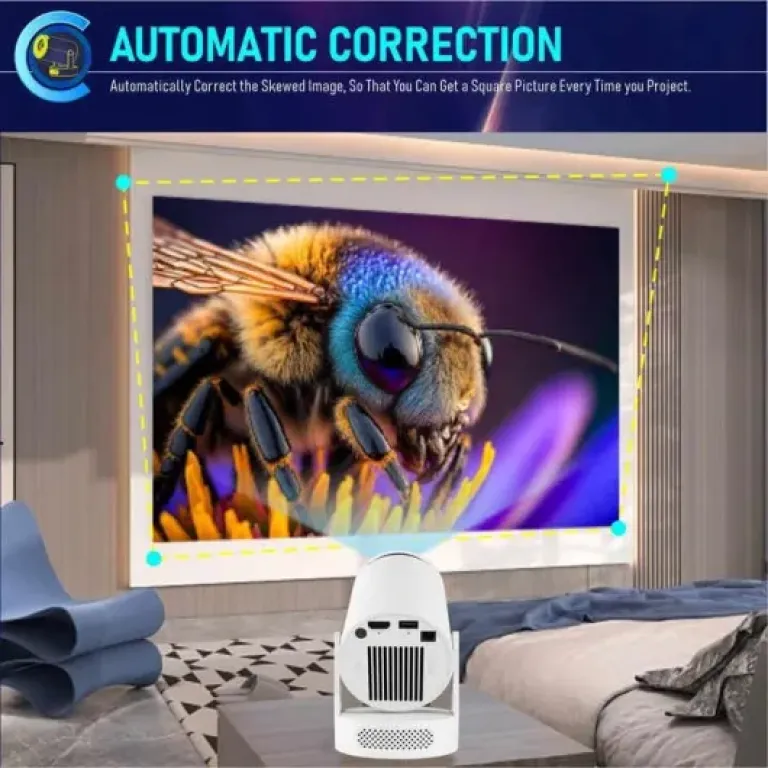
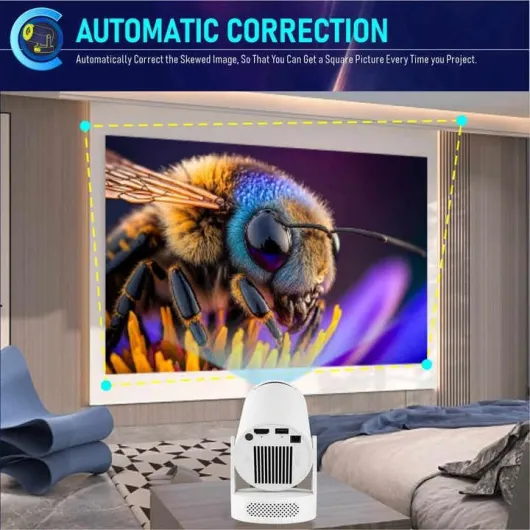
The auto keystone correction is handy. You plonk it down slightly off‑center and it straightens the image by itself. It’s not perfect, but it saves time. You can also adjust the screen size and keystone manually in the settings, which I ended up doing a couple of times to get the edges a bit sharper. Focus is digital, not manual wheel, and I found it mostly okay. Sometimes it hunts a bit, then locks. Once set, it stayed stable unless I moved the projector.
As for performance with streaming and menus: the internal Android system is not fast, but it’s not unusable. One Amazon user called the UI clunky, and I agree. It reacts with a small delay when you move around, especially in heavier apps like Netflix. I noticed less lag when I plugged in an Apple TV and just used it as a display via HDMI. So from a pure performance standpoint, the projector is better treated as a screen, and the built‑in smart side as a backup solution, not the main one.
What you actually get with the HY300 Ultra 2026
Out of the box, it’s pretty basic: you get the projector, a power cord, a small remote, and a thin user manual. No HDMI cable, no carry case, nothing fancy. The projector itself weighs around 750 grams, so it’s light enough to carry in a backpack without thinking about it. It’s clearly sold as a “do everything” device: business, education, gaming, home cinema, travel, etc. In reality, it’s more suited to home cinema and casual gaming than serious office work.
The important bit: the native resolution is 720p (1280 x 720). The listing talks about 1080p and 4K support, but that just means it can accept those signals and downscale them. If you stand close to the image, you can see pixels. From a normal distance (2–3 meters), it looks fine for movies and Netflix, especially on an 80 inch size. The contrast ratio is 2000:1, which is okay for this price range, nothing special. Dark scenes look a bit washed out if there’s any ambient light.
Brightness is advertised as 12000 lumens, but the real spec is 170 ANSI lumens. In practice, that means you need the room pretty dim or dark. With curtains closed and a small lamp on, it’s watchable but a bit flat. With proper darkness, it looks much better. If you’re thinking of daytime viewing with sun coming through the window, forget it. One of the Amazon reviewers calling it “cheap rubbish” because the room must be dark isn’t totally wrong, but that’s basically how all cheap LED projectors behave.
Feature‑wise, it’s packed: Android 11.0 built in, Wi‑Fi (2.4/5 GHz), Bluetooth 5.0, HDMI, USB, AV input, auto keystone correction, built‑in speaker, and screen mirroring for phones. You can plug in a console, a Fire Stick, a laptop, or just use the internal apps like Netflix and YouTube. On paper, it tries to be an all‑in‑one entertainment box. In practice, the core strength is: plug HDMI in, sit back, and use it like a dumb display. The smart side is usable, but not the smoothest.
Everyday use: movies, streaming, and a bit of gaming
In day‑to‑day use, the projector does what most people will want: throw a big picture on a wall for cheap. For movies and series at night, it’s actually pretty enjoyable. I watched a couple of Netflix episodes directly through the built‑in app. It works, but the interface is clearly the mobile version, so navigation with the remote feels a bit awkward. Same thing for Prime Video: it runs, but it’s not the smooth, polished experience you get on a Fire Stick or smart TV. After two evenings, I switched to using an external HDMI device and it felt much better.
Screen mirroring from my Android phone worked, but it’s not something I’d use all the time. There’s a slight delay, which is fine for photos or casual YouTube, but not ideal for anything where timing matters. For iOS, it supports mirroring too, but again, don’t expect Apple TV fluidity. For quick sharing of a video or some holiday photos with friends, it gets the job done. For regular streaming, an HDMI stick or box is just more reliable.
On the gaming side, it’s okay for casual play. I plugged in a Switch and played Mario Kart and some indie games. Input lag is present but not horrible; for casual gaming on a big wall, it’s perfectly usable. I wouldn’t use it for competitive shooters or anything where every millisecond matters, but that’s not really what this projector is made for. The image at 720p is fine for consoles like Switch or older systems. On a PS5 or Xbox Series X, you’ll clearly be limited by resolution and brightness.
Overall, I’d say the projector is effective as a cheap home cinema toy. It’s less convincing as a professional presentation tool or all‑day TV replacement. I tried a PowerPoint from my laptop, and while it was readable, the lack of brightness in a lit room made it a bit tiring. For an occasional movie night, kids’ cartoons on a big wall, or an outdoor session when it’s dark, it works well enough for the money. Just don’t expect miracles or high‑end polish.
Pros
- Compact, lightweight design that’s easy to move and set up anywhere
- Decent picture in a dark room for movies and casual gaming, despite 720p resolution
- Good connectivity: HDMI, USB, Wi‑Fi, Bluetooth, and built‑in Android 11 for basic streaming
Cons
- Real brightness is low (170 ANSI lumens) so you basically need a dark room
- Native 720p resolution despite marketing around 1080p/4K support
- Built‑in smart interface is clunky and better replaced by an external streaming device
Conclusion
Editor's rating
Overall, the HY300 Ultra 2026 / Technyon projector is a decent little unit if you treat it as what it is: a low‑cost 720p LED projector for dark rooms, not a high‑end home cinema system. The design is compact and easy to move around, the fan noise is manageable, and the built‑in Android 11 system, while clunky, is usable for basic streaming. With an external HDMI device like an Apple TV, Fire Stick, or console, it becomes a simple, effective big screen for evenings and weekends.
Image quality is okay in the dark, average in any kind of light, and the sound is fine for casual use but clearly benefits from a Bluetooth speaker. The headline specs (12000 lumens, 4K, etc.) are mostly marketing; the real numbers (170 ANSI lumens, 720p native) tell the true story. If you accept that and you get it at a good price, it offers reasonable value and can replace a TV for occasional viewing. If you’re picky about image sharpness, want bright daytime use, or expect flawless smart TV performance, you should skip it and look at a brighter, true 1080p model from a more established brand.