
Summary
Editor's rating
Is it worth the money or are you paying for convenience?
Coffee-tumbler size is not a joke
Real-world battery life with the PowerBase
Build quality and how it holds up when you move it a lot
Image and sound: good enough if you control the light
What you actually get out of the box
Pros
- Genuinely portable size with integrated 360° stand and easy setup
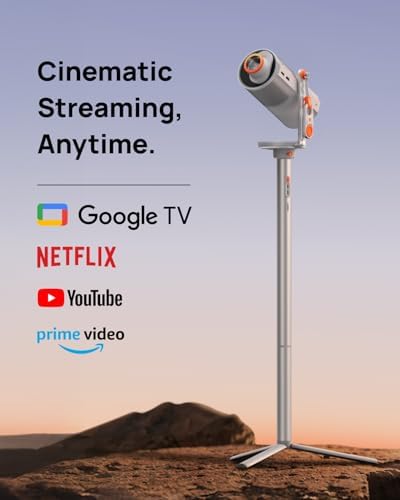
- Google TV with licensed Netflix built in, no extra streaming stick needed
- PowerBase stand roughly doubles battery life to around 4–5 hours in real use
Cons
- 450 ISO lumens limit use to dark rooms or after sunset outdoors
- Price is on the high side if you don’t really need portability and battery

Specifications
View full product page →| Brand | XGIMI |
A pocket cinema that’s almost there
I used the XGIMI MoGo 4 2025 as my main TV replacement for about two weeks, both in my living room and for a couple of outdoor sessions on the balcony and in the backyard. I wasn’t looking for perfection, just something easy to move around, with built-in Netflix, and that didn’t die after one movie. On paper, this one ticks a lot of boxes: small size, Google TV, licensed Netflix, 450 ISO lumens, and a PowerBase that promises around 5 hours of playtime.
In practice, it’s a mixed bag, but in a mostly good way. The projector is genuinely compact, closer to a tall coffee tumbler than a traditional projector. I could toss it in a backpack next to a laptop and a bottle of water without feeling like I was hauling a brick. Setup was pretty painless: plug it in, sign into Google, log into Netflix and Prime, and you’re basically done. No weird hacks needed to get Netflix working, which is already better than half the mini projectors I’ve tried.
Where things get more nuanced is brightness and battery. The 450 ISO lumens are fine in a dim room, but they’re not magic. With the curtains half-open during the day, the image starts to look washed out. For outdoor use, it’s clearly a “after sunset only” device. The PowerBase stand does help a lot with runtime, but don’t expect 5 hours at full brightness with Wi‑Fi blasting and volume high; that’s more of an ideal scenario than a hard guarantee.
Overall, my first impression is that it’s a pretty solid all-in-one movie machine for small apartments, bedrooms, and casual outdoor nights. It’s not cheap, and there are brighter projectors out there if you don’t care about portability. But if you actually want something you can move from the couch to the bedroom to the patio without fuss, it does the job fairly well, with a few trade-offs that you need to accept upfront.
Is it worth the money or are you paying for convenience?
On value, it really depends what you’re comparing it to. If you look at cheaper mini projectors in the sub-budget range, they often claim similar brightness but come with fake resolutions, no licensed Netflix, weak speakers, and no real battery. Versus those, the MoGo 4 feels more serious: real 1080p, better sound, Google TV, and a usable battery with the PowerBase. You’re paying more, but you’re also avoiding a bunch of compromises that make the cheaper units annoying after a month.
Compared to bigger, non-portable projectors in the same price bracket, though, you definitely give up brightness and sometimes contrast. If you have a fixed room where the projector will live, with a power outlet close by, and you don’t care about built-in apps, you can probably get a brighter unit for the same or slightly less money. So you have to be honest with yourself: are you buying portability and convenience, or raw image performance? This one leans heavily toward convenience.
For me, the main value comes from the all-in-one aspect: you set it down, angle it, and hit Netflix. No cables everywhere, no extra streamer, no external speaker required on day one. The PowerBase doubling battery life is also a key point. I can see this being particularly good for people in small apartments, students, or families who want to move the “TV” between rooms or take it to grandparents’ houses or vacation rentals.
Is it good value for money? I’d say it’s pretty solid if you’ll actually use the portability and battery. If you’re just going to park it in one room and never move it, there are better deals out there. So the value is there, but it’s very tied to your use case. If you just want the biggest, brightest image per dollar, look elsewhere. If you want a portable smart projector that behaves like a small TV and you don’t mind paying a bit of a premium for that, it’s a reasonable buy.
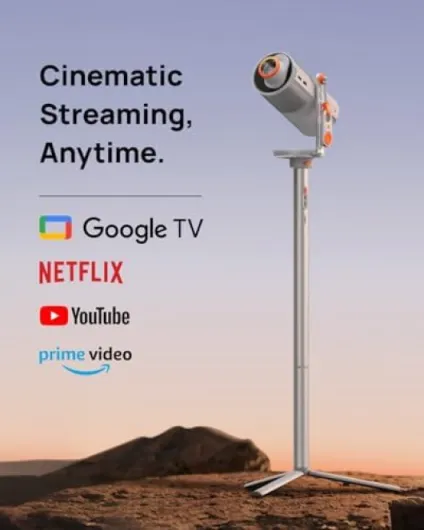
Coffee-tumbler size is not a joke
Design-wise, this thing is clearly built around portability. The projector really is about the size of a tall coffee tumbler: it fits easily in one hand, and I could set it on narrow shelves or window sills without feeling like it was going to topple over. The integrated 360° adjustable stand is built into the body, so you don’t need a separate tripod. You flip it, angle it, and it holds its position well enough for normal use. I tried it on a bed, on a couch armrest, and on a balcony table, and it never felt unstable.
The finish is more on the practical side than fancy. The plastic casing feels solid enough but not premium. It’s the kind of device you’re not scared to throw into a backpack, but you still don’t want to drop it on concrete. The lens has scratch-resistant protection, which is a nice touch for something that will move around a lot. The buttons on the device are minimal; you’re clearly supposed to use the remote for almost everything. Once or twice I wished there were a few more physical controls on the body when I misplaced the remote, but that’s a minor annoyance.
One thing that actually surprised me was the Magnetic Sunset Filter. It snaps onto the front and adds a warm, amber glow effect if you’re using it more as an ambient light or background visual than a serious movie session. It’s a bit gimmicky, but it can be nice in the evening when you just want chill visuals while music plays. XGIMI also sells extra filters separately if you want different moods, but personally I don’t see myself collecting filters for a projector. It’s a fun bonus, not a core feature.
Overall, the design is very much “grab and go”. It’s light, compact, easy to angle, and doesn’t need extra stands or giant cables dangling everywhere. On the flip side, the compact size also means fewer ports, smaller speakers compared to bigger home projectors, and a brightness ceiling that you can’t really cheat. If you’re okay with that and you value being able to move it around the house in one hand, the design will make sense to you.
Real-world battery life with the PowerBase
The battery part is where expectations and reality don’t fully match, but it’s not bad. XGIMI advertises up to 5 hours with the PowerBase stand, and in my tests, that’s achievable only if you’re not pushing brightness and volume to the max. With the projector docked on the PowerBase, Wi‑Fi on, brightness at around 60–70%, and volume at 40–50%, I consistently got between 4 and 4.5 hours. That’s still solid: enough for two normal movies or a long football match plus some YouTube.
When I cranked brightness up to near max and watched a louder action movie, runtime dropped closer to 3–3.5 hours. So yes, you can get 5 hours, but it’s more of a best-case scenario (dimmer image, maybe local playback or screen off between uses). For an outdoor movie night with friends, you’ll usually be fine, but if you’re planning a whole evening of back-to-back content at full blast, bring the power cord as backup.
The internal battery without the PowerBase is more limited. I tried using just the projector on its own on the bedroom ceiling, and I got roughly 2–2.5 hours under similar moderate settings. That’s okay for a movie, but you start watching the battery percentage if you’re bingeing a series. The PowerBase basically turns it from “one movie safe” into “two movies safe”, which is exactly what you want if you’re camping or using it in a garden where power outlets are far away.
Charging time is not instant either. From low battery to full, with the projector off, it took a bit over 2 hours in my case. If you’re the kind of person who forgets to charge devices, you’ll want to plug it in after each long session. Overall, I’d say the battery performance is practical but not magical. It does what it says in broad strokes, but don’t fixate too hard on the 5-hour claim unless you’re okay tweaking brightness down and not maxing everything out.

Build quality and how it holds up when you move it a lot
Durability is always a question mark with portable projectors, because they get moved, bumped, and tossed in bags way more than a fixed home cinema unit. In the two weeks I used the MoGo 4, I carried it between rooms almost every day and took it outside several times. I didn’t baby it, but I also didn’t drop it. So far, no rattling parts, no weird noises, and no signs of the stand loosening up. The hinge of the 360° stand still feels firm and doesn’t sag once you set the angle.
The scratch-resistant lens cover is reassuring, especially if you have kids around or you’re throwing it into a backpack with other stuff. I didn’t see any marks or scuffs on the lens area after repeated handling. The body itself is matte plastic, which hides fingerprints and small marks fairly well. It doesn’t feel luxury, but it feels like it can handle normal everyday use without falling apart. This is more “good tool” than “delicate gadget”, which I prefer for something that’s supposed to be portable.
Heat management is decent. After a two-hour movie, the projector is warm but not scorching. The fan is audible in very quiet scenes, but it’s a soft whoosh, not a high-pitched whine. I’ve had cheaper projectors where the fan noise was louder than dialog; this is not the case here. Long-term, less heat and reasonable fan speeds should help with lifespan, but obviously I can’t judge what happens after a couple of years. Based on build and thermals, though, it doesn’t feel fragile.
If I had to nitpick, I’d say the included outdoor screen feels like the first part that might wear out. The fabric is light and the mounting system is basic, so if you assemble and disassemble it every weekend, I can see it stretching or tearing at some point. The projector itself, though, gives the impression that it can survive regular moving and casual bumps. Just don’t expect it to handle drops from a table to a hard floor without consequences; it’s still a piece of electronics, not a rugged speaker.
Image and sound: good enough if you control the light
On performance, the MoGo 4 is decent, but you have to be realistic about what 450 ISO lumens can do. In a dark room, the 1080p image is sharp and pleasant. Text in menus is clean, and movies and series look crisp enough for casual viewing. I tried it at around 80–90 inches on a white wall and on the included screen. At that size in a dark room, it’s perfectly watchable. When I pushed it over 100 inches, the image was still okay, but brightness started to feel a bit weak, especially in scenes with a lot of dark areas.
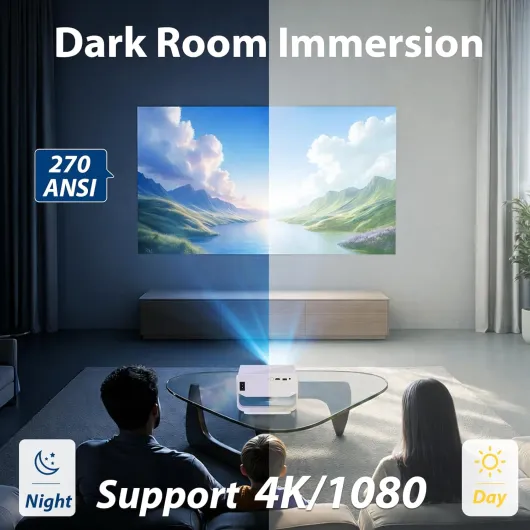
As soon as you introduce ambient light, you see the limit. With curtains half closed in the afternoon, colors lose punch and blacks become more like dark gray. It’s still usable for cartoons or YouTube, but for movies or sports you’ll want the room as dark as you can get it. Outdoors, it’s strictly for use after sunset. I tried starting a movie at dusk and had to wait another 30–40 minutes for the image to really look good. Once it was dark, it held up nicely on the backyard screen.
The automatic image adjustment (XGIMI’s ISA tech) is honestly one of the parts I liked the most. It handles keystone, focus, and screen alignment quite well. I moved the projector around a bunch, from the coffee table to a shelf to the side of the room, and it corrected itself quickly most of the time. Sometimes it took an extra second or two, and a couple of times I had to manually tweak focus, but overall it saves a lot of fiddling. For a casual movie night, not having to dig into menus every time is a big plus.
Sound from the 2 x 6W Harman Kardon speakers is surprisingly usable. It’s not a replacement for a soundbar, but for a small bedroom or a balcony it’s fine. Voices are clear, there’s a bit of bass, and at around 60–70% volume it’s loud enough for 2–4 people without distortion. Compared to cheap mini projectors with tinny speakers, this is a big step up. If you’re picky, you’ll still want to pair a Bluetooth speaker or a small sound system, but you don’t need to do that on day one, which is nice.
What you actually get out of the box
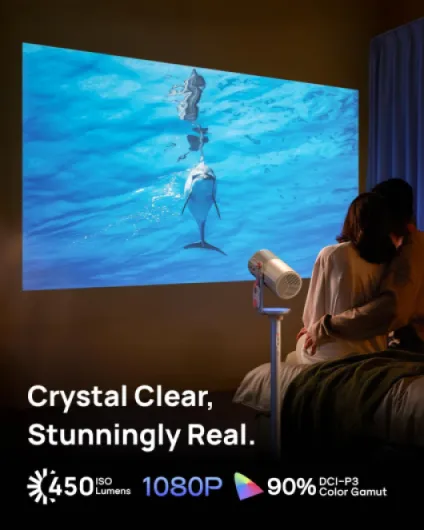
Out of the box, the XGIMI MoGo 4 2025 kit is pretty straightforward: the projector itself, the PowerBase stand, a compact remote, power cable, and in this bundle, an outdoor portable projector screen. No crazy extras, but everything you need to start watching the same evening. The projector is a 1080p unit (1920 max resolution) with 450 ISO lumens and 2 x 6W Harman Kardon speakers. It runs Google TV with licensed Netflix, which means you install apps directly from the Play Store instead of messing around with HDMI sticks or side-loading hacks.
The PowerBase is basically a dock with an integrated battery that doubles the playtime. On its own, the projector’s internal battery is fine for a normal movie, but with the stand attached, I could get close to 4.5–5 hours at moderate brightness and around 40–50% volume. That’s enough for two movies or a long sports event, which is the main selling point if you plan on using it outside or in rooms without power outlets nearby.
The included screen is decent. It’s nothing fancy, but it’s usable: lightweight, easy to move, and good enough for casual use. It’s not tensioned like premium fixed-frame screens, so you’ll see a few wrinkles unless you really stretch it well. For a quick setup in the backyard or against a wall in a rental apartment, it’s totally fine. If you’re picky about image quality, you’ll probably end up buying a better screen later, but as a starter, it does the trick.
In terms of daily use, the biggest advantage is clearly the plug-and-play side: Google TV, proper Netflix support, and built-in audio. You don’t need speakers, you don’t need a Fire TV stick, and you don’t need a separate battery. The downside is the price you pay for this convenience and the fact that you’re locked into a relatively modest brightness level. If you’re expecting a living room projector that competes with a big, wired home cinema unit, this is not it. If you want a portable projector that behaves like a smart TV in a cup-sized body, that’s exactly what it is.
Pros
- Genuinely portable size with integrated 360° stand and easy setup
- Google TV with licensed Netflix built in, no extra streaming stick needed
- PowerBase stand roughly doubles battery life to around 4–5 hours in real use
Cons
- 450 ISO lumens limit use to dark rooms or after sunset outdoors
- Price is on the high side if you don’t really need portability and battery
Conclusion
Editor's rating
After using the XGIMI MoGo 4 2025 for everyday viewing, I’d sum it up like this: it’s a compact, practical projector that does a lot of things right, as long as you don’t expect a home-theater monster. The 1080p image is clean in a dark room, the 450 ISO lumens are enough for evening use, and the built-in Harman Kardon speakers are actually usable without extra gear. The fact that Google TV and licensed Netflix are built in makes a big difference in daily use; you turn it on and stream, no workarounds.
The PowerBase stand is the other big plus. Doubling the playtime to roughly 4–5 hours in real-world use makes it viable for outdoor movie nights, camping, or just moving around the house without hunting for outlets. The 360° stand and auto image correction save time and make it feel more like a casual device than a fiddly piece of AV equipment. On the downside, brightness is clearly limited for daytime or bright rooms, you pay a premium for the convenience, and the included screen is more “good starter” than long-term solution.
I’d recommend this to people who want a flexible, portable “TV substitute”: renters, students, families who move the screen between rooms, or anyone who likes the idea of backyard movie nights. If you have a dedicated home theater room and you care mainly about maximum brightness and perfect image quality for the price, you should skip this and look at larger, non-portable projectors. For what it is—a small, smart, battery-backed projector—it gets the job done pretty well, with clear strengths in convenience and portability and known trade-offs in raw performance.