
Summary
Editor's rating
Is it worth the money?
Compact, clean design that’s actually practical
Battery life: okay for a movie, but manage your expectations
Build quality and reliability: feels solid, but long-term is a question mark
Image quality: solid in the dark, struggles with light
What the Luma 450 actually is (and what it isn’t)
Pros
- Compact and lightweight with tripod mount and included mini tripod, easy to move and set up anywhere
- Native 1080p resolution with decent image quality in dark rooms up to around 80–100 inches
- Built-in Android 9.0, Wi‑Fi, Bluetooth, HDMI, and USB give you several ways to watch content without extra gear
Cons
- Only 200 ANSI lumens, so image washes out quickly in rooms with light or outdoors before dark
- Built-in speakers are weak; external speaker is almost mandatory for a proper movie experience
- Smart OS is a bit slow and finicky, and some streaming apps may work better via an external streaming stick

Specifications
View full product page →| Brand | KODAK |
A tiny projector that tries to be a full home cinema
I’ve been using the KODAK Luma 450 for a mix of stuff: movie nights in the living room, a couple of backyard sessions, and some quick presentations. I didn’t go into it expecting a full TV replacement, more like a compact gadget I could throw in a bag and set up anywhere. That mindset helps a lot with this thing, because it’s not a miracle box, it’s a small projector with real limits.
The first thing that hit me is how small it is compared to what it can do. You’re getting a 1080p native DLP projector with Android TV-style apps, Wi‑Fi, Bluetooth, HDMI, USB, and a built-in battery in something that’s roughly the size of a stack of CDs. On paper it sounds like a dream for camping, holidays, or people who don’t want a big ugly projector permanently mounted to the ceiling.
In practice, the experience really depends on how you use it. In a dark room, on a white wall or a basic screen, the picture is pretty solid for casual viewing. In a room with any serious ambient light, the 200 ANSI lumens show their limits quickly. Same story for sound: the built-in speakers are okay for a bedroom, but if you want any kind of impact you’ll end up pairing Bluetooth speakers or using the 3.5 mm jack.
Overall, after a few weeks, I’d say the Luma 450 is good as a flexible, portable screen for movies, games, and slideshows, as long as you accept some compromises: you need a dark room, you’ll probably want external audio, and you shouldn’t expect super smooth, polished software. If that sounds fine to you, it gets the job done. If you’re picky or want a true home cinema setup, you’ll likely be annoyed by its limits.
Is it worth the money?
On the value side, the Luma 450 sits in an awkward spot. It’s not a cheap impulse-buy projector, and it’s also not in the same league as big, bright home theater projectors. You’re paying for portability + 1080p + built-in smart OS + battery in one compact box. If you actually need all of those at once, the price starts to make sense. But if you only care about one or two of those things, you can probably do better with something else.
For example, there are brighter 1080p projectors without a battery and without Android that cost less. Pair one of those with a cheap streaming stick and you get better image quality in lit rooms, but you lose the compact all-in-one convenience and the cordless option. On the other side, there are cheaper mini projectors (including other Kodak Luma models like the 75 or 150) that don’t reach 1080p or don’t have as many features, but if you just want something for occasional art tracing or kids’ cartoons in a dark room, those might be enough.
Where the Luma 450 feels like good value is if you see yourself actually using it in different scenarios: indoor movie nights, quick office or classroom presentations, camping, gaming at a friend’s place, etc. The fact that it fits in a small bag, sets up in a few minutes, and has a decent full HD picture in the dark is worth something. The included tripod and remote mean you can start using it straight out of the box without extra purchases, aside from maybe a speaker.
But I won’t sugarcoat it: for the price, the brightness and speakers are nothing special, and that’s the main drawback. You kind of pay a premium for the form factor and versatility. If you’re tight on budget or you mainly plan to use it in one room with power outlets and space for a bigger device, I’d say look at a brighter, non-portable projector instead. If portability and the battery are high on your list, then the Luma 450 lands in the “not cheap, but fair enough for what it does” category.
Compact, clean design that’s actually practical
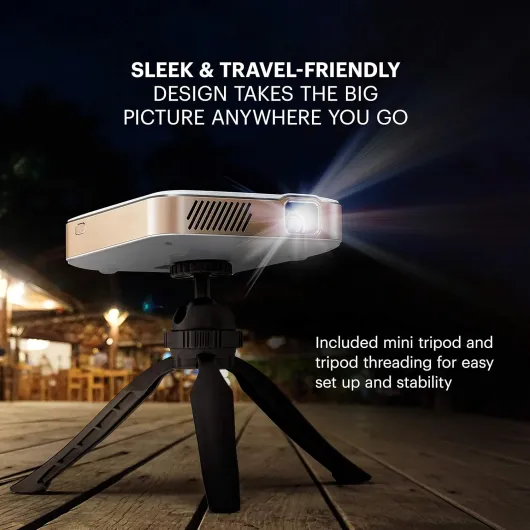
The design is one of the things I liked right away. The Luma 450 is really compact: about 7.9 x 7.9 x 2.2 cm and 454 g, so it’s genuinely easy to toss in a backpack or even a larger handbag. It’s basically a flat square puck, with the lens on one side and vents on the edges. The white finish is simple and neutral; it doesn’t scream “tech toy” when it’s sitting on a table. It looks like a modern gadget without trying too hard.
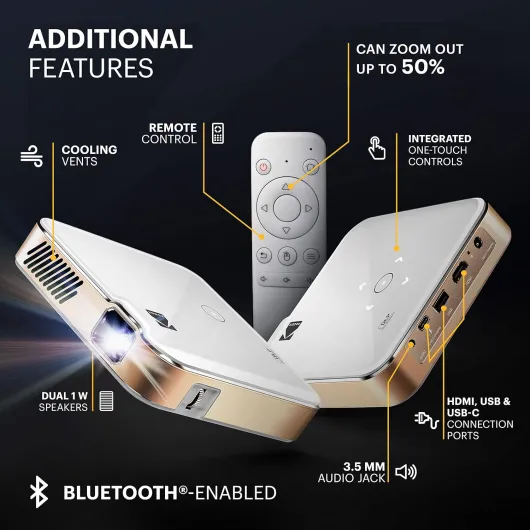
On top, you get touch controls for power and navigation, but in reality, I mostly used the included remote. The touch buttons work, but when the projector is on a tripod or further away, you won’t want to walk up to it to tap anything. The remote is basic but decent: directional pad, home, back, volume, and a few shortcuts. Response is okay, not lightning fast, but perfectly usable. There’s no dedicated hardware focus ring on the top like some other mini projectors; you get manual focus via a small wheel, which is precise enough once you get the hang of it.
Ports are placed logically on the sides: HDMI, USB, 3.5 mm audio, and power. Nothing fancy, but it covers the basics. The tripod mount at the bottom is very useful; the included mini tripod is not premium, but it’s stable enough for indoor use on a table or shelf. I used it on a coffee table pointed at a wall and it was steady. If you want a more serious setup, you can screw it onto a better camera tripod without any problem.
Heat and noise are also part of the design story. The projector does get warm after an hour or so, but the fan noise is relatively low. You hear a soft hum, but with any kind of sound playing, it fades into the background. It’s quieter than some older projectors I’ve tried. Overall, the design is practical and compact, not fancy, but it fits the “throw it in a bag and go” promise pretty well.
Battery life: okay for a movie, but manage your expectations
The Luma 450 comes with a 10,500 mAh battery, and Kodak claims up to 3 hours of play time in Eco mode. In my use, that’s roughly accurate, but there are a few details. In Eco mode with Wi‑Fi on and streaming from an app, I got around 2.5 to 3 hours depending on brightness and volume. That’s enough for a full movie and maybe some trailers, but not a full binge session. If you push brightness to the max and use Bluetooth audio, expect closer to 2 hours before it starts warning you.
For camping or backyard use, I found it “good enough but not generous”. One evening, I ran a movie off a USB drive in Eco mode with the built-in speakers, and it lasted through a 2-hour film with some battery left. Another time, streaming over Wi‑Fi with Bluetooth speakers at higher volume, it dipped under 20% before the end of a long movie. So if you’re planning to use it wirelessly a lot, I’d honestly bring a power bank or extension cord as a backup, or just plug it in when you can.
The good point: it can run while charging, so if you’ve got a decent power bank or access to an outlet, you’re fine. It doesn’t seem to throttle or misbehave when plugged in. Charge time is not super fast though; you’re looking at a few hours to go from nearly empty to full, so it’s more of an overnight thing than a quick top-up before an impromptu movie.
So in short, the battery is good for occasional cordless use, but I wouldn’t buy it expecting a full wireless cinema setup every night. Think of it as a projector that can go cordless when needed, not a fully independent device that lives off-grid. For travel, camping weekends, or moving between rooms without worrying about cables for a while, it does the job. For heavy daily use, you’ll end up leaving it plugged in most of the time.
Build quality and reliability: feels solid, but long-term is a question mark
Physically, the Luma 450 feels reasonably solid for a small plastic device. There’s no creaking when you hold it, the ports don’t feel loose, and the tripod thread seems sturdy enough. The RGB LED light source is rated for 30,000 hours, which on paper is great—you’re not going to burn through that quickly even if you watch a couple of hours a day. So at least in theory, the light engine should outlast your interest in the device.
Where I have some doubts is more on the electronics and software longevity. Reading through user reviews of the Luma family (75, 150, 350, 450), you do see some people reporting failures after a period of not using it—like one review where the unit powered on but didn’t project an image anymore. My unit hasn’t died on me, but that kind of feedback makes me cautious. I also noticed the occasional software freeze where I had to reboot the projector, which doesn’t scream rock-solid reliability.
The finish itself holds up fine to regular handling. I tossed it in a backpack a few times (inside a soft pouch) and it didn’t pick up any major scratches. The lens is recessed enough that it’s not the first thing that hits if you bump it, but I’d still recommend keeping it in some sort of case. The vents do get warm, so I’d avoid covering it with anything while in use. Fan noise stayed consistent over time; I didn’t notice it getting louder or rattly.
In the EU, they mention 7 years of spare part availability, which is reassuring on paper, but that doesn’t automatically mean cheap or easy repairs. Realistically, this feels like a gadget you keep for a few years rather than a decade-long investment. I wouldn’t treat it roughly or leave it in extreme heat or cold. Used with basic care—no drops, no dust-filled shelves—it feels like it should hold up, but I wouldn’t bet on it being unkillable. So: durability is decent, but not bulletproof, and software glitches are probably more likely than the hardware physically breaking.
Image quality: solid in the dark, struggles with light
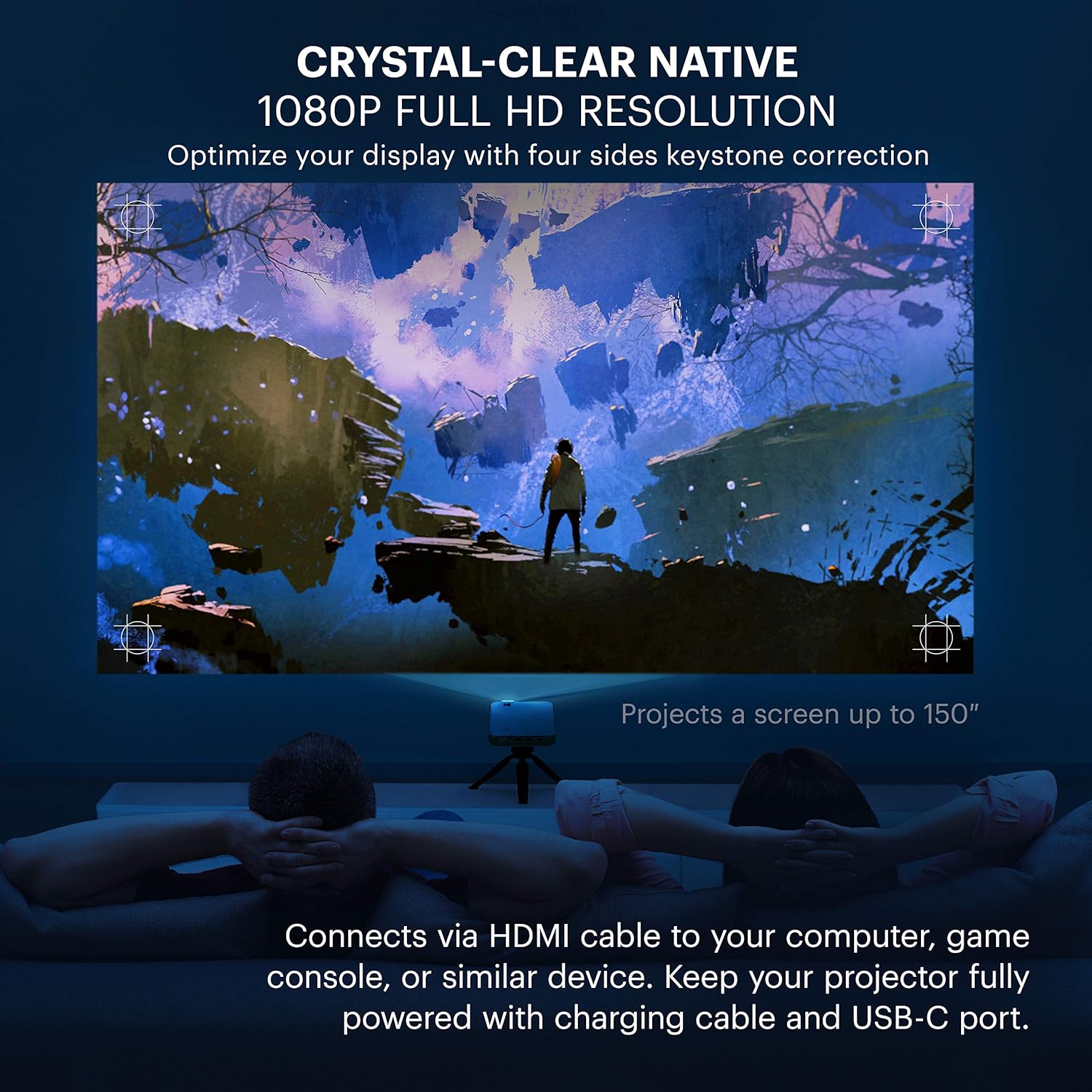
Let’s talk about the picture, because that’s what matters most. The Luma 450 is native 1080p, and you can see the difference compared to cheap 720p projectors. Text in menus and subtitles is crisp, and HD movies look clean. For a portable device, the sharpness is honestly pretty good when you dial in the focus correctly. At around 80–100 inches, sitting a few meters back, it’s more than fine for casual movie nights or gaming.
The weak spot is brightness. The 200 ANSI lumens figure is not a lie, but it’s also not a lot. In a fully dark room, the image is good: colors are decent, black levels are okay for DLP, and contrast is acceptable. You’re not getting OLED-level blacks obviously, but it looks alright. As soon as you add ambient light—open curtains in the afternoon, ceiling lights on—the image starts to wash out quickly. For presentations, I had to dim the lights quite a bit to keep slides readable at larger sizes. So if you were hoping to replace a TV in a bright living room, this is not it.
Color-wise, it claims 100% color saturation and 16.7 million colors. In practice, colors are on the slightly cool side out of the box, but skin tones look natural enough, and cartoons and games pop nicely. There are some basic picture settings, so you can tweak brightness, contrast, and color temperature, but don’t expect advanced calibration options. For Netflix, YouTube, or a console, it’s absolutely fine. Motion is okay too; you don’t get fancy motion smoothing, but 24p and 30p content plays without obvious judder.
The auto vertical keystone (+/- 40°) and 100% offset are handy. You can put the projector slightly below the center of the screen and it will correct the trapezoid shape automatically. It’s not perfect—if you push the angle too far, you lose some sharpness at the edges—but for quick setups on a table or tripod, it saves time. The throw ratio lets you go from about 10 to 150 inches, but in reality, I found the sweet spot around 80–100 inches for a good balance of brightness and sharpness. Overall, the performance is good in the right conditions: dark room, reasonable screen size. Outside of that, its limits show fast.
What the Luma 450 actually is (and what it isn’t)
On paper, the KODAK Luma 450 is a portable DLP projector with a native 1920 x 1080 resolution that can accept up to 4K input, with 200 ANSI lumens, a 3500:1 contrast ratio, built-in Android 9.0 Smart OS, and a rechargeable 10,500 mAh battery. The brand sells it as a mini home theater that can go up to 150 inches diagonally. It has Wi‑Fi, Bluetooth, HDMI, USB, and a headphone jack, plus a small tripod in the box. So basically, it wants to replace a portable screen, a streaming stick, and a speaker in one box.
In real life, I’d describe it more like this: it’s a compact 1080p projector that’s great for dark rooms and night use, decent for camping or backyard movies, and just okay for presentations as long as you can dim the lights. The 200 lumens spec is honest: it’s watchable, but you’re not blasting through daylight or bright office lighting. For movie nights with lights off and curtains drawn, it works. For anything with sunlight in the room, it looks washed out and a bit dull.
The Android 9.0 Smart OS is handy because you can install apps like Netflix, Prime Video, etc., directly on the projector, so you don’t always need a Fire Stick or laptop. That said, like a lot of projectors with built-in smart systems, it feels a bit slower and clunkier than a cheap dedicated streaming stick. Menus take a second to respond, some apps crash occasionally, and typing Wi‑Fi passwords with the remote is a pain. It’s usable, but don’t expect the smoothness of a recent smart TV.
Where it shines is flexibility. You can connect almost anything: phone (screen mirroring or HDMI adapter), laptop (HDMI), console, USB drive (as long as formats and FPS are compatible), or just stream over Wi‑Fi. So if one method gives you trouble, you usually have a backup. That’s why I’d say it’s more of a Swiss Army knife projector than a polished home cinema centerpiece. It does a lot, but not perfectly, and you need to be ready to tweak and adapt a bit.
Pros
- Compact and lightweight with tripod mount and included mini tripod, easy to move and set up anywhere
- Native 1080p resolution with decent image quality in dark rooms up to around 80–100 inches
- Built-in Android 9.0, Wi‑Fi, Bluetooth, HDMI, and USB give you several ways to watch content without extra gear
Cons
- Only 200 ANSI lumens, so image washes out quickly in rooms with light or outdoors before dark
- Built-in speakers are weak; external speaker is almost mandatory for a proper movie experience
- Smart OS is a bit slow and finicky, and some streaming apps may work better via an external streaming stick
Conclusion
Editor's rating
After actually living with the KODAK Luma 450, I’d sum it up like this: a convenient, compact projector that works well in the right conditions, but you have to accept clear limits. In a dark room, on a white wall or simple screen, the 1080p image is sharp, colors are decent, and it’s perfectly fine for Netflix nights, YouTube, and casual gaming. The built-in Android 9.0 means you can stream directly without extra hardware, and the battery lets you pull off a full movie without hunting for an outlet, as long as you don’t crank everything to max.
On the downside, 200 ANSI lumens is not much once you add ambient light, and the integrated speakers are weak for anything beyond a small, quiet room. The smart OS is usable but not slick, and you may run into app limitations or need workarounds like a Fire Stick for some services. Long-term reliability is a bit of a question mark, judging from some user feedback on similar Kodak models, so I’d treat it as a handy portable tool rather than a long-term home theater anchor.
If you want a portable projector for family movie nights, camping, art projects, or occasional presentations, and you’re okay using it mostly in dark environments with an external speaker when needed, the Luma 450 is a pretty solid option. If you care more about brightness and sound than about portability and battery, or if you want a serious home cinema setup in a bright living room, you’re better off with a larger, brighter non-portable projector and a separate streaming stick. So, good product with clear trade-offs: convenient and flexible, but not magic.