
Summary
Editor's rating
Value for money: where it makes sense and where it doesn’t
Design and usability: compact, light, and the rotating stand is actually useful
No built-in battery: what that means in real use
Build quality, noise, and long-term feel
Image quality and sound: good enough in the dark, limited in bright rooms
What you actually get with the finade S106
Pros
- Native 1080p with decent sharpness for movies and series in a dark room
- Built-in Android 12 with Wi‑Fi 6 and Bluetooth 5.4, so no immediate need for a streaming stick
- 270° rotating stand makes setup and ceiling projection easy without extra accessories
Cons
- Only 200 ANSI lumens, so image washes out quickly in bright rooms
- Built-in speakers are weak on bass, external speaker strongly recommended
- No internal battery despite the “mini” and “portable” marketing, always needs mains power

Specifications
View full product page →| Brand | finade |
A small projector that looks like a toy but acts serious
I’ve been using this finade S106 projector for a couple of weeks now, mostly in the bedroom and sometimes in the living room for quick movie nights. When I first unpacked it, I honestly thought it would be one of those cheap gadgets that you try twice and then forget in a drawer. It’s small, light, unknown brand… I didn’t expect much beyond “it turns on and shows an image”.
After a few evenings with Netflix, YouTube and some PS5 gaming, my opinion changed a bit. It’s not a cinema-grade machine and it’s clearly not meant to replace a proper TV for daytime viewing, but for casual use in a dim room it actually holds up pretty well. The big surprise for me was the built-in Android 12 and Wi‑Fi 6: I didn’t need to plug in a Fire Stick right away, which is usually the first thing I do with budget projectors.
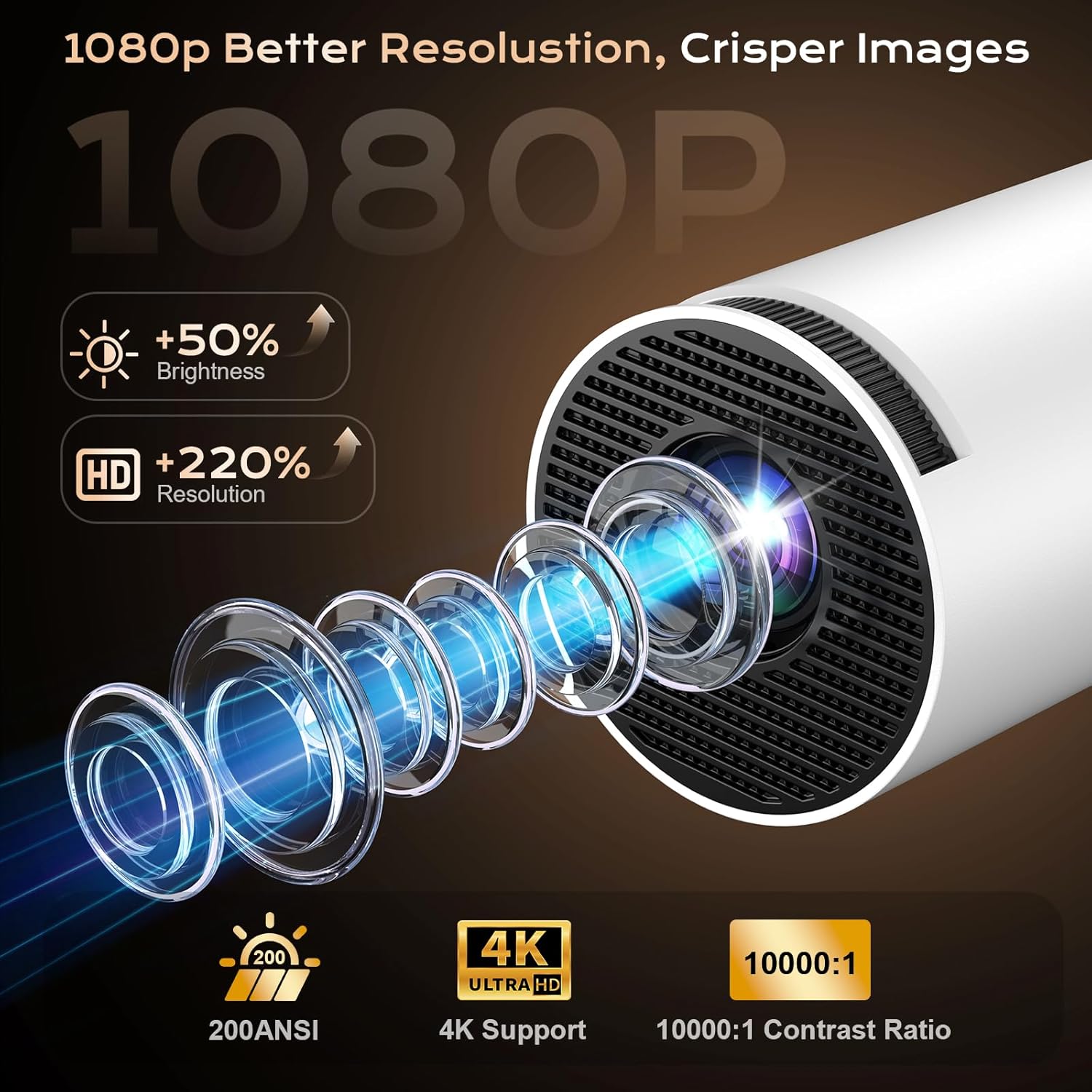
In day-to-day use, I mainly projected between 80 and 120 inches on a white wall, from about 2.3–2.5 m away. I also tried the classic “lazy ceiling setup” in the bedroom thanks to the rotating stand. Image quality is decent for the price: native 1080p looks sharp enough for movies and series, and text in menus and subtitles is perfectly readable. Don’t expect 4K quality; it only supports 4K input, it doesn’t display it natively, but that’s normal at this price.
Overall, it’s one of those devices that doesn’t blow you away but quietly does what you bought it for: throw a big picture on a wall without too much hassle. It has flaws (brightness, speakers, and a bit of plastic feel), but if you keep your expectations realistic, it’s a pretty solid little projector for casual home cinema and occasional outdoor use at night.
Value for money: where it makes sense and where it doesn’t
For what it offers – native 1080p, Android 12, Wi‑Fi 6, Bluetooth, auto keystone, and that rotating stand – the finade S106 sits in a pretty good value spot. You’re basically getting a small smart TV projector that can handle most streaming platforms directly, without having to buy a separate stick. If you mostly watch movies and series in the evening, in a bedroom or a small living room, it does the job without costing as much as the big brands.
Where the value is strong is if you compare it to cheaper 720p projectors that flood the market. For a bit more money, the jump to 1080p and a more stable Android system is worth it in my opinion. Text is clearer, the image looks cleaner, and you don’t have to fight with clunky mirroring apps all the time. Also, the Wi‑Fi 6 and Bluetooth 5.4 mean it’s reasonably future-proof for a while, at least on the connectivity side.
On the downside, if you add up the cost of an external Bluetooth speaker (which I really recommend if you care about sound) and maybe a small tripod or screen, you start getting closer to the price of entry-level models from better-known brands like Epson or BenQ (though those often don’t have Android built in). Also, the 200 ANSI lumens limit what you can do in brighter rooms. If you want something that works well even with lights on, you’ll have to spend more on a brighter projector, and then this one starts looking more like a secondary toy than a main device.
So, value-wise, I’d say this: it’s a solid deal for casual users who mainly watch content at night and want a simple all-in-one box without extra gadgets. If you’re picky about image brightness, color accuracy, or you want something for professional presentations in meeting rooms with lights on, you’re better off saving for a more serious model. For students, renters, and anyone wanting a cheap big screen in a dark room, this one makes sense.
Design and usability: compact, light, and the rotating stand is actually useful
Physically, the finade S106 is quite compact: about 21 x 12 x 13.4 cm. It’s light enough to move around with one hand, and there’s a small handle on top that makes it easy to carry from room to room. The overall look is simple: grey plastic shell, lens on the front with a plastic cap, buttons on top, ports on the back. It doesn’t scream premium, but it doesn’t look like a toy either. It’s the kind of device you can leave on a shelf without it ruining the room.
The 270° rotating stand is the part I ended up liking more than I expected. It’s basically a built-in swiveling base that lets you tilt the projector up, down, or even almost straight at the ceiling without stacking books or using a tripod. For bedroom use, projecting onto the ceiling while lying down actually works and is pretty comfortable. The stand feels stable enough; once you set the angle, it doesn’t drift over time, at least not in my tests. For outdoor use on a table, it’s also handy to quickly adjust the height without messing around.
Controls are straightforward: you have physical buttons on top for power and basic navigation, and the remote for everything else. The remote is standard plastic, not backlit, but the buttons are clear. IR reception is okay; you don’t have to point it perfectly at the front sensor, but you also can’t be completely off to the side. The focus wheel is manual and placed near the lens. It’s a bit small but precise enough – you turn it slightly and can dial in a sharp image in a second or two.
From a day-to-day usage point of view, the design is practical more than pretty. You can set it on a nightstand, coffee table, or desk and adjust the angle faster than with many cheap projectors that need extra stands or tripods. If you’re expecting brushed metal and fancy materials, this is not it. If you just want something light and easy to place anywhere, this design works well.
No built-in battery: what that means in real use
Important point: this projector does not have a built-in battery. It needs to be plugged into the mains at all times. For some people that’s obvious, but many “mini projectors” nowadays include a small battery, so it’s worth stating clearly. In my case, it wasn’t a big issue because I mainly used it in the bedroom and living room, both with power outlets nearby. But for outdoor sessions in the garden or camping, you’ll need an extension cord or a power station.
Technically, this matters because the whole “portable” label can be misleading. Yes, it’s portable in the sense that it’s compact and light, but it’s not standalone like a Bluetooth speaker. I tested it once in a backyard setup: projector on a small table, extension cord from the house, image on a white sheet. It worked fine as soon as it got dark, but the cable management is always a bit annoying. If you’re planning to use it outside often, factor in the cost and hassle of a long, decent extension or a small inverter/battery pack.
On the positive side, not having an internal battery means you don’t have to worry about battery health over the years. Many cheap projectors with built-in packs start losing capacity quickly, and you end up stuck at 30–40 minutes of battery life after a year. Here, at least, you know from the start that you’ll always be tied to a socket, and the only “life span” you care about is the lamp (which is rated at around 50,000 hours on paper – even if that’s optimistic, it’s more than enough for normal use).
So, from a practical standpoint: if your idea of “portable” is moving it between rooms at home or taking it to a friend’s place where there’s power, it’s perfectly fine. If you wanted a true off-grid solution for camping or parks, this is not it unless you already have external power. I’d give it a neutral score here: nothing bad, nothing special, just a wired-only device that the marketing sometimes makes sound more autonomous than it really is.
Build quality, noise, and long-term feel
In terms of build, this projector is mostly hard plastic. It doesn’t feel premium, but it also doesn’t feel like it will fall apart in your hands. The casing has a bit of flex if you press hard, but nothing alarming. The rotating stand mechanism feels better than I expected: it has enough resistance so it holds the chosen angle, and after several days of moving and adjusting it, I didn’t notice any looseness or wobble. Obviously I can’t say how it will behave after a year, but first impression is that it’s okay for normal home use.
The fan noise is advertised as under 30 dB. I didn’t measure it, but in practice it’s audible but not annoying. In a quiet room, you clearly hear a soft whoosh, but once a movie or series starts, you forget about it pretty fast, especially if you use an external speaker. Compared to other cheap projectors I’ve used, this one is on the quieter side. No weird coil whine or rattling so far.
Heat management seems decent. Even after a two-hour movie, the body gets warm but not burning hot. The vents are placed on the sides and back, so try not to block them with curtains or walls. I watched several long sessions back-to-back and didn’t have any shutdowns or overheating warnings. That’s reassuring, especially if you plan to run it for long meetings or gaming sessions.
Long-term durability is always a question mark on these no-name brands. The lamp is rated at 50,000 hours, which is mostly marketing, but even if you divide that by five, it’s still more than enough for years of occasional use. The ports hold the cables firmly, the buttons don’t feel mushy, and the lens cap fits without being loose. I wouldn’t throw it in a backpack without some padding, but for a device that will mostly stay at home or be carried carefully, the durability seems perfectly acceptable for the price.
Image quality and sound: good enough in the dark, limited in bright rooms
Let’s be clear: this is a 200 ANSI lumen projector. That’s fine for evening use or a fully dark room, but it’s not for bright daylight. In a dim bedroom with the curtains closed, the image at 80–100 inches looks pretty decent: colors are reasonably vivid, contrast is okay, and 1080p resolution gives enough detail for movies, series, and casual gaming. Once you start watching with lights on or during the day with light leaking in, the picture starts to wash out quickly. You can still follow a YouTube video or a match, but the “cinema” feeling is gone.
The native 1080p resolution is the strong point here. Compared to older 720p mini projectors I’ve used, you clearly see the difference on text and subtitles. Menu items, HUD elements in games, and small details in backgrounds are much clearer. The projector accepts 4K input but obviously downscales it to 1080p, so don’t buy it expecting real 4K sharpness. Still, streaming 1080p content from Netflix or Prime Video looks clean enough for casual viewing.
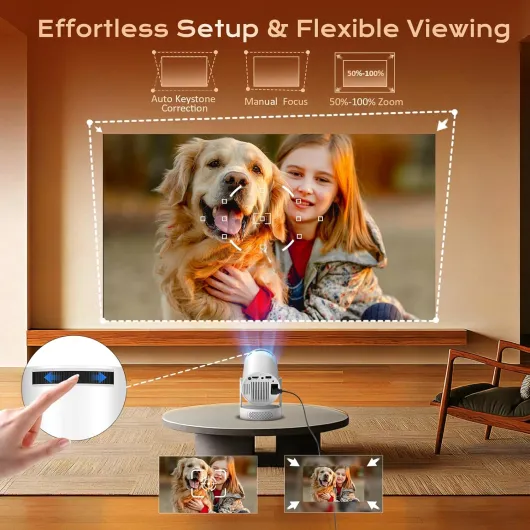
Keystone correction is automatic horizontally, which saves time if the projector isn’t perfectly centered. Vertical adjustments and focus are manual. The auto keystone works fairly well when you move the projector a bit; it quickly recalibrates and straightens the image. You do lose a bit of sharpness in the corners if the keystone is very aggressive, but that’s normal on this type of device. For best results, try to keep the projector as straight as possible and use keystone only for small corrections.
The built-in speakers are… fine for a small room. Sound is clear enough for dialogue, but there is almost no real bass. At 70–80% volume it fills a bedroom or small living room, but it sounds a bit flat. For me, it’s totally usable for a quick episode or a YouTube video, but for a movie night I much preferred using a Bluetooth speaker or soundbar. Latency over Bluetooth for movies was acceptable; I didn’t notice annoying lip-sync issues. Overall, performance is solid for the price bracket, as long as you respect its limits: dark room, reasonable screen size, and external sound if you care even a bit about audio.
What you actually get with the finade S106
On paper, this projector ticks a lot of boxes: native 1080p, 4K input support, Android 12 built in, Wi‑Fi 6, Bluetooth 5.4, auto keystone, manual focus, and a 270° rotating stand. The brand claims 200 ANSI lumens (ignore the silly “22000 lumens” marketing number, the real one is 200 ANSI). In practice, that means it’s fine for evenings or a dark room, but it’s not made for bright daylight. If you’re thinking of using it in a sunlit living room, you’ll be disappointed.
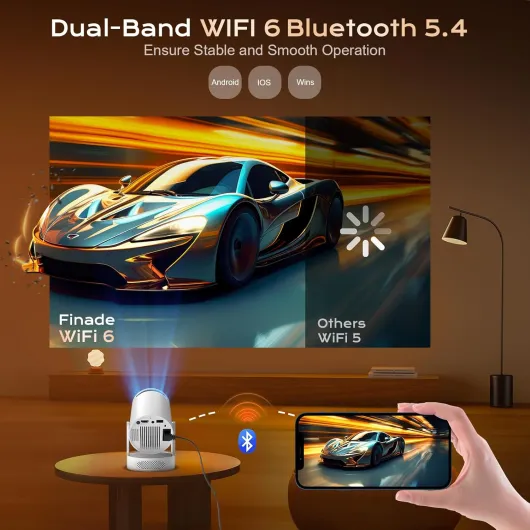
There are enough ports for normal use: HDMI, USB, 3.5 mm audio jack, and a TF (microSD) slot. I used HDMI for my console and laptop, and USB/microSD for some test videos. It detected everything without drama. Network-wise, Wi‑Fi 6 works well: streaming from Netflix/Prime/YouTube inside its Android system was smooth on a decent home connection. Bluetooth 5.4 also did the job – I paired it with a small Bluetooth speaker and headphones with no drops or sync issues noticeable on movies.
Out of the box, you get the projector, power cable, HDMI cable, remote, and manual. No carrying case, but it’s small enough to throw into a backpack if you’re not too fussy. First boot is straightforward: choose language, connect to Wi‑Fi, log into your apps. Android 12 runs fine; it’s not ultra fast like a high-end TV box, but it’s good enough to browse menus and launch apps without feeling sluggish all the time. There’s the usual basic app store, plus preinstalled streaming apps depending on your region.
So in a nutshell, you’re buying a compact 1080p projector with a built-in smart TV box. You don’t have to add a Fire Stick or Chromecast unless you really want your specific ecosystem. For the price range, that’s decent value. It’s not the cleanest or most polished smart interface I’ve seen, but it gets the job done for everyday movie and series watching.
Pros
- Native 1080p with decent sharpness for movies and series in a dark room
- Built-in Android 12 with Wi‑Fi 6 and Bluetooth 5.4, so no immediate need for a streaming stick
- 270° rotating stand makes setup and ceiling projection easy without extra accessories
Cons
- Only 200 ANSI lumens, so image washes out quickly in bright rooms
- Built-in speakers are weak on bass, external speaker strongly recommended
- No internal battery despite the “mini” and “portable” marketing, always needs mains power
Conclusion
Editor's rating
After using the finade S106 for a bit, my conclusion is pretty straightforward: it’s a decent little 1080p smart projector that works well for relaxed home cinema in the evening, but it’s not a powerhouse. The image is sharp enough, colors are okay, and as long as the room is fairly dark, you get a pleasant big-screen experience at 80–120 inches. The built-in Android 12 and Wi‑Fi 6 mean you can just plug it in, connect to Wi‑Fi, log into your apps, and watch without extra hardware. That’s convenient, especially if you move it between rooms.
The weak spots are also clear: brightness is limited to 200 ANSI lumens, the internal speaker is usable but flat, and there’s no built-in battery despite the “portable” label. It’s fine for bedrooms, kids’ rooms, and night-time outdoor use with a power extension, but don’t expect it to work well in bright living rooms or for serious business presentations. Build quality is okay for the price, fan noise is relatively low, and the rotating stand is genuinely handy for quick setup and ceiling projection.
I’d recommend this projector to people who want an affordable big screen for movies, series, and some casual gaming in a dark room, and who don’t care about having a famous brand name on the box. If you’re very picky about image brightness or need something for daytime use or professional work, you should look at brighter, more expensive models. For what it costs, it gets the job done and is pretty solid value, as long as you know its limits.