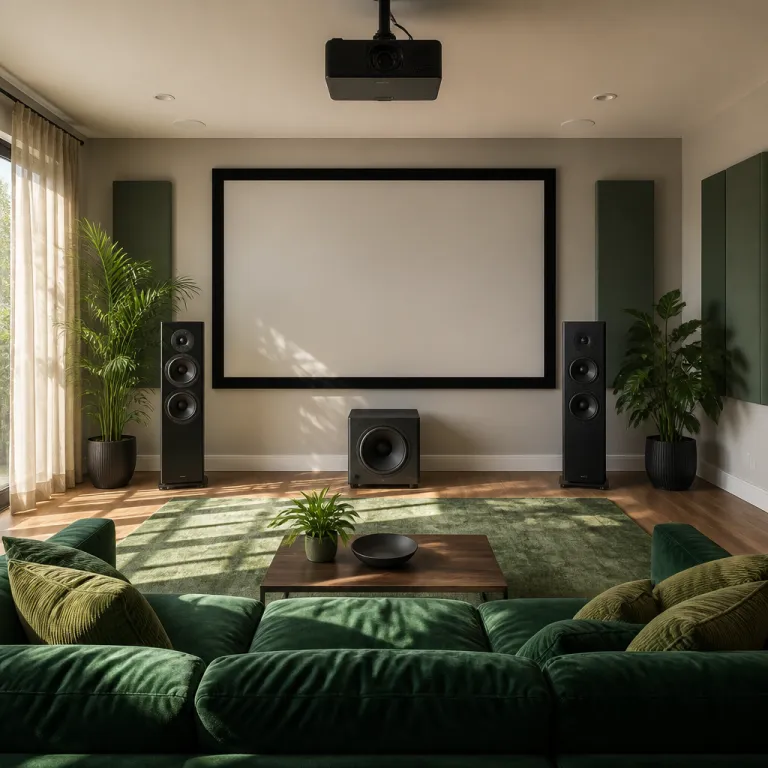
Why a subwoofer centered layout matters for projector home cinemas
A carefully planned subwoofer centered layout anchors the entire soundstage and keeps bass energy tied to the image. When the subwoofer and center speaker work together, dialogue stays locked to the screen while low frequency effects wrap around the room. This balance is crucial in a projector space where the screen is large, the seating can be wide and viewers sit farther from the speakers than with a TV.
Think of the subwoofer as the engine that drives deep bass while the center channel is the narrator that keeps voices intelligible. In a home theater built around a projector and media console, placing the main subwoofer near the acoustic center of the screen often reduces localization issues. Many enthusiasts even build a low console subwoofer under the screen to keep the low end physically and visually aligned with the projected image.
For people coming from basic TV speakers, the jump to a subwoofer centered system feels dramatic. You move from thin sound to a full range experience where explosions, orchestral music and subtle ambience gain weight and scale. This is why serious projector owners usually budget for quality speakers and at least one powered subwoofer before chasing more lumens, a brighter projector or a bigger screen.
Room layout still matters as much as equipment price or famous brands. If your sofa sits against the back wall, a single subwoofer in the front center may create uneven bass with strong peaks and nulls. In that case, adding a second subwoofer to the left or right side and time aligning both can smooth the response across the main seating row and reduce seat‑to‑seat variation.
Projector rooms often double as living spaces, so a visible subwoofer box can be a design challenge. Some people hide subwoofers inside a custom console box or low cabinet that matches the décor. Others integrate a shallow subwoofer enclosure into a stage under the screen, which keeps the cab black and visually unobtrusive while still allowing proper airflow for ports and drivers.
Whatever the furniture, the goal is the same: keep the subwoofer center of gravity close to the visual center console of the screen. This alignment helps your brain fuse what you see and what you hear, especially when the center speaker sits just below the projected image. Done well, the screen seems to radiate sound, not the individual speakers scattered around the room.
Positioning the center speaker and subwoofer for seamless dialogue
Dialogue clarity depends heavily on the relationship between the center speaker and the subwoofer. If the subwoofer center of energy sits far from the center channel, voices can sound thin while effects feel detached. A projector setup magnifies this problem because the screen is wide and the seating often spans several meters, so off‑axis listeners are more sensitive to misalignment.
Start by placing the center speaker as close as possible to the vertical middle of the screen, even if that means slightly raising the console or adjusting the projector throw. Aim the center toward ear height at the main seats, not straight ahead at the floor. Then position the main subwoofer so that its acoustic center lines up horizontally with the center speaker, either directly below or slightly to the left or right, and avoid pushing it tight into a corner unless measurements support that choice.
This subwoofer centered alignment reduces phase issues between bass from the center channel and the dedicated low frequency effects channel. When both arrive in time, male voices gain chesty weight without becoming boomy. Movie soundtracks mixed in Dolby Atmos or DTS formats rely on this coherence, especially when effects pan smoothly across the front speakers and across the width of a cinemascope screen.
Many modern AV receivers offer automatic calibration that measures speaker distances, levels and harmonic distortion. Use that tool, but do not rely on it blindly; verify that the subwoofer and center speaker blend naturally with real content. Play a familiar film scene with strong dialogue and bass, then adjust the subwoofer level in half decibel steps around the auto‑set value until voices sound natural and the sound does not pull toward the subwoofer box.
Wireless surround formats such as Dolby Atmos FlexConnect, explained in detail in this guide on what wireless Atmos changes for projector home cinemas, make speaker placement more flexible. Even then, the physical relationship between the center speaker and the subwoofer remains critical. A wireless link cannot fix a subwoofer placed in a corner that overloads the room with uneven bass or excessive harmonic distortion.
For projector owners using a media console, a low profile console subwoofer can slide under the center console shelf. This keeps the subwoofer center aligned with the screen while freeing floor space. If you run multiple subwoofers, mirror them left and right of the screen to maintain symmetry and avoid pulling the soundstage toward one side, then re‑run room correction to time align both units.
Choosing subwoofers, enclosures and boxes that suit projector rooms
Selecting the right subwoofers for a projector based home theater means thinking beyond raw power. You need to match the subwoofer enclosure type, box volume and amplifier to the room size and listening habits. A small living room with a short throw projector does not require the same subwoofer box as a large dedicated cinema with multiple rows of seating.
Sealed subwoofer enclosures offer tight, controlled bass that suits mixed movie and music use, especially when the room is modest in volume. Ported subwoofer designs deliver more output around the tuning frequency, which can be ideal for action films but may require careful placement to avoid chuffing noise and excessive harmonic distortion. In both cases, the subwoofer center of output should support the main speakers rather than overwhelm them or dominate the front soundstage.
Many readers start their research on large marketplaces such as Amazon, comparing price, specifications and user reviews. That is a useful first step, but do not let a low price or flashy brands list distract you from enclosure quality and amplifier headroom. A well engineered powered subwoofer from a specialist manufacturer often outperforms a larger but poorly braced box compatible only with car audio drivers and tuned for boom rather than accuracy.
Some enthusiasts repurpose car audio gear, building a console box or custom subwoofer enclosure that slides under a projector screen stage. A 12 inch driver in a carefully tuned box fits nicely under many screens and can perform extremely well when powered by a clean home amplifier. For a deeper dive into how enclosure size shapes performance, this analysis of how a 12 inch subwoofer box reshapes projector sound is particularly relevant.
Cabinet finish matters in a dark projector room where light reflections can distract from the image. Many people choose a cab black finish for the subwoofer box and speakers so they visually disappear when the projector is running. Matching the subwoofer and speakers to the console color also helps the system feel integrated rather than like a pile of random boxes scattered under the screen.
Whatever you choose, pay attention to published measurements such as frequency response and total harmonic distortion at realistic listening levels. A subwoofer that claims extreme output but hides distortion figures may sound impressive in short demos yet fatiguing over a full film. Aim for a balanced subwoofer centered system where the low end extends smoothly to around 20 Hz without obvious peaks or dips and maintains low distortion at your typical playback level.
From car audio to living room cinema: what transfers and what does not
Many projector owners come from a car audio background and wonder which skills transfer. The basic physics of subwoofers, boxes and bass certainly remain the same, but the listening environment changes everything. A car interior is tiny compared with a living room, and that difference reshapes how a subwoofer center behaves and how much cabin gain you experience.
In a vehicle, the cabin gain below roughly 50 Hz boosts low bass dramatically, allowing even small subwoofers in compact boxes to feel powerful. Home rooms rarely provide that much gain, so a subwoofer enclosure that sounded huge in a trunk may feel underwhelming behind a projector screen. You also sit farther from the subwoofer at home, which reduces the tactile impact you might associate with car audio systems and makes distortion more noticeable.
Some readers ask whether a console box originally designed as a truck subwoofer enclosure can work under a projector screen. The answer is yes, but only if the box fits the room acoustics and the driver parameters. A ported subwoofer tuned for a crew cab truck may emphasize a narrow frequency band that does not translate well to film soundtracks or orchestral scores.
Truck specific designs such as a console subwoofer for a Silverado GMC or a box compatible with a GMC Sierra or Chevy Silverado crew cab often prioritize minimal depth and unusual shapes. Those constraints matter less in a living room where you can build a rectangular subwoofer box with optimal internal volume. Instead of forcing a crew cab enclosure into a home theater, consider selling it and investing in a purpose built home subwoofer that reaches lower frequencies with less harmonic distortion.
That said, the fabrication skills learned while building car audio systems are extremely valuable. If you are comfortable cutting MDF, sealing joints and lining a subwoofer enclosure, you can create a custom cabinet that matches your projector console perfectly. Just remember that home use demands lower harmonic distortion and quieter ports because the listening distance is greater and the room is quieter than a moving vehicle.
When you move from car audio to home cinema, recalibrate your expectations about how much bass you actually need. A single well designed powered subwoofer in a properly sized box can outperform multiple mismatched car subs driven hard. Focus on integration with the center speaker and front speakers rather than on sheer output numbers that look impressive on a spec sheet but do not guarantee clean, controlled bass.
Integrating the subwoofer center with consoles, furniture and connectivity
Furniture layout often dictates where a subwoofer center can realistically sit in a projector room. Many living rooms rely on a long media console under the screen, which can either help or hinder good bass. Used thoughtfully, that console becomes a structural anchor for both the center speaker and the main subwoofer and simplifies cable routing.
One popular approach is to build a center console with an internal compartment that acts as a subwoofer box. This console subwoofer design hides the driver and ports behind acoustically transparent fabric while keeping the front speakers and electronics neatly organized. The result is a clean look where the subwoofer, speakers and projector all feel like parts of a single system rather than separate components.
When planning such furniture, leave enough internal volume for the subwoofer enclosure and ensure the console box walls are thick and well braced. Thin panels vibrate and add unwanted sound, increasing perceived harmonic distortion and smearing bass transients. Use dense materials, internal cross bracing and damping sheets to keep the structure inert and prevent rattles at high playback levels.
Connectivity also matters, especially if your projector sits far from the AV receiver or console. High quality RCA cables between the receiver and the powered subwoofer help maintain signal integrity over longer runs. For a detailed breakdown of connector choices and cable routing, this guide on choosing the right RCA connector and cable for projector setups is worth reading.
Streaming devices, game consoles and set top boxes all feed into the same audio chain, so keep cable management tidy. Label each console input, route power cables away from signal lines and avoid tight coils that can introduce hum. A clean signal path ensures the subwoofer center responds only to the content, not to electrical noise or ground loop issues.
Finally, think about how you will share your setup and settings with others who might use the room. Some enthusiasts keep a simple diagram in a shared folder or even post a quick share Facebook note with the layout and calibration values. That way, if someone changes the console position or moves the speakers for a party, you can quickly restore the subwoofer and center alignment afterward without guessing.
Evaluating performance: from music listening to late night movie sessions
A subwoofer centered home theater must handle both blockbuster films and everyday music listening. Many projector owners use the same system for streaming concerts, gaming and casual background music. That means the subwoofer, center speaker and front speakers must work as a coherent full range system, not just a special effects machine that only comes alive during explosions.
Start your evaluation with familiar music tracks that feature acoustic instruments and well recorded vocals. Listen at moderate levels and pay attention to how the bass integrates with the rest of the sound; it should feel supportive, not like a separate layer. If the subwoofer draws attention to itself on simple music, it will likely be too prominent during complex film mixes and may mask subtle details.
Next, move to film scenes with strong dynamics, such as a spaceship launch or a thunderstorm. In a well tuned system, the subwoofer center will deliver weight and impact without masking dialogue from the center speaker. You should feel the room pressurize during big moments while still catching quiet lines from characters standing at the left or right of the screen and from rear channels.
Late night viewing introduces another challenge because you may need to reduce overall volume while keeping clarity. Many AV receivers offer night modes that compress dynamic range and slightly reduce bass output. Use these sparingly and instead consider a dedicated low volume calibration where the subwoofer level is trimmed a few decibels to maintain balance and prevent bass from waking the household.
Some enthusiasts schedule calibration sessions during quieter months such as July, when there is more free time to measure and tweak. Whether you run tests in Jul or any other month, keep notes on subwoofer placement, crossover settings and room treatments. Over time, these records help you understand how each change affects the subwoofer center performance and make it easier to repeat a successful setup after moving furniture.
Remember that a projector room is a shared space, so involve your household or viewing crew in listening tests. Ask them to share impressions about dialogue clarity, bass comfort and overall sound quality from different seats. Their feedback, combined with objective measurements of harmonic distortion and frequency response, will guide you toward a system that satisfies everyone.
Special cases: integrating vehicle specific boxes into multipurpose spaces
Some readers own vehicle specific subwoofer boxes and wonder whether they can be reused in a projector room. Examples include a console box originally built for a Silverado GMC or a box compatible with a GMC Sierra crew cab. These enclosures are often shallow and shaped to fit under seats or against cab walls, which complicates their use in a rectangular living room.
If you decide to experiment, start by measuring the internal volume of the subwoofer box and comparing it with the driver manufacturer recommendations. A box that was perfect for a truck cab may be too small to reach full range extension in a larger room. You might need to accept reduced deep bass or add a second subwoofer to compensate for the missing low end.
Pay attention to finish and aesthetics as well, because a carpeted truck enclosure can look out of place next to a sleek projector console. Some people repaint or rewrap the cab black exterior to match their speakers and furniture. Others build a simple outer shell that hides the vehicle box while allowing the driver and ports to breathe and avoiding unwanted resonances.
When integrating such gear, do not neglect safety and stability. A box designed to wedge into a crew cab may tip easily on a flat floor if not secured. Add rubber feet, internal weights or brackets to keep the subwoofer center stable, especially if children or pets share the space and may bump into the cabinet.
Community forums and local recreation centers sometimes host car audio meets where people trade or sell specialized enclosures. If your rec center or local shop organizes such events, you may find someone eager to buy your truck specific box. The funds can then go toward a purpose built home subwoofer enclosure that better suits your projector room and integrates more easily with your center speaker.
Whatever path you choose, keep the focus on how the system sounds from your main seats. A clever reuse of a console subwoofer or crew cab enclosure is only worthwhile if it integrates smoothly with the center speaker and front speakers. Let your ears, not nostalgia for past installs, decide whether the subwoofer center truly serves your home cinema.
Key figures and technical benchmarks for subwoofer centered projector systems
- Most home theater subwoofers for projector rooms aim for usable output down to around 20 Hz, which covers the majority of film low frequency effects without requiring excessively large boxes; bench tests from outlets such as Audioholics and Sound & Vision regularly show that subs rated to roughly 19–22 Hz at −3 dB feel convincingly full range in domestic spaces when measured at the main seat.
- Independent measurements from publications such as Audioholics and Sound & Vision often consider total harmonic distortion below 10% at reference level a reasonable target for quality subwoofers in domestic rooms, with premium models staying closer to 3–5% in the 25–80 Hz band; check the individual product measurement pages from these outlets for exact distortion curves and maximum output data.
- Room modes in typical European living rooms between 4 and 6 meters long often create strong bass peaks around 30 to 50 Hz, which is why careful subwoofer placement and multiple subs are recommended for smoother response; simple sweeps with a USB measurement mic and software such as Room EQ Wizard, or a calibrated phone app that logs frequency response, will usually reveal these resonances clearly.
- Consumer surveys from major AV retailers regularly show that adding a dedicated subwoofer is one of the top two upgrades projector owners report as most improving immersion, alongside upgrading the center speaker, especially when both are calibrated to within ±1 dB of reference level at the main seat using pink noise and an SPL meter.
- Automatic room correction systems in modern AV receivers can typically adjust speaker distances with an accuracy of a few centimeters, which is sufficient to time align the subwoofer center with the front speakers for most listeners and to keep arrival times within a few milliseconds; always confirm by checking the reported sub distance and fine tuning delay if dialogue sounds disconnected from bass.
FAQ: subwoofer center in home theater projector setups
Where should I place the subwoofer relative to my projector screen?
For most rooms, placing the subwoofer near the horizontal center of the screen, either directly below the center speaker or slightly to one side, gives the best integration. This subwoofer centered position helps keep bass anchored to the image rather than to a corner. Always verify with listening tests and, if possible, basic measurements of frequency response at the main seats.
Do I need more than one subwoofer for a projector based home theater?
A single well placed subwoofer can work in small rooms, but two subwoofers usually provide smoother bass across multiple seats. Dual subs allow you to reduce peaks and nulls caused by room modes. If you often host movie nights, a second subwoofer is a worthwhile investment and makes the system less sensitive to small seating changes.
Can I use a car audio subwoofer box in my living room cinema?
You can reuse a car audio subwoofer and box if the enclosure volume and tuning suit home use, but results vary. Vehicle specific boxes for crew cabs or consoles may not provide ideal low frequency extension in larger rooms. In many cases, building or buying a home oriented subwoofer enclosure yields better performance and more even bass across the couch.
How loud should the subwoofer be compared with the center speaker?
In a balanced system, the subwoofer should support the center speaker without drawing attention to itself. Start with the subwoofer level set by your AV receiver calibration, then adjust in small steps while playing familiar content. If you notice bass first and dialogue second, the subwoofer is probably too loud and should be reduced by 1–2 dB.
What specifications matter most when choosing a subwoofer for a projector room?
Focus on low frequency extension, maximum clean output and measured harmonic distortion rather than just wattage claims. Look for honest frequency response graphs and distortion figures at realistic listening levels. A well engineered powered subwoofer with solid measurements will integrate more easily with your center and front speakers and will better support a large projector screen.