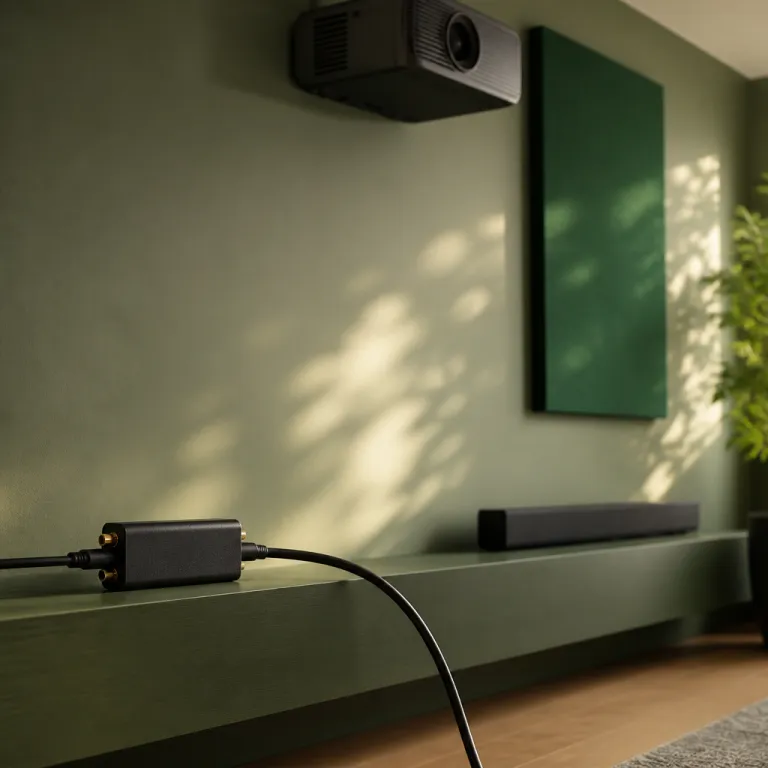
Why your projector sound system needs a ground loop isolator
Many home theater owners chase perfect image quality yet tolerate faint noise in their speakers. When a projector, AV receiver, and powered speakers share different ground paths, a ground loop often forms and the resulting hum ruins otherwise good sound. A compact ground loop isolator between audio components can quietly fix this loop issue and keep your attention on the movie, not the whine.
In a typical living room, the projector sits far from the head unit or AV receiver, so long power wires and signal cables run across the floor and walls. Those extended wires create multiple grounding points, and tiny voltage differences between these grounds push unwanted current through the audio electronics, especially through the low level input stages. The result is a continuous loop of interference, commonly called a ground loop, that rides on the audio signal and becomes clearly audible through amps and speakers at low volumes.
Once you understand that the loop is literally a closed circuit formed by signal cables and safety grounds, the role of a ground loop isolator becomes obvious. The isolator breaks the conductive loop while still letting the audio signal pass, so the ground loop has no complete path and the noise running through the system collapses. For a home theater projector setup, this simple device often delivers a surprisingly large improvement in perceived sound quality for a long time with almost no maintenance, especially on sensitive channels such as a projector subwoofer feed.
How ground loops create hum, buzz, and whine in projector audio
Unwanted noise in a projector based home cinema usually appears as a steady hum at low frequencies, a sharper buzz, or a faint high pitched whine. These sounds often change when you move a power plug, touch an amp chassis, or switch inputs on the head unit, which is a strong sign that a ground loop is present. When the projector, AV receiver, and subwoofer amps connect to different wall outlets, each ground reference drifts slightly and the loop carries that difference as audible interference.
Think about the path from your media player to the AV receiver, then through the set of RCA cables to a power amplifier, and finally to the speakers near the screen. Every extra cable, splitter, or adapter adds more grounds and more chances for wiring noise, especially when low level audio runs parallel to power wires feeding amplifier power supplies. If those power cables lie next to the RCA signal path for a long time, the magnetic fields from the mains current can induce hum directly into the loop, even when the wire appears straight and tidy.
Modern receivers such as entry level Dolby Atmos models from Yamaha, described in detail in this analysis of an HDMI 2.1 AV receiver, still rely on careful grounding to keep their many amps quiet. Even with advanced digital processing, the analog audio input stages remain vulnerable to ground loops and poor grounding point choices behind the rack. That is why installers still pay close attention to where each ground wire terminates and how the loop isolator is placed in relation to the amp chassis and the projector body, particularly on long unbalanced runs to a subwoofer or front channel amplifier.
Where to place a ground loop isolator in a home theater chain
Correct placement of a ground loop isolator matters as much as buying a good model. In most projector systems, the cleanest point for isolation is between the AV receiver or head unit and the external power amp that drives the front speakers or subwoofer. By inserting the loop isolator in the RCA line at that point, you stop the loop from closing through the long audio run to the screen area.
Start by identifying which connection carries the worst noise, often the subwoofer or any amp placed near the projector and its power wires. Disconnect the set of RCA cables feeding that amplifier, then insert the ground loop isolator between the receiver output and the amp input, keeping the wire as straight and short as practical. Many loop isolators are passive transformers, so they do not need extra power and they work well with both stereo and mono low level audio signals.
If your projector only offers digital outputs, a separate digital to analog converter may sit between the projector and the AV receiver or powered speakers. In that case, the isolator usually belongs after the converter, on the analog RCA side, not on the optical link, as shown in detailed tests of a 192 kHz DAC and RCA converter for home cinema use. When you keep the isolator close to the device that introduces the loop, you minimize the length of cable that can pick up wiring noise and you protect the sensitive input stage of the downstream amp.
Quick placement checklist for a projector subwoofer loop isolator (text-only diagram):
1) Projector / media source → HDMI → AV receiver
2) AV receiver sub out (RCA) → ground loop isolator → subwoofer amp input
3) Keep RCA cables short, avoid tight coils, and route them away from mains power cords wherever possible.
Choosing the best ground and wiring strategy around your projector
Before relying entirely on a ground loop isolator, you should aim for the best ground layout you can achieve in your room. Ideally, all major audio electronics, including the projector, AV receiver, and external amps, plug into the same distribution block so they share a single grounding point. When every chassis references the same ground, the voltage difference that drives a ground loop shrinks and the isolator has less work to do.
Route power wires and signal cables thoughtfully, because their physical layout strongly influences noise running through the system. Keep mains power cables away from low level audio wherever possible, and avoid running them in parallel for a long time, especially behind the rack or under the carpet near the screen. If they must cross, do so at a right angle, which reduces the magnetic coupling that can inject hum into the loop and force the isolator to handle more interference.
Some enthusiasts like to share their cable management photos on social platforms once they finally tame the mess of wires. While that may seem playful, the underlying discipline of separating power and audio paths, securing each ground wire, and checking that the amp chassis is firmly bonded to the safety ground is serious work. When you combine a thoughtful wiring plan with a well placed ground loop isolator, you usually achieve both low background noise and stable performance for a long time without constant troubleshooting.
Evaluating loop isolators, amps, and inputs for projector sound quality
Not every ground loop isolator performs equally well with demanding home theater setups. Cheaper loop isolators sometimes roll off low frequencies or add subtle distortion, which undermines the impact of movie soundtracks and makes bass feel weak. When you audition different loop isolators between your head unit and subwoofer amp, listen carefully to how the sound changes at both low and high volumes.
Pay attention to the specifications of your amps and the input sensitivity of each channel, because mismatches can exaggerate any residual noise. A powerful subwoofer amplifier with high amplifier power and very sensitive inputs will reveal even small amounts of wiring noise that a modest stereo amp might hide. In such cases, a higher quality loop isolator with better shielding and carefully matched transformers usually works well and keeps the noise floor low without dulling dynamics.
Home theater projectors often sit near ceiling mounted speakers or compact amps, so the physical distance between devices can be short while the electrical loop remains large due to multiple grounds. When you evaluate gear, consider how each device shares ground with the rest of the system and whether its chassis design encourages a clean grounding point. A thoughtful combination of well specified amps, properly rated RCA cables, and a robust ground loop isolator will give you both good technical performance and a more immersive listening experience. Popular transformer based models from established brands, such as compact stereo isolators designed for subwoofer use, illustrate the kind of build quality and shielding to look for.
Practical troubleshooting steps when a ground loop isolator is not enough
Sometimes a ground loop isolator reduces hum but does not eliminate all unwanted sound, especially in complex projector installations. When that happens, treat the system methodically by muting all amps, disconnecting every audio input, and then reconnecting one audio path at a time until the noise returns. The moment the whine or hum appears, you have identified the segment of the loop that still needs attention.
Check whether any device uses a different circuit or extension cord, because a single component on a distant outlet can reintroduce a loop even when the main rack shares one power strip. Move that device to the same distribution block if possible, or at least to the same wall circuit, then test again with the ground loop isolator still in place on the noisy connection. If the noise persists, inspect each cable for damage, confirm that the wire is straight without tight coils, and verify that the amp chassis is not touching any ungrounded metal that could create unintended grounds.
For projector owners who like to document their setups, a quick photo session can wait until the system is electrically quiet and safe. Take the time to label each cable, document which grounding point serves each device, and note where every loop isolator sits in the chain so future upgrades do not accidentally recreate the same loop issue. Once the system runs quietly for a long time, you can focus on more enjoyable tweaks such as choosing the best screen surface for ambient light control, as explained in this guide to projector screen materials that handle room light effectively.
Key figures on projector audio, noise, and grounding
- Measurements reported by independent audio reviewers show that a typical ground loop in a home system can raise the noise floor by roughly 20 to 30 dB, which turns barely audible hum into a clearly intrusive sound during quiet movie scenes. For example, bench tests published by Audio Science Review on consumer AV receivers and amplifiers regularly document mains related noise components in this range when ground loops are deliberately introduced.
- Tests published in manufacturer datasheets for consumer loop isolators indicate that higher quality transformer based models can reduce common mode noise by around 60 dB across most of the audible band, while maintaining frequency response within about ±0.5 dB from 20 Hz to 20 kHz. Typical examples include the published specifications for Jensen Transformers ISO‑MAX series and similar pro audio isolation transformers used in home cinema installations.
- Informal surveys of home theater installers, summarized in trade magazines and training material, report that more than half of persistent hum complaints in projector rooms trace back to multiple wall outlets feeding different parts of the audio chain, rather than to faulty amps or speakers. Industry groups such as CEDIA and manufacturer training courses on residential AV grounding consistently highlight this pattern.
- Controlled comparisons of cable routing, described in technical notes from cable and accessory makers, show that separating power and audio runs by just 10 cm can cut induced hum by on the order of 70 percent, especially when long unbalanced RCA cables feed high gain subwoofer amplifiers. White papers from pro audio cable brands and EMC application notes from semiconductor vendors document similar reductions in magnetically coupled interference.
- Field data shared by professional integrators in case studies suggests that adding a properly placed ground loop isolator resolves audible noise issues in well over 80 percent of problematic home cinema installations without requiring any change to the main electronics. These figures are consistent with troubleshooting reports in AV integration forums and manufacturer support bulletins that track common causes of hum in projector based systems.
FAQ about ground loop isolators in home theater projector systems
Where should I install a ground loop isolator in my projector setup ?
The most effective location is usually between the AV receiver or head unit and the external power amplifier that drives the noisiest speakers, often the subwoofer near the screen. Insert the isolator in the RCA line at that point, keeping the cable short and away from power wires. This placement breaks the loop while preserving the intended grounding of each device.
Will a ground loop isolator affect sound quality or bass response ?
A well designed ground loop isolator should maintain a flat response across low frequencies and the rest of the audible band. Very cheap models can sometimes soften bass or add slight coloration, especially at high levels. Choosing a quality isolator rated for full range home cinema use minimizes these risks and keeps the sound natural.
Can I fix a ground loop just by changing power outlets ?
Plugging all major audio components into the same distribution block often reduces hum because they share a single grounding point. However, complex rooms with multiple circuits or long cable runs may still form loops even after you rearrange outlets. In those cases, a ground loop isolator remains the most reliable way to interrupt the unwanted loop current.
Do balanced cables remove the need for a ground loop isolator ?
Balanced connections such as XLR are much better at rejecting common mode noise and often prevent audible hum in the first place. Many consumer projectors and compact amps, though, only offer unbalanced RCA connections, where ground loops are more likely. When you cannot switch to balanced wiring, a ground loop isolator on the RCA path is still very useful.
Is it safe to lift the ground pin on my equipment to stop hum ?
Defeating the safety ground by using adapters or cutting ground pins is unsafe and strongly discouraged. The protective earth connection exists to carry fault current away from the amp chassis and prevent electric shock. A ground loop isolator solves hum problems without compromising electrical safety, so it is always the safer choice.