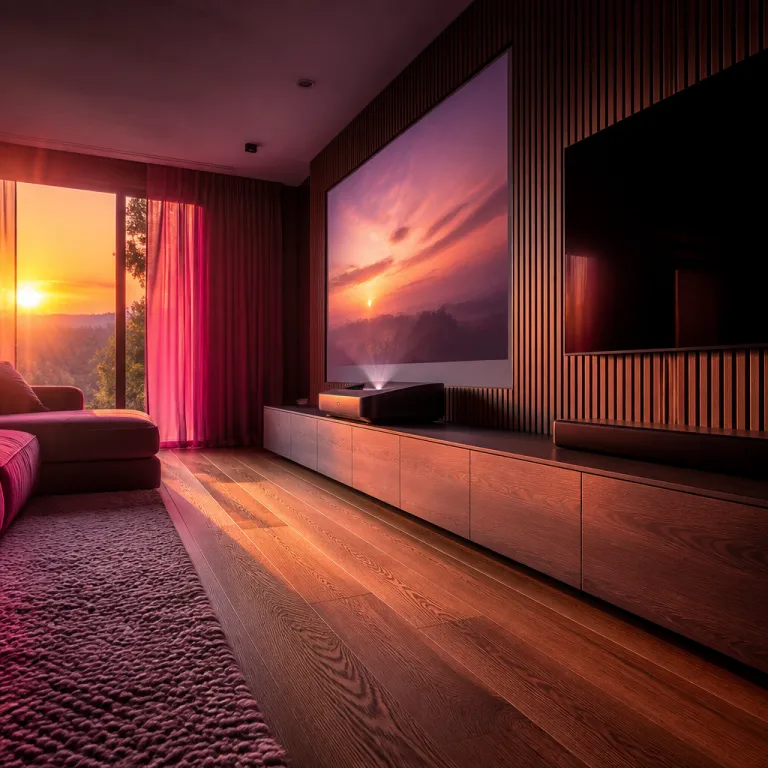
How a laser TV differs from a regular projector or TV
A laser TV is not just a fancy name for a laser projector. It is a bundled system that combines an ultra short throw (UST) projector, a matched ambient light rejecting (ALR) screen, a smart TV interface and often a competent sound system in one package designed to replace large flat‑panel TVs in a living room. Think of it as a floor or cabinet mounted UST projector that behaves like a television rather than a home theater science project.
The defining trait is the ultra short throw design, where the projector sits roughly 20 to 40 cm from the wall and still creates a 100‑inch image. Traditional projectors, even short‑throw models, usually sit several metres back, which complicates cabling, ceiling mounts and room layout, while a laser TV parks against the wall like a low cabinet. Because the light source is a long‑life laser light engine rather than a lamp, you get up to around 20,000 hours of use with relatively stable brightness and colour, which matters when you use it every day for TV, sports and gaming.
Manufacturers position laser TVs as direct competitors to 85‑inch and larger panels on price and usability. You get a huge screen size with reflected light off the screen, which is easier on the eyes than a self‑emissive panel blasting light directly at you. The interface is usually a smart TV platform with built‑in tuners, streaming apps and HDMI eARC, so you can plug in a sound system or soundbar and treat the laser TV like any other living room television.
Size, price and where the value of laser TVs really sits
Cost per inch is where a laser TV starts to look compelling. An 85‑inch OLED panel often sits between about 2,500 and 4,000 euros according to current retail listings, while a 100‑inch laser TV package such as the Hisense L9H typically lands between roughly 2,500 and 4,500 euros including the screen. If you chase a 100‑inch or 120‑inch panel, the price jumps sharply, whereas laser TV systems scale up in image size with only modest increases in overall system cost.
Compare that with buying a separate UST projector and screen. A high‑quality ultra short throw projector alone can run from around 3,000 to 8,000 euros, and a proper ALR screen for a living room adds another 800 to 2,000 euros, so the final price often exceeds a bundled laser TV. The integrated approach also means the projector optics, the screen gain and the colour gamut are tuned together, which reduces the risk of washed‑out contrast or mismatched brightness in real rooms.
Models like the Hisense L9H, Samsung The Premiere LSP9T and the AWOL Vision LTV Pro series illustrate the spread. The L9H offers around 3,000 ANSI lumens from a triple‑laser light source at 100 inches, while the AWOL Vision LTV Pro line pushes higher brightness and wider colour at a higher price point. For readers who want to learn how traditional 1080p projectors compare on value, a detailed guide to top 1080p home theater projectors shows how quickly costs climb once you add a large screen and installation.
To frame the trade‑offs quickly, here is a simplified comparison:
- Laser TV bundle (100"): 2,500–4,500 €; includes UST projector, ALR screen, smart TV platform, basic sound.
- Separate UST + ALR screen (100"): 3,800–10,000 €; more choice in brands and screens, but higher setup cost.
- Large OLED / Mini‑LED TV (85–98"): 2,500–10,000 €; superb contrast and brightness, but smaller size per euro above 85".
Picture quality: brightness, contrast and colour in real living rooms
Picture quality on a laser TV lives or dies by three things. You need enough ANSI lumens from the laser light source to fight ambient light, a screen that rejects overhead light while preserving on‑axis brightness, and a projector engine with decent native contrast and accurate colour. Marketing numbers often exaggerate; independent measurements from review sites such as ProjectorCentral and Projector Reviews frequently show calibrated brightness 20 to 30 percent below the quoted peak, so you should focus on real‑world tests rather than only the figures on the box.
Triple‑laser designs, like those in the AWOL Vision LTV Pro or some Leica Cine prototypes, use separate red, green and blue lasers to expand the colour gamut beyond Rec. 709 and closer to Rec. 2020. That wider colour can look spectacular with HDR and Dolby Vision content, but it also exposes weaknesses in tone mapping and processing if the projector is not tuned well. Single‑laser plus phosphor engines, such as those in many Epson EpiqVision models, trade some colour saturation for lower speckle, simpler optics and often better uniformity across the screen.
In a bright living room, even the best laser projector will not match the perceived contrast of an OLED panel. The reflected‑light image depends on the screen surface and room reflections, so dark scenes can look more like a good LCD TV than an infinite‑black OLED, especially with white walls. Where laser TVs fight back is in eye comfort and size, because a 100‑inch reflected‑light display at moderate brightness feels more cinematic and less fatiguing than a smaller panel driven at very high nits.
For a deeper dive into how different projectors handle real‑world constraints such as no ceiling mount or white walls, the guide on projectors that survive apartment life is a useful companion when you weigh a laser TV against a more traditional setup.
Laser TV versus panel: which works better in your room
Choosing between a laser TV and a large panel is really about your room and habits. If you watch a lot of daytime TV with curtains open, a high‑end OLED or bright mini‑LED LCD still wins for peak brightness, perfect black levels and freedom from screen surface quirks. In a controlled or dimmed living room where you can manage light, a 100‑inch laser TV delivers a more cinematic field of vision and a softer, more natural light profile.
Space is the next big factor. Ultra short throw designs let the projector sit almost against the wall, but you still need about 2.8 to 3 metres viewing distance for a 100‑inch screen to feel comfortable, while a smaller 77‑inch or 85‑inch panel can work in tighter rooms. If your furniture layout forces you closer than roughly 2.5 metres, a panel may feel more balanced, whereas a laser TV shines in medium to large rooms where you can back the sofa up and let the image breathe.
There is also the hybrid household trend. Many buyers now pair a laser TV in the main living room for films, sports and social viewing with a smaller OLED in the bedroom for late‑night series and gaming. That split lets you enjoy the strengths of both technologies, using the laser projector for immersive size and the panel for absolute contrast and convenience when you do not want to manage room light at all.
Smart platforms, sound and daily usability
What makes a laser TV feel like a television rather than a projector is daily usability. You get a smart interface with built‑in streaming apps, tuners in some regions and a familiar remote, so you can turn it on and watch without juggling external boxes. Systems from Hisense, Samsung and others also integrate a sound system that is closer to a mid‑range soundbar than the tinny speakers in many conventional projectors.
That said, audio is still the weak link for most laser TVs. Even the better units with front‑firing drivers and some virtual Dolby Atmos processing cannot match a dedicated surround sound system with separate speakers and a subwoofer. If you care about impact, plan to use HDMI eARC to feed an external soundbar or AV receiver, because the big screen and wide field of vision deserve audio that can keep up.
On the smart side, latency and app support matter if you game or stream heavily. Some laser TVs offer a dedicated game mode with reduced input lag, while others still feel like a traditional projector with slower processing, so you should learn the real numbers before you buy. Brands such as Epson EpiqVision and the newer EpiqVision Ultra lines lean on established smart platforms, while more niche players like AWOL Vision or Leica Cine sometimes rely on external streaming sticks, which is not a deal breaker but adds one more device and remote to manage.
When a regular projector still makes more sense
Despite the appeal of laser TVs, there are situations where a conventional projector is the smarter buy. If you have a fully light‑controlled room, dark walls and the space for a proper throw distance, a mid‑range long‑throw projector with a high contrast ratio on a neutral screen can beat many UST projector models on black levels and uniformity. You also gain flexibility to choose different screen materials, aspect ratios and even acoustically transparent screens that hide speakers behind the image.
Budget is another reason to look at traditional projectors. For under 1,000 euros, you can pair an entry‑level projector with a basic screen and still get a 100‑inch image, which no laser TV can match on price today, even when you hunt for deals on Amazon or local retailers. If you are willing to live with a lamp‑based light source and shorter lamp life, the cost per inch is still unbeatable in this segment.
Portability also favours classic projectors. A compact short‑throw or long‑throw projector can move between rooms, travel to a friend’s house or even project outdoors on a temporary screen, while a laser TV with its rigid ALR screen is more of a semi‑permanent installation. For renters or people in small apartments, guides focused on projectors that survive apartment life often point to flexible models that handle tight spaces better than a fixed ultra short throw setup.
Laser light sources, brands and what to watch for long term
The shift to laser light sources is the real technological backbone of the laser TV category. A solid‑state laser light engine maintains brightness and colour more consistently over time than a traditional lamp, which is crucial when you use the projector as your main TV for several hours every day. You also avoid the recurring lamp replacement cost and the gradual dimming that can make older projectors feel tired.
Different brands take different approaches. Epson, with its Epson EpiqVision and EpiqVision Ultra lines, often combines a laser light source with 3LCD panels to avoid the rainbow artefacts of some DLP‑based laser projectors, while companies like AWOL Vision and Leica Cine lean into triple‑laser DLP engines for maximum colour and sharpness. Hisense and Samsung sit somewhere in between, balancing ANSI lumens, colour gamut and price to hit mainstream living room buyers who might otherwise choose large TVs.
Regional availability and support also matter more than spec sheets. In markets such as Hong Kong, for example, some Leica Cine or AWOL Vision models arrive through limited distributors, which can complicate warranty service compared with more established brands. When you evaluate a laser TV or any laser projector, treat the headline numbers for ANSI lumens and contrast as a starting point, then look at long‑term owner reports, calibration results and service networks, because what makes movie night magical is not the lumens on the box, but the last row on movie night.
Key figures that frame the laser TV decision
- Global projector shipments reached roughly 4.5 million units in recent years according to industry trackers such as Futuresource Consulting and PMA Research, with ultra short throw and laser projector models representing a fast‑growing share as buyers seek TV replacements above 100 inches.
- Search interest for the term “laser TV” sits around 18,000 monthly queries worldwide in tools like Google Keyword Planner and Ahrefs, which signals that many buyers now see it as a distinct category rather than just another projector marketing phrase.
- Typical laser light source lifespans are rated around 20,000 to 30,000 hours to half brightness, meaning a laser TV used for five hours per day can run for more than a decade before significant dimming appears, based on manufacturer specifications from brands such as Hisense, Epson and Samsung.
- Cost comparisons show that 85‑inch OLED TVs often cluster between about 2,500 and 4,000 euros, while 100‑inch laser TV packages usually range from roughly 2,500 to 4,500 euros, and separate UST projector plus ALR screen combinations can stretch from around 3,000 to 8,000 euros depending on model and screen quality.
- Brightness claims for consumer laser TVs typically fall between 2,000 and 4,000 ANSI lumens, but calibrated measurements in reputable reviews commonly land 20 to 30 percent lower, which is why room light control and screen choice remain critical.
FAQ about laser TVs and ultra short throw projectors
Is a laser TV bright enough for daytime viewing in a living room ?
A good laser TV with at least about 2,500 calibrated ANSI lumens and a proper ambient light rejecting screen can handle daytime viewing with curtains partially open. Direct sunlight on the screen will still wash out the image, so you should avoid placing it opposite large uncovered windows. For the best balance of contrast and comfort, aim for moderate room light rather than full daylight flooding the screen.
How long does a laser light source actually last in daily use ?
Most laser TVs and laser projectors quote 20,000 to 30,000 hours to half brightness for their laser light engines. At four to five hours of use per day, that translates to more than ten years before you notice a significant drop in brightness. Unlike lamps, laser light sources also tend to dim more gradually, so the change is less abrupt and easier to live with over time.
Can a laser TV fully replace an OLED or LCD panel ?
For many households, a laser TV can replace a large panel as the main living room display, especially if you value screen size and cinematic immersion. Panels still win for absolute black levels, peak brightness and simplicity in very bright rooms, so some buyers keep a smaller OLED in a bedroom or secondary space. The best choice depends on your room light, viewing distance and how much you prioritise size over perfect contrast.
Do I need a special screen for an ultra short throw laser TV ?
Ultra short throw projectors work best with screens designed specifically for their steep projection angle, usually called UST ALR screens. These screens use optical structures to reflect light from below toward the viewer while rejecting overhead and side light, which boosts perceived contrast in a living room. Using a standard matte white screen or a bare wall will reduce contrast and make the image look washed out under ambient light.
Are laser TVs good for gaming and fast sports ?
Many modern laser TVs offer game modes with reduced input lag, often in the 20 to 40 millisecond range, which is acceptable for casual console gaming and fast sports. Motion handling depends on the underlying projector technology, with some DLP‑based models showing slightly sharper motion at the cost of potential rainbow artefacts for sensitive viewers. If gaming is a priority, check measured input lag and supported refresh rates rather than relying on generic gaming labels.