
Summary
Editor's rating
Value for money: worth it on sale, debatable at full price
Design: simple black boxes that disappear in the room
Build and materials: feels budget, but not flimsy
Durability and long-term feel
Performance: good for the price, with a few clear limits
What you actually get with the T15
Do they actually improve your setup?
Pros
- Clear, lively sound for the price, especially compared to TV speakers and cheap soundbars
- Compact size with wall-mount option, easy to fit in small rooms or use as surrounds
- Easy to drive with most basic AV receivers or small stereo amps
Cons
- Limited deep bass; really needs a subwoofer for full home theater impact
- Budget build and finish with non-magnetic grilles and plastic binding posts
- Dialogue can feel a bit recessed at very low volumes in larger rooms

Specifications
View full product page →| Brand | Polk Audio |
Cheap speakers or real upgrade?
I picked up the Polk Audio T15s because I wanted to upgrade from a basic soundbar setup without dropping a big chunk of money on “audiophile” gear. These sit in that awkward price zone where you’re not sure if they’re just slightly better TV speakers or actual decent bookshelf speakers. I’ve been using them for a few weeks now in a small living room and then moved them to my desk for a bit to see how they behave in different spots.
In day-to-day use, I ran them off a mid-range AV receiver for TV and movies, and also off a little Fosi-style desktop amp from my PC and a turntable. I didn’t baby them – I watched Netflix, played PS5, streamed Spotify, and had them running for hours while working. So this isn’t a lab test, it’s just how they feel to live with when you’re not obsessing over graphs.
Overall, they sound like proper speakers, not like a dressed-up Bluetooth box. The sound has decent weight, voices are clear enough once you dial them in, and they can get loud without falling apart. But they also have limits: the very low bass isn’t there, the cabinets look a bit cheap up close, and at full price I’d think twice. On sale, they make a lot more sense.
If you’re expecting them to compete with $300+ bookshelf speakers, that’s not happening. If you’re coming from a TV’s built-in speakers or a basic soundbar, the jump is pretty noticeable. That’s basically the lane these sit in: entry-level home theater or stereo that actually feels like a real setup, as long as your expectations stay realistic.
Value for money: worth it on sale, debatable at full price
This is where it gets interesting. A lot of people, me included, grabbed the T15s on sale around the ~$100–$120 range for the pair. At that price, they’re good value. You get real stereo imaging, better clarity than a lot of soundbars in the same budget, and flexibility to use them as fronts or surrounds in a growing system. For a first step into proper speakers, that pricing makes sense.
At or near full MSRP (which can creep higher depending on where you live), I’d start to look harder at alternatives. There are other entry-level bookshelf models from brands like Sony, Micca, and Dayton that compete strongly in this bracket. Some of those offer similar or slightly better sound for the money, or at least more modern-looking designs. If you’re willing to spend a bit more and hunt for deals, you can also sometimes find used or discounted speakers that surpass the T15s in both build and sound.
Where the Polks justify their price is in the overall package: easy to drive, easy to place, brand with a decent track record, and sound that’s more than good enough for casual listening and movies. If you’re not trying to squeeze every last bit of performance per dollar and just want something that works and sounds clearly better than a TV, they tick the boxes. For beginners who don’t want to overthink it, that has value.
My honest take: if you see them significantly discounted, they’re a solid buy and I’d recommend them without much hesitation for a starter setup. If they’re closer to the top of their price range and you’re comfortable doing a bit of research, it’s worth comparing with a few other budget bookshelf speakers first. They’re good, but they’re not some unbeatable bargain at any price.

Design: simple black boxes that disappear in the room
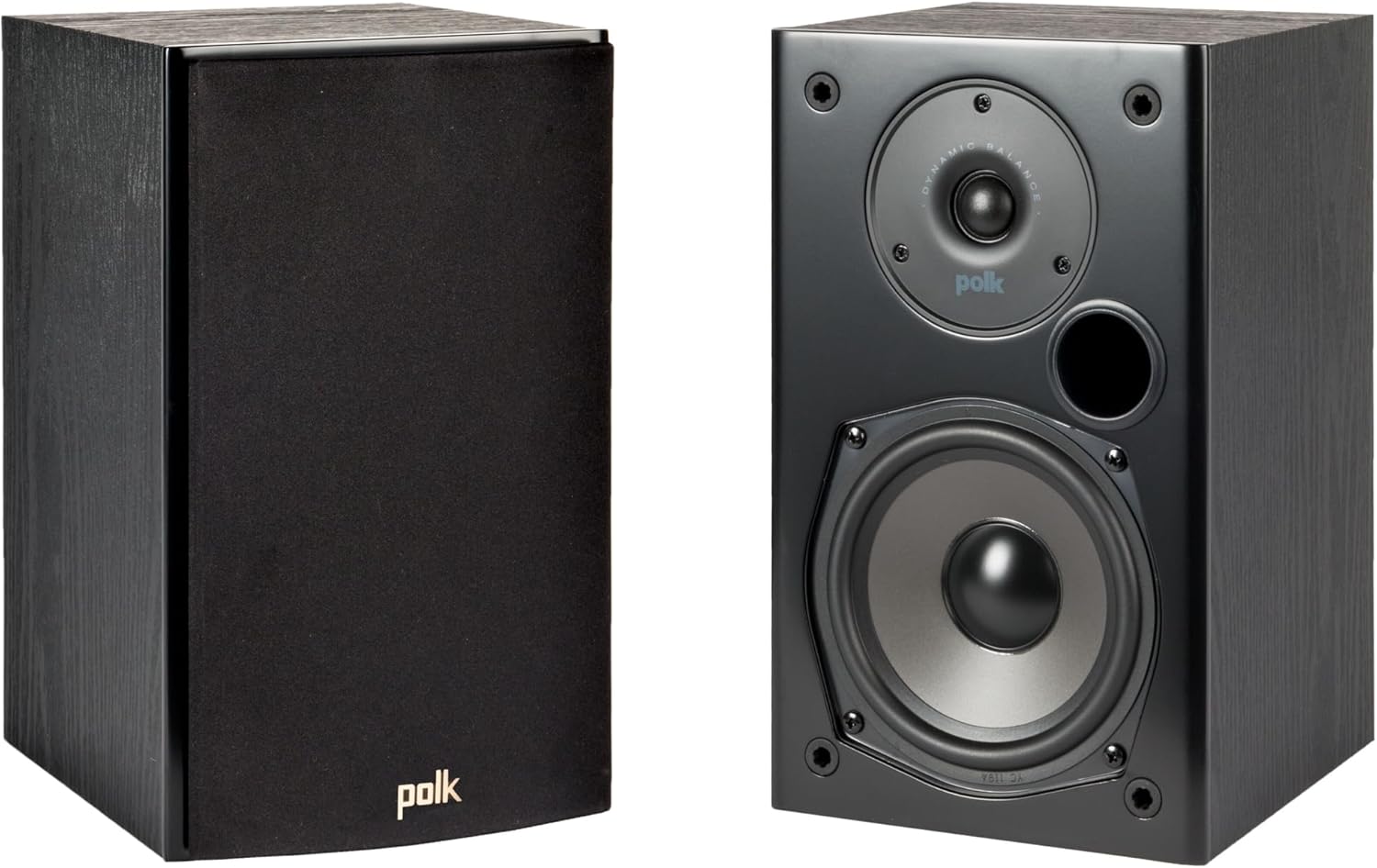
Visually, the T15s are as safe and boring as it gets: black rectangular boxes with a vinyl wrap and a Polk logo. Personally, I prefer that over something flashy. Once they’re on a shelf or stand with the grilles on, they basically fade into the background, which is nice if you don’t want your living room to look like a studio. The size is pretty compact: about 7.25" deep, 6.5" wide, and 10.6" tall – roughly the size of a gallon of milk, like one of the Amazon reviewers said. Easy to fit on a TV console, desk, or small stands.
The vinyl wrap is where you feel the budget side. From a distance it looks fine, but up close it has that kind of cheap fake-wood/plastic vibe. It doesn’t scream quality, but it’s not ugly either. If you care a lot about aesthetics, you’ll probably notice it. If your main goal is for them to blend in and not draw attention, they do that job. The front grilles are not magnetic; they use the old-school peg system, which feels a bit dated and you need to be careful not to snap anything if you remove them often.
On the back, you get a pair of binding posts that accept banana plugs, bare wire, or spades. They’re plastic, not metal, so they don’t feel premium, but they hold the cable well enough. There’s also a keyhole slot for wall mounting, which is handy if you want them as rear surrounds or high on the wall in a small room. Just keep in mind they’re rear-ported, so pressing them completely flat against the wall isn’t ideal for bass.
In day-to-day use, I liked that they’re not huge. On my desk, they didn’t dominate the space, and in the living room they slid easily into a TV stand. The design is basically “don’t offend anyone.” Nothing to get excited about, but also nothing that got in the way. For this price range, that’s pretty much what I expected.
Build and materials: feels budget, but not flimsy
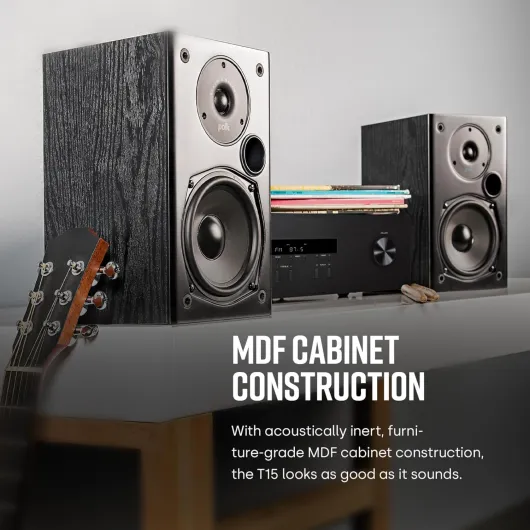
The cabinets are made of MDF with a vinyl wrap, which is standard at this price. When you knock on the sides, there’s a bit of hollowness, but nothing alarming. They don’t feel like heavy, dead-solid hi-fi boxes, but they also don’t feel like toy plastic. At around 8.3 pounds per speaker, there’s enough weight that they stay put on a shelf with the rubber feet on. I never felt like I had to baby them when moving them around.
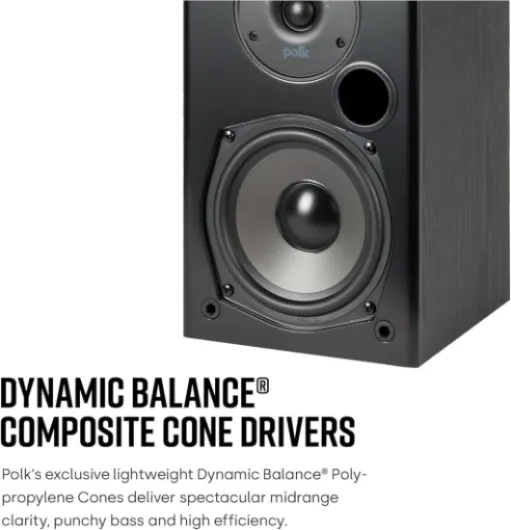
The drivers themselves look fine: the 5.25" woofer and the small tweeter are neatly mounted, and the baffle doesn’t have any weird gaps or sloppy assembly. The removable grilles are basic plastic with cloth, and they do their job, but again, they scream “budget.” The fact that they’re not magnetic and rely on pegs means if you’re constantly pulling them on and off, you might eventually loosen something. I ended up leaving them on most of the time because I preferred the cleaner look.
The binding posts on the back are one of the weaker points in terms of feel. They’re plastic and a bit stiff when you first tighten them down. They still accept banana plugs, which is nice, and once you set them up you’ll probably never touch them again, so it’s not a dealbreaker. But if you’re used to chunky metal posts on nicer speakers, you’ll notice the downgrade.
After a few weeks of moving them between rooms, on and off stands, and plugging/unplugging cables, nothing rattled, nothing came loose, and there were no weird noises from the cabinets. So while the materials are clearly cost-cut, the overall build seems good enough for long-term use. You’re not paying for luxury here; you’re paying for functional boxes that can survive normal handling and probably a few bumps.
Durability and long-term feel
I haven’t owned these for years obviously, but based on a few weeks of daily use and a bit of abuse (moving them around, stacking them temporarily, etc.), they seem solid enough for long-term home use. Polk has been around forever, and this T15 model has been on the market since 2009, which usually means if there were massive reliability issues, they’d be all over the reviews by now. The Amazon reviews are mostly positive, and I didn’t see patterns of people complaining about drivers blowing easily or cabinets falling apart.
The MDF cabinet with vinyl wrap should hold up as long as you don’t soak them or drop them. The corners can probably chip if you smack them into something, but that’s true for most speakers like this. The finish hides dust and fingerprints well, and a quick wipe with a dry cloth is enough. I didn’t notice any peeling or bubbling of the vinyl, but that’s more of a long-term thing to watch out for if they sit in direct sunlight or a humid room.
Internally, you’re trusting Polk’s basic quality control. I didn’t hear any rattles, no buzzing at certain frequencies, and no “blown speaker” type distortion even when I drove them fairly hard with a 100W receiver. They never got more than slightly warm at the amp end, and the speakers themselves obviously don’t heat up, so there’s nothing complicated that’s likely to fail like in active or smart speakers.
So while they don’t feel premium in the hand, I’d be surprised if they didn’t last several years of normal use. If you’re careful with the grilles and don’t overdrive them with some sketchy amp cranked to clipping, they should just sit there and do their job without drama. For budget speakers, that’s really what you want: install once, forget about them, upgrade only when you decide you want something fancier, not because they died.
Performance: good for the price, with a few clear limits
I tested these in two main setups: first as front left/right in a smallish living room with a Yamaha AV receiver, and then as nearfield speakers on a desk with a small class D amp. Across both setups, the general sound character was similar: clear highs, slightly relaxed mids, and decent but not earth-shaking bass. If you’re coming from a TV’s built-in speakers or a cheap soundbar, it’s a solid jump.
For movies, dialogue is mostly clear once you set them up right and maybe bump the center channel or dialogue enhancement if you’re running a full AVR. At very low volumes, voices can feel a bit pushed back, especially if you’re off-axis or sitting far away. Turn the volume up to a normal listening level and they open up. Explosions and sound effects have some punch, but these are still 5.25" woofers, so don’t expect the couch to shake. Under about 60 Hz, you can tell they’re running out of steam. With a subwoofer, the system feels much more complete.
For music, they’re pretty friendly. The sound has a bit of a U-shape: crisp highs, decent bass, slightly tamed mids. Rock, pop, and electronic tracks sound lively enough. Acoustic and vocal tracks are fine, but if you’re picky about midrange presence, you’ll notice that more expensive speakers handle vocals with more body and detail. I pushed them pretty hard with rock and metal, and they held up without obvious distortion at sane volumes. Only when I really cranked the receiver did they start to sound a bit harsh.
As desktop speakers, they shine more than I expected. At about an arm’s length away, the detail in the highs is easier to hear, and you don’t need to run them loud to get a good sound. For gaming, positional cues in FPS titles were much easier to place than with a soundbar. The only downside at the desk is that they’re still passive speakers, so you need the little amp box and some cable clutter. Overall, for what they cost (especially on sale), the performance is pretty solid. Just don’t expect deep sub-bass or super-precise audiophile detail.
What you actually get with the T15
Out of the box, the Polk T15s are pretty straightforward: two passive bookshelf speakers, removable grilles, and the usual paperwork. No cables, no fancy extras. You’ll need a receiver or an amp – these are not powered, and they’re not wireless speakers despite the Amazon listing throwing “Bluetooth” around in the specs. Think of them as classic hi-fi speakers: speaker wire in the back, amp does the work.
Each speaker has a 5.25" woofer and a 0.75" tweeter. Polk pushes the whole “Dynamic Balance” thing, which in real life just means the sound is fairly balanced for the price: you get some bass, clear enough mids, and a bit of sparkle up top. They’re rated for up to 100W and 8 ohms, so basically any half-decent AV receiver or stereo amp will drive them without sweat. I ran them off both a Yamaha AVR and a small Fosi-type amp, and neither had trouble.
Polk also markets these as part of a full T-series setup (T50 towers, T30 center, sub, etc.). That’s actually how they make the most sense: as fronts or surrounds in a budget 5.1 system. I tried them as front L/R only and later as rear surrounds, and they work fine in both roles. For a small room or office, two of these on a cheap amp is already a big step up from most soundbars.
So in practice, what you’re getting is a pair of basic, no drama speakers that can slot into a starter home theater or a simple stereo rig. No smart features, no app, no built-in streaming – just wired speakers. If you want plug-and-play with your phone over Bluetooth, this is not it. If you already have (or don’t mind buying) an amp, they’re a decent starting point.
Do they actually improve your setup?
In terms of “does this actually make my system better,” the answer depends on what you’re coming from. Compared to my TV speakers and a mid-range soundbar I had before, the Polk T15s were a clear upgrade. Dialogue was easier to follow, background details in movies stood out more, and music sounded fuller and less flat. Even without a sub, they had more weight in the low end than any soundbar I’ve owned under a few hundred bucks.
Where they start to show their limits is if you already have decent speakers. I tried swapping them in place of an older pair of entry-level bookshelf speakers from another brand, and the difference was smaller. The Polks had a slightly brighter top end and a bit more presence at moderate volumes, but the overall improvement wasn’t night and day. So if you already own halfway decent speakers, this is more of a side-grade than a big step up.
For home theater beginners, though, they get the job done. You can start with just these as fronts and then add a center, sub, and surrounds over time. They’re easy to drive, they don’t require complicated placement tricks, and they sound fine even when not perfectly positioned. In a small to medium room, they can absolutely carry movie nights and casual listening without feeling weak.
One honest downside: at very low volumes (late-night listening), voices can feel a bit recessed, and the bass falls off, especially in a bigger room. If you’re often watching TV quietly, you’ll probably want to lean on your receiver’s dialogue boost, or just accept that these like a bit of volume to really wake up. Overall, though, for the usual “TV + movies + Spotify” use, they’re effective enough that I didn’t feel the need to constantly tweak things once I got them dialed in.
Pros
- Clear, lively sound for the price, especially compared to TV speakers and cheap soundbars
- Compact size with wall-mount option, easy to fit in small rooms or use as surrounds
- Easy to drive with most basic AV receivers or small stereo amps
Cons
- Limited deep bass; really needs a subwoofer for full home theater impact
- Budget build and finish with non-magnetic grilles and plastic binding posts
- Dialogue can feel a bit recessed at very low volumes in larger rooms
Conclusion
Editor's rating
After living with the Polk Audio T15s for a bit, my overall feeling is that they’re solid budget speakers that get the basics right. They give you real stereo sound, clear enough dialogue, and decent bass for their size. They stay composed at normal to loud volumes, and they work well both as main speakers in a small room or as surrounds in a starter home theater setup. Add a sub and they slot in nicely as part of a 5.1 system.
The downsides are pretty straightforward: the really low bass isn’t there, the cabinets and finish feel clearly budget, and at low volumes voices can feel a bit recessed unless you tweak your settings. At full or high MSRP, there are other options worth considering, but when these go on sale, the value is hard to ignore. They’re not aimed at hardcore audiophiles; they’re for regular people who want their TV, games, and music to sound noticeably better without spending a fortune or dealing with complicated gear.
If you’re upgrading from built-in TV speakers or a basic soundbar and you already have (or don’t mind buying) an amp or AV receiver, the T15s make sense. If you already own decent speakers or want deep bass without a sub, you’ll probably want to look higher up the ladder. For a first step into proper home audio, though, they get the job done in a simple, no-nonsense way.