
Summary
Editor's rating
Value for money: good, but not cheap
Design: looks good, hides easily
Build quality & durability: feels solid, but time will tell
Performance: tight, clean bass, not earthquake mode
What the Sub Mini actually is (and isn’t)
Effectiveness: does it really improve your Sonos setup?
Pros
- Clean, tight bass that clearly improves Beam/Ray/One setups in small to medium rooms
- Very easy wireless setup and control through the Sonos app with Trueplay tuning
- Compact, discreet design that’s easy to place and doesn’t rattle or buzz
Cons
- Price is still high for a compact, ecosystem‑locked subwoofer
- Limited output for large rooms or users who want very strong, room‑shaking bass

Specifications
View full product page →| Brand | Sonos |
Small box, big bass (within reason)
I’ve been using the white Sonos Sub Mini for a few weeks with a Beam and a pair of Ones in my living room, and I’ll be straight: it’s not some magic cinema machine, but it does make a clear difference. Before adding it, the Beam on its own was fine for TV and casual music. After adding the Sub Mini, everything just feels more grounded, especially movies and electronic or hip‑hop tracks. You feel the bass a bit in the couch instead of just hearing a flat thump from the soundbar.
Setup is exactly what you’d expect from Sonos: open the app, scan the code, wait a few minutes. It really is that simple. Trueplay tuning took another 5–10 minutes walking around with an iPhone, and you can actually hear the change: the bass goes from a bit boomy in corners to more controlled. No cables to run across the room, just power and Wi‑Fi. If you already live in the Sonos ecosystem, it slots in without drama.
In day‑to‑day use, what stood out to me is how it fills in the low end without drowning everything. Dialog stays clear, even in loud scenes, and you just get more weight to sound effects, drums, and basslines. It’s not shaking the whole apartment like a huge 12‑inch sub, but honestly, that’s a good thing if you have neighbors or a smaller room. It’s more about clean, tight bass than pure brute force.
It’s not perfect though. The price is still high for a “mini” sub, and if your room is big or you’re a hardcore home theater nerd, you might find it a bit limited. Also, it only works with Sonos, so forget about using it with a random AV receiver. But if you already have a Beam, Ray, One, or One SL and feel your setup sounds a bit thin, this little box does the job quite well.
Value for money: good, but not cheap
Let’s talk about price, because that’s where opinions will split. The Sub Mini is clearly not cheap compared to generic subwoofers you can plug into a receiver. For the money, you can find bigger, more powerful subs from traditional audio brands. But that comparison isn’t totally fair, because those won’t integrate with Sonos at all. If you’re already in the Sonos ecosystem, your real comparison is the full‑size Sonos Sub or just staying without a sub.
Against the full‑size Sonos Sub, the Mini looks more reasonable. It’s quite a bit cheaper and, in a normal living room or bedroom, it gets you maybe 70–80% of the experience for a lot less money. If you’re not chasing reference‑level home theater, that trade‑off makes sense. You get proper bass, easy wireless setup, and integration with Beam, Ray, One, etc., without spending as much as the full Sub. That’s why I’d say the Sub Mini is pretty solid value for small to medium rooms, especially paired with Beam or Ray.
If you look at it from a “pure specs per dollar” angle, then no, it’s not great value. A non‑Sonos sub of similar price will usually be more powerful and more flexible (line‑in, crossover knobs, etc.). But you’d also need an AVR or some other gear, and you’d lose the Sonos simplicity and multiroom features. So it really depends what you’re after: plug‑and‑play convenience in a Sonos world, or maximum power and flexibility in a more traditional setup.
So overall, I’d say: if you already own Sonos speakers and you want better bass without turning your living room into a full cinema build, the Sub Mini is worth considering. It’s not a bargain, but it feels fairly priced for what it does in the Sonos ecosystem. If you’re starting from scratch and don’t care about Sonos specifically, you can build a more powerful setup for the same money with other brands.

Design: looks good, hides easily
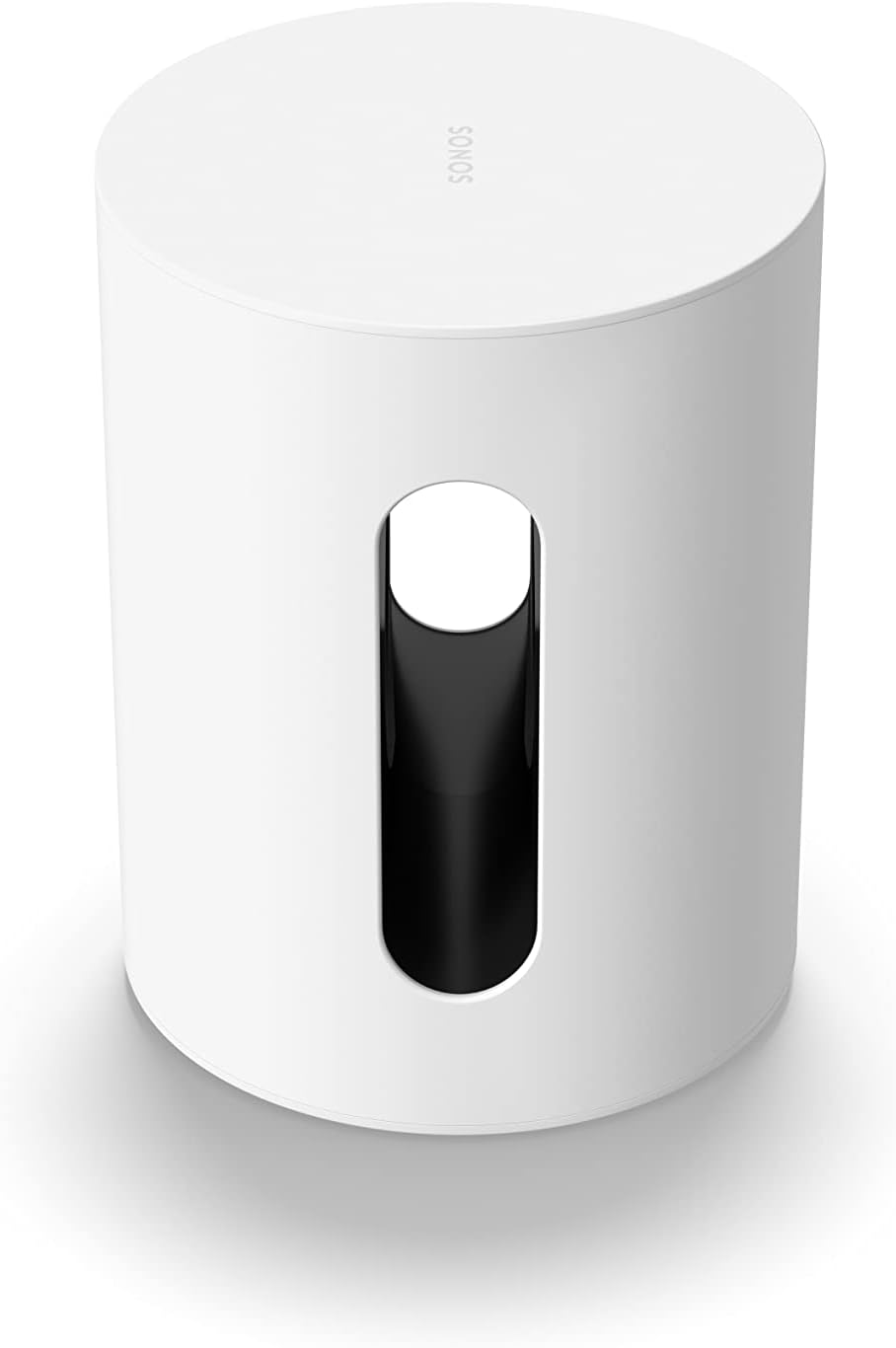
The Sub Mini in white has that typical Sonos look: simple, rounded, and pretty neutral. It’s basically a short cylinder with a vertical cutout in the middle. In a regular living room, it doesn’t scream “home theater gear”, which I liked. You can tuck it next to a TV stand, under a side table, or in a corner and it just looks like a modern piece of tech, not a big black box. The white finish matches white Beams and Ones pretty nicely, so if you’re going for a clean setup, it fits right in.
Size‑wise, at around 9 x 9 x 12 inches and about 6.3 kg, it’s heavier than it looks but still easy to move around with one hand. That’s useful the first few days, because you’ll probably drag it around the room to find the best spot. I moved it between a corner, next to the TV stand, and behind the couch. The lack of vibrating panels means you don’t get annoying rattles from the box itself, even at higher volumes. Most of the time, any buzzing you hear will be from loose furniture or objects in the room, not from the sub.
The only visible controls are minimal: power cable in the back, Ethernet if you want wired, and a pairing button. Everything else happens in the app. There’s no physical volume knob, which might annoy some people who like quick manual control, but Sonos has always worked this way. Once it’s in place, you really don’t touch it again unless you’re cleaning.
Overall, the design feels thought‑through for a normal home: compact, discreet, and easy to place. If you like flashy gear with LEDs and massive grilles, this is the opposite of that. If you want something that blends into the room and doesn’t ruin the look of a white wall or light furniture, it does the job nicely.
Build quality & durability: feels solid, but time will tell
Physically, the Sub Mini feels well put together. The outer shell is polycarbonate, but it doesn’t feel cheap or flimsy. It’s dense and has a bit of weight to it, so it doesn’t slide around when the bass kicks in. I pushed it pretty hard during some movie nights, and there were no weird rattles from the body or the internal parts. The force‑cancelling design seems to help keep vibrations in check, so you don’t feel the box buzzing on the floor like with some cheaper subs.
The finish on the white model is smooth and fairly easy to wipe down. Dust and fingerprints show a bit, but nothing dramatic. The cutout in the middle will collect dust over time, so you’ll want to run a cloth through it occasionally. I bumped it once while moving a vacuum cleaner, and it didn’t leave a mark, so the paint seems reasonably tough. Obviously, don’t treat it like a football, but for normal home use, it feels robust enough.
There’s no active cooling fan or anything noisy inside, so no moving parts apart from the drivers. That’s usually good news for long‑term durability. Sonos gear in general tends to last a while; I still have older Play:1 units that are doing fine years later. I can’t pretend to know how the Sub Mini will behave in 5–7 years, but based on the build and how it behaves so far, I don’t see any obvious weak points.
The main risk, honestly, is more on the software side than the hardware. Sonos is pretty good with long‑term support, but you are reliant on their app and updates. If they ever change something major, you’re stuck with their decisions. From a pure physical standpoint though, it feels like a solid, long‑term piece of kit that will sit on the floor and do its job quietly for years if you don’t abuse it.

Performance: tight, clean bass, not earthquake mode
In terms of raw performance, the Sub Mini does what it says: it fills in the low end that smaller Sonos speakers just can’t reach. The first thing I noticed when I added it to my Beam + One surrounds setup was how much fuller everything sounded at normal listening volumes. Action scenes in movies suddenly had weight—explosions, engines, footsteps all had more presence—but dialog didn’t get drowned out. That’s important, because some cheaper subs tend to just boom and make voices hard to hear. Here, the integration with the rest of the system is pretty smooth.
For music, it depends on what you listen to. With hip‑hop, EDM, and pop, the Sub Mini adds a nice punch. Kick drums hit harder, basslines are more defined, and you can actually feel the rhythm instead of just hearing a low hum. With rock and acoustic stuff, it mainly adds body to bass guitar and drums without taking over. I rarely felt the need to tweak the settings after the first day, except late at night when I dropped the sub level a bit in the app so I wouldn’t annoy the neighbors.
Now, if you’re looking for extreme, chest‑thumping bass that shakes your walls in a large open‑plan living room, this is where the limits show. Compared to the bigger Sonos Sub (which I’ve heard in a friend’s home), the Mini doesn’t go quite as deep or as loud. In a medium‑sized room (say, 15–25 m²), it’s more than enough. In a huge space, it starts to feel a bit polite. You can still hear the low notes, but you don’t feel that heavy rumble you’d get from larger subs or the full Sonos Sub.
Latency and stability have been solid. I didn’t notice any delay between the soundbar and the sub, even with fast action scenes or gaming. No dropouts on Wi‑Fi once it was set up properly. Trueplay tuning also helps avoid bloated bass if you have it near a wall or in a corner. So overall: very clean, controlled performance for small and medium rooms, just don’t buy it expecting cinema‑level shaking in a giant space.
What the Sub Mini actually is (and isn’t)
The Sonos Sub Mini is basically a compact, wireless subwoofer meant to pair with smaller Sonos speakers: Beam, Ray, One, One SL, maybe a pair of Fives in a smaller room. It connects over Wi‑Fi, not Bluetooth, and you manage everything from the Sonos app. No line‑in, no RCA, nothing like that. If you’re thinking of plugging this into a traditional amp or AVR, forget it. It’s Sonos‑only, period.
On paper, it goes down to around 25 Hz with 6‑inch drivers and up to 250 W of power. In real life, that translates to bass that feels firm and controlled, but not the kind that makes your windows buzz from two streets away. The design is a cylinder with a cut‑out in the middle where the two woofers face each other, which Sonos says helps cancel vibration and distortion. In practice, you don’t feel the box shaking even when you push it a bit, which is nice if it sits on a wooden floor or a light piece of furniture.
The product line positioning is pretty clear: this is the “budget” or “small room” option under the bigger Sonos Sub. Compared to the full‑size Sub, the Mini is cheaper, smaller, easier to hide, and honestly enough for most living rooms or bedrooms. If you’re pairing it with a Beam or Ray, it feels like a logical match. With an Arc in a big open‑plan living room, I’d say it starts to feel a bit underpowered and the full‑size Sub would make more sense if you’re picky.
Daily use is simple: you set it once, maybe tweak the sub level in the app, and then forget about it. It turns on and off with your Sonos system, no buttons to press. So overall, think of the Sub Mini as a clean, compact way to add proper bass to a Sonos setup that currently sounds a bit flat. Just be aware it’s locked into the Sonos world and not meant to be a universal subwoofer.

Effectiveness: does it really improve your Sonos setup?
The short answer: yes, if your current Sonos setup feels a bit thin, the Sub Mini fixes that. With just a Beam or Ray on their own, you get decent sound but the low end is clearly missing when you watch action movies or listen to bass‑heavy music. Once you add the Sub Mini, it feels like the system finally covers the full range. You don’t need to crank the overall volume to feel some impact; even at moderate levels, the bass is there and takes some load off the smaller speakers.
Where I noticed it most was during TV series and gaming. On Netflix shows, background music and effects suddenly had more depth. In games, explosions and engine sounds feel more convincing. It’s not about shaking the room, it’s more that the soundstage feels complete. Without the sub, going back to just the Beam feels a bit “flat” once you get used to the Mini. That tells me it’s actually doing real work, not just adding a faint rumble.
It also helps at lower volumes. At night, I usually keep the volume pretty low. Without a sub, you lose a lot of bass and everything sounds a bit tinny. With the Sub Mini, even at quiet levels, you still hear (and slightly feel) the low frequencies. That’s one of the main benefits for me: you don’t have to blast the system to get a satisfying sound. You can also tweak the sub level in the app, and the changes are immediate, so it’s easy to dial it back when needed.
Is it essential? No. If you’re just watching the news and some YouTube, your Beam or Ray alone is enough. But if you actually care about movies, games, or music, it’s a pretty solid upgrade. It just makes the system feel more complete and less like a fancy TV speaker. The only real catch is that you’re locked into Sonos, so this effectiveness only applies if you already have, or plan to have, a Sonos ecosystem.
Pros
- Clean, tight bass that clearly improves Beam/Ray/One setups in small to medium rooms
- Very easy wireless setup and control through the Sonos app with Trueplay tuning
- Compact, discreet design that’s easy to place and doesn’t rattle or buzz
Cons
- Price is still high for a compact, ecosystem‑locked subwoofer
- Limited output for large rooms or users who want very strong, room‑shaking bass
Conclusion
Editor's rating
After living with the Sonos Sub Mini for a while, my conclusion is pretty clear: it’s a strong upgrade for a Sonos system that feels a bit thin, especially with a Beam, Ray, or pair of Ones, but it’s not the right pick for everyone. In a small to medium room, it gives you clean, controlled bass that makes movies, games, and music feel much more complete. Setup is easy, it looks discreet, and day‑to‑day you don’t have to think about it. It just kicks in and does its job.
Who is it for? People already invested in Sonos who want better bass without going all‑in on the bigger Sub. If you live in an apartment, have neighbors, or don’t want your whole house shaking, the Mini’s level of power is actually more practical. It’s also good if you value a neat, wireless setup and don’t want to mess with AV receivers and cables. Who should skip it? If you have a big open space, crave very strong bass, or don’t own Sonos gear yet, there are better or more flexible options for the same money. Also, if you mostly watch light content (news, talk shows, casual YouTube), this will feel like an expensive extra.
Overall, I’d rate it as a good but not insane deal: strong performance for its size, very easy to live with, a bit pricey, and completely locked into the Sonos world. If you accept those trade‑offs and you already like Sonos, you’ll probably be pretty happy with it.