
Summary
Editor's rating
Value: where the XT60 makes the most sense
Design: basic, discreet, and easy to live with
Build and durability: feels budget, but not fragile
Performance: solid for movies, decent for music, needs a sub
What you actually get with the XT60
How it actually works in a real setup
Pros
- Good clarity for dialogue and movies at normal to high volumes
- Compact and light for a tower, easy to place and move
- Fits nicely into a full Polk XT home theater setup at a reasonable total cost
Cons
- Bass is limited without a sub; doesn’t replace a real subwoofer
- Cabinet feels light and can sound a bit boxy at higher volumes
- Not the best choice for critical music listening compared to similarly priced bookshelves

Specifications
View full product page →| Brand | Polk Audio |
A budget tower that actually feels like an upgrade
I picked up a single Polk Monitor XT60 to start upgrading from a basic soundbar setup, mostly for movies and some Spotify listening. I’m not an audiophile, I just wanted something that actually sounds like a real speaker and doesn’t cost as much as the TV. The XT60 kept popping up as a popular budget option, so I decided to try one first instead of buying the full pair right away.
Out of the box, my first reaction was that it looks like a “real” tower speaker, but it’s not huge or intimidating. It’s fairly light for a floorstander, so moving it around and trying different positions was easy. I wired it to a mid-range Denon AVR and did a few evenings of testing: action movies, dialogue-heavy shows, and a bunch of playlists at different volumes.
My quick takeaway: the XT60 is good for the price, especially if you’re coming from TV speakers or a cheap soundbar. It has decent bass for a tower without a sub, voices are clear, and it doesn’t fall apart when you turn it up a bit. But if you’re expecting deep theater-style bass or super detailed music, you’ll still want a subwoofer and maybe better fronts down the line.
So this review is from that angle: normal user, mixed use (movies + music), mid-range AVR, small-to-medium living room. No fancy measuring gear, just ears and some comparison to other budget gear I’ve used, like entry-level Sony towers and older Polk bookshelf speakers.
Value: where the XT60 makes the most sense
For me, the main selling point of the XT60 is value for a starter home theater. You’re getting a full-size tower with decent output, clear dialogue, and okay bass at a price that’s closer to what some brands charge for a single bookshelf. When you catch it on sale (which happens fairly often), it’s even more attractive. It’s not the best speaker out there, but for the money, it’s hard to complain too much.
Where it really makes sense is if you plan to build a whole XT system over time. Start with a pair of XT60s, add the XT30 center, then the XT12 sub, and maybe the XT90 height modules later. Because they’re all timbre-matched, you don’t have to think too hard about mixing brands or voicing. That simplicity is worth something, especially if you’re not into tweaking and just want it to work.
However, if you mainly listen to music and don’t care about surround formats, there’s an argument for spending the same total budget on better bookshelves + a sub instead of towers. A good pair of bookshelves in this price range can sound more detailed and controlled than the XT60, and a sub will cover the low end better anyway. So the XT60’s value is strongest for movie-focused users who want that “big speaker next to the TV” feeling and like the idea of a matching Polk setup.
Overall, I’d call the value pretty solid but not unbeatable. You’re paying for size, brand reputation, and the convenience of a matching line. If that lines up with what you want, it’s money reasonably well spent. If you’re chasing the best pure sound quality per dollar and don’t care about towers, you might want to look at bookshelf options first.

Design: basic, discreet, and easy to live with
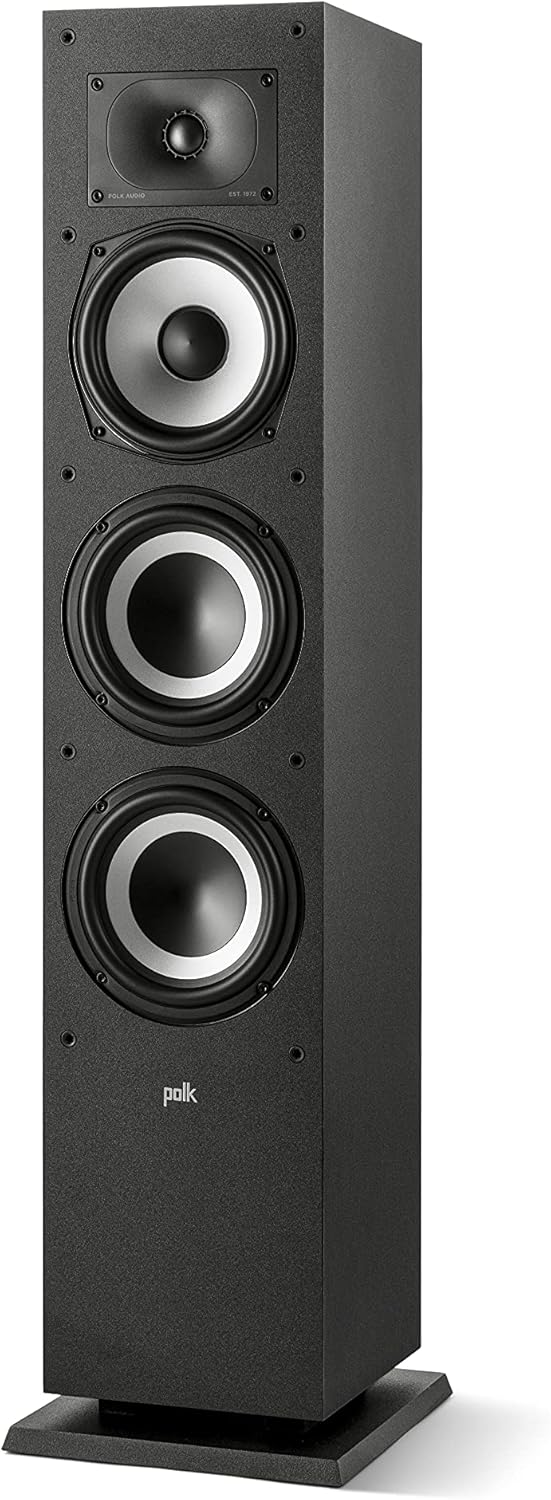
Design-wise, the XT60 is pretty straightforward. It’s a matte black vinyl box with a simple front baffle and a removable grille. Nothing flashy, no gloss panels, no fancy curves. If you want something that looks like a piece of furniture, this isn’t it. If you want something that disappears next to the TV and doesn’t scream “expensive toy,” it does the job.
The footprint is modest for a tower. It doesn’t dominate the room like some big 3-way floorstanders. I was able to tuck it next to a TV stand without blocking anything, and it doesn’t feel visually heavy. The included rubber feet are handy: they work fine on both hardwood and carpet. On carpet it felt stable enough, but if you’ve got thick plush carpet and kids or pets, I’d still be a bit careful not to knock it.
One thing I noticed: it’s lighter than it looks. At around 20 pounds, it’s easy to move with one hand. That’s good for setup but also tells you it’s not packed with super thick wood or heavy bracing. You can feel some hollow resonance if you knock on the side panel. It’s not terrible, but if you’ve handled heavier, more expensive towers, you’ll notice the difference right away.
Overall, I’d call the design “clean but basic.” It blends into most living rooms without drawing attention. If you remove the grille, you see the tweeter, woofer, and two passives, which looks kind of cool, but the finish is still clearly budget vinyl. For the price, I’m fine with it. Just don’t expect a premium look or feel.
Build and durability: feels budget, but not fragile
On the durability side, the XT60 feels good enough but clearly budget. The cabinet is MDF with vinyl wrap, pretty standard in this price range. The vinyl itself looks okay and didn’t show any peeling or bubbling out of the box. The corners are slightly sharp, so if you’ve got kids running around, I’d keep that in mind. After moving it around a few times, I didn’t see any scuffs, but I was also being reasonably careful.
The grille attaches firmly and doesn’t feel like it’s going to snap off with normal use. The driver cones and the passive radiators look fine, but they’re still exposed if you run it without the grille, so if you have pets or kids, I’d keep the grille on. The binding posts on the back are basic but solid enough. They hold banana plugs and bare wire without any drama. I’ve seen cheaper speakers with flimsy posts that spin or feel loose; this isn’t one of those.
The one thing that gives away the price range is the overall lightness and cabinet resonance. If you knock on the side, you can hear it’s not heavily braced. Over time, that can mean a bit more cabinet vibration at higher volumes, which you can hear as a slight boxy character in the mid-bass. I didn’t notice any rattling or weird noises during my tests, but if you’re planning to absolutely hammer these at party levels all the time, I wouldn’t be shocked if something eventually buzzes.
For normal home use—movies a few nights a week, some music on weekends—I don’t see any major durability red flags. It doesn’t feel premium, but it doesn’t feel cheap to the point of worrying either. Treat it like normal electronics, don’t drop it down the stairs, and it should last a good while.
Performance: solid for movies, decent for music, needs a sub
Sound-wise, the XT60 leans clearly toward home theater use. For movies and TV, it does quite well, especially if you’re upgrading from a soundbar. Dialogue is clear, even at lower volumes, and the midrange has enough body that voices don’t sound thin or hollow. In action scenes from stuff like Top Gun: Maverick and Marvel movies, it holds up pretty well. Explosions and effects have some weight, and the speaker doesn’t freak out when you nudge the volume up to “neighbors might notice” levels.
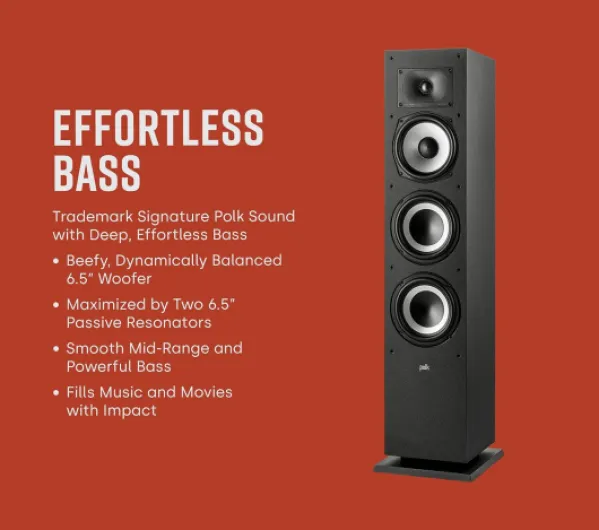
On the bass side, for a tower without an external sub, it’s good but not deep. The passive radiators help give you a bit of punch and fullness, but don’t expect real sub-bass. In practice, it fills a small to medium room fine, but if you watch a lot of blockbuster movies, you’ll want to pair it with a sub like the Polk XT10 or XT12. When I switched my sub off, the sound was still enjoyable, but the big low-end rumble was obviously missing.
For music, it’s okay. I’d say it’s more “enjoyable” than “detailed.” Rock, pop, and electronic tracks sound lively enough. The highs can get a bit bright if you crank it, but not to the point where I had to turn it down immediately. If you’re picky about imaging and fine details in jazz or acoustic tracks, you’ll hear the limitations: the soundstage is a bit flat compared to more expensive speakers, and some instruments blend together instead of standing out clearly.
Overall, performance lines up with the price. It’s a noticeable upgrade over TV speakers or cheap bookshelves, especially for movies. It’s not going to impress hardcore hi-fi people, but for a normal user building a budget 5.1 system, it gets the job done and feels like money reasonably well spent.
What you actually get with the XT60
The XT60 is a single floor-standing speaker, not a pair, which is easy to miss if you skim the listing. Inside you’ve got a 1" tweeter, one active 6.5" woofer, and two 6.5" passive radiators. So technically only one driver is powered, and the other two cones help push more low-end without a bigger box. It’s rated at up to 200W and 8 ohms, so any half-decent AV receiver or stereo amp should run it fine.
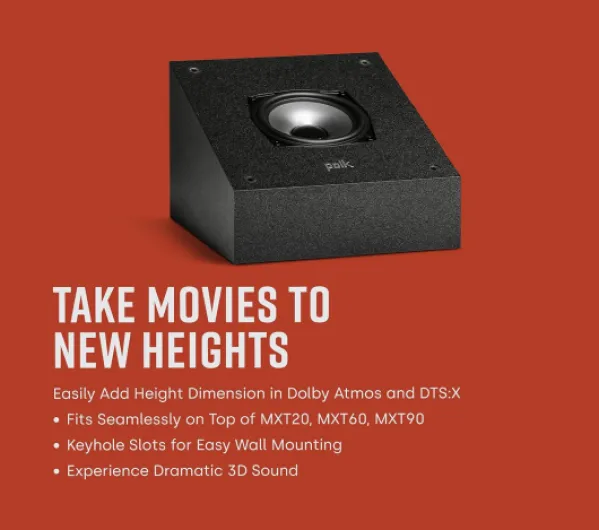
On paper it’s pitched as “Hi-Res Audio Certified” and compatible with Dolby Atmos, DTS:X, Auro 3D, all that. That basically just means it plays nice in modern surround setups and can handle higher quality audio files. In practice, I used it in a standard 5.1 layout and then briefly as just a 2.0 music setup. No fancy height module at first, just the tower doing front-left duty.
Connections are straightforward: standard binding posts that take bare wire or banana plugs. No built-in amp, no Bluetooth in the speaker itself, so ignore the Bluetooth mention in some specs – you still need an amp/AVR. It’s just a passive tower. Polk sells it as part of the Monitor XT family, so you can mix it with the XT30 center, XT20 bookshelves, XT90 height modules, and an XT12 sub if you want a full Polk system.
Overall, the positioning is clear: this is meant to be a budget home theater building block. It’s not a fancy audiophile tower and it’s not meant to be. The idea is: buy one or two XT60s, add the matching center and sub later when budget allows, and end up with something that feels like a proper surround setup without going crazy on price.
How it actually works in a real setup
In day-to-day use, the XT60 is easy to live with. I ran it as front left with a matching Polk center and a sub, and it blended in without much tweaking. Polk advertises the whole XT line as timbre-matched, and that seems fair. Pans across the front (cars moving across the screen, voices moving left to right) sounded consistent, not like three different speakers fighting each other.
In a medium living room, I never felt like the XT60 was struggling at normal watching levels. I usually sit about 8–9 feet away. At moderate volume, it stays clean and controlled. When I pushed it higher, you can tell it’s a budget tower: the bass gets a bit loose, and the top end can feel a bit sharp on some tracks. But I’d say you hit “too loud for the room” before you hit “speaker is dying,” so for most people it’s fine.
As a single speaker for a stereo setup, it’s decent but not mind-blowing. I tested it in 2.0 with just the AVR and no sub. For casual listening (Spotify, YouTube, background music), it’s more than enough. For focused listening, it’s okay but you can tell the low end rolls off and the detail level isn’t on par with better (and more expensive) bookshelves. So if music is your main thing and you’re picky, I’d seriously consider a good pair of bookshelves plus a sub instead.
Overall, in terms of effectiveness for the intended use—budget home theater—this speaker does its job. It fills the room, keeps dialogue clear, and doesn’t require constant fiddling or EQ band-aids. Just don’t expect it to suddenly turn your living room into a high-end listening room. It’s more of a solid workhorse than anything fancy.
Pros
- Good clarity for dialogue and movies at normal to high volumes
- Compact and light for a tower, easy to place and move
- Fits nicely into a full Polk XT home theater setup at a reasonable total cost
Cons
- Bass is limited without a sub; doesn’t replace a real subwoofer
- Cabinet feels light and can sound a bit boxy at higher volumes
- Not the best choice for critical music listening compared to similarly priced bookshelves
Conclusion
Editor's rating
The Polk Monitor XT60 is a solid budget tower that does what most people want from an entry-level home theater speaker: it gets loud enough for a small to medium room, keeps dialogue clear, and gives movies more impact than a soundbar or TV speakers. It looks simple, is easy to drive with a normal AVR, and fits neatly into Polk’s XT lineup if you want to build a full surround system over time.
It’s not perfect. The cabinet feels light and a bit hollow, the bass is decent but not truly deep, and for music-focused listening you can definitely find bookshelves in the same price range that sound more detailed and refined. This is not a high-end audiophile tower, and if you expect that, you’ll be underwhelmed. But if you treat it as what it is—a budget-friendly building block for a 5.1 setup—it performs well and feels like fair value.
I’d recommend the XT60 to someone who mainly watches movies and TV, wants a straightforward upgrade path, and likes the idea of matching Polk fronts, center, and sub. If you’re mostly into music and sit and listen critically, or if you already own a decent sub, I’d at least compare it to some good bookshelf options before deciding.