Summary
Editor's rating
Value for money: where it makes sense and where it doesn’t
Slim design that actually solves the “blocking the TV” problem
Build quality: decent, not fancy, but feels solid enough
Early impressions on durability and daily use
How it actually sounds for movies, TV, and games
What you actually get with the Polk Monitor XT35
Pros
- Very slim design fits under most TVs without blocking the screen or IR sensor
- Clear, easy-to-understand dialog in movies and TV shows
- Simple to integrate with budget and midrange AV receivers and Polk or mixed speaker setups
Cons
- Limited low-mid and bass impact; really needs a subwoofer to feel full
- Can sound a bit thin or strained at very high volumes in larger rooms

Specifications
View full product page →| Brand | Polk Audio |
| Mounting Type | Wall Mount |
| Material | (4) 3" bi-laminate paper |
| Model Name | MXT35 |
| Speaker Type | Center Channel |
| Special Feature | Dolby Enabled |
| Recommended Uses For Product | For Surround Sound Systems |
| Compatible Devices | Television |
A skinny center channel that actually sounds big
I picked up the Polk Monitor XT35 because my old chunky center speaker blocked the bottom of my TV and annoyed me every single day. I wanted something low-profile that could slide in front of the screen without messing with the remote sensor, but I didn’t want to downgrade the sound just to save a couple inches of height. On paper, the XT35 ticks a lot of boxes: slim design, four 3" woofers, 1" tweeter, wall-mountable, and not crazy expensive. I’ve been running it for a few weeks in a 5.1 setup with a Denon AVR and a Polk sub.
In practice, this thing is clearly built for people who care more about clear voices and a clean setup than chasing reference-level volume. I mostly used it for streaming shows on Netflix, Disney+, some Blu-rays, and a bit of gaming on PS5. My living room is medium-sized, around 14x18 feet, and I sit maybe 8–9 feet from the TV. So not a tiny bedroom, but not a home cinema bunker either. That’s a decent real-world use case for this speaker.
Right away, the main thing that jumped out is that dialog is much easier to follow compared to using the TV speakers or a basic soundbar. I didn’t have to ride the volume up and down every time there was an action scene followed by a quiet conversation. Voices sit clearly in the center, even when there’s background music and effects going on. It’s not mind-blowing or anything, but it does the job the way a center speaker should.
It’s not perfect though. The XT35 is slim, and you feel that in the lower midrange and bass. If you don’t have a sub or decent front speakers helping, it can sound a bit thin at lower volumes. It also has its limits if you push it hard in a big room. But overall, for the price and size, it’s a pretty solid upgrade over TV audio or a cheap soundbar, especially if your main goal is to actually hear what people are saying.
Value for money: where it makes sense and where it doesn’t
Price-wise, the XT35 usually sits in that mid-budget range for center speakers. It’s not the cheapest option out there, but it’s also far from the high-end stuff. For what you pay, you get a very practical form factor, solid dialog clarity, and easy integration with most AVRs. If your main pain point is “I can’t hear voices clearly and my center blocks my TV,” this speaker hits both problems at once without wrecking your wallet.
Where the value feels strong is in a Polk-based system or any budget-to-midrange home theater. Pair it with a Polk sub and some bookshelf or tower speakers and you’ve got a coherent setup that does home cinema pretty well for the money. The fact that it’s Hi-Res certified and handles Dolby Atmos / DTS:X signals doesn’t magically make it high-end, but at least you know it won’t choke on modern formats coming from streaming apps or Blu-rays. It just plays what the AVR sends without any drama.
On the flip side, if you have a bigger room or you like to watch movies loud, you might outgrow this center faster than you think. There are chunkier centers in a similar price range that will give you more low-mid body and headroom, but they won’t be as slim or easy to place. So you’re basically trading some raw performance for convenience and size. If you don’t care about height and have room for a taller speaker, it might be worth comparing with something like Polk’s own larger centers or similar models from other brands.
Overall, I’d call the XT35 good value if you specifically need a slim center and watch a lot of dialog-heavy content. If you’re chasing maximum power per dollar and don’t care about blocking a bit of the TV, you can probably find beefier options for similar money. For my use—medium room, mixed streaming and Blu-rays, normal listening levels—it hits a nice balance between price, size, and performance.
Slim design that actually solves the “blocking the TV” problem
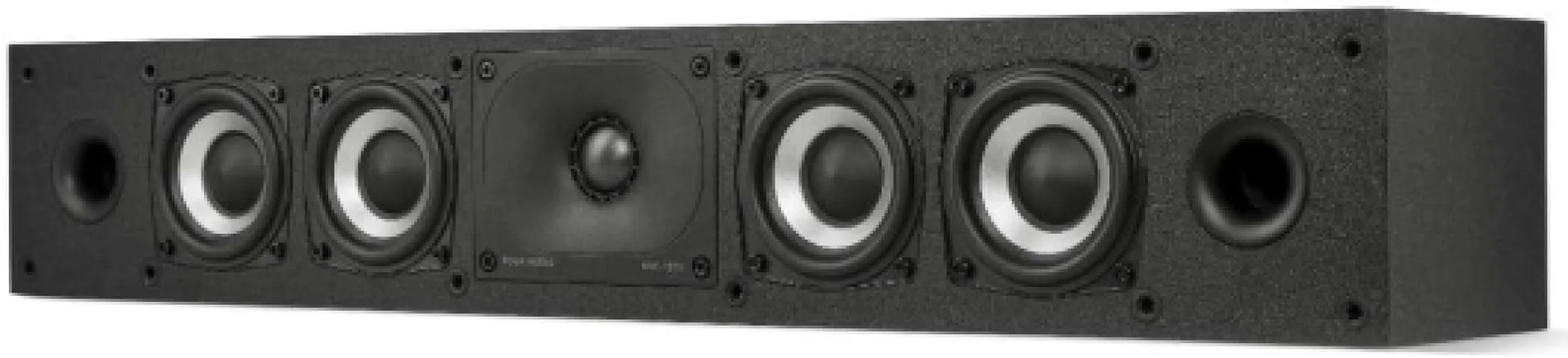
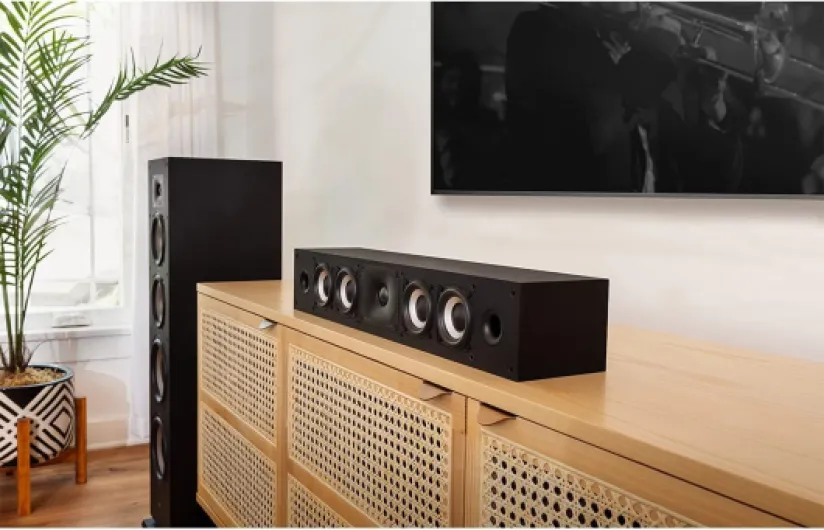
The main selling point for me was the 4" low profile. My old center was tall enough to block the bottom of the screen and the TV’s IR sensor, so the remote didn’t always work unless I held it at a weird angle. The XT35 slides right in front of the TV without getting in the way. Polk clearly designed it with modern TV stands in mind—flat, long, and low. If you’ve been balancing a center speaker in strange positions just to keep it out of the picture, this form factor is a nice relief.
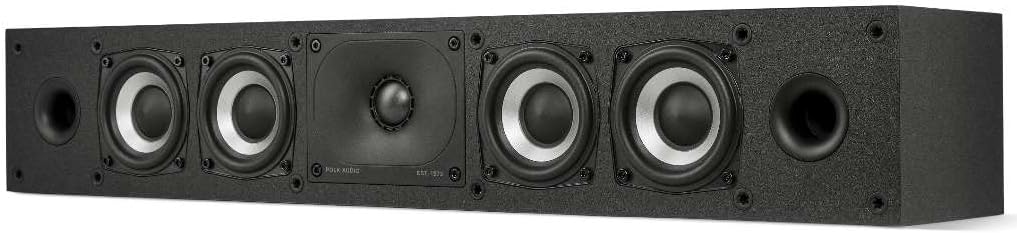
Looks-wise, it’s pretty simple: matte black vinyl, removable grille, and a clean front baffle. There’s nothing fancy here, but it doesn’t look cheap or toy-like either. I’d call it “neutral living room friendly.” It blends into the setup and doesn’t attract attention, which is what I want from a center speaker. The grille is easy to pop on and off; I left it on most of the time because I prefer not seeing drivers, especially with kids and pets around.
On the back you get 5-way binding posts that feel solid and take banana plugs, bare wire, or spades. No spring clips, which is good. There are also keyhole slots for wall mounting. I didn’t mount it on the wall long-term, but I did test it on a mock-up board. It hangs fairly flush and doesn’t stick out too much depth-wise, so if your TV is wall-mounted and you want the center right below it, this is workable. Just remember you’ll have to buy your own screws/anchors and make sure they’re in studs or solid material, because the speaker weighs about 14 pounds.
If I had to nitpick the design, the finish is just standard vinyl wrap. It’s fine, but it’s not going to impress anyone up close. Also, because it’s so wide and light compared to its height, it can slide a bit on a smooth TV stand if you bump it. I ended up putting some small rubber pads under it to keep it from shifting when someone cleaned the stand. Overall though, for the price, the design is practical and focused on solving real placement issues, which I appreciate more than flashy looks.
Build quality: decent, not fancy, but feels solid enough
The XT35 is mostly MDF with a vinyl wrap, pretty standard for this price range. The front baffle feels solid when you tap it, and I didn’t notice any obvious rattles or hollow spots even at higher volumes. The drivers are 3" bi-laminate paper woofers and a 1" Terylene tweeter. On paper that sounds a bit old-school compared to some aluminum or fancy composite materials you see in pricier speakers, but in actual use it’s fine. The cones don’t look fragile, and with the grille on they’re protected anyway.
The binding posts are nickel-plated 5-way posts. They’re not the heavy-duty, chunky kind you find on more expensive speakers, but they grip banana plugs and bare wire properly and don’t feel wobbly. I rewired the speaker a couple of times while testing different receiver settings, and nothing loosened or felt sketchy. For a speaker at this price, I don’t really expect more in terms of terminals.
One thing that stood out is that the cabinet doesn’t flex much when you squeeze it or pick it up from one side. It doesn’t feel like a hollow toy box. Still, you can tell it’s a mass-market product: the vinyl seams are visible if you look closely, and the finish can catch fingerprints or small scuffs if you drag it around. Mine arrived without any peeling or damage, so either I got lucky or Polk’s quality control on this line is at least decent. I’ve seen some reviews on other XT products mentioning cosmetic issues, so I’d still give it a quick inspection out of the box.
Overall, I’d rate the materials as “good enough for the price”. It’s not high-end furniture-grade, but it doesn’t feel flimsy either. If you’re expecting real wood veneer and fancy trim, this isn’t it. If you just want something that feels sturdy, can handle everyday use, and won’t fall apart when you dust it or move it, it gets the job done. I’ve had cheaper centers in the past that buzzed or creaked at certain frequencies; the XT35 has been quiet on that front so far.
Early impressions on durability and daily use
I’ve only had the XT35 for a few weeks, so I can’t pretend I know how it will hold up over many years, but I can talk about day-to-day handling and what’s realistic at this price. I moved it around a few times: on a TV stand, on a temporary wall-mount board, and back again. No creaks, no weird noises from inside the box, and the cabinet stayed tight. The grille clips on and off without feeling like they’ll snap, which is nice if you tend to clean or rewire things often.
The vinyl finish is the part that will probably show age first. It’s matte, which helps hide fingerprints, but it can pick up small scratches if you drag something across it. I had one minor scuff from sliding a console under the TV and bumping the corner of the speaker. It didn’t tear the vinyl, just left a tiny mark that you only see up close. So I’d say: treat it like typical mid-range audio gear, not like a rugged piece of equipment. Don’t stack stuff on top, don’t use it as a shelf, and you’ll be fine.
From a functional standpoint, no issues so far. No buzzing, no distortion at normal listening levels, and no sign of the drivers complaining. I ran a couple of test sweeps and some bass-heavy scenes at higher volume just to see if anything rattled, and it stayed quiet. The binding posts are still tight after several disconnects and reconnects. Polk gives a limited warranty, which is standard. I didn’t have to deal with support, so I can’t comment on that part.
Overall, in terms of durability, I’d put it in the “solid enough for normal home use” category. If you’re careful with your gear and not constantly dragging it around or abusing it, I don’t see any immediate red flags. It’s not bulletproof, but it doesn’t feel cheap or fragile either. For the money, I’m comfortable with how it’s built and how it’s holding up so far.
How it actually sounds for movies, TV, and games
Let’s talk sound, because that’s what matters. In my setup, the XT35 is clearly tuned for dialog clarity. Voices are crisp and easy to pick out, even when there’s music and effects going on. Watching shows like “The Expanse” and “House of the Dragon” where the mix can be a bit dense, I didn’t have to constantly rewind to catch mumbled lines. That alone made it feel like a proper upgrade over using just TV speakers or a basic soundbar.
The midrange is on the clean and slightly lean side. That works well for speech, but you can tell the cabinet and 3" woofers have limits. Without a sub, lower male voices and some sound effects don’t have much weight. Once I crossed it over to my sub around 80–100 Hz, things balanced out a lot better. With the sub doing the low-end work, the XT35 focuses on what it’s good at: clear mids and fairly smooth highs. I didn’t hear any nasty hiss or harshness unless I really cranked the volume beyond what I’d normally use.
For action movies and games (I tried “Top Gun: Maverick” and a bunch of PS5 titles like “Horizon Forbidden West” and “Spider-Man”), the center held its own. Explosions and effects obviously rely more on the sub and the front L/R speakers, but the XT35 kept dialog anchored in the middle even when everything went loud. Off-axis performance was also decent: sitting off to the side of the couch, voices still sounded centered and understandable. That matches Polk’s claim that it gives good coverage “no matter where you sit,” at least within a normal living room width.
If you’re expecting this to fill a large room at reference levels by itself, you’ll hit its ceiling. At very high volumes, it starts to feel a bit strained and thin compared to chunkier centers with bigger drivers. Also, for pure music listening in stereo mode with the center active, it’s fine for background use but not something I’d pick as my main music speaker. Overall, I’d say the performance is strong for dialog-focused home theater in small to medium rooms, especially when paired with a sub and decent fronts, but it’s not trying to be a powerhouse.

What you actually get with the Polk Monitor XT35
The XT35 is a slim center channel with one 1" Terylene tweeter and four 3" woofers packed into a 24" wide, 4" high, 6" deep cabinet. So it’s long and low, more like a big soundbar segment than a traditional chunky box. It’s rated at 8 ohms, recommended amp power 25–200W, and it hooks up with standard 5-way binding posts. No fancy wireless stuff here, it’s a straight wired passive speaker, so you need an AV receiver or amp to drive it. I ran it off a Denon at normal listening levels without any issues.
Polk sells it as part of the Monitor XT line, which is kind of their budget-friendly home theater range. The idea is you can pair it with XT20/XT60/XT70 fronts, XT90 Atmos modules, and a Polk sub and get a matching system without spending a fortune. I didn’t go full XT, but I did try it with other Polk speakers I already had, and the sound character blended well enough that nothing stuck out in a bad way. So the whole “timbre matched” thing is not just marketing fluff; it’s at least roughly true.
In day-to-day use, the XT35 handled pretty much everything I threw at it: movies, TV shows, sports, YouTube, and PS5 games. The main job of a center speaker is dialog, and that’s where this unit focuses. It’s not trying to be a mini subwoofer. Frequency extension down low is limited, but that’s expected for such a slim cabinet with 3" drivers. With a sub handling the heavy lifting below, say, 80–100 Hz, the XT35 fills in the mids and highs cleanly.
One thing to keep in mind: this is just the center, nothing else in the box beyond the speaker and basic documentation. No cables, no wall-mount brackets included beyond the built-in keyhole-style mounts. So if you’re new to home theater, budget a bit extra for decent speaker wire and any wall hardware you might need. It’s a no-frills product in that sense: you pay for the speaker, not a bunch of accessories.
Pros
- Very slim design fits under most TVs without blocking the screen or IR sensor
- Clear, easy-to-understand dialog in movies and TV shows
- Simple to integrate with budget and midrange AV receivers and Polk or mixed speaker setups
Cons
- Limited low-mid and bass impact; really needs a subwoofer to feel full
- Can sound a bit thin or strained at very high volumes in larger rooms
Conclusion
Editor's rating
The Polk Monitor XT35 is a practical, slim center speaker that focuses on doing the basics right: clear dialog, easy placement, and straightforward setup. It doesn’t pretend to be high-end, but in a normal living room with a decent AVR and a sub, it does its job without drama. Voices are easy to follow, off-axis listening is decent, and the low profile actually solves the “speaker blocking the TV” issue that a lot of people deal with. If you’re coming from TV speakers or a basic soundbar, the jump in clarity alone makes it feel worthwhile.
It’s not perfect. The slim cabinet and 3" woofers mean it doesn’t have a lot of weight in the lower mids on its own, and it can start to feel a bit thin or strained if you push it hard in a big room. You pretty much need a subwoofer to get a full sound for movies. The finish is basic vinyl, not fancy, and long-term it will probably show scuffs if you’re rough with it. But considering the price, the build is decent and the sound is pretty solid for dialog-focused home theater. I’d recommend it to anyone who wants a low-profile center for a small to medium room and already has (or plans to add) a sub. If you want big, room-shaking output from the center alone or you don’t care about height, you might want to look at a larger, less slim model instead.