
Summary
Editor's rating
Value: strong for 6 zones, weak if you want a “normal” receiver
Design: functional front panel, dated remote, and a mono surprise
Build and durability: feels like budget gear, but holds up so far
Performance: loud enough, decent sound, but not hi-fi
What this amp actually is (and what it isn’t)
How well it actually does the multi-room / PA job
Pros
- Six speaker channels with independent volume, ideal for multi-room/background music
- Built-in Bluetooth, FM radio, and USB/SD playback make it usable without extra gear
- Good power for small to medium spaces and decent sound for the price
Cons
- Mono output across all channels despite “stereo” marketing, not suitable for home theater
- Remote only controls the internal MP3/FM section, no real global volume or power control
- Push-type speaker terminals and overall build feel budget and a bit dated

Specifications
View full product page →| Brand | Pyle |
A budget 6‑zone amp that’s more “utility tool” than “home theater hero”
I set this Pyle PTA66BT up in a mixed-use space: basically a big garage + workshop downstairs and a small office area upstairs. I wired six pairs of ceiling and wall speakers and used it daily for a few weeks. My goal was simple: background music everywhere, the ability to make quick announcements on a mic, and Bluetooth from my phone. No fancy home theater, no audiophile setup, just something that can run all day without me babysitting it.
First clear thing: this is a mono 6‑zone distribution amp, not a classic stereo receiver like you’d put under your TV. The marketing says “stereo” but in practice all six speaker channels share the same mono signal. If you come in expecting surround sound for movies, you’ll be disappointed. If you just want to flood several rooms or zones with the same music, that design actually makes sense.
Over a few weeks, I tried pretty much everything on it: Bluetooth streaming from Spotify, FM radio, a USB stick with MP3s, and an analog input from a small mixer. I also played around with the mic inputs and the talkover function just to see if it’s usable for real announcements. Short version: it gets the job done, but it also has some rough edges that you feel as soon as you try to use it like a modern living-room amp.
So if you’re eyeing this as a cheap way to power a bunch of speakers in a shop, salon, barn, or whole-house background music system, it’s worth a look. If you want something for TV use with a proper remote and volume control from the couch, this is probably the wrong product and you’ll end up annoyed fast.
Value: strong for 6 zones, weak if you want a “normal” receiver
In terms of bang for the buck, if you specifically need to power up to six speaker zones with independent volume and you’re okay with mono, this is hard to beat at the usual price. Most multi-zone or whole-home amplifiers with 6–12 channels cost quite a bit more, especially from big-name brands. Here, you get Bluetooth, FM, USB/SD playback, and two mic inputs all rolled into one box. For a salon, small business, barn, or whole-house background music on a budget, that’s pretty solid value.
Where the value drops is if you’re comparing it to a regular AV receiver for a single room. For about the same money, you can often get a name-brand stereo or 5.1 receiver that gives you proper stereo, HDMI, better remote control, and more modern features. But that kind of receiver usually doesn’t give you six zones with separate volume knobs. So it comes down to what you actually need: one good room or many okay rooms.
Realistically, you’re paying for channel count and flexibility, not for fancy sound or premium build. If you go in with that mindset, it feels like a fair deal. If you expect rich hi-fi sound, a great remote, and smart features, you’ll find the compromises pretty fast. For me, using it as a background music workhorse, I’d say it’s good value for money as long as you accept its limits and don’t try to make it something it’s not.
So, value rating depends heavily on use case: for multi-zone background music, I’d give it a high score; for a main living-room or TV amp, the missing remote volume and mono output make it feel like a bad purchase, even at a low price. Know which side you’re on before you hit buy.
Design: functional front panel, dated remote, and a mono surprise
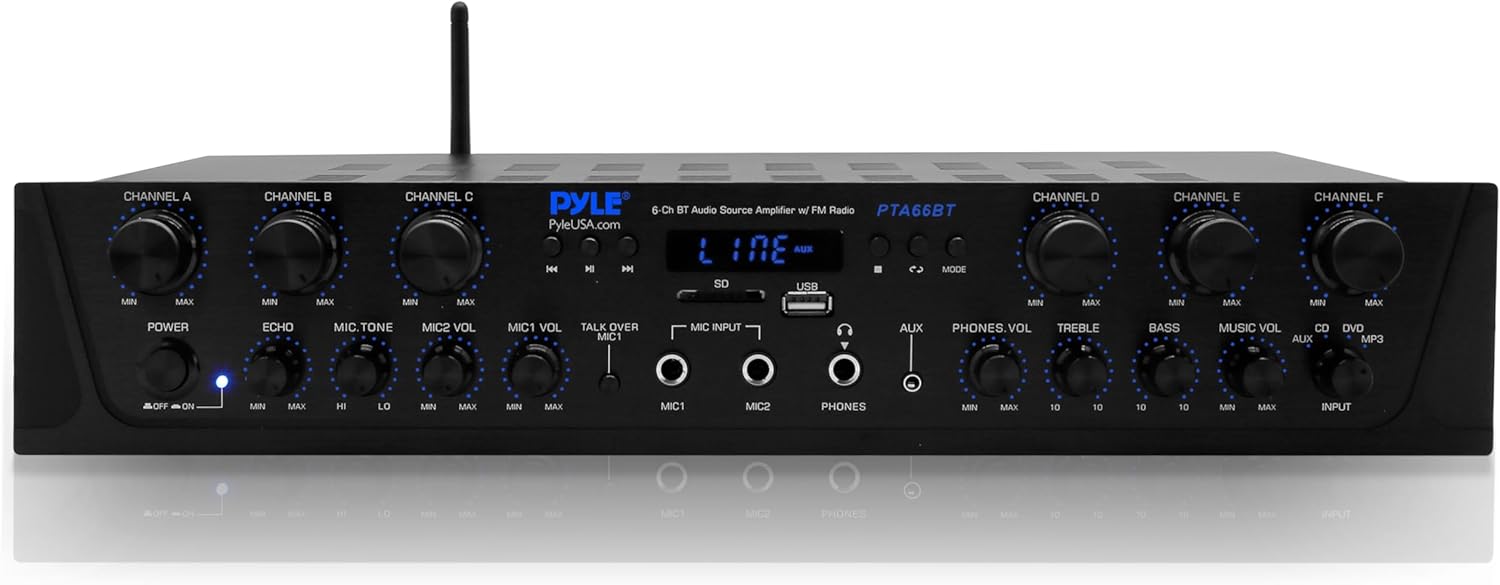
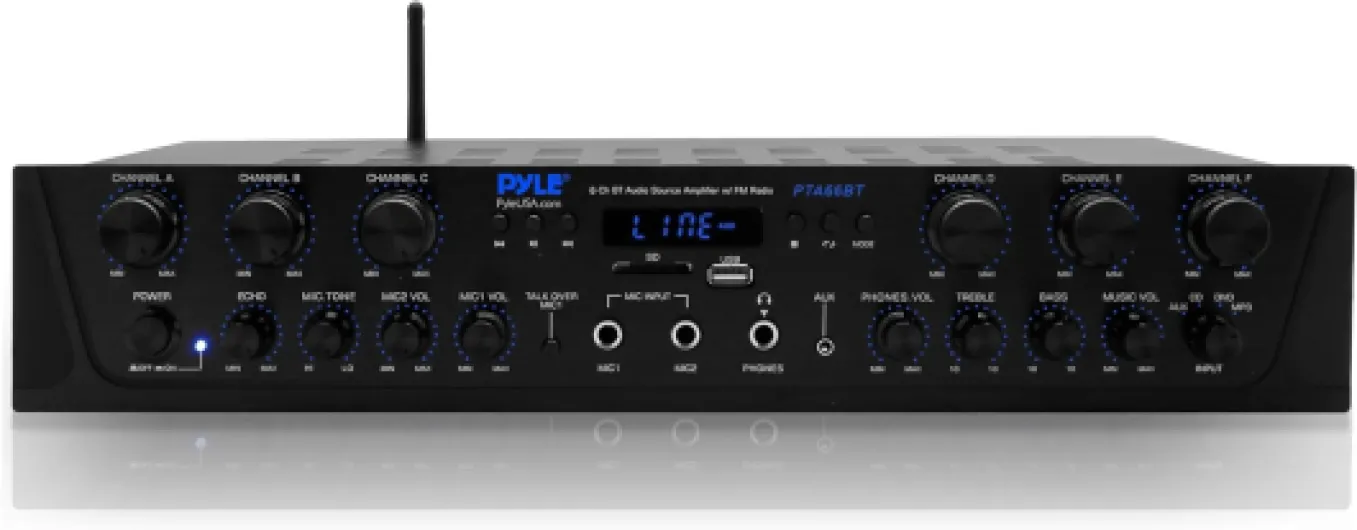
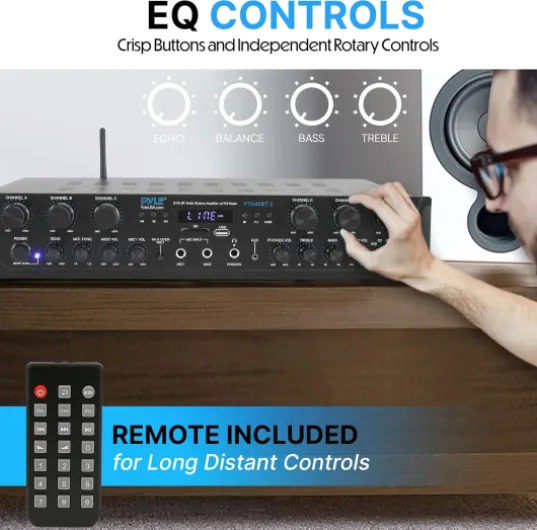
Design-wise, the PTA66BT looks like an older style PA amp. Big rectangular black box, front panel full of knobs and small buttons, and a basic blue LCD display for the FM/MP3 functions. It’s not pretty, but it’s clear enough if you’re standing in front of it. Each of the six channels has its own volume knob, which is honestly the best part of the design: you can dial in each room or zone once and mostly leave it alone.
One thing that might catch people off guard is the lack of a traditional big master volume knob that controls everything including external inputs the way a normal receiver would. There is a “master volume” control, but combined with per-channel knobs it doesn’t behave like a simple one-knob solution, especially when you’re mixing mic and music. If you’re the type who wants one big knob or a remote to handle all volume adjustments, this layout will feel clunky. For a fixed install where you set-and-forget volumes, it’s fine.
The remote design is pretty weak. It basically only talks to the built-in MP3/FM section (USB/SD/BT). You can’t use it to adjust the volume of your AUX/RCA inputs or turn the main amp on/off. Mine felt like a cheap TV remote from the 90s: buttons are small, and responsiveness is hit or miss. If you were planning to control everything from across the room, you’re going to be disappointed. This is more of a “walk up to the amp and twist knobs” type of product.
Another design detail that matters: it’s mono across all six channels. The unit happily accepts stereo inputs (left and right RCA), but it sums them into a single mono signal that goes to all speakers. For my use (even coverage of music in multiple rooms), that’s actually ideal. For someone who wants a stereo soundstage in a living room, it’s completely the wrong design. The product page isn’t super clear about that, so it’s worth stressing: think of this as a PA / distributed audio amp, not a classic stereo receiver.
Build and durability: feels like budget gear, but holds up so far
The amp is not a tank, but it’s not flimsy either. The chassis is metal, the front panel knobs are basic plastic, and the overall feel lines up with the price. It’s a bit over 12 pounds, so there’s some weight to it, which usually means a halfway decent transformer and not just empty air inside. I wouldn’t toss it around in a road case or use it for touring, but for a fixed install on a shelf or rack, it’s fine.
In my use, I left it on for long stretches, sometimes 6–8 hours straight, running multiple zones at moderate volume. It got warm but not scary hot. The unit has short circuit and over-voltage protection, which is reassuring if you’re wiring a bunch of speakers and maybe not 100% confident in your cable runs. I did a few quick disconnect/reconnect tests on the speaker lines while music was playing, and it didn’t freak out or shut down permanently. It behaved like a typical budget PA amp.
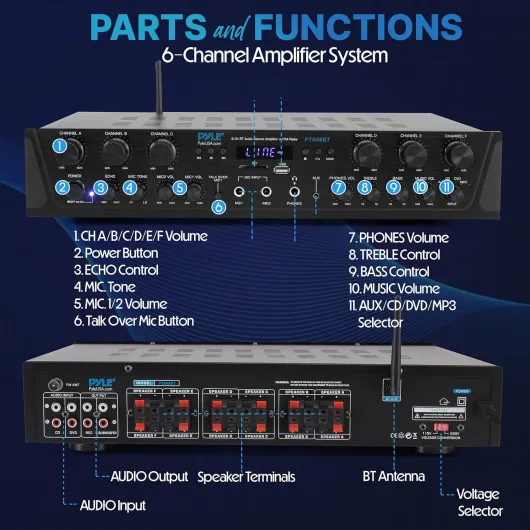
One real-world annoyance is the push-type speaker terminals. If you’re running thicker gauge wire (like 14 or 12 AWG) from a whole-house bundle, you might struggle to fit it in. I had to strip back my heavier cables and splice on thinner wire to make it work cleanly. Once in, the connections held, but I wouldn’t call the terminals robust. This is more of a “set it up once and don’t touch it often” situation; I wouldn’t be constantly plugging and unplugging.
Long-term reliability is hard to judge without years of use, but with the amount of user reviews out there and my own few weeks of constant use, I’d say it’s acceptable for the price. It doesn’t feel like pro touring gear, but for a home, office, salon, or barn where it sits on a shelf and just plays music most of the day, I don’t see an obvious weak point besides the cheap remote and plastic knobs. Just don’t expect it to survive abuse or very dusty, humid environments without issues over time.
Performance: loud enough, decent sound, but not hi-fi
On the power side, Pyle advertises 600W peak, which in real life usually means a lot less continuous power. I ran six pairs of fairly efficient in-ceiling and wall speakers (4–8 ohms) and it handled background to moderately loud music just fine. In a roughly 1,000–1,200 sq ft space, it filled everything with sound without me needing to push it to the edge. If you’re not trying to throw a nightclub-level party, it’s more than enough.
Sound quality is decent but nothing more. It’s not harsh or painful, but it’s also not what I’d call detailed or hi-fi. For spoken word, radio, and background Spotify playlists, it’s perfectly okay. I nudged the bass and treble a bit to taste and left it there. One thing I noticed: at very low volumes on some zones, you can hear a bit of hiss if you put your ear close to the speaker, which is normal for cheaper amps. At normal listening levels, it’s not something you really notice.
Bluetooth streaming is stable if you stay within range. I had my phone on me while walking around the shop and upstairs, and it held up as long as I stayed within about 30 feet and didn’t put too many walls in between. There’s a tiny delay like with most Bluetooth, so I wouldn’t use it for watching TV or anything that needs lip sync, but for music it’s fine. Switching sources is quick, but the feedback from the display is basic, so you need a day or two to get used to what each mode code means.
The mic and talkover performance is actually pretty handy. Plug in a dynamic mic, hit the talkover button, and when you speak, the music ducks down so your voice sits on top. It’s not super polished, and the echo control can make it sound cheesy if you overdo it, but for quick announcements in a shop, studio, or salon, it works. If you want crisp, crystal-clean vocal quality for professional events, you’ll probably want a better mixer and amp combo, but for casual PA use, this holds up well.
What this amp actually is (and what it isn’t)
On paper, the PTA66BT is a 6-channel, 600W (peak) home audio amplifier with Bluetooth, FM radio, USB/SD playback, two mic inputs, and a talkover feature. In reality, the big thing to understand is that it’s a multi-zone mono distribution amp, mainly aimed at commercial or background music use. Each of the six speaker outputs gets the same signal, and you adjust the level per channel with its own little volume knob.
The front panel looks busy but logical once you stare at it for a minute. You get knobs for bass, treble, master volume, echo, mic volume, mic tone, plus volume controls for each of the six channels. There’s also an input selector you really need to understand: some people get confused and think the amp is broken because they don’t set it to the right mode (for example, setting it to “MP3” to use Bluetooth/USB/SD). Once you figure that out, switching between sources is pretty straightforward, even if the labeling feels a bit old-school.
In practice, I mostly used three inputs: Bluetooth, FM, and one RCA input fed by a small mixer. Bluetooth range is roughly what they claim: I could walk around about 30–40 feet away, through a couple of interior walls, before it started cutting out. FM tuning is basic but it auto-scans and saves stations, which is fine for background radio. The USB/SD playback is very bare-bones: it plays MP3s and WMA, no fancy navigation, and it doesn’t like big modern USB 3.0 drives. Stick to a simple USB 2.0 thumb drive and it’s okay.
If you’re trying to decide if this fits your use: it’s great for salons, restaurants, barns, workshops, offices, or whole-home background music. It’s not really suited for TV or home theater, because the remote barely controls anything beyond the built-in MP3/FM section, and there’s no global volume from the remote for external inputs. That limitation is a dealbreaker if you want couch control.
How well it actually does the multi-room / PA job
As a multi-room background music amp, this thing does what it’s supposed to do. The six channels with independent volume knobs are the real selling point. I set different levels for the workshop (louder), office (medium), and hallway (lower), and then basically forgot about them. Once dialed in, you just pick your source (Bluetooth, FM, USB) and let it run. For that purpose, it’s much simpler than running multiple separate amps or a more complex matrix system.
The mono output is actually a benefit in this context. In a lot of commercial or whole-home setups, stereo doesn’t make much sense because you’re not sitting in a sweet spot between two speakers. You’re walking around, and you just want even coverage. By summing everything to mono, every speaker gets the full mix, so you don’t end up with weird left/right only instruments in certain rooms. If you’re okay sacrificing stereo, this design works well.
Where it falls short in effectiveness is when people try to use it as a living-room or TV amp. One big complaint I agree with: the remote basically doesn’t do anything useful for AUX/RCA inputs. It doesn’t control overall volume, and it doesn’t even turn the amp fully off; it just affects the internal MP3/FM section. That makes it awkward if your main source is a TV, PC, or external streamer and you expect to sit on the couch with a remote. You end up having to walk over to the amp to adjust volume, and even then you’re juggling master and channel knobs.
For announcements and light PA, it’s effective enough. The talkover function mutes or ducks the music when you speak into Mic 1, which is great in a store or gym when you need to say something quickly. For karaoke or parties, you can plug in two mics and get some fun out of it, though the sound and echo controls are basic. So in short: for distributed audio and simple PA, it works well; for home theater-style use, it’s a bad fit and feels clumsy.
Pros
- Six speaker channels with independent volume, ideal for multi-room/background music
- Built-in Bluetooth, FM radio, and USB/SD playback make it usable without extra gear
- Good power for small to medium spaces and decent sound for the price
Cons
- Mono output across all channels despite “stereo” marketing, not suitable for home theater
- Remote only controls the internal MP3/FM section, no real global volume or power control
- Push-type speaker terminals and overall build feel budget and a bit dated
Conclusion
Editor's rating
If you treat the Pyle PTA66BT as a budget 6-zone mono distribution amp for background music and light PA, it actually does a solid job. It drives multiple pairs of speakers, lets you set different volumes per area, and gives you Bluetooth, FM, and USB/SD playback in one box. Sound quality is perfectly okay for shops, salons, barns, and whole-home background listening. The mic inputs and talkover function are practical for announcements, and the unit seems comfortable running for hours without overheating.
Where it disappoints is when people buy it expecting a typical home stereo or TV receiver. Everything being mono, the weak and limited remote, and the lack of true global remote volume control make it frustrating in that role. If you want couch-friendly control, proper stereo imaging, and modern features, you should look at a standard AV receiver or a better integrated amp. This Pyle is more of a utility tool than a living-room centerpiece.
So, I’d recommend it to anyone who wants an inexpensive way to power multiple zones for background music—home, office, small business, or workshop. I’d skip it completely if your main goal is TV sound, serious music listening in stereo, or if you’re picky about remote control and user experience. Go in with the right expectations, and it’s a decent workhorse; expect a modern hi-fi receiver, and you’ll be annoyed.