
Summary
Editor's rating
Is it good value or false economy?
Bulky, very blue, and a bit old‑school
Build quality and long‑term confidence
Power, sound quality, and Bluetooth in real life
What this thing actually is (and isn’t)
Does it actually do the job day to day?
Pros
- Plenty of power for home and small party use; drives multiple speakers without strain
- Huge number of inputs (HDMI, optical, coaxial, USB, AUX, mic, FM) for the price
- Dual 10‑band EQ and separate controls give lots of flexibility to tune the sound
Cons
- Clunky interface and cheap remote; not beginner-friendly to set up or operate
- Surround performance and Bluetooth are basic; feels more like multi-channel stereo than real home theater
- Build and long-term reliability feel weaker than big-brand AV receivers

Specifications
View full product page →| Brand | Pyle |
A budget 6‑channel amp that promises a lot
I’ve been using the Pyle PT6060CHAE as the main amp in a small living-room setup plus some patio speakers. I picked it up because I wanted something cheap that could handle multiple speakers, Bluetooth, and basic home theater without getting into big-name receiver prices. On paper, this thing looks loaded: 6 channels, 2000W peak (we’ll talk about that…), dual 10‑band EQ, Bluetooth, USB, HDMI, optical, coaxial, radio, the whole kitchen sink.
In practice, it’s a very “Pyle” product: lots of features, a bit rough around the edges, and you need to be ready to tinker a bit. If you’re used to Yamaha / Denon / Onkyo style receivers, this will feel more like a pro‑audio amp that someone tried to turn into a home theater box. The menus and labeling are not super clear, the manual is thin, and you’ll probably press the wrong button a few times at the beginning.
I tested it with a mix of gear: a pair of older floorstanding speakers, two small bookshelf surrounds, and a passive sub. Sources were a TV via optical, a laptop via Bluetooth and HDMI, and a USB stick with MP3 files. Volume-wise, it has no problem filling a normal room and even an outdoor area. The question is more: how clean is the sound and how annoying are the little flaws day to day?
Overall, my first impression after a couple of weeks was: good power and decent sound for the price, but definitely not a polished AV receiver experience. If you’re picky about interface and true surround processing, you’ll be frustrated. If you mainly want loud, flexible, and cheap, it starts to make sense.
Is it good value or false economy?
Price is where the PT6060CHAE starts to make sense. You’re getting a ton of features for relatively little money: 6 channels, Bluetooth, USB, FM, HDMI, optical, coaxial, multiple mic inputs, and a dual 10‑band EQ. If you tried to match that input flexibility and power with a big-brand AV receiver plus a separate EQ, you’d easily spend several times more. For someone building a budget home setup, a garage system, or a poolside sound system, it’s hard to find this many options in one box at this price.
But there’s a trade-off: you’re paying less upfront and more in patience. You deal with a clunky interface, a cheap remote, and some quirks in how surround and Bluetooth work. If you just need loud, flexible, and cheap, it’s pretty solid value. One Amazon reviewer using it for a pool sound system was very happy—that use case makes sense: set it up once, crank it when you have people over, and you don’t care about fancy on-screen menus.
Compared to a used or entry-level Yamaha/Denon receiver, the Pyle gives you more raw channels and EQ control but worse usability and likely worse long-term support. If you mainly care about home theater quality and ease of use, a basic name-brand receiver is a better value in the long run. If you need something that can double as a party amp, karaoke box, and general audio hub, the Pyle gives you that flexibility on the cheap.
So in my opinion, value is good if your expectations are realistic. It’s not a bargain if you expect it to behave like a polished AV receiver. It is a bargain if you’re okay with rough edges and you just want a loud, feature-heavy amp without spending a lot.
Bulky, very blue, and a bit old‑school
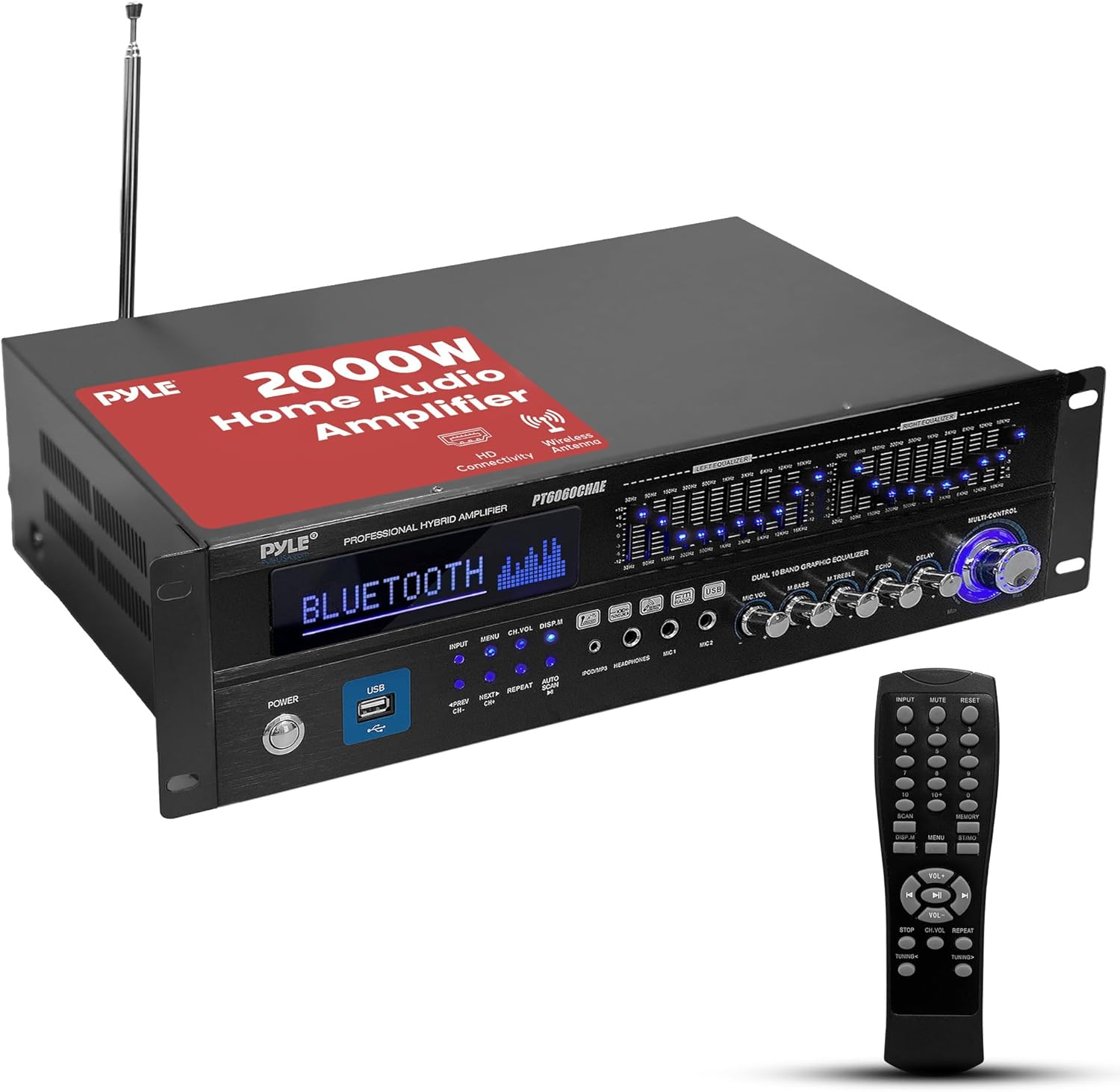
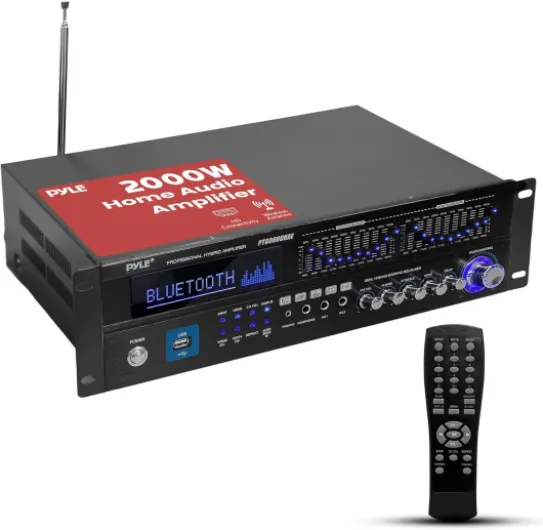
Physically, the PT6060CHAE is a chunky black box with rack ears. It’s clearly inspired by pro audio rack amps more than slick living-room receivers. It’s not small: about 17 inches wide and almost 19 pounds, so you need a decent shelf or rack. It does come with handles and a built‑in cooling fan, which is nice if you’re putting it in a rack or a cabinet. The fan on my unit is audible in a quiet room but not crazy loud; once music or a movie is playing, I don’t really notice it.
The front panel is busy. You’ve got the VFD display, a bunch of buttons for input selection and playback, and two big 10‑band EQ sections with bright blue LEDs. Those EQ lights look cool at first, especially if you like that 90s/early‑2000s vibe, but they are really bright in a dark room. There’s no dimmer or way to turn them off, which one of the Amazon reviewers mentioned, and I agree: at night, it’s a bit much. For a home theater setup, I’d prefer something less flashy.
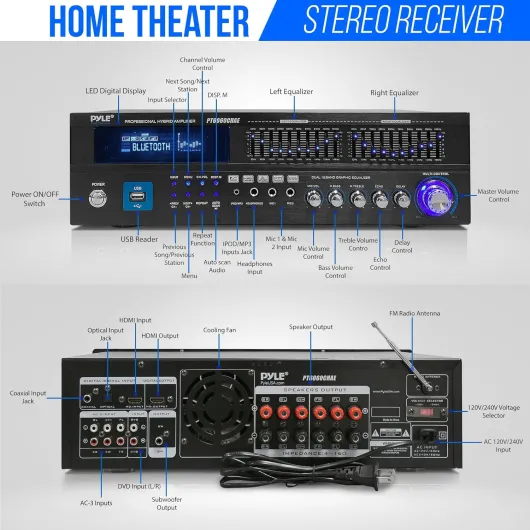
Control-wise, there’s a main volume knob and separate controls for mic volume, echo, treble, bass, and master. It’s handy if you’re doing karaoke or tweaking music, but it also makes the front look cluttered. Labels are small and not super intuitive. The screen itself is basic and, on some units, people report it going dark or being hard to read. Mine is visible but not pretty. It feels like an older car stereo display rather than a modern receiver OSD.
The remote is probably the weakest part of the design. It feels cheap, light plastic, tons of small buttons, and not all of them are clearly marked. Also, you can’t power the unit on from the remote, only off, which is just annoying in 2026. I ended up mostly using the front panel for major changes and the remote for volume and input once I memorized what was what. Overall, the design is functional but rough, more “DJ rack gear” than “living-room friendly.”
Build quality and long‑term confidence
Build-wise, the PT6060CHAE feels like most budget Pyle gear I’ve handled: heavy metal chassis, but cheap-feeling details. The main case is solid enough, and the rack ears and handles are useful if you’re installing it in a rack or moving it around. The weight gives some confidence that there’s a real transformer and not just air inside. The cooling fan and ventilation should help with longevity as long as you don’t stuff it into a sealed cabinet.
Where it feels cheaper is in the knobs, buttons, and remote. The front knobs have a bit of play, the buttons have that “budget electronics” click, and the remote feels like it came from a $20 DVD player. I wouldn’t be shocked if the remote gave up after a year or two of heavy use. The VFD display also seems to be a weak point for some users—there are reviews mentioning blank or very dim screens. Mine is fine so far, but it doesn’t give me the same confidence as a big-brand receiver display.
I can’t say I’ve stress-tested it for years, but after some longer listening sessions at moderate‑high volume, the amp got warm but not scalding, and the fan kicked in as expected. No shutdowns or obvious thermal issues. For a cheap amp being pushed into party duty, that’s decent. Still, given some of the negative Pyle feedback in general and the one-star review about other Pyle models acting up, I’d say: don’t expect lifetime reliability. Treat it as a budget workhorse you might replace in a few years rather than a 10‑year investment.
If you plan to use it in a fixed install (like a bar, church, or outdoor area), I’d keep dust away, give it plenty of air, and maybe run it a bit below its limits. At this price, I’d also keep the box and receipt handy. It’s not fragile like a toy, but it doesn’t have the same long-term, “set and forget for a decade” feel as something from Denon, Yamaha, or Onkyo.
Power, sound quality, and Bluetooth in real life
Let’s talk about how it actually sounds. With a pair of decent floorstanders and a basic passive sub, the PT6060CHAE delivers strong volume and acceptable clarity for the price. For music in stereo, it does fine: punchy enough, mids are clear enough, highs can get a bit harsh if you push the treble or crank the volume, but you can tame that with the dual 10‑band EQ. Once I spent 15–20 minutes dialing in the EQ for my room, I got a sound that I was pretty happy with for background listening and parties.
For movies, it’s more mixed. It will drive a 5.1 set, but don’t expect modern surround processing magic. Compared to my older Yamaha receiver, the surround field feels flatter and less precise. It’s more like “five speakers playing loud” rather than a precise bubble of sound. One Amazon reviewer complained about Bluetooth only sending audio to one main speaker on another Pyle model; I didn’t hit that exact issue here, but I will say Bluetooth on this unit is clearly stereo only, not real 5.1. So if you’re hoping for full surround from Bluetooth, forget it. Use HDMI or optical from your TV or media box instead.
Bluetooth itself is easy enough to pair. The unit shows up as “Pyle Speaker” and once paired, reconnection is quick. Range is fine in a normal house; I could walk around 30–40 feet away with a phone in my pocket and it stayed stable. Sound over Bluetooth is okay for streaming Spotify or YouTube, nothing special, but no obvious lag for video on my setup. Just don’t expect audiophile quality; it’s a budget Bluetooth implementation.
Radio and USB playback work, but they feel like bonus features, not main selling points. FM radio reception depends a lot on your antenna placement; I got a few local stations cleanly, others were noisy. USB playback is basic: drop MP3/WAV files on a stick, plug in, and it plays. Navigation is clunky with the remote; no fancy folder browsing. Overall, performance is solid if your expectations match the price: plenty of power, decent sound, but not a true competitor to mid-range AV receivers when it comes to surround and refinement.
What this thing actually is (and isn’t)
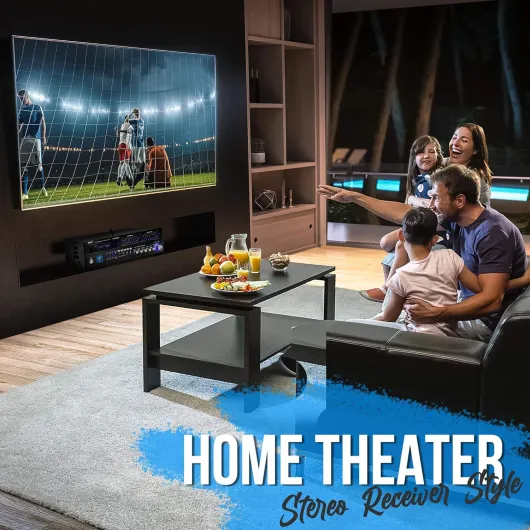
On the box and product page, the PT6060CHAE is sold as a “6‑channel 2000W home theater amplifier.” That sounds like a full 5.1 surround receiver. In reality, it’s more like a multi-channel stereo amp with lots of inputs and basic 5.1 routing. There’s no fancy room correction, no advanced decoding like you’d find on a modern mid-range AV receiver. It will take AC‑3 and basic digital inputs, but don’t expect the same surround experience as a proper Denon or Yamaha.
The headline “2000W” is also a bit of a joke. That’s clearly peak or marketing wattage. In real life, think more like a couple of hundred usable watts spread across the channels. Still, for home use, that’s plenty. I never got close to maxing it out before my speakers or my ears said “enough.” If you’re buying it just for raw power on a budget, you’ll probably be satisfied as long as your speakers are 4–8 ohms and reasonably efficient.
Where it gets interesting is the input options. You get: HDMI, optical, coaxial, DVD/AC‑3 style multi-channel input, USB, 3.5mm AUX, FM radio, two mic inputs for karaoke, and Bluetooth 5.0. For a cheap amp, that’s a lot. I was able to hook up: TV, PC, a DVD player, and still have room for a phone over Bluetooth and a USB stick. For a party or a basic home entertainment setup, it’s actually quite handy.
But there are trade-offs. The interface and documentation are bare-bones. The manual doesn’t really walk you through troubleshooting or more complex setups. Some inputs feel dated (DVD / AC‑3) while something simple like extra analog inputs is limited. If you’re the kind of person who just wants to plug HDMI from the TV and be done, you’ll have to be patient, because getting everything mapped the way you want is a bit of a trial-and-error job.
Does it actually do the job day to day?
As a daily driver, the PT6060CHAE is kind of a mixed bag. On the one hand, it gets the basic job done: it powers multiple speakers, you can switch between TV, Bluetooth, USB, and radio, and it will play loud enough for home use and backyard gatherings. Once you set it up and figure out which input is which, it’s fairly predictable. For my use—TV sound plus music on the patio—it works.
On the other hand, this is not a plug‑and‑play, idiot-proof receiver. A lot of things feel half-baked. The manual barely helps with troubleshooting. One Amazon reviewer mentioned a blank screen and having to guess their way into Bluetooth; I didn’t get a dead screen, but I totally see how a beginner would be lost. Input names are not always clear, and the front panel doesn’t guide you much. If you’re not used to audio gear, you might spend a while pressing buttons and wondering why there’s no sound until you hit the right combination.
The EQ and tone controls are powerful but also easy to mess up. With two 10‑band EQs plus bass/treble knobs, you can overdo it and end up with boomy or harsh sound. It’s useful if you like to tweak, but if you just want “set and forget,” it’s a bit much. I ended up saving a photo of my preferred settings on my phone, just in case someone else in the house started turning sliders for fun.
For karaoke or events, the two mic inputs and echo control are actually handy. It’s not pro‑studio quality, but for casual singing nights, it works fine. No noticeable delay on the mics, and enough control to avoid crazy feedback if you’re careful with levels. So in terms of effectiveness: good for multi-purpose, budget setups and casual use, but if you want something your parents or non-techy partner can operate without calls for help, this is not ideal.
Pros
- Plenty of power for home and small party use; drives multiple speakers without strain
- Huge number of inputs (HDMI, optical, coaxial, USB, AUX, mic, FM) for the price
- Dual 10‑band EQ and separate controls give lots of flexibility to tune the sound
Cons
- Clunky interface and cheap remote; not beginner-friendly to set up or operate
- Surround performance and Bluetooth are basic; feels more like multi-channel stereo than real home theater
- Build and long-term reliability feel weaker than big-brand AV receivers
Conclusion
Editor's rating
The Pyle PT6060CHAE is a classic budget workhorse: lots of power on tap, tons of inputs, and a pretty chaotic user experience. Sound quality is decent for the money, especially in stereo once you dial in the dual 10‑band EQ. It can easily drive multiple speakers for a living room, garage, or backyard, and features like Bluetooth, FM radio, USB playback, and mic inputs make it quite versatile. If you’re building a low-cost party or karaoke setup, or you just want a loud amp for casual TV and music, it does the job.
Where it falls short is polish and true home theater performance. The interface is clunky, the display and remote feel cheap, and the surround experience is basic compared to even entry-level big-brand receivers. Bluetooth is strictly stereo, not real 5.1, and some of the input options feel dated or confusing. Durability seems acceptable but not confidence-inspiring; I’d treat it as a budget unit you might replace in a few years, not a long-term anchor for a high-end system.
I’d recommend this to people who prioritize volume, flexibility, and low price over refinement: DJs on a budget, small venues, pool or patio systems, or someone who likes to tinker and doesn’t mind reading tiny labels and pressing a lot of buttons. If you’re picky about clean interfaces, reliable HDMI behavior, and proper surround sound, or if you just want something simple for your family to use, I’d skip this and save up for a basic Denon/Yamaha instead.