
Summary
Editor's rating
Is the PV3700 good value or false economy?
Big, flashy, and not exactly subtle
Build quality and reliability after real use
Real-world power, heat, and noise: how it actually behaves
What this amp really is (once you ignore the 3700W marketing)
Does it actually improve your system, or just light up?
Pros
- Affordable 5‑channel amp that can run speakers and sub from one unit
- Plenty of usable power for normal daily systems if wired and tuned correctly
- Includes crossovers, bass boost, and remote bass knob for easy tuning
Cons
- Heavily inflated wattage claims; real output is much lower than 3700W label
- Large size makes mounting tricky in smaller vehicles
- Sound quality and build are decent but behind more expensive brands

Specifications
View full product page →| Brand | BOSS Audio Systems |
A big, cheap 5‑channel amp that looks better than its spec sheet
I’ve been running the BOSS PV3700 in a daily driver as a full system amp: four door speakers plus a single 12" sub. I went for it mainly because I wanted one amp to do everything without spending big money on brands like Kicker or Rockford. On paper it says 3700 watts, which sounds crazy for the price, but if you’ve bought budget car audio before you already know those numbers are more marketing than reality.
In practice, the amp has plenty of power for a normal setup. I’m not chasing competition-level SPL, just something that hits hard enough and stays clean at normal to slightly stupid volume. On that front, it does the job. It’s not dead silent or audiophile-grade, but it’s way better than a factory system and honestly better than I expected for what I paid.
The install reminded me this thing is not small. It’s long, fairly heavy, and with the wiring on both sides it needs real space. I tried to tuck it under a seat first and gave up; it ended up on the back of the rear seat. If you drive a compact car, you’ll want to double-check the dimensions and plan the location before you buy.
Overall first impression: it’s a budget workhorse with honest limitations. If you believe the 3700W label, you’ll be disappointed. If you just want an affordable 5‑channel that can run speakers and a sub without frying itself, it starts to look like a pretty solid deal.
Is the PV3700 good value or false economy?
From a pure value for money angle, the PV3700 makes sense if you need a 5‑channel on a budget. You’re getting one amp that can run your whole system—four speakers and a sub—for about what some brands charge for just a decent mono block. If you’re putting together a system on limited cash, being able to skip buying two or three separate amps is a big plus.
That said, part of the “value” comes from BOSS inflating the watt numbers. If you buy it thinking it’s a real 3700W monster, you’re going to feel ripped off. If you buy it as roughly a 900–1000W budget amp with decent features, it starts to feel fair. Compared to something like Kicker or Rockford Fosgate, you save a lot of money, but you also give up some sound quality, real power, and long-term confidence.
One thing people forget to factor in is installation cost and hardware. I spent almost as much on decent power wire, RCAs, fuses, and connectors as on the amp itself. That’s worth mentioning because if you blow a cheap amp by pushing it too hard, you still have to redo all that work for the next one. In that sense, sometimes it’s better to spend a bit more upfront. But if you’re realistic about your expectations and you don’t abuse it, this BOSS can be a cheap way to get a full system running.
Overall, I’d call the value pretty solid for casual users: great if you just want loud, adjustable sound without caring too much about perfect specs. If you’re picky about audio or planning a big build, I’d say it’s better to treat this as an entry-level option and budget for an upgrade later.
Big, flashy, and not exactly subtle
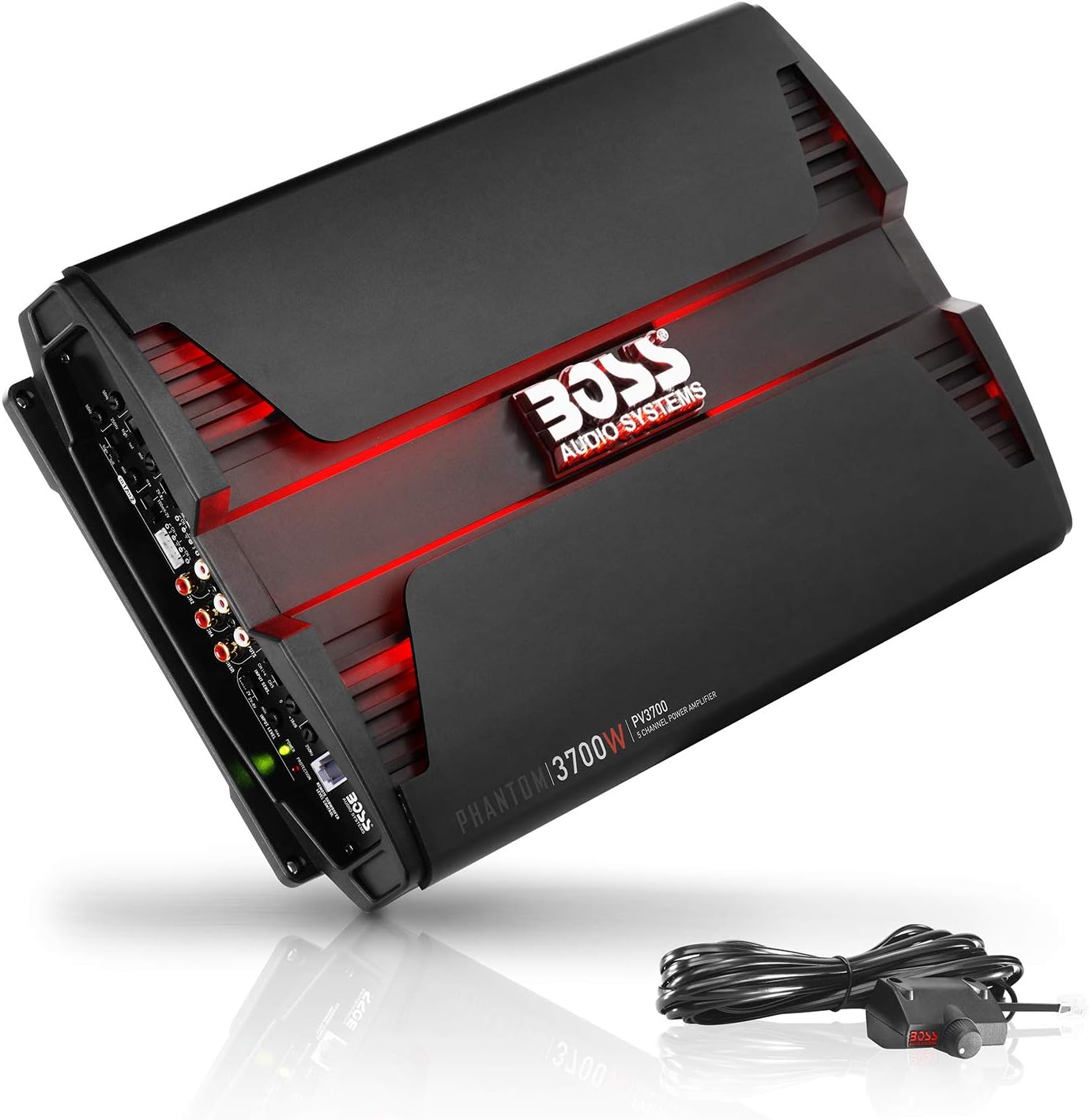
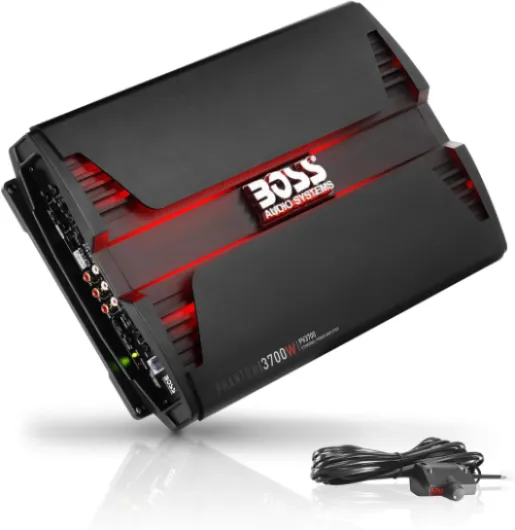
Design-wise, the PV3700 is very “BOSS.” It’s got that black chassis with the Phantom logo and red LED lighting when it’s on. At night, it does look cool if the amp is visible. In my SUV, it sits on the back of the rear seat, and the red glow is noticeable but not blinding. If you’re into the show-car look, you’ll probably like it. If you prefer stealth installs, the lighting is more of a gimmick than a plus, though you can always mount it out of sight.
The main thing you notice when you unbox it is the size. It’s about 17" long, 10" wide, and a bit over 2" tall. Once you add the wiring sticking out, it eats up a chunk of space. In a Tahoe or similar, it’s fine. In a compact sedan or hatchback, you’ll be doing some measuring and maybe compromising on placement. I originally tried under the front passenger seat; it technically fit, but there was no breathing room and the wiring was a pain, so I moved it.
Control layout is decent. The gain, crossover, and bass boost knobs are clearly labeled, but they’re small and you’ll want a flashlight and patience to set them properly. Speaker and power terminals are the usual screw-down style. They’re not high-end, but they grip well enough if you use the right gauge wire and actually tighten them properly. I ran 8-gauge power and ground without any drama.
Overall, the design is more about looks and size than finesse. It’s not compact, it’s not discreet, but it feels like a solid chunk of gear and the lighting gives it a bit of personality. Just be ready to plan your mounting spot and cable routing instead of assuming you can just “drop it in” anywhere.
Build quality and reliability after real use
Build-wise, the PV3700 feels decent in the hand: metal chassis, decent weight, nothing rattling inside. It doesn’t feel like a toy. That said, you can tell it’s not a premium piece either. The terminals and knobs are fine but not fancy, and the overall finish is more functional than refined. For the price, I wasn’t expecting tank-like construction, just something that doesn’t fall apart, and so far it’s holding up.
I’ve run it for several months in a daily driver through hot days and some cold mornings, and I haven’t had shutdowns or random clipping that wasn’t related to me pushing it too hard. As long as it has airflow and you don’t mount it in a dumb spot (like jammed in with zero space), it seems happy. The red LEDs still work, and none of the channels have gone noisy or cut out.
A lot of the horror stories you see in reviews with budget amps come down to bad installs: weak grounds, undersized power wire, gains cranked, speakers wired to crazy low ohms, etc. I’m not saying the amp is bulletproof, but if you follow basic install rules—proper gauge wire, solid ground point, fuses, and sane gain settings—it seems reasonably reliable. BOSS offers a 6‑year online warranty if you buy from the right seller, which is nice on paper, but personally I just assume with cheap amps that if it survives the first few months, it’s probably fine.
So, durability feels decent but not legendary. I wouldn’t use it in an off-road rig that gets hammered every weekend, but for a street car that sees normal use, it seems to hold up. If you want something that will likely outlast the car, you’d look at bigger brands and pay more. This one sits in that “good enough if you treat it right” zone.
Real-world power, heat, and noise: how it actually behaves
Once you get past the fantasy watt numbers, performance is pretty solid for a budget 5‑channel. I ran it with four 6.5" speakers and a single 12" sub. At normal driving volume (say 50–70% of what my head unit can do), the amp stays cool and the sound is clean enough. Vocals are clear, highs aren’t harsh unless you crank the gains too high, and the sub channel has enough punch for everyday use, especially if you wire the sub at 2 ohms.
When you push it harder for longer—windows down, volume up on a highway drive—it does warm up, but in my case it never got so hot I was worried. It was warm to the touch, not scorching. I mounted it where it has some air around it, which helps. If you cram this under a seat with no airflow and then beat on it, I wouldn’t be surprised if it gets pretty toasty.
Noise-wise, I did run into some engine whine the first time around. That turned out to be my own fault: I ran the RCA cables on the same side as the power wire. Once I rerouted the RCAs to the opposite side of the car, the alternator noise pretty much vanished. With the gains set correctly and decent grounding, the background hiss is there if you put your ear to the speakers in a silent garage, but while driving you don’t notice it.
Power to the sub channel is where the limits of the amp show. It’s fine for a single 12" or a pair of modest subs, especially at 2 ohms, but if you’re expecting it to slam two big 15" subs like a high-end mono block, you’ll be disappointed. For a normal daily system, though—front/back speakers and a decent sub—it gets loud enough that you’ll probably back it down before the amp runs out of steam. That’s good enough for me at this price.
What this amp really is (once you ignore the 3700W marketing)
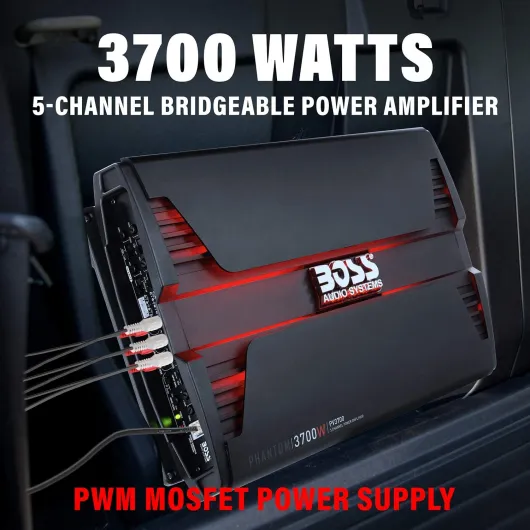
On the box and in the description, BOSS pushes the "3700 watt" angle and all the buzzwords: MOSFET power supply, 5 channels, bridgeable, full range, 2/4 ohm stable, etc. Once you actually look at the hardware, the real story is different. It has two 40A fuses, so 80A total. Do the basic math at 12V and you’re nowhere near 3700W of real output. You’re more in the ballpark of roughly 900–1000W usable power, which lines up with what people have measured and what you feel in a car.
So what is it actually good for? It’s a single amp that can power:
- 4 door speakers (front and rear) on channels 1–4
- 1 or 2 subs on the 5th channel, ideally wired to 2 ohms if you want them to really move
- Or you can bridge channels for more power to fewer speakers if you want to get fancy
You get both high-level (speaker) and low-level (RCA) inputs, which is handy. I tried it with an aftermarket head unit on RCA and also briefly with the stock speaker-level outputs in another car. Both worked, but RCAs obviously sounded cleaner and gave better control over gains. The built-in crossovers and bass boost are basic but usable once you spend a bit of time dialing them in.
From a features point of view, it’s pretty loaded for the price: 5 channels, adjustable high/low pass, bass boost, remote bass knob, bridgeable options, and it’s 2-ohm stable. The catch is simply that you can’t take the wattage numbers seriously. If you walk into it thinking “roughly 150–200W RMS to the sub and decent power to the doors,” it lines up much better with reality and you’ll probably be happier.

Does it actually improve your system, or just light up?
In terms of doing what I bought it for—making a stock-ish system louder and cleaner—it delivers. In my Mazda with factory speakers and head unit, swapping in this amp immediately gave more headroom. At the same volume setting on the radio, everything sounded fuller and more controlled. Bass had more weight, and the mids didn’t fall apart when I turned it up. It’s not magic; bad speakers will still be bad, but it lets halfway decent speakers show what they can do.
The built-in crossovers and bass boost are simple but useful. I set a high-pass on the door speakers to keep the deep bass away from them and let the sub channel handle the low end. That alone cleaned things up a lot. The variable bass boost is easy to overdo, though. If you just crank it because “more bass is better,” you’ll end up with boomy, muddy low end and probably stress the sub. With a bit of patience, you can dial it in so the sub hits hard without drowning everything else.
Where it’s less effective is if you’re chasing super clean, audiophile-level sound. There’s a limit to how refined a budget class A/B amp like this can be. At higher volume, you can tell it’s not as tight or controlled as better (and more expensive) brands. Also, BOSS seriously oversells the total watts, so if you design your whole system around those fake numbers, you’ll end up disappointed or wiring things wrong.
For a normal user who just wants more volume, more bass, and better control over their speakers, it does the job well enough. For someone who obsesses over THD graphs and super precise tuning, I’d say skip it and save up for something nicer. It’s effective as a big upgrade from stock, less so as a centerpiece for a high-end build.
Pros
- Affordable 5‑channel amp that can run speakers and sub from one unit
- Plenty of usable power for normal daily systems if wired and tuned correctly
- Includes crossovers, bass boost, and remote bass knob for easy tuning
Cons
- Heavily inflated wattage claims; real output is much lower than 3700W label
- Large size makes mounting tricky in smaller vehicles
- Sound quality and build are decent but behind more expensive brands
Conclusion
Editor's rating
The BOSS PV3700 is basically a big, flashy 5‑channel amp for people who want one box to run their whole system without dropping serious money. It has enough real power to wake up stock or mid-range speakers and drive a decent sub, and the built-in crossovers and bass boost give you enough control to tune things to your taste. Ignore the 3700W claim and think of it as an affordable ~1000W-class amp and it makes a lot more sense.
Where it falls short is honesty on specs and ultimate refinement. The watt numbers on the box are fantasy, the sound is good but not high-end, and the size makes installation a bit of a puzzle in smaller cars. Durability seems fine if you install it correctly and don’t abuse it, but I wouldn’t call it bombproof. It’s a budget piece that performs well enough if you treat it like one, not like a premium competition amp.
I’d recommend this to someone who wants a loud, simple, all-in-one solution for a daily driver: basic upgrade from stock, weekend cruiser, first system, that kind of thing. If you’re chasing super clean SQ builds, running expensive speakers, or planning to push multiple big subs hard, you should skip this and look at more serious brands with honest RMS ratings. For the right user with realistic expectations, it’s good value and gets the job done.