
Summary
Editor's rating
Value for money: strong when on sale, less attractive at full MSRP
Big black box with copper – looks nice enough but it’s bulky
Build quality: solid enough, but it’s still MDF and vinyl
Durability and reliability: feels solid, but time will tell
Performance: hits hard for movies, decent for music, room setup matters a lot
What you actually get with the R-120SW
How well it actually improves your setup day-to-day
Pros
- Strong, room-filling bass for movies and gaming, especially compared to smaller 8-inch subs
- Simple setup with standard RCA/LFE input and basic controls that most AV receivers handle easily
- Good output and extension (down to around 29 Hz) for the price, especially when bought on sale
Cons
- Bulky cabinet and rear port require space and careful placement to avoid boomy sound
- Only RCA inputs, no high-level speaker inputs or wireless/app features
- Bass can be more "fun" and boomy than tight and precise, so not ideal for very picky music listeners

Specifications
View full product page →| Brand | Klipsch |
A budget-friendly way to finally feel the bass
I’ve been running a basic 5.1 setup for a while, and my old 8-inch budget sub was clearly the weak link. It made noise, sure, but you didn’t really feel much during movies. I picked up the Klipsch R-120SW because it was on sale, had a 12-inch driver, and a ton of good reviews. I’ve been using it for a few weeks now in a medium-sized living room, mostly for movies and some Spotify listening.
In simple terms: this thing is a noticeable step up from small, cheap subs. It hits harder, digs lower, and fills the room more easily. You don’t have to crank it like crazy to get that couch vibration during action scenes. At the same time, it’s not some magic box that gives you perfect bass no matter what. Placement, settings on your receiver, and your room make a big difference, and you’ll probably need to tweak things a bit.
I ran it with a Denon AVR, some older bookshelf fronts, and a mid-range center channel. Nothing fancy. Setup was straightforward: one RCA cable from the receiver, power cord in, adjust the gain and crossover, run the receiver’s auto-calibration, and that’s it. No apps, no Wi‑Fi, no gimmicks. If you like simple and wired, it’s fine. If you’re looking for wireless features or app control, this isn’t that kind of sub.
Overall, my first impression after a couple of movie nights was positive: the R-120SW brings a lot more impact than entry-level subs, but it’s not perfect. It’s big, a bit boomy if you’re not careful with placement, and there are definitely more precise subs out there if you’re picky about music. But for a home theater upgrade on a reasonable budget, it does the job pretty well.
Value for money: strong when on sale, less attractive at full MSRP
Price-wise, the R-120SW often floats around the mid-range for consumer subs. At full list price, I’d say it’s okay but not unbeatable. There are other brands that offer similar performance in the same bracket. Where it starts to make more sense is when it goes on discount, which happens a lot with Klipsch. At a reduced price, getting a 12-inch, 200W RMS sub with this level of output is pretty good value.
What you’re paying for here is: a big driver, decent power, simple setup, and a known brand. You’re not paying for advanced room correction in the sub, wireless connectivity, app control, or super fancy materials. If those features matter to you, you might feel it’s a bit basic. But if you just want solid bass without extra tech, it’s money better spent on driver size and amp power rather than bells and whistles.
Compared to a lot of cheap no-name 10" subs, this one clearly hits harder and feels more controlled, especially at higher volumes. Compared to more expensive sealed subs from more audiophile-focused brands, it doesn’t have the same tightness or finesse, but those often cost significantly more. So it kind of sits in the middle: not budget junk, not high-end, but a decent middle ground for a typical living room setup.
If you can catch it at a good sale price, I’d say it’s good value for money. At full price, it’s still fine, but I’d at least compare with a couple of competitors like Monoprice, SVS (if you stretch the budget), or other Klipsch models. Bottom line: worth it if you want a noticeable upgrade from a small sub and don’t want to spend a fortune, but it’s not the absolute king of value at any price.
Big black box with copper – looks nice enough but it’s bulky
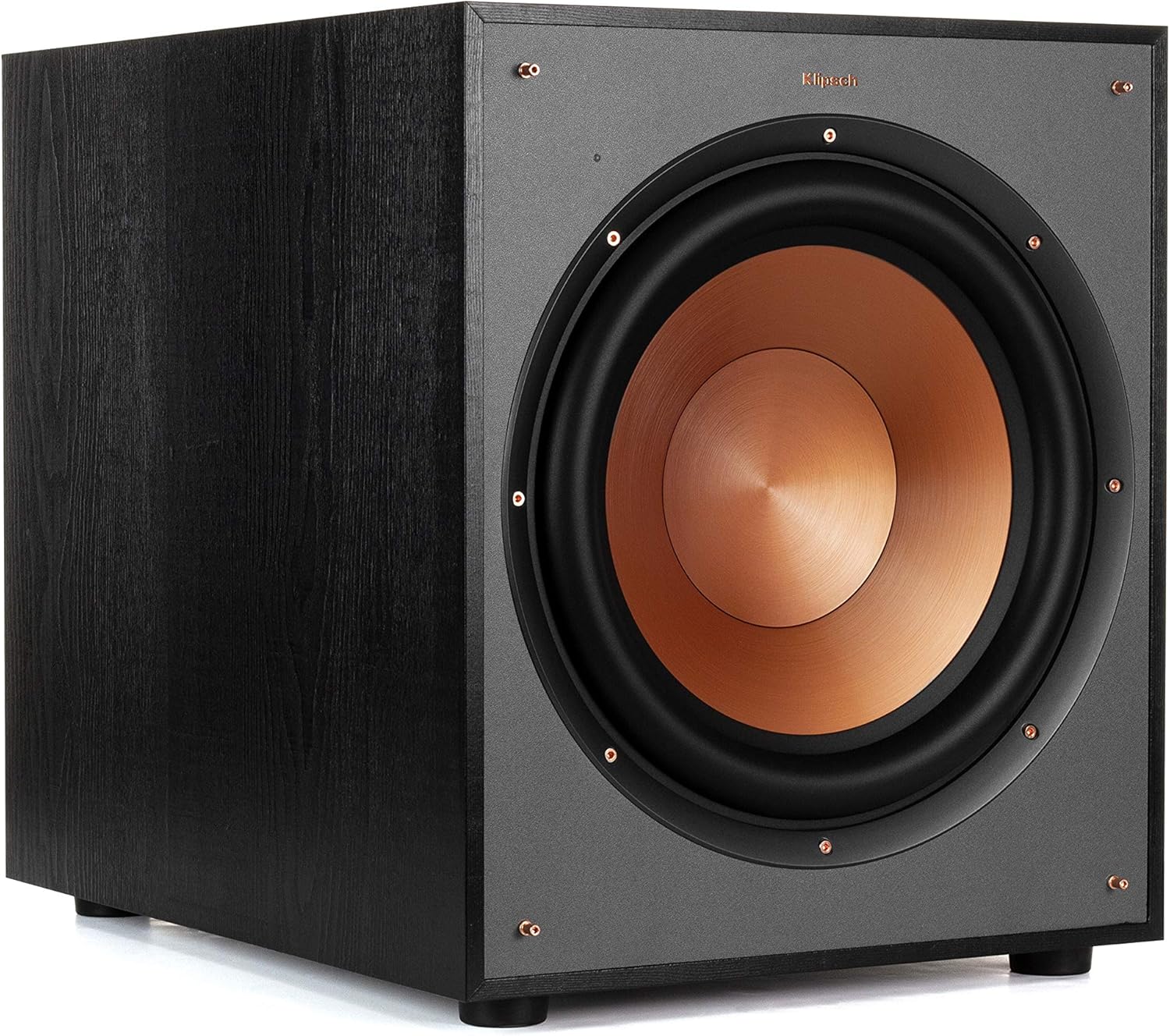
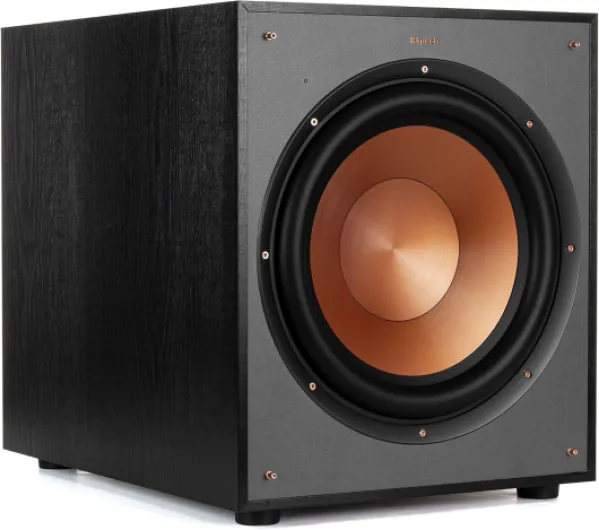
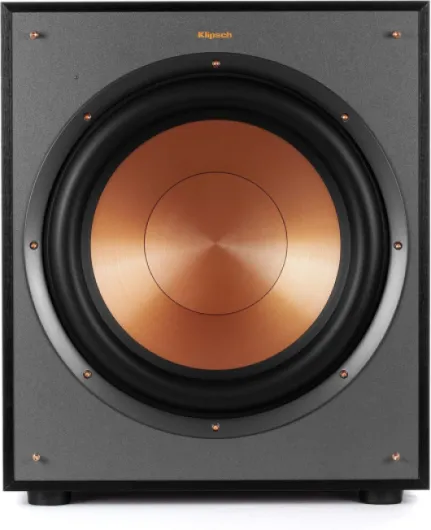
Design-wise, it’s exactly what you’d expect from a Klipsch sub: a black box with a copper-colored 12" woofer. With the grille off, it looks pretty cool if you like that copper look. With the grille on, it just turns into a plain black cube that blends in. I personally leave the grille off because I like seeing the driver, but if you’re trying to keep things low-key, the grille does its job and doesn’t feel cheap.
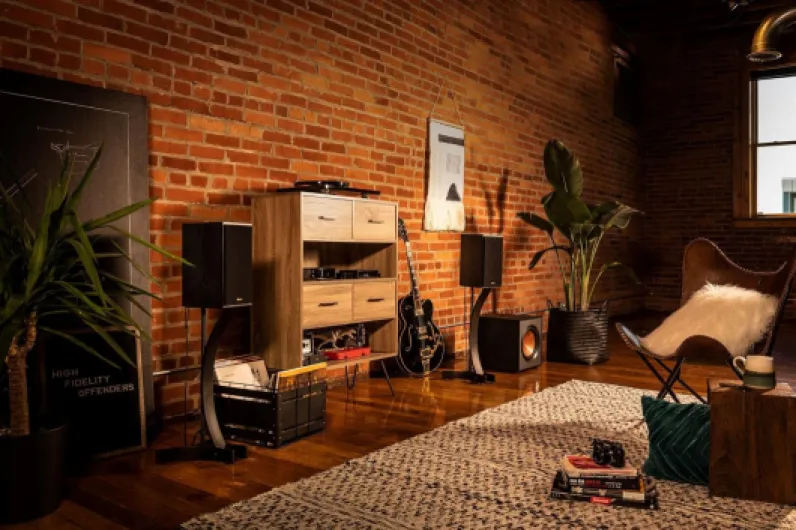
The main thing to know is that this sub is not small. The depth especially can be annoying if you’re tight on space. I had to move my TV stand farther from the wall to keep the sub from sticking out awkwardly. The rear-firing port also means you can’t just slam it directly against the wall; it needs a bit of clearance, otherwise the bass gets muddy and boomy. In my room, about 6–8 inches from the wall worked best.
There’s a small LED on the front that tells you if it’s on/active. It’s not super bright, which I appreciate, because some subs have LEDs that light up the whole room in the dark. Here, it’s visible but not annoying during a movie. The controls on the back are basic but clear, with decent-sized knobs. You don’t get any fancy digital display or anything, but honestly I don’t think that’s necessary for this price range.
If I had to nitpick, the boxy shape and faux-wood vinyl finish are pretty standard. It doesn’t scream "premium" up close, but it doesn’t look cheap either. It’s somewhere in the middle: solid enough, visually fine, but nothing that makes you stop and stare. If your priority is sound per dollar and you don’t care that it’s a big black rectangle on the floor, the design is totally acceptable. If you want something super compact or stylish, this probably won’t impress you.
Build quality: solid enough, but it’s still MDF and vinyl
The cabinet is standard MDF with a vinyl wrap, which is what you get on most subs in this price range. It feels sturdy when you knock on it, no obvious rattles or flexing. The unit has some weight to it at around 31 pounds, so it doesn’t feel hollow. The wood finish is clearly not real wood, but the black vinyl is even and doesn’t look too cheap from a normal viewing distance. Up close, you can tell it’s a budget finish, but again, you’re not buying furniture here.
The 12-inch driver with the spun-copper look is probably the nicest part visually. It doesn’t feel flimsy, and I didn’t notice any weird noises like cone rub or mechanical clacking, even when I pushed it with bass-heavy movie scenes. Klipsch likes to talk about their "injection molded graphite" cones being light and rigid. I’m not going to pretend I tested the material in a lab, but in use, the driver handled loud scenes without obvious distortion or crackling, which is what matters.
The rear port is well-finished, no sharp edges, and I didn’t hear "chuffing" (that annoying air noise) unless I really cranked it beyond what I’d normally use. In my normal listening levels, it stayed pretty clean. The back panel with the amp and controls feels decent too. The knobs have some resistance, not super premium, but they don’t feel like they’ll fall off. The RCA jacks are snug, and the power socket holds the cable tightly.
If you’re expecting some heavy-duty, pro-audio level construction, this isn’t that. It’s a typical consumer-grade sub with decent build. I’d call the materials and build quality "pretty solid for the price". Not tank-like, but not flimsy either. For living room use, I don’t see any obvious weak points as long as you don’t abuse it or keep kicking it around.
Durability and reliability: feels solid, but time will tell
I haven’t owned this sub for years, so I can’t pretend I know exactly how it will age, but I can share what I’ve seen so far and what I’ve seen with similar Klipsch gear. After a few weeks of use, including some long movie sessions at decent volume, there have been no weird noises, no overheating, and no cut-outs. The amp runs warm but never alarmingly hot, and there’s no burning smell or anything sketchy. That’s a good sign for day-one reliability.
The cabinet and driver feel sturdy enough for normal home use. You’d have to actually abuse it (kick it, drop it, spill drinks on it) to damage it. The vinyl wrap can scratch if you’re careless with moving furniture around it, so if you’re often rearranging your room, just be cautious. The grille goes on and off easily and the pegs don’t feel like they’re going to snap right away, but like any plastic peg, you don’t want to yank it too hard.
Klipsch as a brand has a decent reputation for their speakers lasting a long time if not abused. I’ve got older Klipsch speakers that are still running fine after many years. That doesn’t guarantee anything for this exact model, but it gives some confidence. Also, the user reviews online are mostly positive, and you don’t see a flood of complaints about the amp dying in a year, which is usually the weak point on subs.
So in terms of durability, I’d say: it feels solid enough for normal living room use, with no immediate red flags. I wouldn’t treat it like pro gear you throw in a van every weekend, but for a stationary home theater, it should hold up. As always, giving it some ventilation space and not constantly maxing it out will likely help it last longer.
Performance: hits hard for movies, decent for music, room setup matters a lot
This is the part that actually matters. In my setup, the R-120SW was a clear upgrade from my old 8-inch 100W sub. The first thing I noticed was the extra low-end extension. Scenes with deep rumbles and explosions finally had weight. You feel the couch shake a bit during big action moments, which is what you usually want from a home theater sub. It gets loud enough for a medium to large living room without sounding like it’s dying.
On movies, I’d say it does a good job of giving you that "cinema" style bass: strong, punchy, maybe a bit on the boomy side if you’re not careful with placement. I had to move it around a bit (front left corner worked best) and run my receiver’s room correction to tame some peaks. Once dialed in, it sounded much more controlled. Without calibration, it can easily overpower the rest of the system if you crank the gain too much.
For music, it’s decent but not mind-blowing. With rock, pop, and electronic tracks, it adds nice weight to kick drums and basslines. It’s fun. But if you listen to a lot of acoustic or very detailed music, you can tell it’s more about impact than super tight definition. It doesn’t smear everything, but it’s not the cleanest sub I’ve heard either. At moderate volumes, it blends fine with my bookshelf speakers. At very high volumes, it starts to feel a bit less precise, which is pretty normal in this price range.
One thing I liked is that the built-in amp never got hot or noisy. Even after a long movie night at a decent volume, the amp plate was just warm, not roasting. I didn’t hear any hum, hiss, or ground loop noise when connected properly. Overall, performance is strong for home theater users and casual music listeners. If your expectations are realistic for the price and you’re willing to spend 30 minutes on placement and calibration, it gets the job done very well. If you’re super picky about ultra-precise bass, you might want to look higher up the range or at more music-focused subs.
What you actually get with the R-120SW
The Klipsch R-120SW is a 12-inch powered subwoofer rated at 200W RMS and 400W peak. On paper, it goes down to 29 Hz and up to 120 Hz, with a bass-reflex design using a rear-firing port. In practice, that means it’s built more for home theater punch than for super tight, super flat audiophile bass. You get the sub itself, a removable grille, a power cord, and a manual. No fancy accessories, no wireless kit included.
On the back, you’ve got the basics: RCA line-level inputs (including an LFE input), a volume (gain) knob, a low-pass crossover knob, a phase switch (0/180), and an auto/on power switch. That’s it. There are no high-level speaker inputs, so if you’re trying to hook this up to an old stereo amp without a sub out, you’ll need some kind of workaround. For most people with a modern AV receiver, though, the RCA LFE input is all you need.
The sub is clearly aimed at a typical 5.1 or 7.1 living room setup. It’s not tiny: around 19.2" deep, 14" wide, 16.5" high, and about 31 pounds. So you need to plan for floor space and a bit of distance from the back wall because of the rear port. It works best if you can give it some breathing room instead of stuffing it in a tight cabinet or directly against the wall.
In terms of use, I’d say it’s mainly for: movies and TV (explosions, soundtracks, effects), casual music listening, and gaming if you want the rumble. If you’re a hardcore 2-channel music person who focuses on super accurate, super controlled bass, this might feel a bit on the "fun and loud" side rather than super precise. But for most home theater users, the feature set is simple, and it covers the basics without overcomplicating things.
How well it actually improves your setup day-to-day
In daily use, the question is simple: does this sub actually make movies and music more enjoyable compared to a basic or built-in solution? In my case, yes. Switching it off mid-movie was like sucking the life out of the soundtrack. You don’t always consciously notice the sub when it’s on, but the moment you cut it, everything sounds thin. So in terms of real-world impact, it does its job well. It fills in that low-end gap that most small speakers just can’t handle.
For TV shows and streaming content, it’s a bit mixed. On some content with well-mixed audio, it adds nice weight without drawing attention to itself. On cheap compressed TV audio, it can expose how bad the mix is, with muddy or one-note bass. That’s not the sub’s fault, but it’s something to keep in mind. You may end up tweaking the sub level depending on what you’re watching, especially at night when you don’t want to shake the whole house.
In gaming, it’s pretty fun. Explosions, engine sounds, and environmental effects feel more immersive. I used it with a console for a few hours and didn’t notice any lag or weird behavior. It’s just a sub taking the LFE channel, so nothing fancy, but it adds a good layer of impact that you won’t get from a soundbar alone. For people who mainly game and watch movies, I’d say it’s an effective upgrade over any built-in TV or soundbar bass.
So if we talk "effectiveness" in a non-technical way: it clearly improves the experience compared to no sub or a very small one. It’s not perfect, and it needs some setup work, but once dialed in, you actually feel like your home theater has some weight. For the price these often go for on sale, I’d call it a pretty solid upgrade that actually changes how your system feels day-to-day, not just on paper.
Pros
- Strong, room-filling bass for movies and gaming, especially compared to smaller 8-inch subs
- Simple setup with standard RCA/LFE input and basic controls that most AV receivers handle easily
- Good output and extension (down to around 29 Hz) for the price, especially when bought on sale
Cons
- Bulky cabinet and rear port require space and careful placement to avoid boomy sound
- Only RCA inputs, no high-level speaker inputs or wireless/app features
- Bass can be more "fun" and boomy than tight and precise, so not ideal for very picky music listeners
Conclusion
Editor's rating
The Klipsch R-120SW is a straightforward, powerful 12-inch sub that does what most people want in a home theater: more impact, more rumble, and a sense that your system finally has some weight. It’s not packed with extra features, it’s not compact, and it’s not the most precise sub on the planet, but for movie nights and casual music listening, it delivers solid performance. If you’re coming from a small 8-inch sub or from no sub at all, the difference is obvious.
It makes the most sense if you’ve got a mid-range AV receiver, a basic 5.1 or 7.1 setup, and you mainly watch movies, TV shows, and play games. You get decent build quality, simple controls, and strong output for the price, especially when it’s on sale. On the flip side, it’s bulky, only has RCA inputs, and can sound a bit boomy if you don’t take the time to place and tune it properly. If you’re really picky about tight, ultra-clean bass for music, or if you want wireless/app features, you might want to look at other options.
Overall, I’d rate it as a good, no-nonsense subwoofer for typical living rooms: not perfect, but it gets the job done and feels like a sensible upgrade instead of a gimmick. If you find it at a decent discount and you’re okay with the size, it’s a pretty solid choice. If you’re paying full price and mainly care about music precision, you might want to compare a bit more before pulling the trigger.